
When a Gas Fireplace Needs a Chimney—and When a Wall Vent Will Do
Vent-free appliances may be prohibited, restricted, or subject to room and installation conditions depending on the jurisdiction and appliance category.
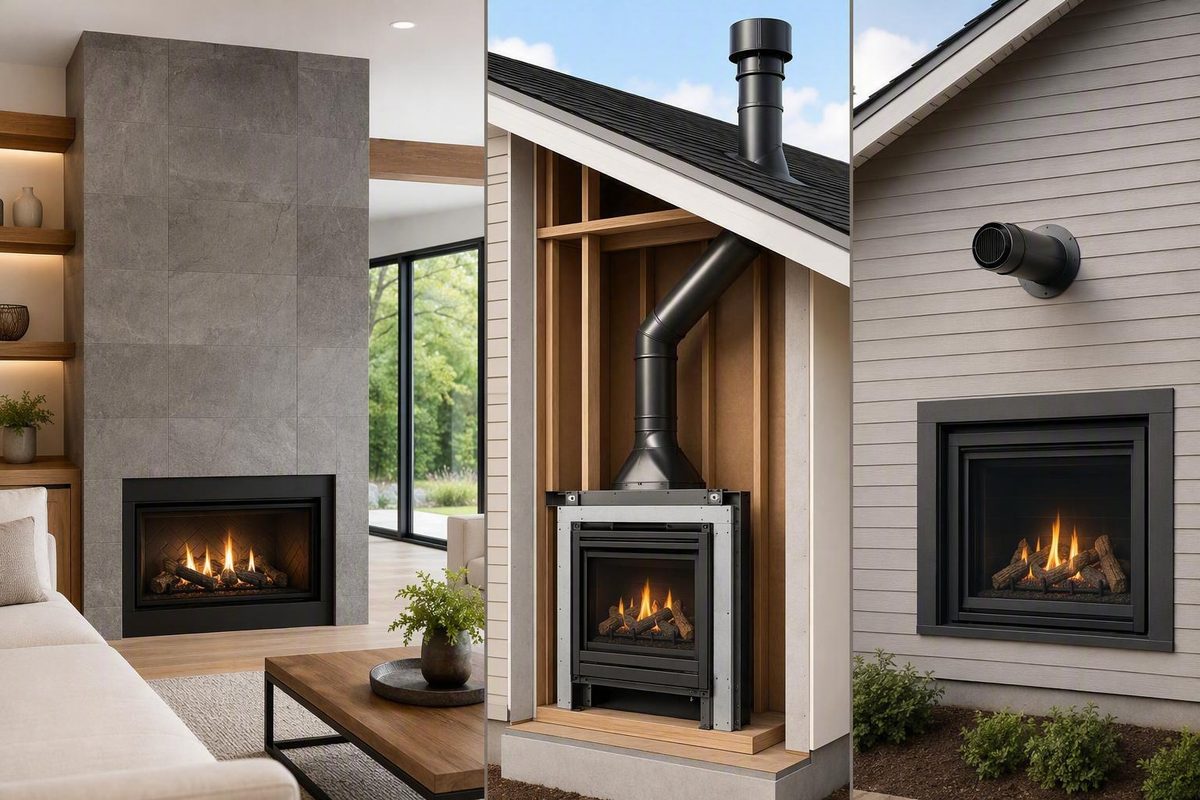
The short answer: a chimney and a vent are not the same thing
No, not every gas fireplace needs a traditional masonry chimney. A house without a chimney may still accommodate a gas fireplace.
The important qualification is that most gas fireplaces other than vent-free models still need an approved route for combustion exhaust. Depending on the listed appliance, that route may be dedicated pipe through an exterior wall, approved pipe through the roof, a vertical metal flue, or liners installed inside an existing masonry chimney. Direct-vent fireplaces, for example, use a sealed system that draws combustion air from outdoors and discharges exhaust outdoors rather than relying on a conventional chimney, as explained in Valor’s comparison of gas-fireplace venting types.
The appliance’s listed design determines which arrangement is permitted. Wall venting cannot be selected merely because it is convenient, and an available chimney cannot be used simply because a connection appears to fit. The exact model, installation instructions, approved components, site conditions, and applicable local requirements govern the project.
Several terms that are often used interchangeably have different meanings:
- Dedicated vent pipe: A listed, appliance-specific piping system. Depending on the appliance, it may carry exhaust alone or provide separate paths for outdoor combustion air and exhaust.
These distinctions matter when selecting equipment. “No chimney required” does not necessarily mean “no outdoor vent required.” A direct-vent fireplace may not need masonry, but it still sends exhaust outdoors through dedicated piping. Direct vent is not the same as vent-free.
Similarly, an appliance designed for natural-draft vertical venting may use a factory-built metal flue instead of a brick chimney. It still requires the vertical exhaust route specified for the appliance.
When speaking with a dealer, installer, chimney professional, or local building authority, ask whether the exact model requires a masonry chimney, a liner, B-vent, direct-vent pipe, another listed system, or no exterior vent. That is more precise than asking only whether it “needs a chimney.”
Gas-fireplace venting types compared
Gas fireplaces can look similar from inside the room while handling combustion air and exhaust in very different ways. A built-in fireplace, an insert fitted into an existing firebox, and a gas-log set are distinct appliance categories. Their venting requirements may differ even when they produce a similar-looking flame.
The following table is a general comparison, not a substitute for the installation manual for a specific model.
| Appliance type | Traditional masonry chimney needed? | Outdoor vent needed? | Combustion-air source | Usual exhaust route | Key limitation |
|---|---|---|---|---|---|
| Direct-vent fireplace | No | Yes | Outdoors | Listed sealed pipe through an exterior wall or roof | Permitted routes, pipe, clearances, and terminations are model-specific |
| Direct-vent gas insert intended for an existing fireplace | Commonly uses an existing masonry fireplace and chimney as the liner route | Yes | Outdoors | Separate intake and exhaust liners commonly pass through the chimney | The insert, firebox, chimney, liners, and termination must be compatible |
| Natural-draft fireplace using B-vent or another listed vertical system | Not necessarily masonry, but a suitable vertical flue is required | Yes | Generally the room | Listed vertical vent, or a masonry chimney and liner when expressly permitted | Depends on vertical draft and cannot be treated as a generic wall-vent system |
| Vented gas-log set | Generally installed in a functioning fireplace and flue | Yes | Generally the room | Existing open, serviceable fireplace flue | The firebox, damper arrangement, and chimney must be suitable for the listed log set |
| Vent-free fireplace, insert, or log set | No | No | The room | Combustion products and water vapor enter the occupied space | Local permission, room suitability, and manufacturer restrictions must be resolved before purchase |
| Power-vented model | Usually not, unless its listed design requires one | Yes | Depends on the model | Fan-assisted, manufacturer-specified route | Power venting is model-specific, not a universal add-on |
Direct vent
A direct-vent fireplace does not inherently need a masonry chimney. It uses a sealed, manufacturer-specified assembly to bring in outdoor combustion air and discharge exhaust outdoors. This commonly takes the form of a pipe-within-a-pipe system or another listed dual-path arrangement.
Some models permit horizontal venting through an exterior wall. Some permit vertical routing through a roof, and certain models allow both within defined limits. Those options cannot be generalized to every direct-vent appliance.
The sealed combustion chamber and dedicated vent system are integral parts of the appliance design. Direct-vent pipe is not generic ductwork that can be substituted based only on diameter. The required pipe series, adapters, elbows, penetration components, supports, and termination must match the appliance instructions.
Natural draft and B-vent
Heated exhaust rises through a vertical flue and terminates above the roof. The approved route may be a dedicated factory-built metal vent or, where the appliance instructions allow it, a suitable masonry chimney and liner.
This means a vertical flue may be necessary even when a traditional brick chimney is not. Heat & Glo’s overview of fireplace venting distinguishes B-vent equipment, which takes combustion air from the room and routes exhaust vertically, from sealed direct-vent equipment.
The terms natural draft and B-vent should not be used to imply that every natural-draft appliance accepts every vertical vent system. The appliance listing and manual must specify the permitted configuration. A wall penetration suitable for one direct-vent model cannot automatically be used for a natural-draft fireplace.
Vent free
A vent-free—or ventless—gas fireplace uses neither a chimney nor an outdoor exhaust vent. It uses room air for combustion and releases heat, water vapor, and combustion products into the occupied space.
That design changes both the indoor environment and the questions that must be answered before installation. Permission and placement may depend on the jurisdiction, appliance category, room, and current local rules. A product being available from a retailer does not establish that it is permitted or suitable for a particular home.
Built-in controls also vary. Do not assume that every vent-free appliance contains identical sensors, shutoffs, or operating features.
Power venting
It may provide options that differ from natural-draft venting, but it is not a generic workaround.
The central rule across all these categories is simple: identify both the appliance type and exact model before making assumptions about venting. “Gas fireplace” is too broad a description on its own.
Installing a gas fireplace in a home without a chimney
A house without a chimney may accommodate a direct-vent fireplace when the selected model has an approved route to an exterior wall or through the roof. This makes direct vent a relevant category for new construction, additions, basement renovations, and rooms without an existing masonry fireplace.
It does not mean a direct-vent fireplace can be installed anywhere.
Horizontal direct venting
In a horizontal arrangement, listed piping passes from the fireplace through an exterior wall. One path brings outdoor combustion air to the appliance, while the other carries combustion exhaust outdoors. The system ends at a listed exterior termination.
An exterior-wall location may allow a relatively direct route, but it is not automatically acceptable. The installer must compare the proposed location with the model’s permitted vent direction, required rise, routing limits, elbow allowances, component requirements, and termination instructions.
The exterior location should be reviewed in relation to:
- Windows, doors, and other openings
- Grade and expected landscaping
- Decks, patios, walkways, and outdoor-use areas
- Roofs, overhangs, corners, and nearby surfaces
- Expected snow and ice conditions
- Leaves, dirt, animal activity, and other possible obstructions
- Access for inspection and service
- Future construction or stored objects that could obstruct the termination
These are questions to resolve from the exact manual and local review, not a universal set of numerical clearances. Measurements taken from another fireplace or a generic online diagram may not apply.
Vertical direct venting
Some direct-vent models permit listed piping to run upward and terminate through the roof. This can make an interior-wall installation possible when an approved route can be provided through the building.
Vertical routing must still be designed for the selected model. The route may pass near framing, floors, ceilings, attic space, and other building systems, so the required components, support, enclosure, offsets, and roof termination need to be established before construction begins. Blue Ridge Energy’s description of direct-vent systems notes that they use separate air and exhaust paths and may vent through a wall or roof; whether either route is allowed for a particular fireplace remains model-specific.
Choose the appliance before designing the vent
A practical planning sequence is:
- Choose a proposed fireplace location.
- Identify a listed appliance intended for that type of installation.
- Obtain the current installation manual for the exact model.
- Confirm that the model permits the proposed vent direction and route.
- Design the route using the specified components and stated limits.
- Ask the authority having jurisdiction and qualified trades what local approvals or inspections apply.
- Confirm that the complete installation is feasible before buying vent components or modifying the building.
A direct-vent model can expand the options in a house without a chimney, but the appliance, vent system, and building must form one approved installation.
Using an existing chimney for a gas fireplace or insert
An existing wood-burning fireplace can sometimes be adapted for gas, but “conversion” can describe several different projects. Three common categories should be kept separate.
1. A gas insert in an existing fireplace
A gas insert is a complete appliance designed to fit inside an existing fireplace opening. A direct-vent gas insert commonly uses the masonry chimney as a protected route for separate intake and exhaust liners. Those liners connect the insert to an approved termination at the top of the chimney.
The insert does not simply discharge freely into the old flue. The liner arrangement is part of the listed installation. Heat & Glo explains that gas inserts commonly use two liners through an existing masonry chimney, providing separate paths for combustion air and exhaust.
Whether a particular insert will work depends on the fireplace opening, chimney configuration, permitted liner arrangement, termination, fuel supply, electrical needs, and required service access.
2. A vented gas-log set in an existing firebox
It is not the same as a sealed gas insert.
Vented gas logs rely on a functioning flue to carry combustion exhaust outdoors. The existing firebox, damper arrangement, smoke path, flue, and chimney therefore remain relevant. A chimney should not be presumed suitable merely because it was used previously or appears intact from inside the room.
Unvented gas logs belong to a different category. They are designed to operate without exhausting through the chimney, and their local legality, room placement, and installation requirements must be checked before purchase. Vented and unvented logs should not be treated as interchangeable operating modes unless the exact product listing and instructions expressly permit both.
3. A natural-draft appliance connected to a vertical flue
A natural-draft gas appliance may be designed to use a suitable masonry chimney and approved liner, or it may require a dedicated factory-built vertical vent. The permitted arrangement depends on the appliance’s listing and instructions.
The presence of masonry does not prove compatibility. An older chimney may have a configuration or condition that prevents use with the selected appliance. It may need evaluation, repair, or an approved liner, but no single liner material or size is appropriate for every gas fireplace.
Existing does not mean reusable
Matching diameters do not establish compatibility. Existing vent pipe or chimney components may differ from the new appliance’s specified system in construction, joints, material, manufacturer, or approved application. The eFireplaceStore guide to fireplace venting cautions against assuming that old pipe can be reused merely because its diameter matches the new connection.
Before planning to reuse a chimney:
- Identify the exact appliance and its required vent or liner system.
- Have the fireplace and chimney evaluated for the proposed use.
- Confirm that the specified liner can be routed and terminated as required.
- Address defects that would prevent the approved installation.
- Verify that any retained components are expressly permitted for the new appliance.
- Determine what local approvals or inspections apply.
Do not block a required flue, bypass an insert liner, discharge exhaust into a space not intended by the appliance design, or fabricate transitions between incompatible components. Improper venting can create carbon-monoxide, fire, illness, and property-damage risks, according to the same fireplace-venting guidance cited above.
Vent-free fireplaces: no chimney, but important trade-offs
A vent-free gas fireplace has no chimney and no exterior exhaust vent. If the only question is whether masonry or outdoor vent pipe is required, the answer is straightforward: neither is used.
The consequences require closer attention. With no outdoor exhaust route, water vapor and combustion products enter the occupied room. Moisture, odors, residue, and other combustion byproducts are therefore relevant considerations rather than incidental installation details. Aire Serv’s comparison of vented and ventless fireplaces likewise notes that ventless appliances use room air and release water vapor and combustion products into the home.
That does not mean every installation produces identical indoor conditions. The room, building, appliance, maintenance, and pattern of use can differ. It does mean that indoor-air effects are inherent to the vent-free design and should be considered before purchase.
Legality comes before convenience
Vent-free appliances may be prohibited, restricted, or subject to room and installation conditions depending on the jurisdiction and appliance category. Local rules can also change, so current requirements should be verified directly with the authority having jurisdiction before the appliance is purchased. Manufacturer guidance on gas-fireplace venting likewise emphasizes that installation must follow the appliance manual and applicable local rules, while noting that vent-free restrictions vary by jurisdiction in Valor’s venting guide.
Questions to settle include:
- Is this appliance category permitted locally?
- Is it permitted in the proposed room?
- What room, ventilation, or placement conditions apply?
- Is the model approved for the intended residential use?
- What permits or inspections, if any, are required?
- What alarm requirements apply to the home?
- Does the manufacturer impose conditions beyond local minimums?
A product’s presence in a catalog or showroom does not answer those questions.
Sensors do not replace an approved installation
Vent-free equipment varies, so do not assume that every model has the same oxygen-monitoring, shutoff, or other controls. Confirm the features and restrictions of the actual model.
Such devices cannot substitute for selecting an allowed appliance, following its instructions, meeting room restrictions, and completing required installation checks.
The absence of a chimney should not be treated as an uncomplicated safety, cost, or performance advantage. Legality, indoor-air implications, room suitability, and manufacturer requirements are threshold questions. If any remain unresolved, appliance selection is incomplete.
A pre-installation decision process for homeowners
Gas-fireplace planning is easier when the decisions are made in the correct order: identify the appliance, evaluate the location, and then establish an approved vent route.
Step 1: Identify the appliance category
Determine whether the project involves:
- A new built-in gas fireplace
- A gas insert for an existing masonry fireplace
- A vented gas-log set
- An unvented gas-log set
- A freestanding gas stove or another appliance category
Then identify its venting design:
- Direct vent
- Natural draft using B-vent or another listed vertical system
- Vent free
- Power vent or another manufacturer-listed configuration
Record the manufacturer and exact model number. Do not rely only on appearance, a showroom label, or a retailer’s broad product category.
Step 2: Evaluate the possible route
Ask what the proposed location offers:
- Direct access to an exterior wall
- A feasible path upward through the building and roof
- An existing masonry fireplace and chimney
- More than one possible route, subject to model approval
- No practical exterior route
If an existing chimney is involved, its condition and configuration should be considered together with the vent or liner system required by the selected appliance. A chimney assessment without an identified appliance cannot establish compatibility, and appliance specifications alone cannot establish that an existing chimney is suitable.
Step 3: Read the exact installation manual
Use the current manual for the exact model, not a similar fireplace from the same manufacturer. Confirm:
- Approved vent brands, series, and components
- Permitted horizontal and vertical configurations
- Routing limits
- Elbow and offset limitations
- Required vertical rise
- Support and enclosure requirements
- Clearances from combustible materials
- Wall- and roof-penetration components
- Termination type and placement
- Requirements for an existing chimney or liner
- Gas-supply and electrical provisions
- Access needed for setup and service
Do not replace these instructions with generic numerical clearances. A measurement suitable for one model may be wrong for another.
Step 4: Review the termination environment
For a proposed exterior termination, ask the installer to review:
- Windows, doors, vents, and air intakes
- Grade and expected landscaping
- Snow, ice, and roof runoff
- Leaves, dirt, nests, and windblown debris
- Decks, porches, patios, walkways, and gathering areas
- Corners, overhangs, fences, and nearby structures
- Future additions or stored materials that could obstruct the vent
- Access for inspection and maintenance
The objective is not merely to find a place where the termination fits. It must remain consistent with the appliance instructions and usable after landscaping, seasonal weather, and normal changes around the building.
Step 5: Verify local requirements
Contact the authority having jurisdiction and the qualified trades involved in the work. Ask what applies to:
- Building or mechanical permits
- Gas-line work
- Electrical work
- Inspections
- Carbon-monoxide alarms
- Fireplace and vent placement
- Vent-free appliance legality and room restrictions
- Existing-chimney or liner review
- Propane supply arrangements, where applicable
These requirements cannot be established from a general article because they depend on location, project scope, and appliance type.
Step 6: Confirm the fuel configuration
Use only the fuel configuration identified by the appliance listing and instructions. Do not improvise changes to orifices, regulators, burners, or controls based on physical resemblance.
Step 7: Review the complete system before purchase
Before ordering the fireplace and vent components, confirm the proposed combination of:
- Exact appliance model
- Fuel
- Installation location
- Complete vent route
- Existing chimney, if applicable
- Termination position
- Required building alterations
- Gas and electrical work
- Local approval process
- Access for future service
Qualified installation is appropriate because errors involving fuel gas, combustion air, or exhaust can create carbon-monoxide, fire, illness, and property-damage hazards; the appliance instructions, listing, and applicable local requirements control the installation rather than general online guidance, as the fireplace-venting compatibility guide emphasizes.
Maintenance depends on the venting system—not just the fuel
Gas fireplaces do not produce wood-fire creosote, but they are not maintenance-free. Burners, ignition components, seals, decorative media, controls, vent passages, and terminations can still require inspection or service.
Four different services are often confused:
- Appliance servicing: Inspection and maintenance of the fireplace and the components identified by its manufacturer.
- Vent inspection: Evaluation of the dedicated exhaust path and, for direct-vent equipment, the combustion-air path.
- Chimney inspection: Assessment of masonry, liners, connections, and related components when a chimney is part of the system.
- Chimney sweeping: Physical removal of deposits or debris when the system’s condition makes that work necessary.
Not every gas fireplace requires all four services on the same schedule. A direct-vent fireplace without masonry has no traditional chimney to sweep, but it still has a vent path and exterior termination. An insert using liners through a masonry chimney has both an appliance and a chimney-based route to consider. A vent-free appliance has no exterior vent but still requires the maintenance specified in its manual.
Keep vent paths unobstructed
Leaves, dirt, nests, snow, ice, and other debris can obstruct an exterior termination or vent path. Commercial maintenance guidance for gas fireplaces identifies debris and animal nests as possible vent obstructions and recommends keeping the system clear in its summary of gas-fireplace maintenance.
Homeowners may visually check an accessible termination and keep the surrounding area free of obvious obstructions when that work can be performed safely and is consistent with the manual. Do not remove listed termination components, disassemble vent joints, alter screens, or insert tools into the vent unless the manufacturer’s owner instructions expressly authorize the task.
Where an appliance uses a masonry chimney or liner, those components remain part of the exhaust system. Inspection and cleaning should follow the appliance instructions and the findings of qualified service personnel. Physical sweeping is not automatically required every year for every gas fireplace.
Signs that warrant qualified evaluation
Arrange qualified evaluation if you observe:
- Visible soot or unexplained residue
- Unusual or persistent odors
- Weak, uneven, or markedly changed flames
- Reduced or inconsistent performance
- An obviously obstructed exterior termination
Visible soot, unusual odors, weak or uneven flames, and reduced output are identified as possible maintenance or venting indicators in the same gas-fireplace maintenance guidance cited above. Follow the appliance manual for whether continued operation is permitted; a general symptom list cannot replace model-specific shutdown instructions.
Limit owner maintenance to tasks authorized by the manual, such as cleaning accessible surfaces or visually checking an exterior termination. Burner adjustment, gas-control work, vent-joint disassembly, and alteration of safety devices belong with qualified personnel.
Follow the manufacturer’s service schedule rather than assuming either that every chimney needs annual sweeping or that a gas appliance needs no attention.
Frequently asked questions
Can a gas fireplace vent horizontally through an exterior wall?
Yes, many direct-vent gas fireplaces can terminate horizontally through an exterior wall. Their listed vent systems provide separate paths for outdoor combustion air and exhaust.
Horizontal venting is not universal. The exact model must permit it, and the installation must satisfy that model’s requirements for pipe, routing, rise, elbows, wall penetration, clearances, and termination placement. The exterior site must also be suitable for the approved termination.
Does a gas fireplace insert need a chimney liner?
A direct-vent gas insert installed in an existing masonry fireplace commonly uses separate intake and exhaust liners routed through the chimney. Other insert designs may have different requirements.
Do not assume that the original chimney flue can be used without modification or that one liner system works for every insert. The appliance manual specifies the required configuration, while an evaluation determines whether the existing chimney can accommodate it.
Can a gas fireplace be installed on an interior wall?
Potentially. Some direct-vent models permit vertical piping through the building and roof, which may make an interior-wall location possible.
Feasibility depends on the exact model and the availability of an approved route through the building. An interior-wall installation does not mean that no vent is required, and not every direct-vent fireplace permits every vertical configuration.
Does every gas fireplace chimney need to be swept annually?
No. A direct-vent fireplace without a masonry chimney has no chimney to sweep, although its appliance and vent system still require maintenance under the manufacturer’s instructions.
Where a gas appliance uses a masonry chimney or liner, the need for inspection or cleaning depends on the appliance instructions and the condition of the system. Gas does not produce wood-fire creosote, but debris, nests, soot, residue, or deterioration may still require attention.
Can you burn real wood in a gas fireplace?
No—not unless the appliance is expressly listed and configured for wood, which an ordinary gas-only fireplace is not. Gas fireplaces, gas inserts, and gas-log systems are designed around specific fuels, burners, firebox conditions, and venting arrangements. Guidance on adding a gas fireplace to a home likewise cautions that gas fireplaces are not designed to burn real wood.
Do not place firewood, manufactured firelogs, or other solid fuel in a gas fireplace merely because it contains ceramic logs or occupies a former wood-burning opening. Use only the fuel and decorative media approved for the exact appliance.
The practical rule
A gas fireplace may not need a masonry chimney, but its combustion products must be handled exactly as the listed appliance requires. Direct-vent fireplaces can make an installation possible in a house without a chimney; natural-draft appliances require a suitable vertical vent; many gas inserts use liners routed through an existing chimney; and vent-free equipment presents separate legal and indoor-environment questions.
Before buying components or modifying the building, identify the exact appliance, obtain its current installation manual, verify local requirements, and have the proposed vent route or existing chimney evaluated for that specific installation.