
Choose a Direct Vent Propane Fireplace by Fuel, Heat and Supply
Choose a direct vent propane fireplace by LP approval, room heat needs, tank capacity and outage operation. Estimate fuel use and compare complete quotes.
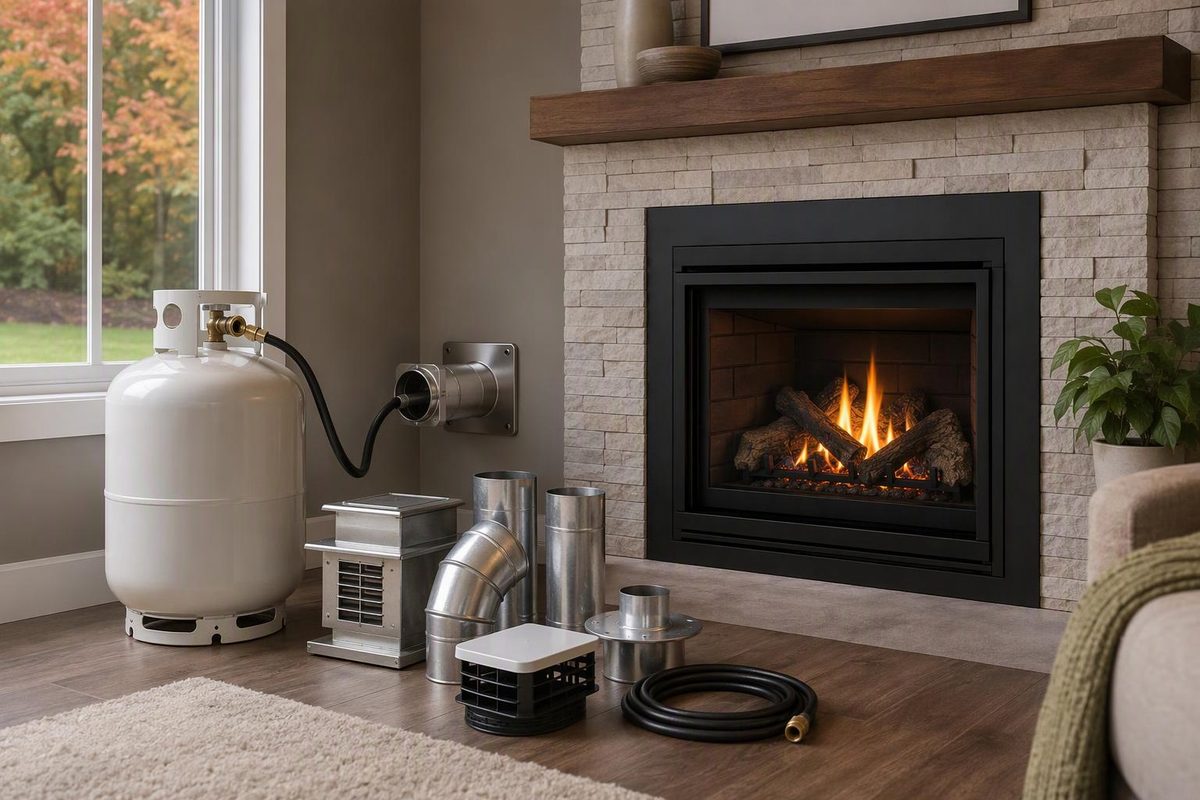
A direct vent propane fireplace burns LP gas in a sealed combustion chamber, takes combustion air from outdoors and exhausts outdoors. It does not need a traditional masonry chimney, but it does need its approved vent system. “Direct vent” describes the combustion and venting arrangement—not fuel compatibility, heating capacity or power-outage operation. Acucraft explains the basic design.
Before choosing the flame style, confirm three things: the exact appliance is approved for propane, its installation fits the building, and the propane supply can support it alongside your other appliances.
Confirm propane approval and building fit
Get the full model number, installation manual and fuel designation before paying a deposit. A natural-gas fireplace is not ready for propane simply because a gas line can be connected. It must be a propane version or have a manufacturer-approved conversion completed using the specified certified kit. Have the installer confirm the fuel designation and any conversion documentation. Leave conversion and gas-system work to qualified professionals. The Valor H5 installation manual, for example, identifies separate natural-gas and propane versions and their conversion kits.
Next, identify the project:
- A new framed fireplace: check enclosure depth, framing, noncombustible finishes, hearth requirements and mantel clearances.
- An existing wood-burning fireplace: look for an appliance specifically approved for that installation, then verify opening dimensions and the required intake/exhaust liner arrangement. Do not assume a built-in fireplace fits or qualifies as an insert.
- A replacement gas fireplace: have the existing vent components and fuel supply checked against the new model’s requirements rather than assuming they can stay.
The H5 manual illustrates why the model matters: it has specific requirements for framing, finishes, trims and approved vent components, plus separate instructions for installation into an existing fireplace. Local codes and the applicable appliance instructions govern the work.
Have the installer confirm a compliant route and outdoor termination before choosing finishes. Use the separate direct vent fireplace venting guide for pipe, routing and clearance checks.
Choose heat output—not just the largest BTU number
BTU/h input is the fuel energy consumed, not the useful heat delivered to the room. Ask the dealer to compare these items for the propane version:
| Specification | What it helps you decide |
|---|---|
| Maximum input and rated heat output | Whether the fireplace can meet the intended heating load |
| Minimum input | How far the flame and fuel consumption can turn down |
| Thermostat and modulation controls | How the appliance responds as the room warms |
| Propane efficiency rating and test method | Whether efficiency claims are comparable |
Minimum input deserves attention in a small or well-insulated room. A high minimum firing rate can make long periods of flame viewing uncomfortable even when the maximum rating seems appropriate. Ask for a room heat-loss assessment rather than choosing solely from an advertised square-foot coverage figure.
As a concrete example—not a product recommendation—the Valor H5 1100MP manual lists propane input from 16,000 to 30,000 BTU/h. It also describes the appliance as a supplemental heater and advises an alternate primary heat source. Those limits and intended uses are model-specific. Source: H5 specifications and safety instructions.
For efficiency comparisons, look for the same test method on each model. Natural Resources Canada defines fireplace efficiency (FE) as performance over an entire heating season; a higher FE means a more efficient unit. Do not treat a differently defined efficiency percentage as interchangeable. Source: NRCan fireplace product information.
Have the propane supplier check more than tank gallons
A tank with fuel remaining is not necessarily able to deliver enough propane vapor during cold weather. Vaporization capacity falls as the liquid level and temperature fall. Tank size, aboveground or underground placement, regulators and piping all matter. PERC’s Propane Technical Pocket Guide explains these factors and directs system sizing around the total appliance input load.
Give your propane supplier:
- The fireplace’s maximum propane input.
- The input ratings of the furnace, water heater, range, generator and other connected appliances.
- The proposed fireplace location and gas-line route.
- Your expected use: occasional evening flames, daily room heating or outage backup.
Ask the supplier to confirm cold-weather vapor capacity, regulator capacity and gas-line sizing—not just estimate refill frequency. Also coordinate tank placement with the fireplace termination: tank fittings and direct-vent air intakes have separation requirements. The supplier should apply the current requirements for your installation rather than use a generic tank-to-wall distance. Source: PERC tank-placement guidance.
Estimate propane use from input
Propane contains approximately 91,500 BTU per U.S. gallon, according to PERC’s technical guide.
For the main burner:
Gallons used ≈ input in BTU/h × burner operating hours ÷ 91,500
For a fireplace burning at 30,000 BTU/h:
- One hour uses approximately 0.33 gallon.
- Four hours daily for 30 days uses approximately 39 gallons.
- At an illustrative—not quoted—price of $3 per gallon, that is about $118 in fuel.
Use actual burner-on hours, not merely the time the thermostat is enabled. Lower flame settings and cycling change consumption. Account separately for any continuously burning pilot, electricity, tank rental, delivery charges and service. Efficiency affects useful heat delivered; do not multiply the input by efficiency before calculating fuel consumption.
Verify outage operation before relying on it
Ask for the exact model’s outage procedure and which functions remain available. Battery-powered ignition does not mean every accessory works without household electricity.
For example, the H5 1100M is designed to operate as a heater on battery power, but its optional circulating fan and Wi-Fi module require electrical power. Source: H5 electrical specifications.
Have the installer demonstrate the approved outage procedure and show you battery access before handover. Keep the correct batteries available and follow the manual’s replacement instructions. Treat outage heating as a specific capability to verify, not a benefit guaranteed by the word “propane.”
Compare complete quotes and plan ownership
Ask each installer to separate the appliance, required trim and fuel-bed components, vent system, propane tank or supply upgrades, gas work, electrical work, permits, finish work and commissioning. Confirm who handles future service and whether the quoted controls and blower are included. An appliance-only price does not answer the installed-cost question.
After installation:
- Arrange professional inspection at least annually and follow the model’s cleaning schedule. The H5 manual calls for inspection before use and at least annually; some conditions require more frequent cleaning.
- Keep the required glass barrier installed. Do not run the fireplace with its sealed glass removed, cracked or broken. Source: H5 safety instructions.
- Monitor fuel and arrange deliveries before running out. PERC says an empty-tank system needs inspection by a qualified professional. Source: propane home-safety guidance.
- Maintain CO alarms. CPSC recommends battery-operated alarms or alarms with battery backup on every level and outside sleeping areas. Source: CPSC carbon-monoxide guidance.
If you smell gas, do not attempt ignition or troubleshooting. Get everyone out without operating switches or phones in the affected area. From a safe location, call your propane supplier; if you cannot reach them, call 911 or the fire department. Do not return until a qualified professional or emergency responder declares the area safe. Before using propane appliances again, have the supplier or a qualified service technician check the entire system to ensure it is leak-free. Source: PERC gas-leak instructions.