
Electric Fireplace Versus Gas: Start With the Installation
Compare electric and gas fireplaces by venting, electrical supply, usable heat, running cost, safety and power-outage operation.
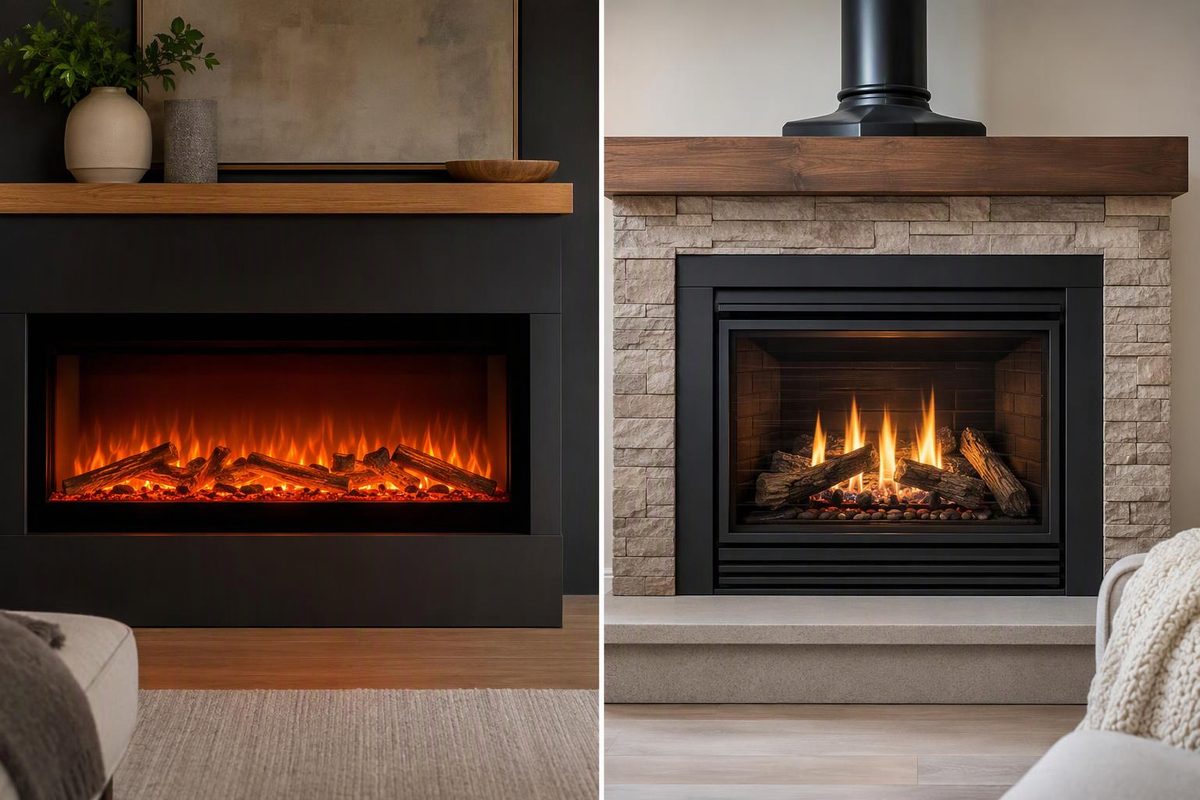
Choose electric if you mainly want the fireplace appearance, modest supplemental heat and no combustion vent. Consider a direct-vent gas fireplace if you want a real flame and greater room-heating capacity—and can provide the approved vent route, gas supply and clearances. Neither fuel is automatically cheaper to run, and not every gas fireplace works during a power outage.
Before comparing finishes or prices, establish what the building can accommodate. The examples below use North American appliance specifications; your model’s listing, installation manual and local requirements govern the actual work.
1. Check the vent path, utilities and clearances
Electric: no flue, but still a heater installation
An electric fireplace does not burn fuel and needs no combustion exhaust vent. That makes it worth considering where an exterior termination is impractical. It still needs the specified electrical supply, unobstructed air openings, mounting support and clearances.
Check:
- Whether the model plugs in or requires hardwiring.
- Required voltage, circuit capacity and any dedicated-circuit requirement.
- Wall-cavity depth, approved mounting method and service access.
- Heater-outlet clearance to furniture, curtains, a mantel or television.
A nearby receptacle alone does not establish that the circuit is suitable. The Dimplex DFI2309/DFI2310 manual, for example, specifies a 15-amp, 120-volt circuit, prefers a dedicated circuit and prohibits extension cords and power strips. Have an electrician assess new wiring or an uncertain existing supply.
Recessing and voltage options are model-specific. The Dimplex Ignite Evolve 60 specification allows 120- or 240-volt operation and partial or full recessing; that does not establish what another electric fireplace permits.
Gas: identify the vent type first
For a new gas installation, direct vent is a useful starting point for comparison. It draws combustion air from outdoors and exhausts outdoors through an approved system, with the combustion chamber separated from the room by fixed glass. A masonry chimney is not necessarily required, but an approved outdoor termination is. Heat & Glo explains the airflow arrangement.
Before buying, have the installer verify the vent configuration and termination clearances, available gas type and supply capacity, framing, mantel clearances and electrical requirements. The Heat & Glo SlimLine X installation manual illustrates why this is a complete system: it specifies approved components, vent diagrams, gas checks, electrical work and finishing restrictions.
Do not treat all gas products alike. B-vent appliances and gas log sets need their own assessment. Vent-free gas is not equivalent to electric: it still burns fuel, and EPA identifies unvented gas heaters as sources of indoor combustion pollutants. Check local acceptance and the exact listing before considering one. See how gas fireplace venting depends on design.
Stop the purchase if the installer cannot demonstrate a compliant installation for the selected model.
2. Compare usable heat—not fireplace width
A long electric flame display does not necessarily provide more heat than a smaller one. Compare watts and heat output, not viewing area.
The Ignite Evolve 60 provides a concrete example:
| Electrical configuration | Rated power | Listed heat output |
|---|---|---|
| 120 volts | 1,500 watts | 5,118 Btu/h |
| 240 volts | 2,500 watts | 8,530 Btu/h |
These are model-specific ratings, not limits for every electric fireplace. The same model can operate with flame effects only, heat only, or both.
Gas offers higher firing rates in many room-heating models. For example, the natural-gas SlimLine SL-7X is rated at 30,500 Btu/h maximum input at 0–2,000 feet elevation. But input is fuel consumed—not heat delivered into the room. Ask for the model’s heating-efficiency rating and expected usable output. Its installation manual also explicitly says it is supplemental room heat or a decorative appliance, not a primary heat source.
For a cold room, ask for a heat-loss assessment rather than relying on a “heats up to” square-footage claim. Also check minimum heat output: an oversized gas appliance may make a small, well-insulated room uncomfortable even at low flame.
3. Separate installation cost from running cost
Electric avoids gas piping and combustion venting, so it can have a simpler installation where a suitable electrical supply already exists. A recessed feature wall, new circuit and extensive finish work can still change the budget substantially.
Compare complete quotes:
- Electric: appliance, mounting or framing, circuit/receptacle or hardwiring, finish work and any required approvals.
- Gas: appliance, listed venting and termination, gas and electrical work, framing, finishing, permits and commissioning.
For an existing fireplace conversion, use the gas insert installation budget guide to check the scope—not just the appliance price.
Calculate energy cost with your own rates
While drawing 1,500 watts, an electric unit uses 1.5 kWh per hour. At an illustrative electricity rate of $0.20/kWh, that costs $0.30 per hour. Thermostat cycling reduces heater-on time; flame-only use has a different draw.
A natural-gas appliance firing at 30,500 Btu/h consumes approximately 0.305 therm per hour. At an illustrative $1.50/therm, burner fuel costs about $0.46 per hour, before pilot use or electrical accessories. EIA’s conversion factors establish that one therm equals 100,000 Btu and one kWh equals 3,412 Btu.
Those hourly figures do not compare equal amounts of heat. For an approximate energy-cost comparison per 10,000 Btu delivered into the room, use:
- Electric resistance heat, assuming electrical energy becomes room heat: 2.93 × electricity price per kWh.
- Natural gas: 0.1 × gas price per therm ÷ heating efficiency expressed as a decimal.
For example, an assumed 70% gas heating efficiency and $1.50/therm give about $0.21 per 10,000 Btu delivered, versus about $0.59 for electric at $0.20/kWh. These are calculation examples, not current local prices or a rating for the SL-7X. They compare energy use at the appliances, not electricity-generation efficiency. Use rates including applicable usage-based delivery charges, then account separately for service costs and any new gas-account fixed charges. Propane requires a calculation using its own fuel units and price.
4. Check safety, maintenance and outage behavior
Electric removes combustion hazards at the fireplace, not heat or electrical hazards. The DFI2309/DFI2310 manual warns that its heater-outlet trim becomes hot and requires combustibles at least three feet from the front. It also calls for regular inspection for dust and dirt, at least annually. Follow your own model’s clearances and cleaning instructions; do not assume its glass, outlet or surrounding finishes remain cool. Dimplex safety and maintenance instructions.
Gas needs ongoing appliance and vent attention. The SlimLine X owner’s manual, revised January 2026, calls for professional inspection at least annually and warns against operation with damaged or removed fixed glass. Its required barrier reduces contact-burn risk; it does not make hot glass safe to touch. Maintain working CO alarms—CPSC recommends battery-operated alarms or alarms with battery backup on every level and outside sleeping areas.
If outage heat matters, verify it before ordering:
- Electric: heating and flame effects stop without an adequate backup electrical supply.
- Gas: some models can run their burner using battery backup, but fans, lights and other mains-powered functions may stop. The SlimLine X owner’s manual documents that limitation. Confirm outage operation for the complete installation, including any powered venting—not just the ignition controls.
Before committing, obtain the selected model’s manual, a verified utility/vent plan and a complete installed quote.