
When a Gas Fireplace Needs an Outdoor Vent—and When It Does Not
Most exhaust outdoors; only listed vent-free models do not. A vented unit with a missing or disconnected flue is not vent-free.
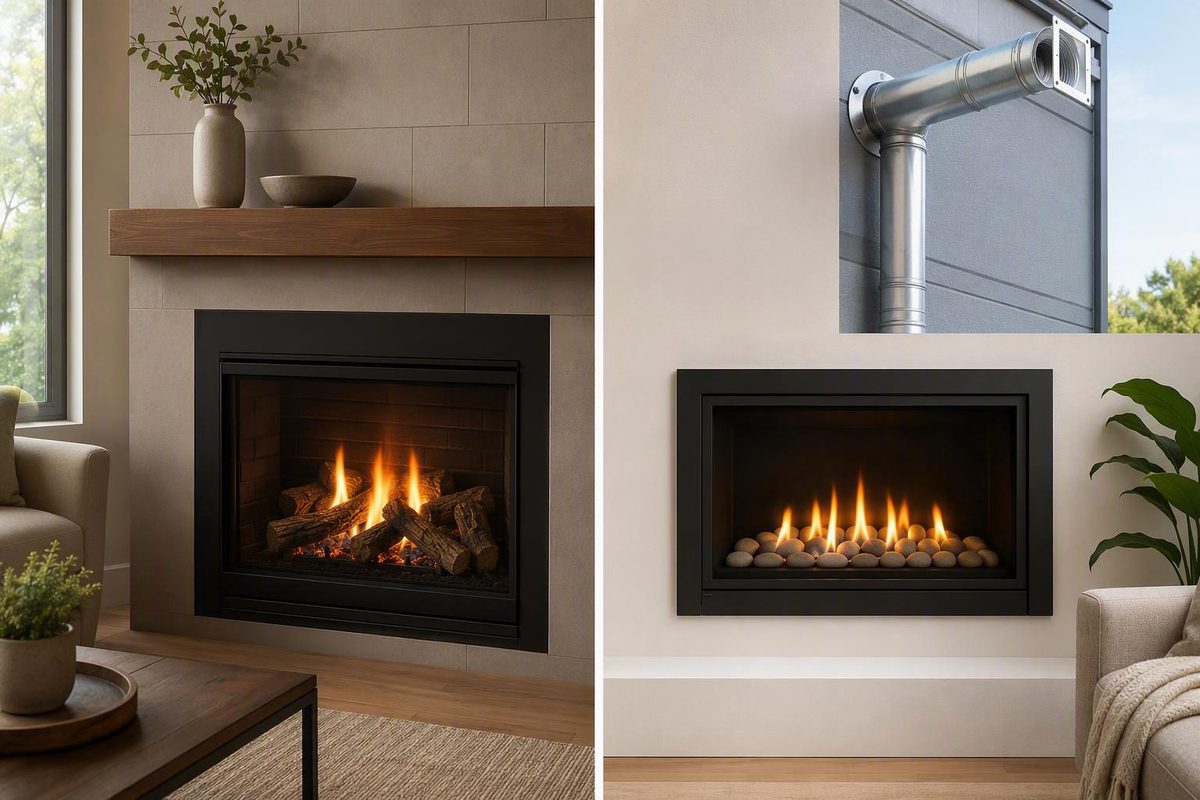
The short answer: venting depends on the fireplace’s listed design
Most gas fireplaces are designed to exhaust outdoors. The exception is an appliance specifically designed and listed as vent-free, also called ventless or unvented. Direct-vent and B-vent fireplaces discharge exhaust outside; a vent-free fireplace has no exterior exhaust connection.
That answers the general question “do gas fireplaces need to be vented,” but not what a particular fireplace requires.
An outdoor exhaust vent is different from general room ventilation. A vent-free appliance has no flue carrying combustion products outside, but it still uses and affects the air in the occupied room. Direct-vent and B-vent systems both discharge exhaust outdoors, although they obtain combustion air differently. These distinctions are reflected in Valor’s comparison of the three gas-fireplace venting systems.
A vented fireplace should never be operated without the complete vent system specified for that model. Closing a damper that must remain open, removing a liner, disconnecting a flue, or failing to install the required pipe does not make the appliance vent-free; vented fireplaces and inserts rely on an approved exhaust arrangement to remove combustion products outdoors.
Likewise, continued ignition does not establish that a modified fireplace is safe or properly classified. Vented and vent-free products are engineered for different methods of handling combustion air and exhaust. Unless the manufacturer provides an approved procedure for the exact model and purpose, do not attempt to change one type into the other.
Before buying, operating, or modifying a gas fireplace:
- Find the rating plate and exact model number.
- Confirm whether the appliance uses natural gas or propane.
- Obtain the manufacturer’s manual for that exact model and fuel.
- Identify its stated classification: direct vent, B-vent or natural vent, or vent-free.
- Compare the observed installation with the manual.
- Ask the relevant local building or fire authority what current requirements apply.
If the appliance cannot be identified or its installation conflicts with the manual, keep it off until a qualified gas-fireplace professional evaluates it.
Direct vent, B-vent, and vent-free compared
The labels direct vent, B-vent, and vent-free describe distinct combustion systems. They are not optional installation methods that can be selected after buying the fireplace.
| System type | Combustion-air source | Exhaust destination | Normal vent direction | Masonry-chimney requirement | Room-air relationship | Key limitations |
|---|---|---|---|---|---|---|
| Direct vent | Outdoors | Outdoors | Horizontal through a wall or vertical through a roof, where approved | Not normally required | Combustion chamber is generally separated from the room by fixed glass | Must use the model-approved vent components, route, clearances, and termination |
| B-vent or natural vent | Occupied room | Outdoors | Generally vertical, terminating above the roof | A masonry chimney is not automatically required, but an approved vertical flue is | Uses room air for combustion and is not a sealed-combustion system | Relies on natural draft and the prescribed vertical vent arrangement |
| Vent-free | Occupied room | Occupied room | No outdoor exhaust route | No | Uses room air and releases combustion products and water vapor into it | Must be specifically listed for vent-free use and permitted and appropriate for the proposed location |
A direct-vent fireplace normally has a fixed glass front and a two-path vent assembly. One passage brings outdoor air to the fire, while the other carries exhaust outdoors. Many systems use a coaxial arrangement—a pipe within a pipe—but the exact components depend on the model. Its defining characteristics are outdoor combustion air, outdoor exhaust, and separation of the combustion chamber from room air.
A B-vent fireplace, also called a natural-vent fireplace, uses air from the occupied room for combustion. Hot exhaust rises by natural draft through an approved vertical flue and terminates outdoors above the roof. It is therefore outdoor-vented, but it is not sealed from room air.
A vent-free fireplace uses room air for combustion and has no outdoor exhaust pipe. The combustion products and water vapor remain in the occupied space. “No chimney required” does not mean that the appliance has no effect on indoor air.
These differences are functional, not cosmetic. An open firebox could contain a B-vent fireplace, a gas-log set, or a listed vent-free product. The rating plate and correct product documentation remain decisive.
No one design is suitable for every installation. Direct vent needs a model-approved route outdoors. B-vent requires a suitable vertical draft path and uses room air. Vent-free avoids an exterior exhaust route but leaves combustion products and moisture indoors. Selection should therefore account for the exact appliance, room, building, and local requirements—not just appearance or installation convenience.
How outdoor-vented gas fireplaces route air and exhaust
Many direct-vent fireplaces can terminate horizontally through an exterior wall or vertically through a roof. This means they do not necessarily need an existing masonry chimney. The route must nevertheless be one permitted by the appliance manual; Heat & Glo’s overview illustrates wall and roof terminations as well as the separate intake and exhaust paths used by direct-vent fireplace systems.
In a typical direct-vent installation, fixed glass separates the combustion chamber from the occupied room. Outdoor air travels to the burner through one passage, and exhaust returns outdoors through another. The passages may be concentric or otherwise paired within the vent system approved for that appliance.
A nearby exterior wall is not automatically an acceptable termination location. Depending on the model, the installation instructions may control:
- Approved vent components
- Pipe size and configuration
- Horizontal and vertical run limits
- Permitted elbows
- Required rise or slope
- Clearances from combustible materials
- Required wall or floor protection components
- Pipe support and joint assembly
- Separation from doors, windows, air intakes, grade, and building features
- Termination-cap type and orientation
The applicable values must come from the exact appliance manual. A route approved for one fireplace may be prohibited for another, even if the two products look similar.
B-vent systems work differently. Because they depend on the buoyancy of hot exhaust to establish natural draft, they generally require a vertical flue terminating above the roof. A short horizontal run through the nearest wall is not a substitute for the approved B-vent arrangement.
Some fireplaces support specialized power-vent systems that permit more complex routes than natural draft or standard direct vent would allow. Power venting is not a generic accessory or a universal retrofit.
An existing chimney opening proves only that an opening exists. Likewise, leftover pipe from another fireplace or stove should not be treated as interchangeable with the vent components named in the new appliance’s instructions.
Choose the appliance and plan its approved vent route together. If the required route cannot be built, select a different listed appliance rather than improvising the vent.
What vent-free really means for indoor air and moisture
Vent-free means no outdoor exhaust. It does not mean emission-free.
A vent-free gas fireplace draws combustion air from the occupied room and returns combustion products and water vapor to that room. Its indoor-air implications are therefore different from those of a sealed direct-vent appliance.
Potential concerns include carbon monoxide when combustion is incomplete or the appliance malfunctions, nitrogen dioxide, oxygen depletion, soot, added humidity, and reduced indoor-air quality. A chimney-service discussion identifies carbon monoxide and nitrogen dioxide among vent-free combustion byproducts and notes that incomplete combustion can increase carbon monoxide and soot production in its overview of ventless fireplace indoor-air effects.
Water vapor also matters. Burning gas produces moisture, and a vent-free appliance leaves that moisture indoors. The result depends on appliance input, operating time, room volume, air exchange, outdoor conditions, and the building enclosure. Added vapor may contribute to excess humidity or condensation on cold surfaces; persistent moisture can create conditions favorable to mold, but mold is not an inevitable result of every vent-free installation.
These are qualitative concerns, not a prediction of what will happen in every home. Actual conditions depend on the listed appliance, its installation and maintenance, the room, operating practices, and local requirements.
An ODS is not a carbon-monoxide alarm
An oxygen-depletion sensor, or ODS, is an appliance safety control that responds to oxygen conditions associated with its design and can shut down a compatible fireplace. It does not measure carbon monoxide and is not a substitute for a carbon-monoxide alarm.
Conversely, a carbon-monoxide alarm does not prove that a fireplace is correctly sized, installed, maintained, or permitted. It is a warning device, not a venting system or a remedy for defective combustion.
Fairfax County Fire and Rescue addresses oxygen depletion and carbon monoxide as separate concerns and recommends both an appropriate ODS-equipped ventless appliance and an audible carbon-monoxide alarm in its ventless fireplace safety guidance. Whether a particular appliance has an ODS or another control must be verified in its own manual.
Safety devices do not override:
- Room-volume or combustion-air requirements
- Restrictions applying to particular room types
- Manufacturer operating instructions
- Required clearances
- Maintenance provisions
- Local restrictions or approval conditions
- Evidence of malfunction, damage, or incomplete combustion
Evaluate a vent-free fireplace through three separate questions:
-
Is the appliance physically designed and listed as vent-free? A vented unit with a missing or disconnected flue is not vent-free.
-
Is that appliance permitted in this location? Rules may vary with jurisdiction, building or housing context, room, appliance input, and available combustion air.
-
Is it appropriate for the proposed room and occupants? Permission to install a product does not establish that every appliance is suitable for every enclosed space or household.
This framework avoids unsupported absolutes. A vent-free fireplace should not be declared universally safe merely because it has safety controls, nor should every listed vent-free product be declared universally unsafe without considering its approval, condition, installation, room, and operation.
How to identify the type of gas fireplace you have
Start with documentation rather than visual guesswork.
Identification checklist
-
Turn the appliance off and let it cool. Do not remove fixed glass or disassemble components unless the user instructions expressly allow homeowner access.
-
Locate the appliance label or rating plate. Consult the user instructions if its location is not obvious. Record the manufacturer, complete model number, serial number, fuel, and any stated venting classification.
-
Obtain the matching manufacturer manual. Confirm that the manual covers the exact model and fuel. A brochure or manual for a similar-looking fireplace is not enough.
-
Read the venting and installation sections. Look for terms such as “direct vent,” “natural vent,” “B-vent,” “unvented,” or “vent-free.” Compare the required components and diagrams with the observed installation.
-
Observe only what can be checked safely. Look for an exterior wall cap, roof termination, chimney liners, visible vent pipe, damage, or blockage. Do not casually open concealed construction.
-
Compare rather than assume. If the manual requires a vent that is absent, or the visible components conflict with its instructions, do not use the fireplace.
Keeping an unidentified or apparently altered appliance off is a precaution against operating it with a missing, damaged, or incorrect exhaust arrangement. Service guidance identifies damaged connections, blocked terminations, failed seals, soot, fogged glass, and abnormal operation as conditions warranting shutdown and evaluation.
Visual clues—and their limits
Certain features can suggest a category:
- Fixed glass with a wall or roof termination commonly suggests direct vent.
- An open front with a vertical flue may suggest B-vent or a vented gas-log installation.
- No visible exterior termination may suggest a vent-free appliance, but the vent could instead be concealed, difficult to see, disconnected, or missing.
- Liners visible at the top of a masonry chimney may indicate a vented insert.
None of these clues is conclusive by itself. Glass can appear on different product styles, and a masonry chimney may contain approved liners, an unsuitable flue, an unused passage, or no connection to the appliance.
Do not operate an unidentified fireplace merely because it lights, produces heat, or appears to draft. Ignition does not demonstrate that exhaust is reaching the correct destination.
Professional verification is appropriate when:
- The label, model number, or manual is unavailable
- The model cannot be identified conclusively
- The vent route is concealed
- Pipe, seals, glass, controls, or burner components appear altered
- The exterior termination cannot be found
- The observed installation conflicts with the manual
- A former wood fireplace contains an unfamiliar burner or insert
Use this decision path:
Documentation confirms the type and installation → Follow the manual and applicable local requirements. Documentation is unavailable → Treat visual observations only as preliminary clues. Uncertainty or conflict remains → Keep the appliance off and obtain qualified identification.
Gas inserts, gas logs, and wood-fireplace conversions
“Gas fireplace” is often used as a catch-all, but factory-built fireplaces, inserts, and gas-log sets are different products.
Depending on its listed design, it may be direct vent, B-vent, or vent-free.
A gas insert is a complete appliance installed within an existing fireplace opening. A direct-vent insert may use separate intake and exhaust liners routed through an existing masonry chimney. The chimney provides a pathway and enclosure, while the liners perform the air-intake and exhaust functions; Heat & Glo describes this common insert arrangement in its gas-fireplace venting overview.
Not every insert uses the same liner configuration. The insert manual determines the approved liners, adapters, caps, and other installation details. The existence of a masonry chimney does not establish that an insert can simply discharge into it without the vent arrangement required for that model.
The log set’s listing and manual—not general rules for gas inserts—control its installation.
An unvented gas-log set is specifically designed and listed to operate without outdoor exhaust. Physical fit inside an old wood-burning firebox does not establish compatibility.
An existing wood-burning fireplace may sometimes accept:
- A compatible direct-vent gas insert
- Another approved vented insert
- A listed vented gas-log set
- A listed unvented gas-log set, where permitted and compatible
The correct choice depends on the original fireplace and chimney condition, selected product, fuel, manual, listing, and local approval. Adding a gas burner does not remedy a damaged or unsuitable fireplace or chimney.
Vented and unvented products cannot be converted into one another merely by changing a damper position, removing vent components, substituting a burner, or adding arbitrary pipe. They are designed to handle air and exhaust differently, as Regency also explains in its discussion of why vented and ventless fireplaces are engineered as different systems.
Codes, permits, room restrictions, and the approval workflow
Two layers of requirements must be addressed:
- The product listing and installation manual establish the approved configurations for the exact appliance.
- The current local rules and relevant authority determine whether and where that appliance may be installed.
Neither layer should be treated as a substitute for the other. A configuration shown in a manufacturer’s manual may still be subject to local restrictions, while local permission does not change the appliance’s listed installation instructions.
Requirements for vent-free appliances may vary by jurisdiction, building or housing context, room type, room volume, appliance input, and available combustion air. Verify the current rule with the authority responsible for the specific property.
A practical approval workflow
-
Identify the exact appliance and fuel. Record the model, serial number, input information, and whether it is configured for natural gas or propane.
-
Obtain the correct manual and listing information. Confirm the venting classification, approved components, clearances, room restrictions, and required controls.
-
Document the proposed installation. Note the room, intended vent route, chimney condition, wall or roof termination area, and nearby openings or air intakes.
-
Contact the local building department or fire authority. Ask whether the appliance is permitted in that location and whether permits, inspections, plan review, or other project-specific steps apply.
-
Ask about room and alarm requirements. Do not assume general household alarm rules answer every appliance-specific question.
-
Use a qualified gas-fireplace professional. The installer should compare the appliance, fuel supply, vent components, clearances, and combustion-air provisions with the manual and applicable local requirements.
-
Complete any required approvals before operation. Retain the manual and available installation, permit, or inspection records for future service and resale.
Regulated or manufacturer-controlled details may include approved pipe, vent size and route, maximum runs and elbows, clearances, firestops, termination placement, combustion air, room sizing, and carbon-monoxide alarm placement. Do not copy dimensions from another model or installation.
Legal permission and practical suitability are also different questions. A vent-free appliance permitted in a jurisdiction may still be inappropriate for a particular room or building. Conversely, a route that appears physically possible may conflict with the appliance manual or local placement requirements.
Mechanical Mentor covers fireplaces, venting, and other home mechanical systems as described on its About page, but this article is general educational material. The site’s terms for combustion-appliance guidance note that venting is code-governed and may involve permits and inspections. Online guidance cannot replace an appliance manual, product listing, project-specific review, inspection, or decision by the relevant authority.
Warning signs, carbon-monoxide precautions, and when to stop using the fireplace
Changes in appearance or operation should be judged against the instructions for the exact model. Possible appliance or vent warning signs include:
- Soot on the glass, logs, firebox, wall, or ceiling
- Persistent unusual odors
- Flames that are abnormal for that model
-
Glass that repeatedly fogs or develops unusual deposits
-
Damaged door or glass seals
- Loose, corroded, disconnected, or visibly damaged vent components
- Debris, nests, snow, ice, or other blockage at an exterior termination
- Repeated unexplained shutdowns
- Evidence that the burner, logs, damper, liners, or vent have been altered
These signs can have different causes, but soot, vent damage, failed seals, blocked terminations, or unauthorized alterations warrant stopping use until the appliance is evaluated. A service-provider overview of gas-fireplace venting warning signs identifies soot, unusual odors, fogged glass, abnormal flames, and damaged or blocked venting as possible concerns.
Possible carbon-monoxide exposure symptoms include headache, dizziness, nausea, and unusual weakness or fatigue. Carbon monoxide is colorless and odorless, so an absence of smell cannot establish that the room is safe. Treat symptoms that arise during fireplace operation as an urgent safety matter rather than remaining inside to troubleshoot the appliance.
Maintain working carbon-monoxide alarms according to their instructions and applicable local requirements. An alarm is an important warning layer, but it does not replace correct venting, installation, maintenance, or required appliance controls. An ODS likewise does not replace a carbon-monoxide alarm.
If a carbon-monoxide alarm sounds while the fireplace is operating:
- Shut down the fireplace only if that can be done immediately and safely.
- Move everyone outside or to fresh air.
- Call emergency services or the relevant local emergency authority.
- Do not restart the appliance until the event and fireplace have been evaluated.
- Arrange qualified inspection before using it again.
Fairfax County Fire and Rescue similarly instructs occupants to shut down a ventless fireplace, leave the home, and call emergency services if a carbon-monoxide alarm sounds or an ODS-related safety event occurs. An ODS may shut down the appliance rather than produce an audible household alarm; repeated unexplained shutdowns still require attention.
Keep the fireplace off pending qualified inspection after an alarm event, suspected vent blockage, soot accumulation, unexplained symptoms, repeated shutdowns, a damaged seal, or evidence of unauthorized alteration.
For routine care, follow the manufacturer’s maintenance schedule and applicable local requirements. Professional inspection is prudent when the appliance’s condition, installation, or service history is uncertain, but annual inspection should not be presented as a universal legal requirement for every fireplace and jurisdiction.
Frequently asked questions
Can a gas fireplace be vented through an exterior wall instead of a chimney?
Yes. Many direct-vent gas fireplaces can terminate horizontally through an exterior wall, while others may be approved for vertical roof termination. The exact pipe, route, run length, elbows, clearances, and termination location come from the model’s installation manual and applicable local requirements.
B-vent fireplaces are different. Because they rely on natural draft, they generally require a vertical flue terminating above the roof. A wall termination is not automatically an acceptable alternative.
Does a direct-vent gas fireplace need a masonry chimney?
No. A direct-vent fireplace can commonly use a listed vent system through an exterior wall or roof, so it does not necessarily require a masonry chimney.
A direct-vent insert installed in an existing fireplace may use the masonry chimney as a route for approved intake and exhaust liners. The chimney is then part of the installation setting, but the appliance still depends on the liner configuration specified in its manual.
Is an oxygen-depletion sensor the same as a carbon-monoxide detector?
No. An oxygen-depletion sensor responds to oxygen conditions associated with its design and may shut down the appliance. It does not detect or measure carbon monoxide.
A carbon-monoxide alarm detects carbon monoxide under the conditions covered by its design. Neither device proves that a fireplace is correctly installed or operating properly, and neither substitutes for the other.
Can a vented gas fireplace be converted to vent-free?
Not by removing vent components, closing a damper, replacing a burner, or adding unrelated parts. Vented and vent-free appliances are differently engineered and listed systems.
If a different configuration is wanted, the usual approach is to select a complete fireplace, insert, or log set specifically listed for that use, verify its compatibility with the fireplace and fuel, and obtain any required local approval. Do not modify an existing appliance unless its manufacturer expressly provides an approved procedure for that exact model and purpose.
What should I do if my carbon-monoxide alarm sounds while the fireplace is operating?
Shut down the fireplace only if it is safe to do so, move everyone outside or to fresh air, and call emergency services or the appropriate local emergency authority. Do not assume that opening a window has corrected the cause, and do not silence the alarm and restart the fireplace.
Keep the unit off until qualified personnel have evaluated the alarm event and the appliance. If anyone develops headache, dizziness, nausea, or unusual fatigue while the fireplace is running, move to fresh air and seek emergency assistance.
Most gas fireplaces exhaust outdoors; only appliances specifically designed and listed as vent-free are intended to operate without an exterior exhaust. Identify the exact model, read its manual, and confirm current local requirements before using or modifying it. If the fireplace is unknown, altered, or inconsistent with its documentation, keep it off until a qualified professional verifies the installation.
The essential distinction is simple: no outdoor vent does not mean no indoor combustion products. Neither an oxygen-depletion sensor nor a carbon-monoxide alarm can compensate for an unsuitable, defective, or incorrectly installed fireplace.