
Choosing and Operating an Electric Fireplace Insert With a Blower
Check integrated blower controls, flame-only operation, noise and service access—and know when a fan symptom needs cleaning or professional repair.
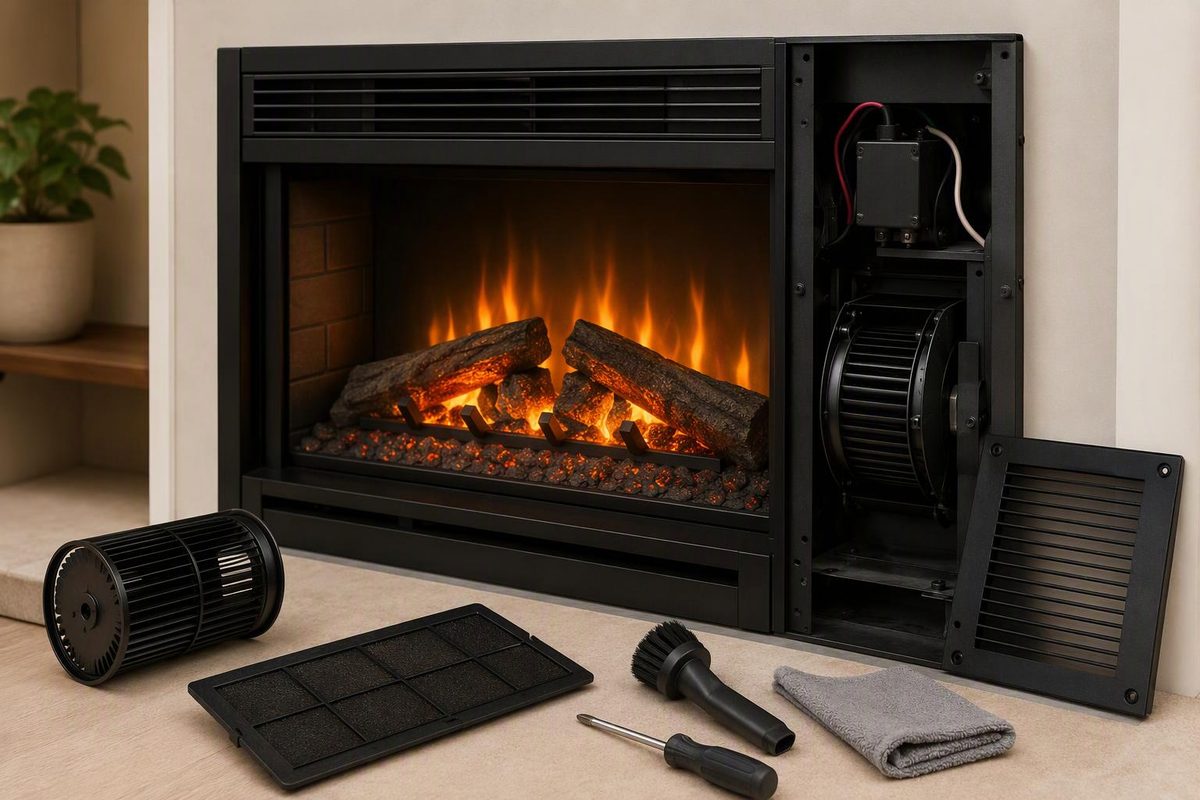
For a fan-forced electric fireplace insert, the blower is part of the heater system: it moves warmed air into the room. It is not simply an optional circulation accessory. Dimplex, for example, describes its electric heating system as fan-forced.
The useful buying question is therefore not just “Does it have a blower?” It is how the blower operates, what you can control, and how it can be serviced. For opening dimensions and electrical planning, use the separate electric fireplace insert fit-and-power guide.
Check the controls before choosing
Read the operating section for the exact model and part number—not just the retailer’s feature list.
| Check | What to establish before buying |
|---|---|
| Blower control | Is fan speed automatic, manually adjustable, or not separately selectable? |
| Heat settings | Do Low, Eco or Boost change heating operation rather than provide a dedicated fan-speed control? |
| Flame-only operation | Can you switch heat off while leaving the flame effect on? |
| Thermostat behavior | Does the fan stop at the set temperature, or continue at reduced output? |
| Service access | Is the replacement item a blower alone or a complete heater assembly, and how is it accessed? |
These distinctions are real. The Dimplex RBF24DLX/RBF24DLXWC owner’s manual describes ComfortSaver control that automatically adjusts fan speed and heater wattage. At the temperature set point, it can keep the fan and heater running at a low level. Its “Flame Speed” button changes the visual effect—not blower speed—and its Normal, Eco and Boost settings are heat modes. See the RBF24 owner’s manual, operation section.
If independently adjustable airflow matters to you, require an explicit fan-speed function in the manual. Do not infer one from “adjustable flame,” “thermostat” or “multiple heat settings.” Likewise, do not buy on the assumption that flame-only operation also provides a selectable, continuous fan-only mode.
For repairability, ask the seller to identify the model-specific replacement assembly and confirm availability. The Revillusion service manual distinguishes a separate blower for RBF30/RBF36/RBF36P/RBF42 from a heater assembly for RBF24DLX. It also directs repairs to qualified technicians or service agencies. A parts listing is useful, but it is not evidence that a part is currently in stock.
Evaluate noise with heat running
A flame-only demonstration cannot tell you how the heater blower sounds. Ask to hear the exact model:
- With flames on and heat off, after any fan run-on ends.
- With heat actively running.
- Near the thermostat set point, if it uses automatic fan control.
Listen from roughly where you will sit. Treat descriptions such as “quiet” as insufficient for a noise-sensitive room unless you can hear the unit or obtain a meaningful sound specification.
This comparison is also diagnostic. Dimplex technical support identifies the blower motor, flame motor and flicker rod as possible noise sources. Noise that disappears when the heater fan stops points toward the blower assembly; noise that remains can come from the flame mechanism. That narrows the service question—it does not prove which part needs replacement.
If the blower behaves unexpectedly
1. Check the selected mode. Confirm heat is enabled and the thermostat is calling for heat. A working flame effect does not establish that the heater is switched on. Use the appliance controls as well as the remote to check the setting, following your model’s operating instructions.
2. Allow for normal fan run-on. A fan continuing briefly after Heat Off can be normal. The Revillusion service manual, operation section specifies 60 seconds for RBF30/RBF36/RBF36P/RBF42. Use your own model’s instructions rather than treating that delay as universal.
3. Inspect accessible airflow openings with power disconnected and the heater cool. Remove obstructions and clean only as the owner’s manual permits. Do not add trim, fabric or a screen across the intake or outlet to hide it or quiet the fan. The RBF24 manual prohibits obstructing airflow, and Dimplex technical support associates blocked intake slots with overheating shutdowns.
4. Stop using the unit at repeated cutouts or persistent abnormal noise. Disconnect power and arrange service. Do not repeatedly reset an overheating heater, bypass its cutoff, or open the housing for internal repairs. Dimplex directs users who need continuous resets to disconnect the unit and contact technical support; the RBF24 owner’s manual states there are no user-serviceable parts inside and calls for qualified repair.
Keep the model and serial numbers, selected heat mode, any error code and a description of when the noise occurs ready for service. Do not substitute a universal fireplace blower kit for the integrated assembly; require the manufacturer’s specified replacement for that appliance.