
Choose an Electric Fireplace Insert by Fit, Power and Heat
Check fireplace dimensions, electrical supply, airflow and realistic heat output before buying an electric fireplace insert.
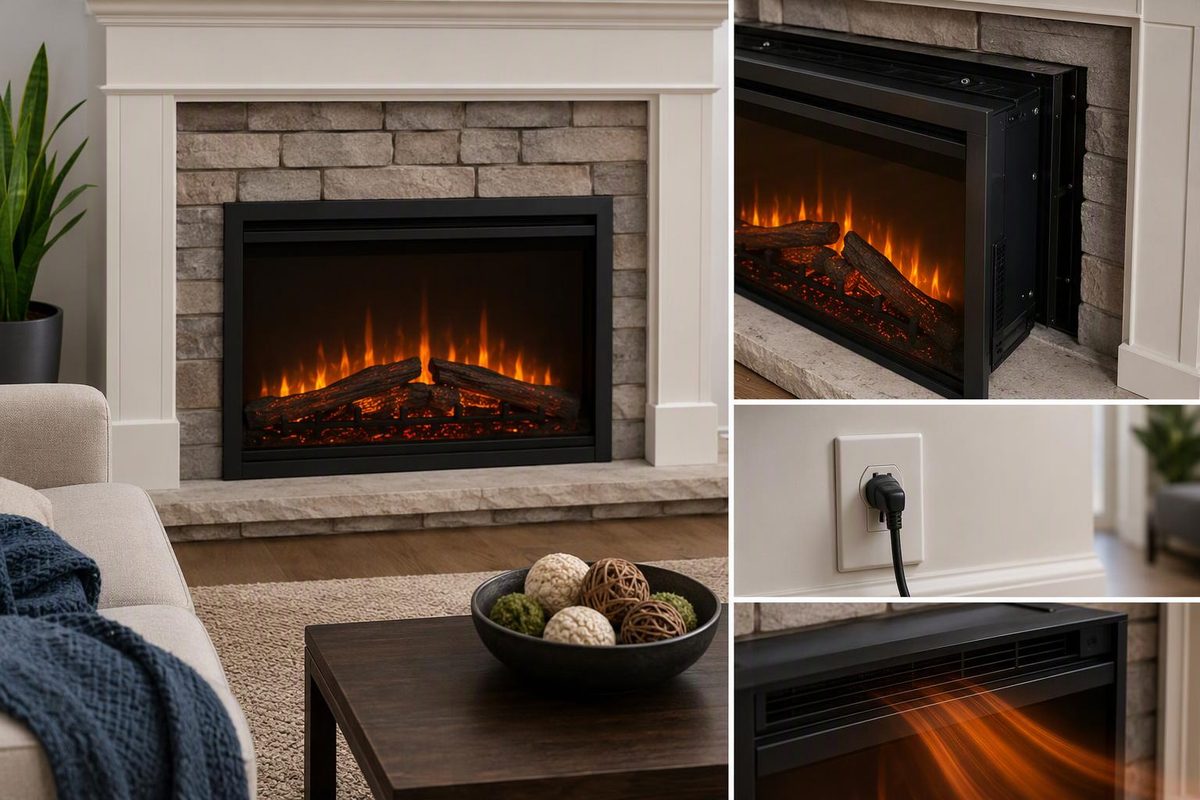
An electric fireplace insert can put a flame effect and electric heat into an existing fireplace without adding a combustion vent. But “no venting” does not mean “fits anywhere.” The opening, electrical supply and heater airflow still have to match the exact appliance instructions.
Before buying, verify three things: the approved installation location, the required opening dimensions and the electrical circuit. Then decide whether its heat output suits the room—not just whether its trim covers the opening.
1. Match the insert to the fireplace
Start with the installation manual, not the advertised screen size. Check whether the model is intended for an existing fireplace, a framed enclosure or both. A decorative log set and a complete enclosed firebox are different products; do not assume they have interchangeable installation requirements.
Record these measurements:
| What to measure | What it tells you |
|---|---|
| Opening width at the front and farther back | Whether a tapered firebox will accept the appliance body |
| Opening height at several points | Whether the body clears uneven masonry or projecting metalwork |
| Usable depth | Whether the unit fits without pinching its cord or obstructing required space |
| Hearth level and support surface | Whether the appliance can sit securely as instructed |
| Surround width and height | Whether the specified trim covers the remaining gap |
| Mantel position and projection | Whether the model’s clearance requirements can be met |
Keep appliance dimensions, minimum opening dimensions and trim dimensions separate. For example, the Dimplex DFI2309/DFI2310 manual requires an opening at least 24 inches wide, 21.5 inches high and 12 inches deep. Those are requirements for those models, not a standard for every electric insert. That manual also requires airflow beneath the unit and prohibits placing it directly on carpet. Dimplex DFI installation manual
Stop if fitting the appliance would require cutting a factory-built fireplace shell, removing its ventilation components or modifying the electric unit. Obtain an approved installation approach before altering either assembly. The fireplace compatibility guide provides a broader measurement worksheet.
Check the old fireplace, too
Do not hide a damp firebox behind a new insert. The DFI manual specifically prohibits installation in an existing fireplace prone to dampness and calls for measures to prevent chimney debris and rain from reaching the appliance. Have needed chimney work planned for that fireplace; do not apply a blanket “seal the chimney” instruction to other flues serving appliances. Dimplex existing-fireplace instructions
2. Verify power before ordering
A nearby receptacle is not proof that the circuit is suitable. Check the appliance’s voltage, wattage, connection method and circuit requirements, then identify what else uses that circuit.
For a specific example, the Dimplex REV24 manual specifies 120 volts, permits plug-in or hardwired installation and recommends a dedicated, properly fused 15-amp circuit. Its hardwiring instructions call for a dedicated circuit. It prohibits an extension cord and requires electrical work to comply with applicable codes. Follow the section for your connection method—not just the least restrictive sentence in the manual. Dimplex REV24 installation guide
At 120 volts, a 1,500-watt load draws approximately 12.5 amps, calculated as watts divided by volts. That is a substantial load on a circuit also supplying other equipment.
Have a licensed electrician install any new receptacle or circuit and handle a hardwired connection. Plan the cord route before sliding the insert into place: no pinched cable, extension cord or power strip. Dimplex electrical installation precautions
Stop using a plug-in heater if the plug, receptacle or faceplate becomes hot, or the plug fits loosely. CPSC’s portable-electric-heater guidance calls for an electrician to check hot plugs or outlets and warns against extension cords and power strips. Repeated breaker trips also need assessment—not repeated resets. CPSC electrical-heater safety guidance
3. Keep the heater’s airflow clear
“Zero clearance” is not permission to cover the heater outlet or ignore every spacing requirement. The REV24 manual describes a zero-clearance design but requires insulation and vapor barriers to remain at least 2 inches above the unit. It also requires furniture, curtains and similar combustibles at least 3 feet from the front and prohibits blocking air intakes or exhaust. Those distances belong to that model. Dimplex REV24 placement and safety instructions
Check existing fireplace doors as well. The DFI manual prohibits doors that seal the insert off from the room and requires bi-fold doors to stay open so heat can escape. Do not assume an old screen, custom trim or decorative cover leaves adequate airflow. Dimplex DFI airflow requirements
4. Judge heat by watts, not the flame display
For scale, 1,500 watts of heat equals about 5,100 BTU per hour, calculated using 3.412 BTU/h per watt. That is a useful comparison figure, not a promise to heat a particular floor area. Insulation, windows, outdoor temperature and adjoining spaces determine whether that output is enough.
Treat a modest-output insert as supplemental room heat unless a heat-loss assessment shows otherwise. Increasing the thermostat setting does not increase the appliance’s maximum output, and an electric insert does not provide heat when its electrical supply is interrupted.
For running cost, use:
Input kW × operating hours × electricity rate per kWh
A 1.5 kW appliance running continuously at full input for four hours uses 6 kWh. At an illustrative rate of $0.20/kWh, that costs $1.20. Thermostat cycling changes actual consumption; use your bill’s applicable rate rather than this example.
Before purchase, price the complete job: appliance, model-specific trim, electrical work, fireplace preparation and finish work. If you need substantially more heat or are comparing fuel options, use the electric-versus-gas fireplace guide before committing to an insert.