
Check the LP Fuel Supply and Room Before Buying a Ventless Fireplace
Choose an LP ventless fireplace by propane approval, room-air requirements, tank capacity, clearances and controls—and know when to stop using it.
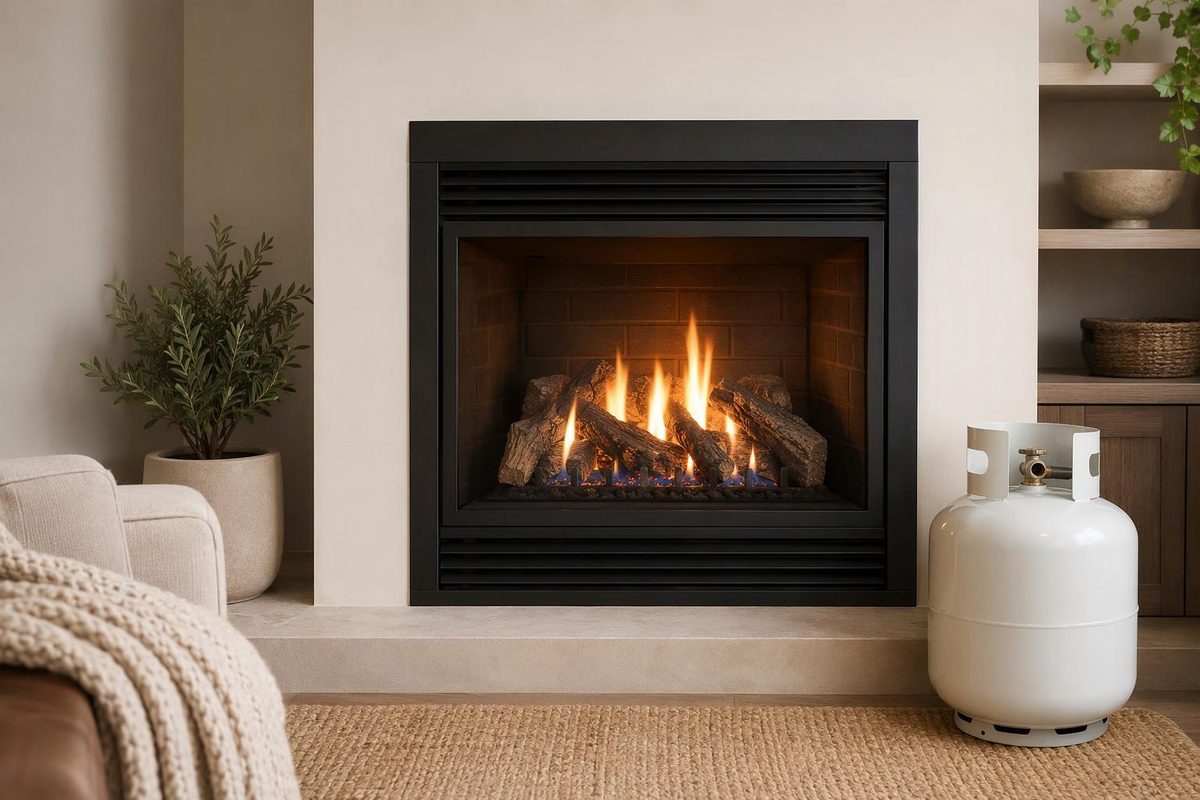
An LP ventless fireplace burns propane without an outdoor exhaust vent. LP refers to liquefied petroleum gas; in this application, the fuel is propane. The fireplace takes combustion air from the room and releases combustion products, including water vapor, indoors. “Ventless” and “vent-free” describe the appliance design—not permission to install it anywhere.
Treat it as supplemental room heat, not your home’s primary heating system. ASHRAE’s June 2026 position document recommends against using unvented combustion devices as the primary or sole heat source and states that vented devices reduce exposure to combustion-related pollutants. It also advises consumers seeking to reduce health risks from combustion products not to use unvented devices. Compare a direct vent propane fireplace if keeping combustion exhaust out of the room is a priority.
1. Verify the exact fireplace and proposed room
Before ordering, obtain the full model number, rating-plate information and installation manual. Ask your local building department whether that specific unvented propane appliance is permitted at the proposed location, and what permits and inspections apply.
Check these items before appearance or price:
- LP approval: The rating plate must identify propane as the permitted fuel. Do not assume a natural-gas version can be converted. Both the Pleasant Hearth VFF-PH series and Empire Vail VFPA series manuals prohibit field conversion.
- Complete assembly: Establish whether the purchase is a complete fireplace, an insert, or a firebox needing a separate burner and log set. Require the supplier to identify the approved components in the quote.
- Room restrictions: Check the manual rather than relying on a general bedroom exception. For example, the Pleasant Hearth fireplace manual prohibits bedroom and bathroom installation.
- Clearances: Measure the proposed enclosure, sidewalls, ceiling, mantel depth and nearby furnishings against the model’s drawings. Include any required hood, screen and unobstructed air openings.
These are model-specific checks, not interchangeable dimensions. See the Pleasant Hearth VFF-PH manual and Empire Vail VFPA manual for examples of how fuel, components and clearances are specified.
Room volume is not a heating-capacity recommendation
Have the installer complete the combustion-and-ventilation-air assessment. The Vail manual uses a confined-space threshold of 50 cubic feet per 1,000 Btu/h of combined input from appliances drawing combustion air from that space. It also addresses unusually tight construction and which adjoining rooms can count toward the available volume. A room that passes the volume calculation is not automatically cleared on every installation requirement. Source: Vail manual, combustion-air section.
2. Size the propane supply—not just the fuel storage
Do not assume a barbecue cylinder and hose are suitable. The Pleasant Hearth VFF-PH manual requires propane supply tanks outdoors and specifies a minimum 100-pound fuel capacity to prevent performance problems. That is a requirement for those models, not a universal ventless-fireplace tank size—and pounds are not gallons. Source: VFF-PH safety instructions.
Ask the propane supplier to check:
- The fireplace’s maximum input and other appliances that may operate simultaneously.
- Tank vaporization capacity at the coldest expected temperature and lower fuel levels.
- Regulator arrangement, gas-line length and size, and required appliance inlet pressure.
- Tank placement and delivery access.
A tank can contain propane yet fail to vaporize it fast enough for the load, particularly in cold weather. DCC Propane explains why tank sizing must account for vaporization, temperature and peak demand, not merely monthly gallons consumed.
The appliance’s built-in regulator does not make a direct tank-pressure connection acceptable. For example, Pleasant Hearth specifies an external LP regulator supplying 11–14 inches water column, with a listed LP manifold pressure of 10 inches water column. These are technician verification values for that series, not homeowner adjustment instructions or settings to transfer to another fireplace. Source: VFF-PH specifications and gas connection instructions.
3. Estimate fuel use and indoor moisture
For budgeting, use the burner input rating:
Gallons per burner-hour ≈ input Btu/h ÷ 91,500
Using HOP Energy’s approximate propane energy content, a 32,000-Btu/h burner consumes about 0.35 gallon per hour at full input. Four full-input burner-hours use about 1.4 gallons. Multiply by your delivered propane price; thermostat cycling, lower firing rates and pilot consumption change actual use. This calculation estimates fuel consumption, not safe operating duration.
Moisture also belongs in the decision. Empire estimates approximately one fluid ounce of water per 1,000 Btu of gas input. At 32,000 Btu/h, that is roughly a quart of water vapor released indoors each hour. Persistent window condensation or rising humidity warrants reducing use and reassessing the installation—not treating moisture as a free benefit. Source: Vail water-vapor guidance.
4. Require commissioning and model-specific operating instructions
The installation quote should cover gas piping and regulation, an accessible shutoff, leak testing, pressure verification, correct log placement, required accessories and the local approval process. Have the installer demonstrate lighting, shutdown and any battery-backup procedure.
Do not assume “gas” means every function works during an outage. The Vail manual describes separate millivolt and electronic ignition versions, including battery backup for electronic controls; the blower has its own electrical requirements. Confirm the exact controls and accessories supplied. Source: Vail operating and wiring instructions.
Keep logs and decorative media in their prescribed positions, do not aim fans into the flames, and arrange professional inspection at least annually. Incorrect log placement and restricted burner air openings can cause soot. Repeated safety shutdowns require service, not bypassing the pilot safety system. Source: Vail safety and soot-prevention instructions.
Do not operate the fireplace in a room where people are sleeping. The oxygen-depletion sensor responds to reduced oxygen; it does not replace a household CO alarm. CPSC recommends CO alarms with battery power or battery backup on every level and outside sleeping areas, and warns against operating unvented fuel-burning appliances in rooms where people sleep.
Stop using the fireplace if soot develops or shutdowns recur. If you smell gas, leave immediately without operating switches or attempting ignition; call the propane supplier or fire department from outside. If a CO alarm sounds or you suspect CO poisoning, get everyone outside into fresh air and call 911. Do not re-enter until emergency responders give permission, and do not reuse an appliance identified as the CO source until trained personnel have serviced it. Gas-emergency instructions; CPSC CO emergency guidance.