
Vent-Free Gas Firebox: Check the Enclosure and Heater Together
A vent-free gas firebox is an enclosure, not necessarily a complete heater. Check its listing, compatible log set, dimensions and installation requirements.
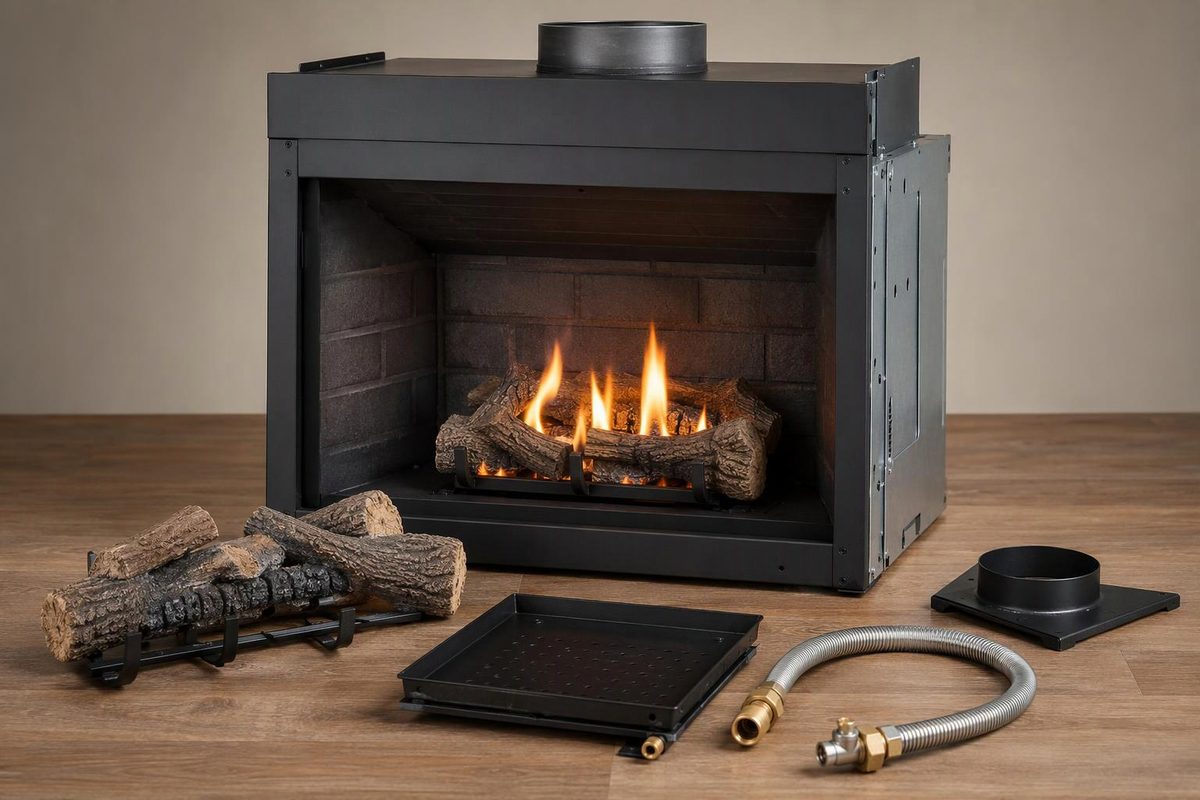
A vent-free gas firebox is a fireplace enclosure designed for an approved unvented gas burner/log heater. A firebox-only purchase is not a complete heating appliance: check whether the burner, logs and controls are included or sold separately. For example, Superior sells its VRT3200 fireboxes separately from the compatible log sets and controls. Superior VRT3200 specifications
The important distinction is between the enclosure’s approval and the heater’s approval. Superior’s VRT3200 fireboxes are tested to ANSI Z21.91 for ventless firebox enclosures and accept approved ANSI Z21.11.2 vent-free gas-log room heaters. The manufacturer requires both installation manuals to be followed—not just the firebox instructions. Superior VRT3200 manual, pages 1–3
1. Identify the enclosure before choosing a burner
Find the firebox’s model and serial number, rating label and matching manufacturer manual. Confirm that it is a listed ventless enclosure and read the permitted heater type, maximum input and accessory restrictions.
“Universal” does not mean any burner that fits. Empire’s Deluxe universal vent-free fireboxes, for example, specify a listed unvented decorative room heater with input no greater than 40,000 BTU/h, and require the enclosure to meet the heater’s minimum fireplace dimensions. That is a specification for those models, not a sizing rule for every firebox. These enclosures are not for burning wood. Empire Deluxe firebox manual, pages 1 and 6
Do not treat an unidentified enclosure—or a vented fireplace with missing pipe—as a vent-free firebox. The broader distinction is covered in gas fireplace vent types.
Stop point: If the label or matching manual cannot be found, have the enclosure identified before ordering a heater or connecting gas.
2. Match the heater to the usable firebox space
Check these items together:
- Approved installation: The heater manual must permit installation in that category of enclosure, and the firebox manual must permit the heater type.
- Fuel: Match the heater to natural gas or propane as specified on its label.
- Input: Keep the heater within the firebox’s stated BTU/h limit and the room’s combustion-air requirements.
- Internal dimensions: Compare the usable front width, rear width, depth and height with the heater’s minimum-dimension diagram—not merely the firebox’s advertised size.
- Complete assembly: Use the specified burner, logs and accessories rather than assembling unrelated parts.
Monessen’s Lumonessen manual illustrates why both documents matter: it permits installation in a listed CSA/ANSI Z21.91 ventless enclosure only when the hearth dimensions meet its minimum requirements. It also directs installers to use the enclosure manufacturer’s installation and clearance requirements. Lumonessen manual, pages 5–9
For the differences between log-set types, see how to choose gas logs. Physical fit alone is not approval.
3. Check framing, finishes and required parts
“Zero clearance” must be read by location. It does not make the entire installation safe against wood, drywall, a mantel or furniture.
For example, Empire’s cited Deluxe models allow zero clearance at the outer casing’s side and back flanges, but require a 3/4-inch clearance for combustible finishing material above the unit. They also have separate sidewall, ceiling and mantel requirements and require the supplied hood or an approved optional hood. Those dimensions apply only to the models covered by that manual. Empire manual, pages 4–5
Before closing the wall, have the installer verify the framing diagram, support surface, facing materials, hood, screen, air openings and service access. Do not omit required parts to achieve a cleaner-looking opening.
4. Approve the room—not just the wall opening
Vent-free does not mean ventilation-free. The heater uses room air, so the installation needs an adequate combustion-and-ventilation-air assessment. Lumonessen also prohibits its cited models in bedrooms and bathrooms and directs installers to check local restrictions, permits and inspection requirements. Its oxygen-depletion safety pilot does not remove those installation requirements. Lumonessen manual, pages 1 and 4–8
Before buying, give the qualified installer both model numbers, both manuals, the proposed room and the planned mantel/facing details. Proceed only when the enclosure, heater and room meet the applicable requirements together.