
The Missing Credit Does Not Make Gas The Default
Compare heat-pump and gas-furnace costs after the federal credit, including installation scope, local utility rates, cold-weather output, and backup heat.
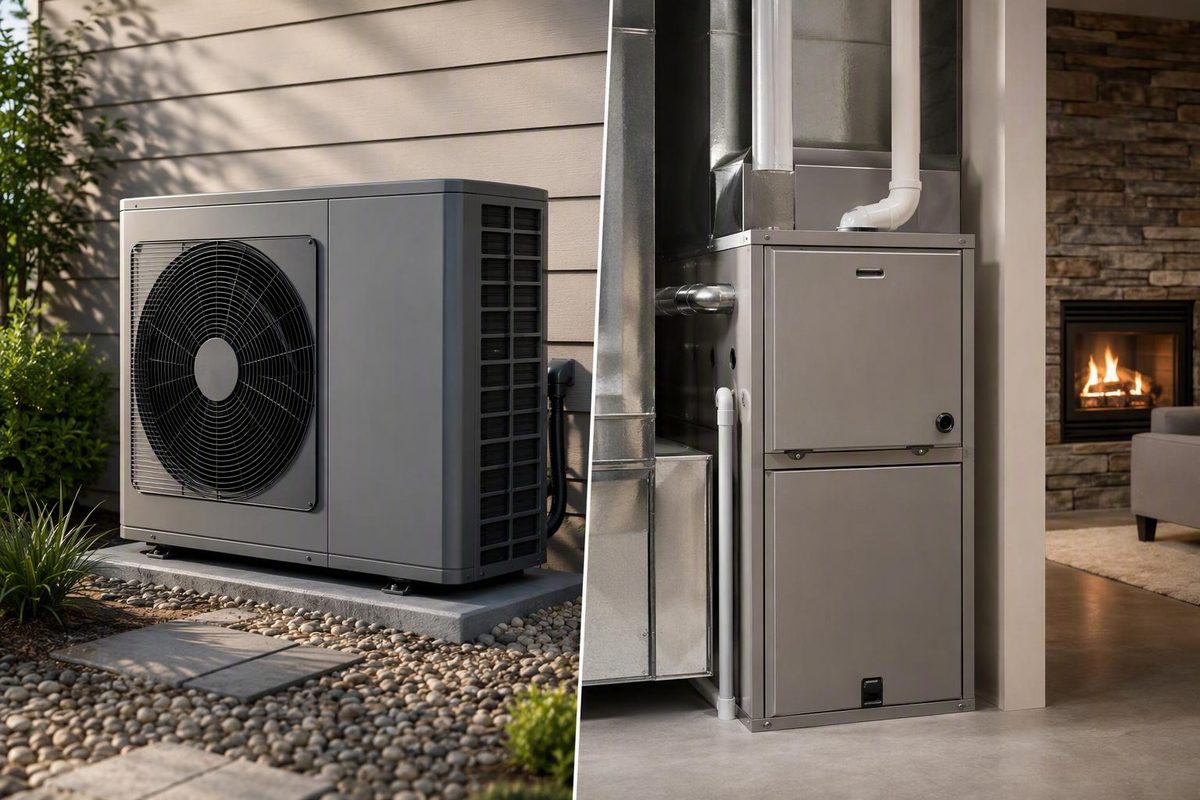
Skipping a heat pump because the federal subsidy is gone is the wrong lesson from 2026. Heat pumps outshipped fossil-fuel furnaces by 32% in the first quarter—the first full quarter after the former $2,000 credit expired—and the underlying AHRI data cover about 90% of the U.S. HVAC market (MIT Technology Review’s shipment analysis). The credit helped qualified buyers, but its disappearance did not send demand back to gas.
That is a market verdict, not a promise that a heat pump will be cheaper in every house. A furnace can still win when only the furnace has failed, the air conditioner has useful life, gas is inexpensive, or a heat pump requires costly electrical or duct work. The no-credit comparison has to match project scope and use local rates.
The Best Case For Defaulting Back To Gas
The received wisdom is straightforward. From 2023 through 2025, a qualifying heat pump could receive 30% of project costs up to $2,000. A gas furnace commonly had a lower initial price, so the credit appeared to close the gap. Once it expired, a homeowner facing a dead furnace might reasonably assume that gas again became the economical default.
There is truth in that view. The former credit could change a close bid, and it was especially visible at the kitchen table because it reduced the buyer’s effective cost. A furnace-only replacement also avoids paying to retire an air conditioner that still works.
The mistake is treating the credit as the only reason heat pumps were selling. Heat pumps have now outsold gas furnaces for four consecutive years. Shipments were flat from December to January at the exact credit cutover, then rose gradually through early 2026 rather than collapsing. UC Berkeley energy economist Lucas Davis concluded that expiration did not measurably dent demand, according to the same reporting (MIT Technology Review). Grist reported the 32% first-quarter lead and that heat-pump sales had doubled over 15 years (Grist’s market report).
Shipments are not completed installations, and one quarter cannot establish the lifecycle economics of a particular home. The evidence does establish that removing the credit did not restore gas furnaces as the automatic market choice.
Start With The Equipment That Actually Failed
A heat pump supplies heating and cooling. A furnace supplies heat only. That difference divides the decision into two distinct jobs.
If only the furnace failed, compare a furnace-only bid with the complete cost of installing a heat pump. Do not give the heat pump credit for replacing an air conditioner you did not intend to replace. Retiring useful cooling equipment early can overwhelm years of operating savings.
If the furnace and air conditioner are both due, compare one heat-pump system with a furnace-plus-air-conditioner package. This is where the heat pump’s economics usually become more competitive: both bids now include new cooling.
| Replacement Scope | Stronger Starting Case | Main Reason |
|---|---|---|
| Furnace only; AC remains | Gas furnace | Avoids replacing usable cooling |
| Furnace and AC both due | Heat pump | One system provides both functions |
| Mixed or cold climate | Price dual fuel | Fuel choice can change with temperature |
| Major electrical work required | Furnace may win | Infrastructure can erase savings |
A same-week furnace failure does not leave time for a theoretical comparison. It does leave time to insist that bidders quote the same scope, capacity, controls, permits, removal and commissioning.
Enter your actual bids and annual costs; the result identifies the lower 10-year cost without applying a federal credit.
Compare 10-year ownership and delivered-heat cost. The ownership fields are editable because utility rates alone cannot account for cooling, maintenance, financing or installation work.
Mixed climate: use a weather-weighted COP and include expected backup heat in annual cost.
Defaults are inferred from the published 10-year totals and midpoint installed ranges. Replace them with all-in annual heating, cooling and maintenance estimates from equivalent bids.
The main result always applies $0 in federal credit. Enter a fixed charge only if it is not already included in your annual gas estimate.
| 10-Year Ownership | Heat Pump | Gas Alternative | Difference |
|---|---|---|---|
| Installed cost | $9,500 | $11,750 | Heat pump −$2,250 |
| Annual costs × years | $15,000 | $19,250 | Heat pump −$4,250 |
| Fixed gas charges | $0 | $0 | $0 |
| Total without credit | $24,500 | $31,000 | Heat pump −$6,500 |
Bar shows the heat pump’s share of the two combined ownership totals; a shorter share means a lower heat-pump total.
A cold-climate selection does not automatically change COP. Enter the proposed model’s weather-weighted performance and include defrost and backup energy in the annual estimate.
Sources: AHRI shipment reporting summarized by MIT Technology Review; federal-credit terms from ENERGY STAR; installed ranges and the moderate-climate ownership illustration from AC Direct. Default annual figures are arithmetic inferences needed to reproduce the published approximately $24,500 and $31,000 10-year totals; they are not national promises.
The 2026 Federal Credit Is Zero
For equipment placed in service in 2026, start with no federal heat-pump credit. ENERGY STAR says the relevant federal energy-efficiency credits were available only through December 31, 2025. The former heat-pump credit covered 30% of qualifying costs up to $2,000; it was nonrefundable, could not exceed federal income-tax liability and could not be carried forward (ENERGY STAR’s federal credit guidance).
Older proposals and sales calculators may still subtract that amount. Add it back before comparing a 2026 installation.
State, utility, municipal and manufacturer programs may remain available, but their funding and eligibility are address-specific. Calculate the project with no incentives first. Add a program only after confirming current funding, equipment eligibility, household eligibility, deadlines and any reservation requirement.
Installed Prices Only Help When The Scope Matches
One commercial 2026 comparison gives pre-incentive installed ranges of $5,500–$10,000 for a 96% gas furnace, $7,000–$12,000 for a high-efficiency inverter heat pump and $3,000–$5,000 for a separate central air conditioner. These are retailer estimates, not standardized national prices (AC Direct’s 2026 comparison).
Those ranges illustrate why a furnace-only quote can look much cheaper while a full-system comparison can favor the heat pump. Using the published midpoints, the heat pump is about $9,500, while the furnace and separate AC total about $11,750 before project-specific work.
Another commercial guide gives broader ranges of $2,500–$7,500 for a gas furnace and $4,000–$8,000 for a standard heat pump. The disagreement reflects different equipment tiers, capacities, labor markets and scopes rather than a universal price (Filterbuy’s comparison).
An equivalent comparison must include electrical circuits or panel work, duct alterations, condensate handling, backup heat, controls, permits, disposal and commissioning on the appropriate side. A premium variable-speed cold-climate heat pump is not product-equivalent to a basic single-stage furnace. A whole-system heat-pump proposal is not scope-equivalent to a furnace-only proposal.
Local Fuel Prices Can Reverse The Result
A heat pump commonly delivers three or more units of heat for each unit of electricity under suitable conditions, but efficiency alone does not determine the bill. Electricity and gas must be converted to the cost of delivering the same amount of heat.
Heat-pump cost per million Btu delivered equals 293.1 times the electricity rate in dollars per kWh, divided by COP.
Furnace cost per million Btu delivered equals 10 times the gas rate in dollars per therm, divided by AFUE.
At $0.15/kWh, $0.80/therm, a heat-pump COP of 3.0 and furnace AFUE of 0.96, the heat pump costs $14.66 per million Btu delivered and the furnace costs $8.33. Gas is the cheaper marginal heat under those assumptions.
The break-even COP equals 29.31 times the electricity rate times furnace AFUE, divided by the gas rate. With the same inputs, the heat pump would need to average approximately 5.28 to beat gas on heating energy alone. At COP 3.0 and 96% AFUE, the break-even electricity-to-gas price ratio is approximately 0.1066. If gas costs $2.00 per therm, the corresponding break-even electricity rate is about $0.213/kWh.
Use marginal all-in rates, not promotional supply prices or whole-bill averages. Keep the fixed gas customer charge separate. It disappears only if every gas appliance is removed and the utility terminates service. SWEEP’s operating-cost tool likewise distinguishes an existing 80% furnace from a new 95% model and lets users replace state averages with their own rates (SWEEP’s calculator explanation).
These formulas compare heating energy. They do not include installation, cooling, maintenance, financing, fixed charges or replacement timing.
Cold-Weather Operation Is Not The Same As Cold-Weather Economy
A heat pump can continue running below zero without necessarily supplying the home’s full load or producing heat more cheaply than gas. Those are three separate tests: operating range, available capacity and operating cost.
Broad commercial examples place COP around 2.5–4.0 above 30°F and 1.5 or lower around 5°F. Some modern cold-climate systems can operate around -13°F, but a minimum operating temperature does not promise full capacity, low cost or comfort (Filterbuy’s cold-weather discussion).
For the exact outdoor and indoor model combination, the contractor should provide heating capacity and COP at the local winter design temperature, intermediate-temperature performance, defrost assumptions and the temperature at which backup heat begins. Resistance backup must be included in annual consumption.
Model at least a mild, typical and unusually cold winter. The design temperature is a sizing condition, not an annual weather scenario.
Ten-Year Ownership Can Favor The Heat Pump Without $2,000
A retailer-supplied moderate-climate model for a 2,000-square-foot home used midpoint installation costs, assumed maintenance and national-average energy prices. Adding the expired $2,000 credit back to its published heat-pump result produces an inferred no-credit total of approximately $24,500 over 10 years. Its 96% furnace-plus-AC total was approximately $31,000.
That leaves the heat pump ahead by about $6,500 without the credit. It is the default illustration in the calculator above, not a forecast for every home. It assumes both heating and cooling are replaced. It does not apply unchanged to a furnace-only job, colder weather, different rates or extensive infrastructure work (AC Direct’s ownership model).
The same source assigns approximate lives of 15–20 years to both furnaces and heat pumps and 12–15 years to central air conditioners. That timing matters: a furnace-only decision can postpone an AC purchase, while a full-system heat pump replaces cooling immediately.
Total ownership cost is upfront cost plus financing, energy, maintenance, repairs, fixed charges and replacement costs, minus verified incentives. Use the same analysis period and accounting method for both systems.
Simple payback is the heat pump’s incremental upfront cost divided by expected annual savings. A $4,000 premium with $500 in annual savings produces an eight-year simple payback. If annual savings are zero or negative, there is no simple payback. This shortcut omits financing, repairs, rate changes and replacement timing.
Dual Fuel Can Preserve The Better Heat Source
A dual-fuel system combines a heat pump with a gas furnace. The heat pump serves conditions where it has adequate capacity and favorable operating cost; the furnace takes over when gas is cheaper or the heat pump cannot carry the load.
The economic balance point is the outdoor temperature where the two operating costs cross. The thermal balance point is where heat-pump capacity falls below the home’s load. A useful changeover setting accounts for both.
Dual fuel is worth pricing in mixed and cold climates, particularly when the alternative is substantial electric-resistance backup. It is not automatically cheapest. It retains gas service, fixed gas charges and two heating technologies.
The Bid Must Supply The Missing Numbers
The draft evidence does not provide a national installation price, annual load or seasonal COP that can be assigned to every house. Those figures must come from the home and the proposed equipment.
Require exact model numbers, heating and cooling load calculations, local design temperatures, furnace AFUE, heat-pump capacity and COP at relevant temperatures, backup type and expected backup hours. The bid should separately price duct work, electrical work, controls, permits, removal and commissioning.
Electrical service labels alone do not settle feasibility. Homes with service of 100 amps or less may face constraints, especially with resistance backup, but the actual requirement depends on a calculated electrical load (Clean Energy Districts’ electrical-service discussion).
For a furnace-only failure with a sound AC and cheap gas, the furnace can remain the financially stronger choice. For a full heating-and-cooling replacement in a moderate climate, the heat pump deserves a complete no-credit comparison. The missing subsidy is not evidence that gas wins; matching bids, local rates and low-temperature performance decide that.