
What You Actually Get—and Pay—for a Quarter Cord of Wood
If you are asking how much is 1/4 cord of firewood, there are two answers:
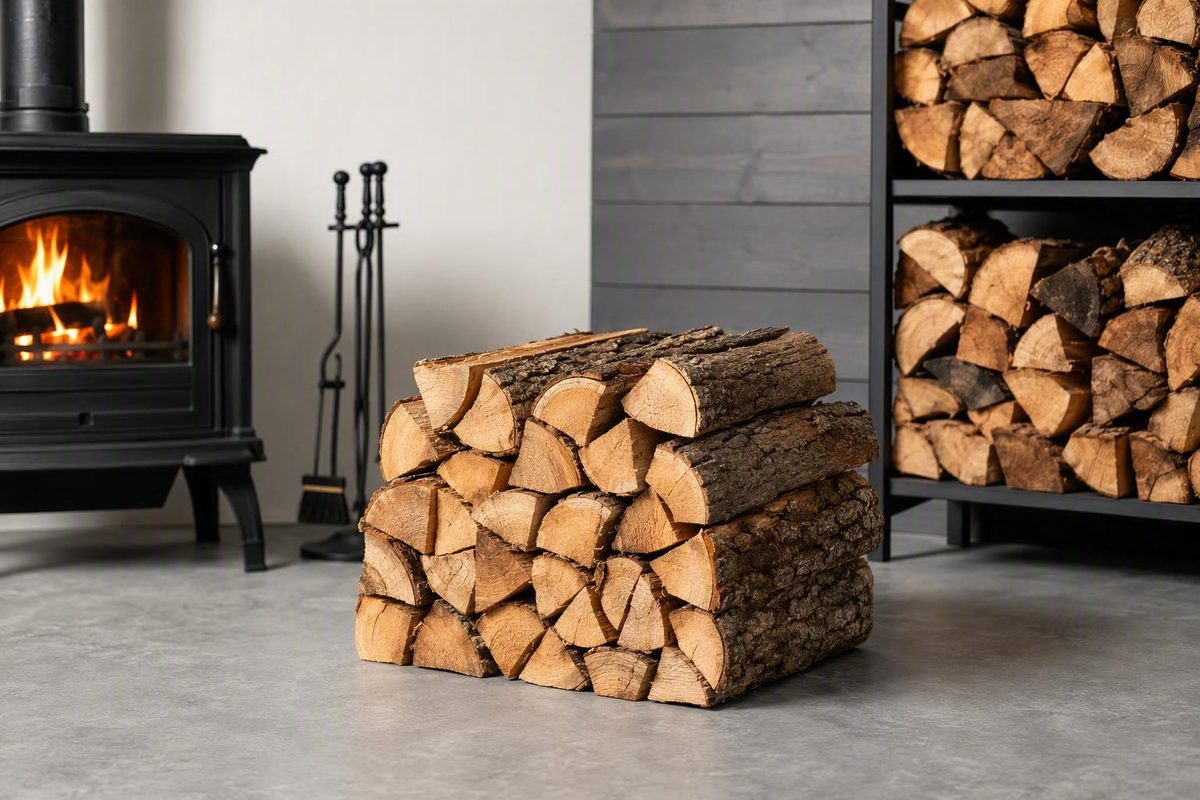
The short answer: 32 stacked cubic feet, with prices varying widely
If you are asking how much is 1/4 cord of firewood, there are two answers:
- Quantity: A quarter cord is 32 cubic feet of neatly stacked firewood. A full cord occupies 128 stacked cubic feet, so one-quarter is calculated as 128 ÷ 4 = 32 cubic feet. The measurement includes normal air spaces between the pieces; it is not 32 cubic feet of solid, gap-free wood. (HY-C)
- Price: There is no dependable national quarter-cord price. Your total depends on the region, seller, species, moisture condition, drying method, delivery distance, packaging, and whether stacking is included.
They are a time-sensitive regional snapshot, not a national average:
- Carolina Firewood Company lists an all-hardwood, kiln-dried quarter cord for $250, with driveway delivery starting at $49 plus tax in selected parts of Western North Carolina. (Carolina Firewood Company)
- Firewood Flex displays a $399 sale price, reduced from $470, for 32 stacked cubic feet of kiln-dried mixed hardwood. Included residential liftgate delivery is restricted to qualifying addresses in its stated Northeast local zone. (Firewood Flex)
- Stauffers displays hardwood labeled as a quarter cord for $119.99, but availability depends on store selection, the inclusions are not specified, and its statement that two skids equal one cord is unclear beside the quarter-cord label. (Stauffers)
- Hawkins sells seasoned firewood by the quarter cord, but the supplied listing does not show a fixed price before the buyer selects a delivery area and stacking option. Its average log length is stated as 16 inches.
These offers are not directly equivalent. They differ in geography, wood condition, delivery arrangements, packaging, and the amount of product information supplied.
Quarter cord at a glance
Item Practical answer Stacked volume 32 cubic feet Example dimensions 4 ft × 4 ft × 2 ft or 8 ft × 4 ft × 1 ft Observed advertised prices $119.99 to $399, under materially different terms Approximate weight 750–1,250 pounds, subject to species and moisture (HY-C) Approximate piece count No fixed count; one guide estimates roughly 140–165 splits (Cutting Edge Firewood) Best way to price it Request the all-in total for your address, including delivery, stacking, tax, packaging, and other fees Best way to verify it Stack the wood compactly and confirm that length × height × depth equals the promised volume
The reliable quantity answer is straightforward: a quarter cord is 32 stacked cubic feet. The price must be established locally through an address-specific quote.
What a true quarter cord looks like
A cord is a volume measurement, not a requirement that every stack have the same shape. A quarter cord can be long and shallow, short and deep, or divided among multiple rows. What matters is that the compactly stacked dimensions produce the required volume.
These are three valid configurations:
- 4 ft high × 4 ft long × 2 ft deep = 32 cu ft
- 4 ft high × 8 ft long × 1 ft deep = 32 cu ft
- 2 ft high × 8 ft long × 2 ft deep = 32 cu ft
The first two configurations are consistent with published quarter-cord examples, while the third is the same volume rearranged into different dimensions. (Cutting Edge Firewood)
Use this formula:
Stack length × stack height × stack depth = stacked cubic feet
All measurements must use the same unit. To calculate cubic feet, convert inches to feet before multiplying. For example, a 24-inch depth equals 2 feet, so an 8-foot-long, 2-foot-high, 2-foot-deep stack contains 32 cubic feet.
Depth is particularly important because it often reflects log length and the number of rows. A single row of 12-inch logs is approximately 1 foot deep. A row of 16-inch logs is approximately 1⅓ feet deep. If the wood is arranged in several rows, measure or calculate their combined depth.
This is why rack length and height alone cannot prove capacity. Carolina Firewood Company says its quarter cord will fill a rack 6 feet long by 4 feet high, but the listing does not state the rack depth or average log length. A 6-by-4-foot face would need an effective depth of approximately 1⅓ feet to contain 32 cubic feet, but that depth cannot be confirmed from the listed footprint alone.
Before ordering for a rack, measure:
- Usable interior length, rather than the rack’s overall outside width.
- Usable stacking height, allowing for a roof or cover.
- Usable depth, including the number of rows that will fit.
A rack marketed for a quarter cord is suitable by volume only if its usable interior dimensions hold approximately 32 stacked cubic feet. A shipping pallet, skid, bulk bag, or sack may have a different shape because its dimensions include packaging, bulges, or unstacked pieces.
Real quarter-cord price examples—and what each price includes
The following listings show why a quarter-cord price needs context. Prices, sales, delivery zones, and availability can change, so confirm the checkout total for your address.
| Seller example | Advertised price | Wood condition | Delivery terms | Geographic limitation | Important caveat |
|---|---|---|---|---|---|
| Carolina Firewood Company | $250 | All-hardwood, kiln-dried | Driveway delivery starts at $49 plus tax | Selected ZIP codes in Asheville and Western North Carolina | The starting subtotal is at least $299 before tax when the minimum delivery charge applies |
| Hawkins Landscape Supply | No fixed price visible in the supplied listing | Seasoned wood; average log length stated as 16 inches | Price depends on delivery area; stacking can be selected subject to the seller’s policy | Parts of Maryland, Washington, D.C., Northern Virginia, and Greater Richmond | A price cannot be established from the supplied page without making the relevant selections |
| Firewood Flex | $399 sale price, reduced from $470 | Kiln-dried, 16-inch mixed hardwood | Residential liftgate delivery included for qualifying local addresses | CT, NJ, New York metro, eastern Pennsylvania, and Delaware are named in the local zone | An address outside that zone may require an individual freight quote |
| Stauffers | $119.99 | Described only as hardwood | Not specified | Store-dependent | Dimensions, drying condition, delivery, tax, and other inclusions are unstated; the skid language is unclear |
The Carolina example demonstrates the difference between the product price and the delivered subtotal:
$250 wood + $49 minimum delivery = $299 before tax
That calculation applies only where the stated minimum delivery charge is available. A different ZIP code or delivery arrangement could produce a different total.
Hawkins uses location-based pricing rather than displaying one fixed amount in the supplied page text. The buyer must select a delivery area and decide whether stacking is required. Its listing therefore supports the conclusion that price and service depend on those choices, but it does not support quoting a universal Hawkins quarter-cord price.
Firewood Flex uses a more bundled model for qualifying local addresses. Its listed pallet contains the stated quarter-cord volume, and residential liftgate delivery is included when the destination falls inside the specified local zone. “Included delivery” should not be read as nationwide shipping or as hand-stacking at the final storage location.
Stauffers occupies the low end of this price snapshot, but its product page supplies far less detail. It does not state dimensions, moisture condition, log length, delivery terms, taxes, or other charges. Its separate “two skids equal one cord” statement cannot be used to verify the volume of the product labeled as a quarter cord.
These examples show regional retail variation. They do not establish what a quarter cord normally costs across the country.
Why a quarter cord may cost more than one-fourth of a full cord
Dividing a full-cord price by four provides a useful arithmetic benchmark, but it does not produce a dependable quarter-cord quote.
For example, one commercial guide reports a U.S. full-cord average of $296. Proportional division gives:
$296 ÷ 4 = $74
The $74 result is simply one-fourth of that guide’s stated full-cord figure. It is not an observed average retail price for quarter-cord orders.
Another seller guide cites a $200–$500 range for a full cord of mixed hardwood. Dividing the endpoints by four produces $50–$125, but that is also an inferred proportional range rather than evidence that retailers sell quarter cords at those prices. The same guide identifies region, species, drying method, delivery distance, and season as relevant price variables. (Best Burn Firewood)
Smaller orders can cost more per cubic foot because many transaction costs do not decline in proportion to the wood volume. A seller may still have to process the order, load the wood, package or palletize it, schedule a vehicle, drive to the address, unload it, and maintain a workable margin.
Common price variables include:
- Region and local supply
- Species or species mix
- Green, seasoned, or kiln-dried condition
- Air-seasoning versus kiln processing
- Seasonal demand
- Delivery distance
- Stacking service
- Pallet, sack, crate, or other packaging
- Log length or specialty splitting
To compare offers, first calculate the all-in price and then divide it by the guaranteed stacked volume:
All-in price ÷ 32 = price per stacked cubic foot
Using the Carolina starting subtotal as an example:
$299 ÷ 32 = approximately $9.34 per stacked cubic foot before tax
A hypothetical $320 delivered-and-stacked quote would equal:
$320 ÷ 32 = $10 per stacked cubic foot
The lower unit price is not automatically the better purchase. One seller may leave a bulk bag in the driveway, while another may carry and stack the wood. Compare what each total includes and assign value only to services you actually need.
Wood condition should also be compared separately. A seasoned offer and a kiln-dried offer are not interchangeable merely because both promise the same volume. Group comparable quotes—green with green, seasoned with seasoned, and kiln-dried with kiln-dried—before comparing price, species, log dimensions, and service.
The charges that can change the final delivered price
The largest number on a product page may be only the base price of the wood. Ask whether the quote includes:
- Delivery or freight
- Fuel or distance surcharges
- Stacking
- Sales tax
- Pallet, skid, sack, crate, or packaging
- Liftgate or unloading service
- Small-order or minimum-order charges
- Difficult-access or special-placement charges
Carolina separates its base wood price from a starting delivery charge. Firewood Flex bundles residential liftgate delivery into its displayed price only for qualifying addresses within its stated local zone. Hawkins varies pricing by delivery area and lets customers choose whether stacking is required.
These models are not directly comparable until every charge is included. Use this worksheet:
Base wood price + delivery or freight + stacking + tax + packaging, pallet, liftgate, or other stated charges = all-in cost
Clarify what delivery means. “Driveway delivery” can describe a sack placed where the seller’s mechanical equipment can reach. “Liftgate delivery” can mean a pallet lowered at the curb or driveway. Neither description necessarily includes carrying individual splits to a backyard rack or stacking them.
A concise seller-call script can prevent misunderstandings:
“What is the total delivered-and-stacked price for my address, including tax and every fee? Is the quantity guaranteed as a quarter cord by stacked volume? What are the average log length, species, and wood condition? How will it arrive, where will it be unloaded, and are there access, pallet, bag, or stacking charges?”
Give the seller your ZIP code and describe any steep grades, narrow driveways, gates, soft ground, overhead obstructions, limited turning space, or long distance between the unloading point and the rack. Ask for the final terms in writing rather than relying on a search-result price or an incomplete product-page preview.
How many logs and how much weight to expect
Neither piece count nor weight defines a quarter cord. Both are approximate planning figures; stacked volume is the quantity standard.
The supplied estimates vary substantially:
- One commercial guide estimates roughly 140–165 split pieces.
- HY-C estimates approximately 150–200 logs and 750–1,250 pounds.
- Carolina estimates approximately 250–300 pieces for its specific quarter-cord product.
- Firewood Flex describes its particular pallet as weighing approximately 1,000 pounds.
These figures should not be combined into a universal specification. They come from different guides and products, and the sellers do not necessarily define “piece” or “log” in the same way.
A quarter cord containing larger splits may have far fewer pieces than the same volume cut into small fireplace splits. The count can also change with:
- Log length
- Split thickness
- Species and trunk diameter
- The amount of bark or small material
- Whether rounds are mixed with split wood
- The seller’s counting method
- Stacking density
Weight also varies with species and moisture. The Firewood Flex pallet estimate falls within HY-C’s broader planning range, but that does not make 1,000 pounds a universal quarter-cord weight.
Use these estimates for logistics only. Consider whether the unloading area can accept a heavy pallet or bag, whether you have adequate help and equipment to move the wood, and whether your storage rack can hold the full volume without unstable overstacking.
After delivery, verify the quantity by stacking and measuring it. A heavy load can still be short on volume, while a lighter load can still contain the promised volume if the wood is less dense or drier. Piece count creates the same problem: many small splits do not necessarily occupy more space than fewer large ones.
Transport and storage planning before the delivery arrives
A commercial firewood guide associates approximately a quarter cord with a small pickup load, but that is only a rough visual comparison. It does not establish that every small pickup has enough payload capacity for the wood. (Better Burn Firewood)
Before hauling the wood yourself, consult the specifications for the actual vehicle. Available payload must account for the driver, passengers, tools, bed accessories, racks, hitch equipment, and any other cargo—not only the firewood.
Do not choose a vehicle solely because the wood appears likely to fit in the bed. Also consider:
- The vehicle’s available payload
- Load distribution
- Suitable cargo containment and securement
- The condition and specified loading of the tires
- Trailer limits, if a trailer is used
- Visibility
- Safe loading and unloading
If capacity is uncertain, arrange seller delivery or divide the wood into smaller loads rather than assuming that a visual fit makes the load suitable.
For storage, reserve enough usable space for the promised stacked volume.
Remember that final stack dimensions may not match shipping dimensions. A pallet can be taller and narrower than the finished stack. A flexible bulk sack can bulge, and loose wood occupies space differently from compactly stacked wood.
Before delivery, confirm:
- The truck can reach the intended unloading point.
- The seller’s liftgate, forklift, boom, or mechanical arm has adequate access.
- The ground can accommodate the delivery method.
- The rack has sufficient depth as well as length and height.
- You know whether a pallet, skid, sack, or bulk bag will remain on site.
- You have a plan to move the wood if service ends at the curb or driveway.
No rack or vehicle can be declared suitable without its dimensions and load specifications. Measure first and evaluate both volume and weight.
How to verify a quarter-cord delivery and avoid ambiguous labels
Before paying, ask the seller to put the guaranteed stacked cubic footage and average log length on the quote or order confirmation. Those details are more useful than informal descriptions such as “pickup load,” “rick,” “pallet,” or “big bag.”
A loose pile cannot be verified reliably as a fraction of a cord merely by looking at it. Loose pieces settle unpredictably, and the apparent outer dimensions contain large, irregular voids. The same limitation applies to a truckload, sack, or pallet unless the seller provides complete volumetric specifications or a written stacked-volume guarantee.
To check a delivery:
- Stack the pieces compactly. Keep them generally parallel and touching without deliberately creating large voids.
- Measure the total length in feet.
- Measure the average height in feet. If the top is uneven, do not use only the highest point.
- Measure the total depth in feet. Include the combined depth of multiple rows.
- Multiply length × height × depth.
- Compare the result with the quantity promised on the order.
Normal air spaces between irregular pieces are part of stacked cord volume. The goal is not a gap-free block of solid timber. Unusually loose, crossed, or deliberately irregular stacking can, however, exaggerate the apparent dimensions.
Be cautious with face cord and rick. These terms can describe the face of a stack while leaving its depth dependent on log length. A stack 8 feet long and 4 feet high with 12-inch logs is 1 foot deep and therefore occupies 32 cubic feet. With longer logs, the same face occupies more volume. A firewood buying guide specifically notes that a face cord reaches the quarter-cord volume only when its logs are 12 inches long. (Best Burn Firewood)
Use this checklist before ordering:
- [ ] All-in price for your address
- [ ] Guaranteed stacked cubic footage
- [ ] Expected finished-stack dimensions
- [ ] Average log length
- [ ] Species or species mix
- [ ] Green, seasoned, or kiln-dried condition
- [ ] Delivery fee and service boundary
- [ ] Exact unloading location
- [ ] Stacking charge and restrictions
- [ ] Tax
- [ ] Freight, fuel, small-order, or liftgate charges
- [ ] Pallet, skid, bag, or packaging terms
- [ ] A plan for stacking and measuring after delivery
A true quarter cord is a defined stacked volume, but its price must be established locally. Request a written all-in quote, compare wood of similar condition, confirm the promised volume and log length, and measure the finished stack rather than trusting a piece count or informal load description.
Is a quarter cord the same as a face cord or rick?
Not necessarily. A quarter cord is fixed by stacked volume, while “face cord” and “rick” can describe stacks whose depth changes with log length.
An 8-foot-long, 4-foot-high row made with 12-inch logs has the required quarter-cord volume. The same face made with longer logs contains more wood. Ask for all three dimensions instead of assuming the terms are synonyms.
What dimensions equal one-quarter cord of firewood?
Any compact stack whose dimensions multiply to 32 cubic feet qualifies. Common examples include:
- 4 ft × 4 ft × 2 ft
- 8 ft × 4 ft × 1 ft
- 8 ft × 2 ft × 2 ft
Use the same unit for every measurement and convert inches to feet before calculating cubic feet.
How many pieces of wood are in a quarter cord?
There is no fixed count. Published estimates vary because split size, log length, species, stacking density, and counting methods differ.
Treat the count only as a handling estimate. Confirm the purchase by measuring the compactly stacked volume.
Can a quarter cord fit in a pickup truck?
It may fit in some pickups by volume, but that does not establish that a particular truck can carry it safely. Check the actual vehicle’s available payload after accounting for passengers, tools, racks, and other cargo.
Also consider load distribution, containment, securement, and unloading. If the specifications are unclear or the load is close to the vehicle’s limit, use delivery or make smaller trips.
How do I compare quarter-cord prices from different sellers?
First confirm that every offer guarantees the same stacked volume. Then compare similar wood conditions, species, log lengths, and split sizes.
For each quote, add the wood price, delivery or freight, stacking, tax, packaging, and other charges. Divide the all-in total by the guaranteed cubic footage to obtain a comparable cost per stacked cubic foot.
Finally, compare service terms. A higher advertised price may include delivery or unloading, while a lower price may exclude both. The useful figure is the complete cost for the required quantity and wood condition at your address.