
What You Should Pay for a Half Cord—and How Much Wood You Should Receive
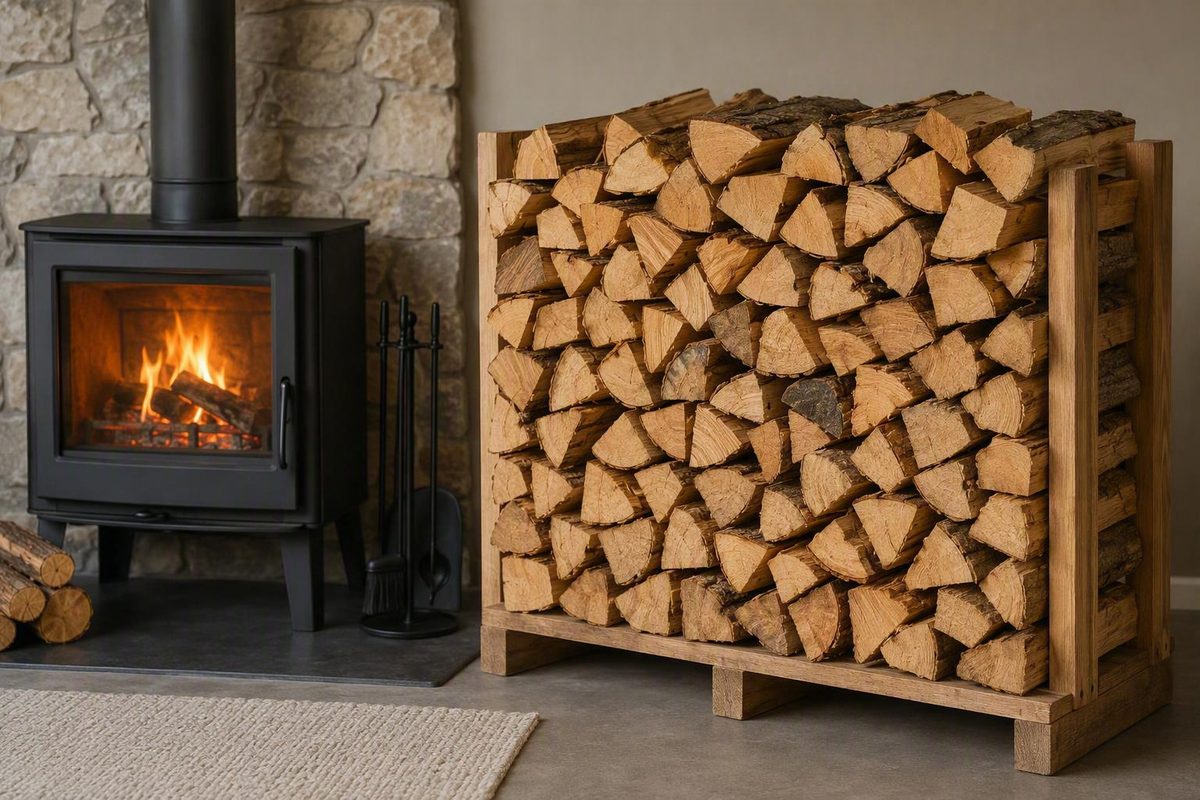
The 64-cubic-foot figure describes the space occupied by compactly stacked firewood, including the normal gaps between irregular pieces.
The short answer: half-cord price and quantity
A half cord of firewood contains 64 cubic feet when compactly stacked. For budgeting, Angi reports a broad average of $100–$300 per half cord, but that is a general estimate—not a guaranteed local price or an all-inclusive delivered total. Wood type, condition, location, season, delivery, and stacking can all change the final bill (Angi’s 2026 firewood cost guide).
Half-cord answer at a glance
- Quantity: 64 stacked cubic feet
- Broad cited price range: Approximately $100–$300
- Simple example shape: 4 ft × 4 ft × 4 ft
- Before ordering: Ask whether delivery, unloading, placement, and stacking are included
- Best verification method: Compactly stack the wood and measure it
A cube measuring 4 feet long, 4 feet high, and 4 feet deep is an easy way to picture the quantity:
4 ft × 4 ft × 4 ft = 64 cubic feet
That is only one valid arrangement. A long, shallow stack can contain the same volume as a shorter, deeper stack. The controlling measurement is the total volume of the compact stack, not its shape.
The advertised price may cover only the wood. Delivery, unloading, placement near a rack or shed, and stacking can be separate services. Before comparing quotes, determine exactly what each price includes. A lower headline price can become the more expensive option after service charges are added.
What does one-half cord of firewood look like?
Using the conventional cord measurement applied by the guides in this article, a full cord occupies 128 cubic feet when the pieces are ranked and compactly stacked. Half of that volume is:
128 ÷ 2 = 64 cubic feet
A half cord therefore does not require one fixed set of dimensions. The following layouts all provide approximately the same compactly stacked quantity:
| Example layout | Calculation | Stacked volume |
|---|---|---|
| Compact cube | 4 ft × 4 ft × 4 ft | 64 cu. ft. |
| Long, two-foot-deep stack | 8 ft × 4 ft × 2 ft | 64 cu. ft. |
| One row of 16-inch pieces | 12 ft × 4 ft × 1.33 ft | About 64 cu. ft. |
The final shape depends on the available storage area and the length of the pieces. A commercial firewood guide, for example, uses a 4-foot-high by 12-foot-long by 16-inch-deep stack as one half-cord layout (Best Burn Firewood’s cord-size guide).
To check a rectangular stack, use:
Length × depth × height = stacked cubic feet
Measure all three dimensions in feet. If one is stated in inches, divide it by 12 first. For a single row of nominal 16-inch pieces:
- 16 inches ÷ 12 = approximately 1.33 feet
- 12 ft × 1.33 ft × 4 ft = approximately 64 cubic feet
To convert the measured stack directly into cords, use:
Length × depth × height ÷ 128 = number of cords
A result of approximately 0.5 indicates a measured half cord. This calculation follows the 128-cubic-foot cord basis used by cord-measurement tools (Omni Calculator’s cord-of-wood formula).
The 64-cubic-foot figure describes the space occupied by compactly stacked firewood, including the normal gaps between irregular pieces. It does not mean the order contains 64 cubic feet of solid, gap-free wood.
When planning storage, allow some practical margin beyond the calculated dimensions. Split pieces will not form perfectly straight walls, and you may need room to carry, arrange, or restack them. The volume calculation nevertheless provides the proper starting point for determining whether a rack, shed bay, or other storage area is large enough.
What current price examples reveal about the market
The broad $100–$300 estimate is useful for initial budgeting, but individual listings can fall below, within, or far above that range. That does not automatically make one listing representative and another unreasonable. The products may differ in species, moisture condition, processing, packaging, delivery method, and service area.
The examples below are individual seller listings—not national benchmarks. Prices and stated service terms were checked on August 19, 2026 and may change.
| Seller and listed product | Half-cord price | Wood description | Delivery and stacking details |
|---|---|---|---|
| Golden Pinestraw half cord | $120 | Described as dry, seasoned hardwood | Delivery is available and stacking costs extra, but the page does not establish whether delivery is included. Availability is unclear because the page displays conflicting purchase-status information. |
| Braglio Farms half cord | $200 | Semi-seasoned mixed hardwood, mostly oak, cut to 16 inches | Pickup is available. Stacking costs an additional $100–$150; delivery inclusion is not clearly established. |
| Indian Head Firewood half cord | $520 | Texas oak, with Live Oak and Post Oak options listed | Destination-dependent delivery is extra. Half-cord white-glove delivery starts at $100 and includes stacking. |
| Firewood Flex half cord | $749 | Palletized kiln-dried hardwood | Delivery is stated as included within the seller’s specified Northeast service area. This is a geographically limited premium product. |
These listings span $120 to $749, but the spread should not be interpreted as the normal range in every community. The products and services are not equivalent:
- The $120 listing describes seasoned hardwood but leaves delivery inclusion and availability unclear.
- The $200 listing describes semi-seasoned mixed hardwood and reaches $300–$350 if the stated stacking service is added, before any separately charged delivery.
- The $520 listing is for named oak varieties, with delivery priced according to the destination.
- The $749 listing combines kiln drying, palletization, and delivery within a limited service area.
This is why searches for the price of a half cord can produce seemingly contradictory answers. One seller may quote bulk wood for pickup, while another is selling a processed product delivered on a pallet. The stated volume may be the same, but the wood condition and included services are not.
Use retailer listings to understand possible product and regional variation—not to decide what a business in your ZIP code should charge. The relevant comparison is among current local quotes for comparable wood and equivalent services.
The factors that change half-cord firewood prices
A half cord is a defined volume under the cord-measurement basis used here, but it is not a standardized product. Several variables can move the price above or below a broad average.
Location and local supply. Firewood is bulky, so transportation distance matters. Species availability also varies by region. Only current quotes from businesses serving your location can establish your local price.
Hardwood versus softwood. Angi lists broad full-cord category ranges of $250–$500 for hardwood and $150–$300 for softwood. These figures show that wood type can influence price, but they should not simply be divided in half to manufacture a local half-cord quote. The guide also estimates that seasoned wood can cost 30%–50% more than green wood and that winter prices may be 20%–30% higher because of seasonal demand. These are general estimates, not universal premiums or surcharges (Angi’s firewood cost factors).
Species. “Hardwood” is a category rather than a precise product description. A mixed load and a single-species load may be priced differently. Ask whether the quote covers one named species, a hardwood mix, a softwood mix, or a combination.
Moisture condition and drying method. Common product descriptions include:
These descriptions are not interchangeable, and sellers may apply them differently. Ask what condition is being offered, how the wood was dried, and whether the seller provides a measured moisture range. Do not assume that “seasoned” has exactly the same meaning in every listing.
Processing. Processed and packaged wood is not directly comparable with a loosely dumped bulk load.
Delivery distance. A seller may charge by load, mileage, delivery zone, or destination ZIP code. An inexpensive supplier located farther away can cost more overall than a nearby business after transportation is included.
Season and availability. Buying earlier may provide more choices, but no seasonal discount or surcharge applies universally.
Order size. A half cord does not have to cost exactly half the local full-cord price. A smaller order can therefore carry a higher price per cubic foot.
When comparing quotes, do not treat words such as “premium,” “hotter,” “longer-burning,” or “cleaner-burning” as substitutes for specifications. Compare the species, dimensions, moisture description, processing, and included services instead.
Wood price versus delivered-and-stacked price
A firewood quote can contain four separate components:
- Wood: The price of the 64-cubic-foot quantity.
- Delivery: Transportation to the property.
- Unloading or placement: Dumping at the driveway or moving the load to a designated location.
- Stacking: Arranging the pieces into a compact stack.
Some sellers combine these services, while others itemize them. “Delivery included” does not necessarily mean “stacking included,” and driveway delivery is not the same service as carrying wood to a backyard rack.
The Angi guide cited above estimates delivery at $25–$75 per load or about $2 per mile, with stacking at $25–$80 per load. These are broad budgeting estimates, not fixed fees. Documented seller charges can be higher: Braglio Farms lists $100–$150 for stacking, while Indian Head Firewood states that its half-cord white-glove delivery starts at $100 and includes stacking.
Illustrative arithmetic—not a market quote:
- Half cord of wood: $200
- Delivery: $50
- Stacking: $50
- Final total: $300
This example shows how an advertised $200 product can become a $300 purchase. It does not imply that $50 is the applicable delivery or stacking fee in your area.
Use this worksheet when requesting quotes:
| Cost component | Seller’s amount |
|---|---|
| Base price for a 64-cu.-ft. half cord | $_____ |
| Delivery charge or mileage | $_____ |
| Unloading or placement charge | $_____ |
| Stacking charge | $_____ |
| Taxes, if applicable | $_____ |
| Final delivered-and-stacked total | $_____ |
You can also divide the wood-only price by 64 to calculate the price per stacked cubic foot:
Wood-only price ÷ 64 = price per stacked cubic foot
For example:
- $200 ÷ 64 = $3.125 per stacked cubic foot
- $320 ÷ 64 = $5 per stacked cubic foot
This comparison is useful only when the products are reasonably equivalent. Account for species or mix, moisture condition, piece processing, packaging, and service inclusions.
If one quote includes delivery and another does not, separate the wood price from the service charges—or compare final totals after adding equivalent services. Otherwise, a more complete quote can appear artificially expensive.
Half cord versus face cord, rick, and other firewood terms
A half cord is 64 stacked cubic feet under the cord-measurement basis used in this guide. A face cord, rick, rank, load, or similar regional term does not automatically represent that amount.
A face cord is commonly described as a stack 4 feet high and 8 feet long, with a depth equal to the length of one piece of firewood. Because piece length can vary, so can the total volume.
For 16-inch pieces, the dimensions are:
- 8 feet long
- 4 feet high
- 16 inches, or approximately 1.33 feet, deep
The volume is:
8 × 4 × 1.33 = approximately 42.66 cubic feet
That is approximately one-third of a 128-cubic-foot full cord—not one-half. A supplier’s dimensions guide gives the same approximate volume for an 8-foot by 4-foot face cord made with 16-inch pieces (Boston Firewood’s cord-dimensions explanation).
| Quantity | Stacked cubic feet | Example dimensions | Share of full cord |
|---|---|---|---|
| Full cord | 128 | 8 ft × 4 ft × 4 ft | 1 |
| Half cord | 64 | 4 ft × 4 ft × 4 ft | 1/2 |
| Face cord with 16-inch pieces | About 42.66 | 8 ft × 4 ft × 1.33 ft | About 1/3 |
The difficulty is terminology rather than arithmetic. In some markets, “rick” is another name for a face cord. “Bush cord” may refer to a full cord in some Canadian markets.
Do not convert an informal label into “half cord” unless the seller provides dimensions totaling 64 cubic feet. If a quote says “one rick” or “one load,” ask:
- How long will the compact stack be?
- How high will it be?
- How deep will it be?
- How long are the individual pieces?
- How many stacked cubic feet are included?
Request the answer in writing. “One face cord of 16-inch pieces” is clearer than “one load,” but “64 stacked cubic feet” is clearest when you want a measured half cord.
How to verify that you received a true half cord
A loose dumped pile is difficult to evaluate by sight. Its irregular shape and large spaces between pieces can make it appear more substantial than the same wood arranged compactly. Treat the pile as a delivery format, not the final measurement basis.
To estimate the delivered quantity:
- Arrange the pieces compactly. Build a stable stack with normal, reasonably small gaps.
- Measure the length. Record the full horizontal span.
- Measure the height. Use a reasonable average rather than the tallest protruding pieces.
- Measure the depth. If the stack has several rows, include the combined depth.
- Multiply the three measurements.
For the common cube arrangement:
4 ft × 4 ft × 4 ft = 64 cubic feet
To express any measured stack in cords:
Length × depth × height ÷ 128 = cords
For example:
- 8 × 2 × 4 ÷ 128 = 0.5 cord
- 12 × 1.33 × 4 ÷ 128 ≈ 0.5 cord
- 8 × 1.33 × 4 ÷ 128 ≈ 0.333 cord
These examples apply the standard volume formula; a result near 0.5 represents an estimated half cord when reasonable average dimensions are used (Omni Calculator’s measurement method).
Calculate each section’s cubic footage, add the results, and then divide the total by 128.
Avoid using weight or piece count as the deciding test. Weight changes with species and moisture condition. Piece count changes with log length, split width, shape, and the number of small pieces.
Piece-count estimates can still provide rough planning context. Best Burn Firewood estimates approximately 280–300 pieces per half cord for 16-inch logs split to its standard residential size. Fairwood gives an estimate of 300–400 pieces under different log-length assumptions (Fairwood’s firewood-size estimates). The difference illustrates why piece count is not a dependable purchase-verification method.
Do not treat the appearance of a pickup bed as proof either. Bed length, side height, racks, loading density, and whether the pieces are loose or stacked all affect capacity. A “truckload” is only a rough description unless the seller also specifies the resulting compact stacked volume.
If the seller stacks the order, measure it before accepting the quantity as confirmed. If the load is dumped for you to arrange, retain the written quote and document the final measurements. Photographs showing the compact stack and a visible tape measure can help preserve a record if the quantity is disputed.
A practical checklist for comparing half-cord quotes
Use this checklist when calling, emailing, or messaging sellers:
- [ ] Is this a half cord containing 64 cubic feet after compact stacking?
- [ ] What stack dimensions should that quantity produce?
- [ ] Is the wood hardwood, softwood, or a mix?
- [ ] Which species are included?
- [ ] How long are the pieces?
- [ ] What is the approximate split size?
- [ ] Is the wood green, semi-seasoned, seasoned, air-dried, or kiln-dried?
- [ ] Is a measured moisture range available?
- [ ] Is the advertised price for the wood alone?
- [ ] Does delivery mean curbside or driveway dumping only?
- [ ] Is unloading or placement in a designated area included?
- [ ] Is stacking included?
- [ ] If stacking costs extra, what is the exact fee?
- [ ] Is delivery charged by load, mileage, zone, or ZIP code?
- [ ] Is there a minimum order?
- [ ] Are there seasonal surcharges?
- [ ] Is the product currently available?
- [ ] Is pickup available, and does it have a different price?
- [ ] Are taxes or other fees added?
- [ ] What is the final delivered-and-stacked total?
Ask the seller to put the essential terms in writing:
- Quantity in stacked cubic feet
- Expected stack dimensions
- Species or wood mix
- Piece length and approximate split size
- Wood condition or drying description
- Delivery and placement terms
- Stacking terms
- Taxes and surcharges
- Final total
Compare the final delivered-and-stacked cost, not only the headline price. A $180 quote with $120 in additional services has the same final cost as a $300 quote that includes those services. The second may be easier to understand and budget.
Exact local pricing requires current quotes from sellers serving your area. The cited $100–$300 range and the individual listings are reference points, not substitutes for a ZIP-code-specific quote.
The central points are straightforward: one-half cord means 64 cubic feet after compact stacking, while the final price depends on the wood and the services attached to it. Confirm the species and condition, obtain the quantity and dimensions in writing, and measure the compact stack after delivery. Do not judge the order solely by truck size, dumped-pile appearance, weight, or piece count.
How many cubic feet are in a half cord of firewood?
A half cord contains 64 cubic feet of compactly stacked firewood, based on half of a 128-cubic-foot full cord. A commercial dimensions guide lists both the 128-cubic-foot full cord and a 64-cubic-foot half cord (Best Burn Firewood’s size comparison).
The stack can have any practical dimensions that multiply to 64. Examples include 4 feet by 4 feet by 4 feet and 8 feet by 4 feet by 2 feet. The measured volume includes normal gaps between pieces.
Is a face cord the same as a half cord?
No—not automatically. A face cord is commonly 4 feet high and 8 feet long, but its depth is determined by the length of the pieces.
With 16-inch pieces, that stack occupies approximately 42.66 cubic feet, or about one-third of a 128-cubic-foot cord. A half cord occupies 64 cubic feet, so the two quantities are not equal (Boston Firewood’s face-cord dimensions).
Always request all three stack dimensions rather than relying on “face cord,” “rick,” or another informal label.
How many logs are in a half cord?
There is no exact number. Best Burn Firewood estimates approximately 280–300 pieces for standard residential 16-inch splits, while Fairwood estimates 300–400 pieces using different assumptions. Piece length, split width, shape, and species all affect the count.
Use the number of pieces only for rough handling or storage planning. Verify the purchase by compact stacked volume.
How much does a half cord of firewood weigh?
There is no fixed weight because species and moisture condition vary. Commercial guides commonly estimate approximately 1,500–2,500 pounds for a half cord, but that range should not be used to verify a purchase. HY-C presents that estimate while also noting that species and moisture affect weight (HY-C’s cord and face-cord guide).
A generic weight range is also unsuitable for calculating whether an elevated storage area can carry a particular order. Use product-specific information and appropriate qualified guidance for load planning. For purchase verification, measure the compact stacked volume.
Does the price of a half cord usually include delivery and stacking?
Not necessarily. Some sellers include delivery within a defined area, some charge according to distance or destination, and others offer stacking separately. A “white-glove” charge may combine delivery, placement, and stacking, but the exact service depends on the seller.
Ask for an itemized quote covering the wood, delivery, unloading or placement, stacking, taxes, and final total. Unless a service is explicitly confirmed in writing, do not assume it is included.