
Wood Stove With Blower: Better Heat Circulation, Not a Bigger Stove
Learn what a wood-stove blower does, when it helps, how to verify an approved kit, and what to check if the fan will not start.
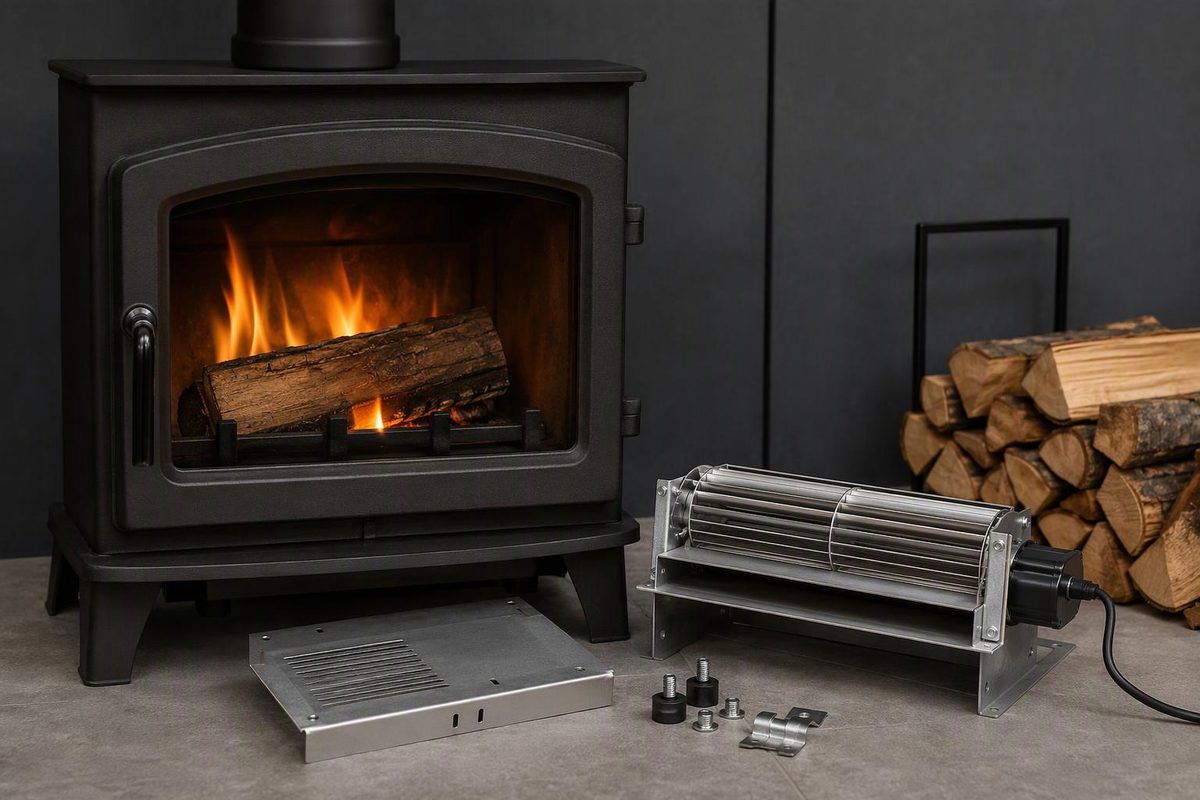
A wood stove with a blower circulates room air around the stove’s hot exterior and returns that warmed air to the room. This room-air blower does not feed the fire or pull smoke through the chimney. Its main benefit is heat distribution—not turning an undersized stove into a larger heater. Regency’s blower explainer describes that separation between room-air circulation and combustion.
Choose the stove by its approved installation, chimney requirements and heat output first. Then decide whether a blower would make the room more comfortable.
When a blower is worth considering
A blower is most useful when the stove produces plenty of heat nearby but warmth spreads unevenly across the room. It moves air over hot surfaces rather than relying only on radiation and natural air movement.
It is less convincing as a solution when the entire space stays cold, or when the rooms you want to heat are separated by closed doors. Treat it as a room-air circulation aid, not a promise of whole-house heating.
Before paying extra, ask:
- Is the stove appropriately sized? Compare usable heat output with the building’s heating needs, not just an advertised square-foot range.
- Can air reach the intended space? Consider the stove’s location and the paths between rooms.
- Will you tolerate the sound? Ask to hear the blower at both low and high speed, preferably on a burning display stove.
- Can you clean and replace it? Check access to the motor, fan wheel and controls.
A blower’s airflow rating in CFM—cubic feet per minute—is not a BTU/h heating rating. For stove-output comparisons, see how to compare wood-stove efficiency and heat ratings.
Verify the stove and blower as a matched setup
“Blower compatible” does not necessarily mean “blower included.” For example, the Drolet Escape 1800 DB03102 specification page lists its blower as optional as of October 2026.
Before ordering a stove or retrofit kit, confirm these details with the manufacturer’s documentation and your dealer:
| Check | What you need to confirm |
|---|---|
| Stove identification | Exact model, plus revision or serial-number range where applicable |
| Approved blower | Part number specified for that appliance |
| Included components | Motor, housing, mounting hardware, speed control and any temperature switch |
| Air-routing components | Any required deflector, bracket or airmate |
| Installed fit | Applicable clearances, hearth protection, chimney arrangement and safe cord route |
Do not select a “universal” fan solely because its dimensions fit. The Drolet blower installation sheet expressly limits the assembly to stoves whose certification label permits that use. It also prohibits routing the cord over sharp edges or hot surfaces.
As a specification example—not a recommendation for every stove—Drolet’s AC02050 blower is listed in October 2026 at 100 CFM, with variable-speed control, 120V AC operation and an eight-foot cord. A compatible AC02055 thermodisc is identified separately. Check whether automatic temperature control is included in the kit you are buying.
The blower does not replace installation planning. Use the exact appliance manual and local permit requirements; our woodburner installation guide covers the broader checks.
Operation and power outages
Let the stove reach its specified operating condition before running the blower. Automatic mode commonly uses a temperature switch to start the fan when the stove is warm and stop it as the stove cools. Manual mode may bypass that switch, but it does not cancel the manufacturer’s operating instructions.
For example, the Regency F2450-2 manual’s “Fan Operation” section says not to turn on the fan until the fire has burned for at least 20 minutes and the unit is hot enough. That section also specifies shutting the fan off for 20 minutes after each fuel loading. Follow your model’s complete firing instructions; this is not a universal timer.
A conventional natural-draft wood stove with an optional room-air blower can generally continue heating during a power outage, although the electric fan stops. Regency confirms radiant heating without electricity for its wood stoves and inserts. Verify your own manual rather than extending that advice to a ducted wood furnace or an appliance with electrically dependent combustion or venting.
If the blower will not start
Start with checks that do not expose wiring or require reaching behind a hot stove:
- Check the controls. Confirm the speed control is not off and identify whether automatic or manual mode is selected.
- Check the warm-up requirement. A silent fan on a cold stove may be normal.
- When the stove is cold, inspect the accessible cord and plug. Stop using the blower if either is damaged.
- Let the stove cool and disconnect power before cleaning or removing the assembly. Follow the manual’s maintenance instructions. The F2450-2 manual’s annual maintenance table calls for disconnecting power, removing and cleaning the blower, and specifically says not to lubricate it.
If it remains silent when it should run, have the dealer or service technician check the motor and controls. If it hums without turning or develops persistent rattling, switch the blower off and arrange service rather than leaving it running. Do not jumper the temperature switch or alter wiring to force it on.