
Identify Your Fireplace Controls, Then Start and Shut It Down Safely
Match operation to the model: waiting periods, pilot-hold times, approved ignition methods, power-outage behavior and shutdown procedures all vary.
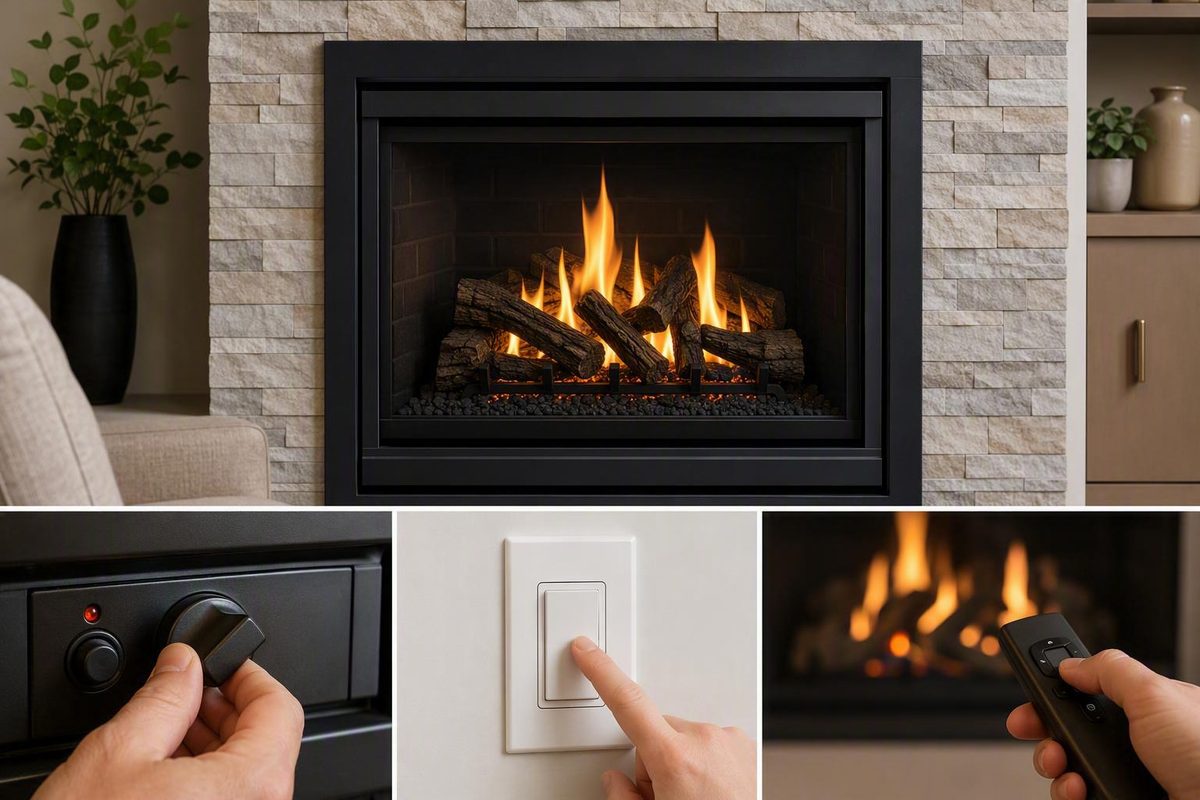
There is no single startup sequence for every gas fireplace. Some use a standing pilot and an Off–Pilot–On knob. Others use electronic ignition, a wall switch, a remote, a control panel, or a keyed gas valve. Waiting periods, pilot-hold times, approved ignition methods, power-outage behavior, and shutdown procedures vary by model.
The safe way to learn how to work a gas fireplace is to identify its brand, model, listed fuel, ignition system, and approved controls first. Then follow the corresponding owner’s manual. This guide explains the common control types and the limited checks an occupant can make without working on gas, burner, electrical, sealed-glass, or vent components.
Before You Touch the Controls: Gas-Odor and Safety Checks
If you smell gas, stop trying to operate the fireplace. Do not relight the pilot, test the igniter again, or continue troubleshooting. Leave the area and contact the gas utility, fire department, or emergency services from a safe location.
Do not remain beside the appliance trying to identify the source or decide whether the odor is serious enough to act. Gas-fireplace operating guidance treats gas odor as a reason to leave and call for assistance rather than continue testing the appliance (Fire Pit Surplus’s gas-fireplace operating guidance).
If there is no gas odor, complete these checks before routine use:
- Confirm that household carbon-monoxide alarms are working. Test and replace them according to the alarm manufacturer’s instructions.
- Clear the surrounding area. Remove paper, clothing, decorations, toys, pet bedding, furniture, and other combustible or heat-sensitive objects that do not meet the clearances specified in the fireplace manual.
- Check accessible vent openings. Look only for obvious obstruction, such as leaves, snow, nesting material, or stored objects. Do not remove vent parts or reach into inaccessible passages.
- Inspect visible components. Do not operate the fireplace if accessible glass is cracked, displaced, or visibly damaged, or if a user-accessible part is loose when it should be secured.
- Look for soot or an abnormal flame pattern. Soot and persistent operating problems require professional evaluation rather than adjustment of the logs or burner.
- Take recurring shutdowns seriously. First rule out a selected timer or thermostat mode. If shutdowns remain unexplained, leave the fireplace off and arrange service.
- Respond to a carbon-monoxide alarm. Follow the alarm’s instructions and applicable emergency guidance, stop using the fireplace, and do not restart it until the cause has been evaluated. General fireplace-safety guidance recommends working carbon-monoxide detection, clear space around the appliance, and professional inspection (Yahoo’s syndicated gas-fireplace safety guide).
Do not automatically open or close a chimney damper merely because the appliance burns gas. Some gas log installations may require a specified damper position. A direct-vent fireplace may have no user-operated chimney damper, while B-vent and vent-free appliances use different combustion-air and exhaust arrangements.
The governing rule is simple: the instructions attached to or supplied with the appliance override generic directions. If the manual conflicts with this guide, follow the manual. If you cannot identify the appliance or determine its required ventilation setting, leave it off until the manufacturer, property owner, gas utility, or a qualified fireplace technician can help.
Identify the Fireplace and Find Its Correct Instructions
Before choosing a startup procedure, record the fireplace’s:
- Brand or manufacturer
- Model number
- Serial number, if visible
- Listed fuel—natural gas or propane
- Remote, receiver, or control model number, if applicable
Look only in areas intended for user access. The identifying information may be near an approved control compartment, behind user-removable decorative trim, in documents retained with the home, or somewhere else specified by the manufacturer. There is no universal rating-plate location.
If the original manual is missing, search the manufacturer’s website using the exact model number or request the manual from the manufacturer. Manufacturers commonly make model guidance available online, but a manual for a fireplace that merely looks similar is not an adequate substitute (Napoleon’s operating guide).
Use this decision tree to identify the likely control system:
-
Do you see a knob labeled Off, Pilot, and On, usually near a push-button igniter? This suggests a standing-pilot system. Confirm the manual, then use the standing-pilot section below.
-
Do you have a wall switch, remote, control panel, or ignition button? The fireplace may have electronic ignition or a low-voltage control system. The visible switch alone does not identify the internal ignition method. Continue to the wall-switch and remote section.
-
Is there a key slot in the wall, hearth, or floor? This indicates a keyed gas valve. It does not prove that the burner is approved for manual lighter ignition. Verify the exact manual before releasing gas.
-
Are both a pilot knob and a wall switch present? The knob may establish a standing pilot while the switch controls the main burner. Follow the manual for the required knob position before using the switch.
-
Is there a separate receiver box? It may be part of a remote-control system. Use only the receiver position identified by the fireplace and remote manuals.
Control compartments are often near the lower part of the fireplace behind decorative access trim or a removable screen, but locations vary. Open only an area the manual identifies as user-accessible. Do not treat a secured firebox panel as an access door.
It also helps to distinguish the two types of flame:
- The pilot flame is the small flame used in the ignition and flame-sensing process.
- The main burner flames form the larger visible fire and provide most of the apparent flame and heat.
A standing pilot may remain lit while the main burner is off. With another ignition design, a pilot may appear only during startup. Do not infer the system solely from the fireplace’s appearance.
Gas fireplaces may burn natural gas or propane.
Once you have identified the approved controls, continue to the matching section. If you still cannot tell whether the fireplace has a standing pilot, electronic ignition, or a burner approved for manual lighting, do not experiment.
How to Start a Fireplace With a Standing Pilot
The following is a typical operating pattern, not a substitute for the model manual. Do not begin if gas is present, a carbon-monoxide alarm has activated, soot or damage is visible, or another stop-use condition exists.
1. Identify the normal controls
Find the knob marked Off, Pilot, and On, the manufacturer-approved igniter, and the normal control for the main burner. Depending on the model, that burner control may be the same knob, a wall switch, a remote, or another approved control.
Do not operate an unlabeled valve or assume a nearby wall switch belongs to the fireplace.
2. Select Off and wait as directed
If the manual directs you to do so, turn the pilot control to Off. Wait for the full period specified by the manufacturer so residual gas can clear.
Several general lighting guides use a waiting period of approximately five minutes, but that is not a universal setting or permission to ignore the appliance instructions (The Home Depot’s general pilot-lighting guide). Never shorten the stated waiting period. If gas is smelled, leave rather than continuing the sequence.
3. Move the control to Pilot
Move the knob to Pilot as the manual directs. Some controls must be pushed inward before turning; others operate differently. Do not force a control that does not move normally.
Press and hold the pilot control only as instructed.
4. Use the approved igniter
While holding the control as directed, operate the fireplace’s built-in or otherwise approved igniter. Observe the pilot through the viewing area identified by the manual.
Keep your hands and face away from the burner area. Do not remove glass or move logs to improve the view. If the built-in igniter fails, do not substitute a match or lighter unless the instructions for that exact appliance expressly authorize manual ignition.
5. Hold the control for the specified time
After the pilot appears, continue holding the control for the period stated in the model manual. This allows the flame-sensing system to respond.
General published instructions illustrate why timing must remain model-specific: some describe approximately 15–30 seconds, while others describe 30–60 seconds (Mantels Direct’s overview of ignition systems). Do not choose a hold time from a generic article when the appliance manual gives a different duration.
6. Release the control and observe the pilot
Release the knob as directed. The pilot should remain lit and stable.
If it goes out, return the controls to the position required by the manual and follow its waiting period, retry limit, and retry procedure. Do not make repeated attempts beyond the manufacturer’s instructions.
7. Select On and start the main burner
If the pilot remains stable, move the control to On as directed. Then use the normal wall switch, remote, thermostat, or burner control to request the main flame.
Confirm that the main burner ignites as the manual describes. Do not move logs, reach toward the burner, or adjust internal components to change the flame.
Stop and request qualified service if:
- The pilot repeatedly fails to light
- The pilot repeatedly goes out when the control is released
- The approved igniter does not work after permitted checks
- The main burner does not ignite despite a stable pilot
- A control is damaged, unusually stiff, or cannot select its positions normally
- The fireplace repeatedly shuts down
- Soot appears
- Gas is smelled
A blocked pilot or a thermocouple, thermopile, valve, or related problem may be possible when a pilot will not remain lit, but these are possibilities rather than homeowner diagnoses. Internal inspection and repair belong to a qualified technician.
How to Use a Wall Switch, Remote, or Electronic Ignition
A wall switch or remote may initiate an automatic ignition process, or it may control the main burner of a standing-pilot system. You cannot reliably identify the internal system from the switch alone.
Normal startup
After completing the safety checks:
- Confirm that the fireplace is in the operating mode specified by its manual.
- If there is a receiver, verify its prescribed normal position.
- Install only the approved battery type in the remote or receiver, following the marked orientation.
- Use the approved wall switch, remote, control panel, or ignition button to request operation.
- Allow the model’s specified startup sequence to finish without repeatedly cycling the control.
- Confirm that the main burner establishes as described in the manual.
Common control functions may include:
- Basic on/off operation
- Flame-height adjustment
- Thermostat operation
- Fan control
- Countdown timer
- Programmable time or temperature schedules
Not every model includes every function. Use only features described in the fireplace and control manuals.
In thermostat mode, the main burner may cycle on and off according to the temperature detected by the control. Some thermostat remotes use a sensor in the handheld transmitter, while timer controls can shut the fireplace off after a selected interval. Programmable controls may combine temperature, time-of-day, or day-of-week settings (Fireplaces Direct’s remote-control guide).
If the switch or remote does nothing
Limit troubleshooting to user-approved checks:
- Confirm that the control is in the intended operating mode.
- Replace approved batteries and verify their orientation.
- Check the receiver position specified by the manual.
- Read any displayed message and follow only the corresponding manual instructions.
- Determine whether the wall switch works when the remote does not, if the manual supports both controls.
- Confirm that a replacement remote is compatible with the installed fireplace and valve system.
A remote designed for one valve or control system is not automatically compatible with another. Visual similarity is not proof of compatibility.
Do not assume the fireplace will work during a power outage.
Key-Valve Fireplaces: Use Manual Ignition Only When Authorized
A key slot in a wall, hearth, or floor commonly operates a gas valve. Some keyed systems are associated with burners designed for manual ignition; others are not. The key slot alone does not authorize using a lighter.
Because this method can involve placing an ignition source near the burner as gas is released, treat it as a model-dependent exception, not a general procedure.
Before proceeding, verify that:
- The exact manufacturer’s manual expressly permits key-and-lighter ignition
- The appliance is complete and configured as shown in that manual
- The designated burner and ignition point are accessible without removing sealed glass or dismantling the appliance
- You have the long ignition tool specified or approved by the manufacturer
- There is no gas odor or other stop-use condition
- You understand the manual’s valve operation, waiting period, and failed-ignition procedure
If—and only if—the exact manual authorizes manual lighting, follow its sequence precisely. General consumer guidance for authorized key-lit systems places the specified long ignition source at the designated burner point before the keyed valve is opened, because turning the key releases gas (Yahoo’s key-valve overview).
Never:
- Open the gas valve and then search for an ignition tool
- Use a short match that places your hand near the burner
- Lean over the ignition area
- Guess the key’s opening or closing direction
- Force the key
- Continue releasing gas if ignition is not prompt
- Apply this method to a fireplace whose manual does not expressly authorize it
If ignition fails, close the valve exactly as the manual directs and observe its full waiting period. Do not approach the appliance to deliberately sniff for gas. If gas is noticed, leave and call for assistance from a safe location. Stop after the number of attempts permitted by the manufacturer.
On some systems, the key may also regulate flame height. Direction, valve travel, and response vary, so no universal direction or number of turns is appropriate. An uncertain, inaccessible, damaged, or repeatedly failing key-valve system should remain off pending qualified service.
Adjust the Flame and Heat Without Altering the Appliance
Supported adjustments depend on the model. They may be made with a gas control knob, key, wall control, remote, thermostat, fan control, or a combination of approved controls.
These functions are related but not interchangeable:
- Flame-height control changes the supported burner setting.
- Thermostat control starts or stops heat according to sensed temperature. It may cycle the main burner rather than continuously change flame height.
- Fan control changes the setting of an installed blower; it does not necessarily change the burner flame.
- Timer control shuts the fireplace off after a selected interval.
- Programmable control may schedule operation by time and temperature.
Use only the modes and adjustment range described in the manual. Do not force a knob, key, or control beyond its normal stop.
Never try to change flame appearance by:
- Moving decorative logs, stones, glass media, or embers
- Bending, drilling, cleaning, or modifying burner ports
- Opening sealed glass
- Adjusting internal gas pressure or a regulator
- Altering an air shutter
- Repositioning the pilot assembly
- Substituting unlisted decorative media
Follow the model’s placement diagram, but leave corrections requiring sealed access or burner work to a qualified technician.
Flame appearance varies by appliance, fuel, burner design, and operating stage, so photographs of another fireplace are not a reliable adjustment standard.
How to Turn the Fireplace Off
For routine shutdown, use the approved operating control that normally calls for the main burner:
- Move the wall switch to Off
- Press Off on the compatible remote
- Use the electronic control’s shutdown command
- Return the burner control to its normal burner-off setting
- Close a keyed operating valve only as the model manual directs
Watch the fireplace and confirm that the main burner flames are completely extinguished before leaving. If thermostat, timer, or programmable operation was selected, verify that it has been canceled or placed in the intended off mode.
A standing pilot may remain lit after the main burner goes out. That can be normal. Keep these four actions distinct:
- Routine burner shutdown: Stops the main fire after ordinary use.
- Pilot shutdown: Extinguishes a standing pilot.
- Seasonal or complete shutdown: Places the appliance in the manufacturer’s specified out-of-service condition.
- Service gas shutoff: Isolates the gas supply for service or another specified purpose.
Consult the exact manual for pilot shutdown, extended storage, battery removal, and service-valve instructions.
Do not apply a universal valve-handle position or turning direction. Valve designs and installations vary.
Avoid leaving a gas fireplace unattended or operating it overnight unless the manufacturer expressly permits that use and all applicable operating, clearance, alarm, and supervision instructions are satisfied. General fireplace guidance does not establish that a particular model is approved for extended or overnight operation.
If the main burner does not shut down through its normal control:
- Keep people away from the fireplace
- Do not open sealed panels
- Do not alter wiring
- Do not strike or force a valve
- Follow any emergency shutdown instructions printed on the appliance or in its manual
- Contact the manufacturer, gas utility, emergency services, or a qualified technician as the circumstances require
If gas is smelled, leave immediately and call from a safe location.
Troubleshooting, Venting, and Routine Care
Safe homeowner troubleshooting is deliberately limited. You can verify documented settings, replace approved batteries, check the prescribed remote or receiver mode, read manual-defined messages, and look for an obvious obstruction at an accessible vent termination. Gas, burner, sensor, wiring, sealed-glass, and vent repairs are outside this scope.
| Symptom | Reasonable user checks | Stop and obtain help when |
|---|---|---|
| Remote or wall switch does nothing | Confirm the operating mode, approved batteries, battery orientation, specified receiver position, and remote compatibility. Follow only communication checks documented in the manuals. | The problem persists, wiring appears damaged, or the system shows an unexplained fault or lockout. Do not alter wiring. |
| Igniter does not spark | Follow the manual’s control-position and battery checks. Confirm that you have not exceeded the permitted attempts. | Spark remains absent or unreliable. Do not bypass the igniter with a match or lighter unless the exact manual authorizes manual ignition. |
| Pilot lights but goes out | Confirm that the control was held for the model-specified duration and released as instructed. Follow only the permitted retry procedure. | The problem repeats. A blocked pilot or thermocouple, thermopile, valve, or related fault is possible, but diagnosis requires a qualified technician. |
| Pilot stays lit but the main burner does not light | Confirm that the pilot control is in the operating position and the approved switch, remote, or thermostat is calling for heat. | The burner still fails, ignition is delayed, or operation is erratic. Do not adjust the valve or burner. |
| Fireplace repeatedly shuts down | Check whether thermostat or timer operation explains the shutdown. Read any manual-defined message and inspect accessible vents for obvious obstruction. | Shutdown remains unexplained or recurring. Leave the fireplace off pending service. |
| Soot appears | Turn the fireplace off and note where the soot appeared without touching or dismantling components. | Discontinue use and request professional evaluation. Do not move logs or adjust the burner. |
| Gas odor or a carbon-monoxide alarm is detected | Do not troubleshoot. Leave the area and follow applicable emergency instructions. | Contact the gas utility, fire department, emergency services, or another appropriate authority from a safe location. Do not restart the fireplace until the cause has been evaluated. |
Why venting changes the instructions
Gas fireplaces do not all handle combustion air and exhaust in the same way:
- Direct-vent units draw combustion air from outdoors and discharge exhaust outdoors through their vent system.
- B-vent units generally use indoor air for combustion and discharge exhaust through a chimney or listed flue.
- Vent-free units use room air and do not have an exterior exhaust vent. They may be restricted or prohibited in some jurisdictions.
These broad differences are described in Valor’s comparison of gas-fireplace configurations. Actual installation and operating requirements still come from the appliance listing, manual, and local authority.
This is why “open the chimney damper” is not a universal instruction. A gas log set in an existing fireplace may require a specified damper position. A direct-vent unit may have no user-adjustable chimney damper. A B-vent unit depends on its designed flue, while a vent-free appliance is subject to a different set of manufacturer and local requirements.
Do not modify a damper, disconnect a vent, cover a termination, or assume that any venting design eliminates combustion hazards. If you cannot identify the venting type and required user settings, do not operate the fireplace.
Routine care
Annual professional inspection and cleaning are commonly recommended in general gas-fireplace maintenance guidance (Mantels Direct’s maintenance overview). Follow the interval stated by the appliance manufacturer. Appropriate professional work may include evaluating ignition, burner condition, gas connections, component wear, and venting.
Between professional visits, user care may include:
- Testing household carbon-monoxide alarms as their manufacturer directs
- Replacing approved remote and receiver batteries
- Inspecting accessible glass for damage or unusual deposits
- Keeping the exterior and surrounding area clear
- Observing the visible pilot and burner area without moving components
- Checking accessible exterior vent openings for obvious obstruction
- Reporting delayed ignition, soot, unusual noise, odor, or recurring shutdowns
Why does the pilot light go out when I release the control knob?
The control may not have been held for the model-specified period, or the pilot flame may not be heating the flame-sensing system adequately. A blocked pilot or a thermocouple, thermopile, valve, or related problem is also possible.
Return the control to the position required by the manual, observe the stated waiting period, and make only the permitted number of attempts. If the pilot repeatedly goes out, stop and arrange qualified service rather than cleaning, repositioning, or replacing internal components.
Does every gas fireplace need the chimney damper open?
No. The required damper or ventilation setting depends on the appliance and venting design. Some gas log installations may require an open or fixed damper position, while many direct-vent fireplaces have no user-operated chimney damper. B-vent and vent-free systems have different requirements.
Follow the exact model manual and appliance labeling. If you cannot identify the fireplace or its venting arrangement, leave it off rather than guessing.
Can I leave a gas fireplace running overnight?
Do not assume that you can. Overnight or unattended operation depends on the manufacturer’s express instructions, the control mode, installation, required clearances, and other safety conditions. A thermostat or timer does not by itself establish that overnight use is permitted.
Unless the manual expressly authorizes that use and all applicable instructions are satisfied, shut down the main burner with its normal control before sleeping or leaving the area.
Why does my gas-fireplace remote do nothing?
Possible user-checkable causes include depleted or incorrectly installed batteries, an unintended operating mode, an incorrectly positioned receiver, lost communication, or an incompatible replacement remote.
Check the fireplace and remote manuals, use only approved batteries, and verify the prescribed receiver setting. Do not open wall wiring or bypass the receiver. If documented checks do not restore operation, contact the manufacturer or a qualified technician. Generic remotes are not universally interchangeable.
What should I do immediately if I smell gas near the fireplace?
Stop trying to operate the fireplace. Do not relight the pilot, test the igniter, or continue troubleshooting. Leave the area and contact the gas utility, fire department, or emergency services from a safe location. Do not restart the fireplace until the cause has been appropriately evaluated.
For ordinary operation, remember the control-based sequence: identify the exact model, read its manual, use only its approved ignition method, and shut down the main burner with its normal control. Batteries and documented control settings are reasonable user checks. Repeated ignition failure, soot, visible damage, gas odor, or a carbon-monoxide alarm means stop using the fireplace and obtain qualified or emergency help.