
Why Your Gas Furnace Stops When the Power Goes Out—and Which Heaters May Not
A modern ducted furnace generally stops in an outage, but some fireplaces can use batteries to run their burners. The exact model decides which case applies.
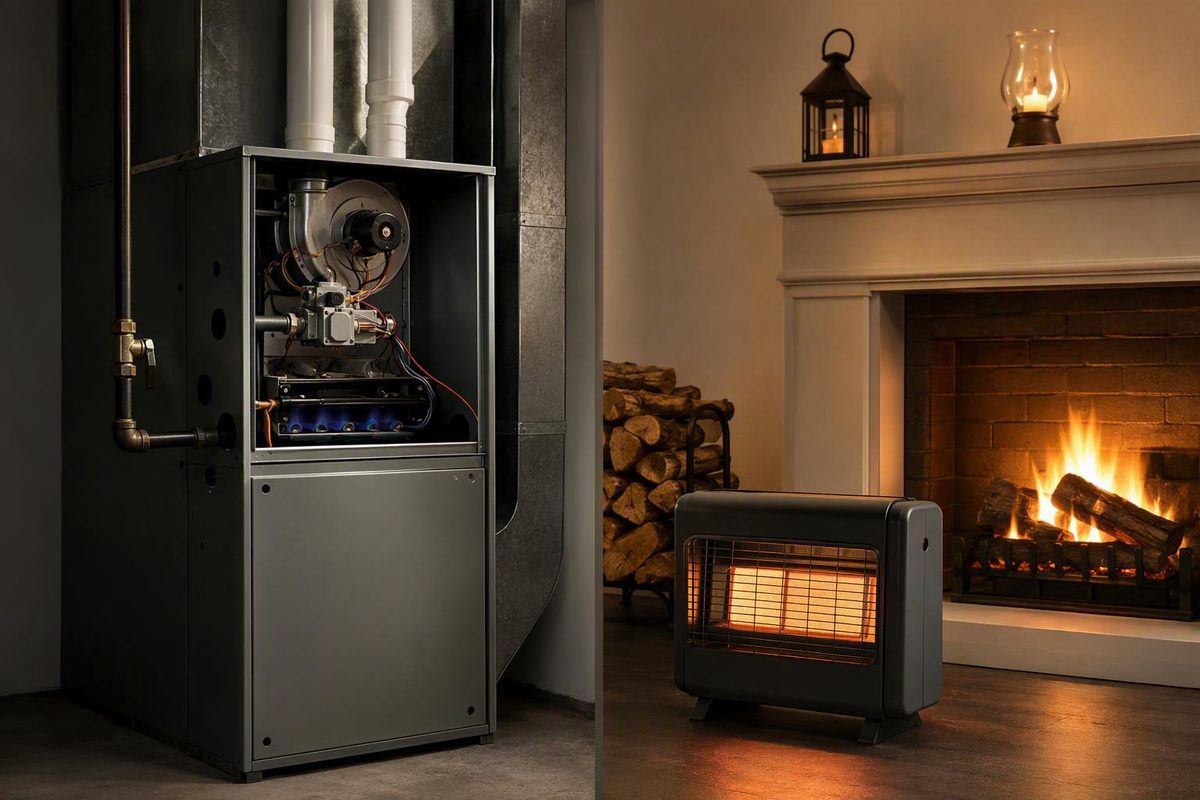
The short answer: most gas furnaces stop when the electricity goes out
A typical modern forced-air gas furnace will not operate during a power outage, even if natural gas is still flowing to the house. Gas supplies the fuel, but electricity starts and controls combustion, checks operating conditions, and moves heated air through the ducts. The Oregon Citizens’ Utility Board likewise notes that furnace circuit boards, thermostat communication, fans, switches, and safety systems require power (Oregon CUB’s gas-appliance outage guide).
That answer needs one important qualification: “gas heat” can describe several kinds of equipment, including:
- A central forced-air gas furnace
- A gas fireplace or fireplace insert
- A floor furnace
- An older gravity heating system
- A freestanding gas stove or room heater
- A boiler with pumps, valves, controls, or powered venting
These appliances do not necessarily behave alike when utility power fails. A modern ducted furnace generally stops. Some specifically designed fireplaces can use batteries to operate their burners. Certain uncommon floor or gravity heaters may rely on natural convection instead of a blower.
It also helps to distinguish operating without utility power from operating without electricity. A compatible fireplace may use batteries when grid power is unavailable. A conventional furnace may receive electricity from a properly planned generator or home battery. In both cases, the appliance still uses electricity—it simply receives that power from somewhere other than the utility grid.
The practical rule is:
Assume a modern central gas furnace will stop during an outage. Treat fireplaces, floor heaters, gravity systems, and older equipment as model-specific exceptions that must be confirmed in the manufacturer’s instructions.
Do not use the appliance’s fuel, age, appearance, or visible pilot flame as the test. Find the exact model and determine what its manual says about electrical requirements and outage operation.
Why a gas furnace still needs electrical power
A modern furnace divides the heating job between two energy sources:
- Natural gas produces heat through combustion.
- Electricity controls that process and distributes the heat.
That distinction explains why continued gas service does not keep a conventional furnace running. The furnace is not merely a burner connected to a gas pipe. It is a coordinated mechanical and electrical appliance designed to ignite gas only after its controls establish the required operating conditions.
Depending on the model, electricity commonly powers:
- The thermostat circuit, which communicates the request for heat
- The control board, which coordinates startup, heating, and shutdown
- Electronic ignition, which creates a spark or heats an igniter
- Gas-valve controls, which regulate when gas reaches the burners
- The draft inducer, where powered draft is part of the design
- Pressure and flame-sensing devices, which monitor draft and ignition
- The circulating blower, which sends heated air through the ducts
At a high level, a normal cycle begins when the thermostat requests heat. The furnace then establishes draft, checks the necessary operating conditions, activates ignition, opens the gas valve at the proper point, confirms flame, and starts the circulating blower. This sequence varies by furnace, but each powered step is part of the appliance’s normal operation (EVS Mechanical’s overview of furnace electrical requirements).
When power fails, that coordinated sequence cannot proceed normally. The thermostat circuit or controls may be unavailable, the inducer cannot run, electronic ignition cannot start, and the blower cannot distribute heat. The precise stopping point depends on the furnace, but the usual result is the same: no normal heating cycle.
This behavior is intentional. The controls and operating checks are integral parts of the appliance, not optional obstacles to be bypassed when the house is cold. An available gas line is insufficient because the furnace is designed to release and burn gas only through its approved sequence.
The blower is also fundamental to a forced-air system. Even if someone could improperly ignite the burners, that would not create normal furnace operation or deliver heat safely through the ductwork. The answer is to restore an approved electrical supply—not to defeat the ignition or control system.
There is no useful universal wattage, startup load, or startup time for every furnace. Electrical demand varies with furnace size, blower type, draft equipment, controls, installed accessories, and operating mode. Those equipment-specific values matter when backup power is being considered.
A standing pilot does not guarantee outage heat
A standing pilot is a small flame that remains lit and can ignite a larger burner when the appliance calls for heat. Because the pilot may remain burning during a power failure, homeowners sometimes conclude that an older furnace will continue heating.
The pilot, however, is only one part of the system.
A lit pilot does not prove that the main gas valve can open, the thermostat can initiate a heating cycle, the required controls can operate, or the blower can run. In a ducted forced-air arrangement, electricity is normally still needed to move heated air through the home. A visible pilot flame is therefore not evidence that the complete furnace is outage-capable.
Older equipment also cannot be treated as one uniform category. Historical designs varied, and some uncommon systems may use non-electric controls or distribute heat naturally. Conversely, an older-looking appliance may contain powered controls, a blower, or later modifications that make it dependent on electricity.
Use these principles instead:
- Do not judge by age. Manufacturing era alone does not establish outage capability.
- Do not judge by the pilot flame. The pilot may be independent while the rest of the heating cycle is not.
- Do not assume a blower is optional. Forced-air distribution normally depends on it.
- Find the exact manual. The manufacturer’s model-specific instructions should identify electrical requirements and approved outage procedures.
- Do not manipulate gas or safety controls without explicit instructions.
Do not hand-light a modern furnace, force its gas valve open, or alter it to defeat its normal ignition sequence. Contractor guidance in the evidence reviewed for this article likewise warns homeowners not to modify a furnace to make it work during an outage (True Heating & Cooling’s outage guidance).
Relighting procedures for equipment with a standing pilot vary by model and valve design. Do not apply a generic online procedure to an unidentified appliance. Follow the exact manufacturer instructions. If the model cannot be identified or the instructions are unavailable, have a qualified service professional determine how the appliance is intended to operate.
Which gas heaters may work without utility power?
The useful comparison is by appliance design, not fuel. This is a limited overview, not a comprehensive classification of every gas-fired heating system.
| Appliance or system | Likely outage behavior | What determines the answer |
|---|---|---|
| Modern forced-air gas furnace | Generally stops without backup electricity | Powered controls, ignition, draft equipment, sensors, and blower |
| Thermopile floor furnace using natural convection | May operate without grid power | Exact control and venting design, model manual, and current installation |
| Older gravity heater | May distribute heat without a fan | Whether its controls and associated components are also non-electric |
| Gas fireplace or insert | Model-specific | Ignition system, approved battery backup, controls, and reliance on a fan |
| Gas stove or room heater | Model-specific | Listed design, valve and ignition controls, venting, and manufacturer instructions |
| Boiler or hydronic system | Outside a simple general rule | Possible dependence on controls, pumps, valves, or powered venting |
Modern forced-air furnaces
For a modern central furnace, outage operation is generally unavailable unless a suitable backup source supplies electricity. Power is needed not only for ignition but also for control functions, draft equipment where installed, operating checks, and air circulation.
The presence of a gas pipe does not create a passive heating system. A ducted gas furnace is a powered appliance that uses gas as its principal heating fuel.
Floor furnaces
Some floor furnaces were designed around a thermopile and natural convection. A system designed entirely around those principles may provide heat without grid power.
That does not mean every floor furnace will work during an outage. Controls and configurations vary, and the article evidence does not establish a universal rule for this equipment category. One HVAC contractor describes thermopile-controlled, convection-based floor furnaces as a possible exception while distinguishing them from conventional forced-air furnaces (Advantage Heating’s furnace outage comparison).
Treat that as a reason to check the exact model—not as permission to assume that any floor furnace is non-electric.
Gravity heating systems
Some older gravity systems distribute warmth through natural buoyancy: heated air rises and cooler air falls without a central blower. In principle, that can allow heat distribution without utility electricity.
But the phrase “gravity system” is not enough to determine outage operation. A thermostat, gas valve, damper, retrofit control, or another associated component may still require power. The current configuration of the entire installation matters more than its appearance or original heating concept.
Because the available evidence does not document every historical design, an older gravity system should be treated as an equipment-specific question for the manufacturer, where documentation exists, or a qualified technician.
Gas fireplaces, inserts, and stoves
Gas fireplaces are especially model-specific. Some need household power for ignition or control. Others include a manufacturer-approved battery system that can operate the burner when utility power is unavailable. A compatible unit may continue producing radiant or naturally convected heat even though its fan and accessories stop.
Kozy Heat, for example, says compatible fireplaces using its described intermittent-pilot system can operate during an outage when functioning batteries are installed in the designated backup system. The manufacturer also states that fireplace lights and the fan kit will not operate without household electricity (Kozy Heat’s fireplace outage instructions).
Valor makes a separate brand-specific claim. It says its gas fireplaces, inserts, and stoves use battery-powered controls and provide heat through radiation and natural convection during an outage. Some electrically powered accessories, including lighting and connectivity features, may remain unavailable (Valor’s power-outage product guidance).
These examples do not establish what another manufacturer’s fireplace can do. They illustrate two narrower lessons:
- A burner may operate even when every normal feature does not.
- Battery-backed heating is a designed and documented capability, not something to infer from the presence of gas or a battery compartment.
A fireplace operating without its fan may also warm the room differently than it does during normal service. It may still deliver radiant or naturally convected heat, but powered lights, blowers, wall controls, or connectivity features can have separate electrical requirements.
How to determine whether your exact heater will operate
General rules establish expectations, but the exact model decides the answer. Complete the following verification before an outage, when there is time to locate documentation and obtain qualified help.
1. Identify the appliance category
Determine whether the equipment is a forced-air furnace, floor furnace, gravity heater, fireplace, insert, freestanding stove, boiler, or another appliance. Do not rely solely on the name used by a previous owner, installer, or real-estate listing.
The method of heat distribution provides a useful clue:
- Ducts and registers usually indicate forced air.
- A heater beneath a large floor grille may be a floor furnace.
- Large air grilles without an obvious blower may indicate an older gravity arrangement.
- Radiators or hydronic baseboards indicate a system with different equipment dependencies.
- A firebox may be a decorative fireplace, a heater-rated fireplace, or an insert.
These observations help identify the category; they do not establish outage capability.
2. Find the rating plate and exact model number
Locate the rating plate only through an area the owner’s instructions authorize you to access. Do not dismantle the appliance or enter a sealed or service-only compartment.
Record the complete model number.
3. Locate the matching manufacturer manual
Search the manufacturer’s support site or contact the manufacturer or dealer. Confirm that the manual matches the complete model designation rather than merely a similar product name.
Look for sections such as:
- Power failure or power outage
- Emergency operation
- Ignition system
- Battery backup
- Remote receiver or battery pack
- Blower or fan
- Electrical requirements
- Lighting and shutdown instructions
- Restart after interruption
The manual should explicitly describe any approved outage capability. The absence of an outage procedure is not permission to improvise one.
4. Inventory electrical dependencies
Determine whether the appliance has:
- Electronic ignition
- Electronic gas-valve controls
- A control board or powered receiver
- A circulating blower
- A draft-inducer or power-vent motor
- A circulator pump
- Powered valves or dampers
- An electronic thermostat circuit
Any of these components indicates an electrical dependency. The manual should explain whether the component is essential to burner operation or only powers an accessory.
5. Verify what a battery compartment actually powers
A battery compartment does not prove that an appliance can heat during an outage.
For a fireplace specifically approved for battery-backed heating, determine:
- The required battery type and quantity
- Where the batteries are installed
- What functions they power
- How their condition should be checked
- Which features will remain unavailable
- Whether the manual requires a switching or startup step
Maintain the batteries as the manufacturer directs. Do not wait until an outage to discover that the compartment is empty, corroded, or intended only for a remote control.
6. Get help when the documentation is ambiguous
If you cannot identify the model, locate the correct manual, or determine whether a powered component is essential, contact the manufacturer or a qualified technician.
The goal is a model-specific answer to four questions:
- Will the burner operate during an outage?
- What powers its ignition and controls?
- How does it distribute heat?
- Which normal features will be unavailable?
Appliance age and a standing pilot are not substitutes for those answers.
Using a generator or home battery to run a furnace
A conventional gas furnace may operate during an outage if a sufficiently capable generator or home battery supplies the electricity it needs. This is backup electrical operation—not operation without electricity.
Planning requires more than choosing a source with an appealing wattage label. The furnace, backup source, total load, and connection arrangement must be evaluated together.
Determine the actual load
Obtain the furnace’s electrical requirements from its rating information, installation documents, manufacturer, or a qualified professional. Consider both normal operating demand and motor startup demand. The blower, draft inducer, controls, and installed accessories can all affect the load.
Do not rely on a universal furnace wattage or generator-size recommendation. Two furnaces may use different blower motors, accessories, and operating modes.
If the backup source will also serve a refrigerator, well pump, lighting, or other equipment, the combined demand must be considered.
Check compatibility, not just capacity
Nominal power capacity alone does not establish compatibility. The evaluation should address the particular furnace, backup source, other connected loads, and installation.
A qualified electrical or backup-power professional should determine:
- Whether the source can handle startup demand
- Whether it supplies power compatible with the furnace
- Which other loads can operate simultaneously
- What transfer arrangement is appropriate
- Whether the furnace manufacturer specifies backup-power conditions
These are installation-specific questions, not subjects for a universal do-it-yourself wiring recipe.
Use an appropriate connection arrangement
A permanently wired furnace needs a professionally evaluated means of receiving backup power. Do not modify furnace wiring or attempt to energize it through an improvised cord or ordinary receptacle arrangement. Contractor guidance cited here specifically recommends suitable transfer equipment and warns against connecting a furnace directly through an outlet (EVS Mechanical’s backup-power discussion).
Portable generators must be operated outdoors rather than inside a house, garage, basement, or other enclosed area; the available contractor guidance identifies enclosed generator operation as a carbon-monoxide hazard (generator and furnace guidance from Advantage Heating).
Backup power should supply the furnace’s normal controls. It must not be used to bypass ignition controls, switches, sensors, gas-valve controls, or other parts of the designed operating sequence.
Have the arrangement planned before severe weather. An outage is not the time to experiment with furnace wiring, unfamiliar transfer equipment, or generator placement.
What to do during the outage—and what never to try
If a modern central furnace stops when the lights go out, that is normally the expected response. Leave its combustion and electrical systems intact.
Do not:
- Manually light the burners of a modern furnace
- Force a gas valve open
- Hold, tape, or bypass a switch or sensor
- Rewire the furnace to defeat its controls
- Connect an improvised power supply
- Apply fireplace instructions to a central furnace
- Apply one manufacturer’s procedure to another manufacturer’s appliance
- Operate a portable generator in an enclosed area
The powered startup sequence is not merely a convenience feature. It coordinates draft, ignition, fuel flow, flame verification, air circulation, and shutdown. Contractor guidance in the evidence pack specifically warns against bypassing furnace controls or attempting to make the appliance operate outside that sequence.
For equipment with a standing pilot, follow the exact model manual. There is no single relighting procedure suitable for every valve and ignition design. If the manual directs the owner to obtain service—or if the appliance cannot be positively identified—do not improvise.
For a fireplace designed to use batteries during an outage, use only the designated battery system and manufacturer-authorized procedure.
This article does not recommend portable kerosene, propane, or other combustion heaters for indoor emergency use. The evidence provided does not establish which products are approved for indoor operation or what conditions would apply to a specific model.
For an extended cold-weather outage, make a contingency plan instead of altering the furnace. Priorities may include conserving warmth in occupied rooms, checking on vulnerable household members, following official emergency information, and relocating to a safe heated location if the home cannot remain adequately warm.
When power returns: restart checks and warning signs
Many modern furnaces normally resume operation after electrical service returns and the thermostat calls for heat.
Do not treat a contractor’s suggested waiting period as a universal rule. Follow current utility restoration guidance and the instructions for the exact furnace, especially if electrical service is fluctuating or being restored in stages.
Once service appears to have returned, limit yourself to basic, non-invasive checks:
- Confirm that electrical service has returned to the home.
- Verify that the thermostat is set to Heat and above room temperature.
- Check whether the furnace’s normal user-operated switch or circuit remains off.
- Allow the furnace to follow its ordinary startup sequence.
- Observe its operation without opening internal compartments.
Do not troubleshoot internal wiring, ignition components, gas valves, sensors, switches, or circuit boards during outage recovery.
Stop operating the furnace and seek qualified help if it produces an unusual odor or sound, repeatedly fails to start, operates abnormally, or does not resume heating after basic user checks. The contractor guidance reviewed for this article similarly recommends shutting the furnace down and obtaining help when unusual smells or sounds occur after an outage (True Heating & Cooling’s post-outage furnace guidance).
Stop troubleshooting and obtain qualified emergency assistance rather than manipulating appliance controls.
Before the next outage:
- Keep the exact appliance manual accessible.
- Record the complete model and serial numbers.
- Determine whether the appliance has manufacturer-approved battery backup.
- Keep required fireplace batteries functional.
- Test approved backup features as the manufacturer directs.
- Have any generator or home-battery arrangement planned in advance.
- Know which heating features will and will not operate without utility power.
- Establish a safe contingency plan for an extended loss of heat.
Frequently asked questions
Will a gas furnace work if the natural gas is still flowing but the power is out?
Usually not. A modern forced-air gas furnace needs electricity for its controls, ignition, draft equipment where installed, operating checks, and blower. Continued gas service supplies fuel but does not allow the furnace to complete its normal startup sequence or circulate heated air.
A suitable generator or home battery may restore operation by supplying the missing electricity. Without approved backup power, expect a conventional furnace to remain off until utility service returns.
Can I manually light my gas furnace during a power outage?
No. Do not manually light a modern furnace, force its gas valve open, or bypass its controls. The burners must operate through the appliance’s designed ignition and control sequence.
If an older appliance has a standing pilot, follow only the exact manufacturer procedure. If the model or instructions cannot be identified, obtain qualified service.
Will a furnace with a standing pilot work without electricity?
Not necessarily. The pilot may remain lit while the main burner controls, thermostat circuit, gas valve, safety devices, or circulating blower still require electricity.
Some uncommon historical designs may differ, but a visible pilot does not prove outage capability. Verify the complete model and current installation.
Can a gas fireplace heat a room when the electricity is off?
Some can. A compatible fireplace may use battery-backed ignition and controls while delivering heat through radiation or natural convection. Its fan, lights, connectivity features, or other accessories may remain unavailable.
The capability is model-specific. Check the exact manual, determine what the batteries power, and ensure the specified batteries are functional.
Can I power my gas furnace with a portable generator?
Potentially, if the generator can meet the furnace’s operating and startup demands and the furnace has an appropriate professionally planned connection.
Do not choose a generator from a universal wattage estimate, alter furnace wiring, or improvise a connection. Operate a portable generator outdoors and keep all furnace controls and operating safeguards intact.
Gas may supply the fuel, but most modern central furnaces still need electricity to start normally and distribute heat. Treat fireplaces, floor heaters, gravity systems, and older equipment as model-specific exceptions—not assumptions. Verify the appliance manual before an outage, use only properly planned backup power, and never defeat ignition, wiring, or combustion controls to make a heater run.