
Choosing 8-Inch Stovepipe Without a Sizing Mistake
Check whether your stove needs 8-inch pipe, distinguish inside from outside diameter, and verify reducers, clearances and chimney connections.
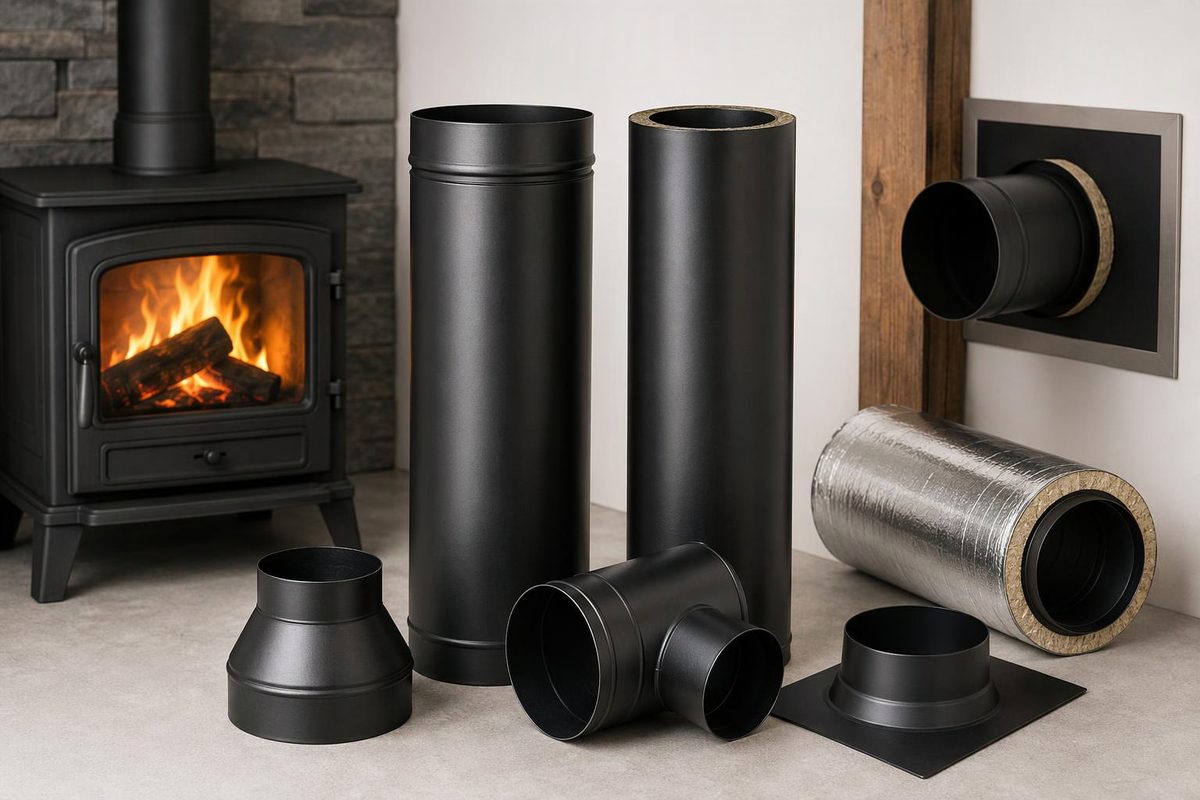
Buy 8-inch stovepipe when the exact stove manual calls for or permits an 8-inch connector—not simply because the existing chimney looks that size. The stove outlet, connector and chimney must form an approved venting arrangement. DuraVent warns that reducing the diameter even one inch can affect draft and says to check the appliance instructions before using a decreaser. DuraVent sizing guidance
For a freestanding wood stove, stovepipe is the exposed connector between the appliance and chimney. This guide concerns that connector, not every vent product sold with an “8-inch” label.
First, establish whether you need eight inches
Find the stove’s model and identification label, then obtain its matching installation manual. An 8-inch outlet is a real appliance requirement on some models: Buck Stove lists an 8-inch flue size for its Model 91. That does not make eight inches the right choice for another large stove. Buck Stove Model 91 specifications
Use these stop points before ordering:
| What you find | What to do |
|---|---|
| The manual specifies an 8-inch connector and matching chimney | Plan an 8-inch system using the permitted connector type and approved connections. |
| The stove has an 8-inch outlet but the existing chimney is 6 inches | Stop before buying a reducer. Establish whether the exact appliance permits that reduction; an adapter’s availability is not approval. |
| The stove has a 6-inch outlet but the existing chimney is 8 inches | Check the manual’s permitted chimney sizing before buying an increaser or replacing the connector with 8-inch pipe. |
| The stove has an oval outlet | Identify the prescribed oval-to-round connection; do not select pipe from the oval’s widest dimension alone. |
Eight inches is not a small step up from six. Calculated from the inside diameters, a round 8-inch passage has about 50.3 square inches of area, versus 28.3 square inches for a 6-inch passage—roughly 78% more. That is not a draft prediction, but it explains why the sizes are not interchangeable. Vermont Castings’ installation guidance warns that oversized flues slow and cool exhaust gases, weakening draft. Defiant CAT-C installation manual, flue sizing
“8-inch” does not mean an 8-inch outside measurement
Check the manufacturer’s dimensional drawing, not just a tape measure across the outer casing. For example, DuraVent’s 8-inch DVL double-wall straight pipe has an 8-inch inner diameter and a 9-inch outer body diameter; its connecting ends have additional dimensions. A piece measuring about nine inches outside may therefore be the correct nominal 8-inch connector. DVL dimensional tables
For an oval collar, DuraVent’s DVL instructions use circumference as a sizing check: approximately 25 inches around corresponds to its 8-inch pipe. This helps identify the size, but does not override the stove’s required adapter or venting configuration. DVL instructions, oval outlets
Record both the nominal size and the brand/product series of an existing connector and chimney. “Eight inches” alone is not enough information to order a replacement joint or chimney adapter.
Choose the wall construction by available clearance
Two examples show why diameter alone cannot determine the installed space:
- 8-inch DuraBlack single-wall: its instructions require at least 18 inches to combustible materials. DuraBlack installation instructions
- 8-inch DVL double-wall: its instructions specify 6 inches to walls and 8 inches to ceilings, measured perpendicular to the pipe. DVL installation instructions
These are product-specific requirements, not universal single- and double-wall rules. The stove’s own clearances must also be satisfied.
For a layout example, the 9-inch-diameter body of a vertical 8-inch DVL section needs its centerline 10½ inches from a flat combustible wall to provide a 6-inch gap: 4½-inch radius plus 6 inches. Larger connecting ends and fittings must also maintain the required clearance, so this body-only calculation is not the minimum distance for the complete assembly. Nor does it establish the stove’s required wall distance.
Order the complete connection, not just straight pipe
Confirm the stove-collar connection, installed length, elbows or tee, and chimney transition together. DVL straight sections overlap by ¾ inch; a nominal 24-inch section therefore contributes 23¼ inches of installed length. Its double-wall pipe cannot be cut, so use the manufacturer’s adjustable or telescoping components where needed. DVL catalog and installation instructions
Do not extend an 8-inch room connector through a ceiling or attic merely because it matches the chimney diameter. DVL expressly prohibits enclosure and passage through walls, ceilings, attics or closets; the route must transition to the appropriate chimney assembly. DVL installation restrictions For that distinction, see Class A chimney pipe planning.
Before purchase, have the installer confirm the stove model, approved diameter, pipe series, clearance measurements and chimney connection. Also check with local building or fire officials about permits and installation inspection requirements, as the DVL instructions direct. If any part of the proposed system is unidentified, resolve it before fitting parts or lighting the stove.