
A Beginner’s Guide to How Energy Moves and Systems Change
Equilibrium analysis links the system boundary, state and process to heat, work and mass. It balances energy and tests direction, not how quickly change occurs.
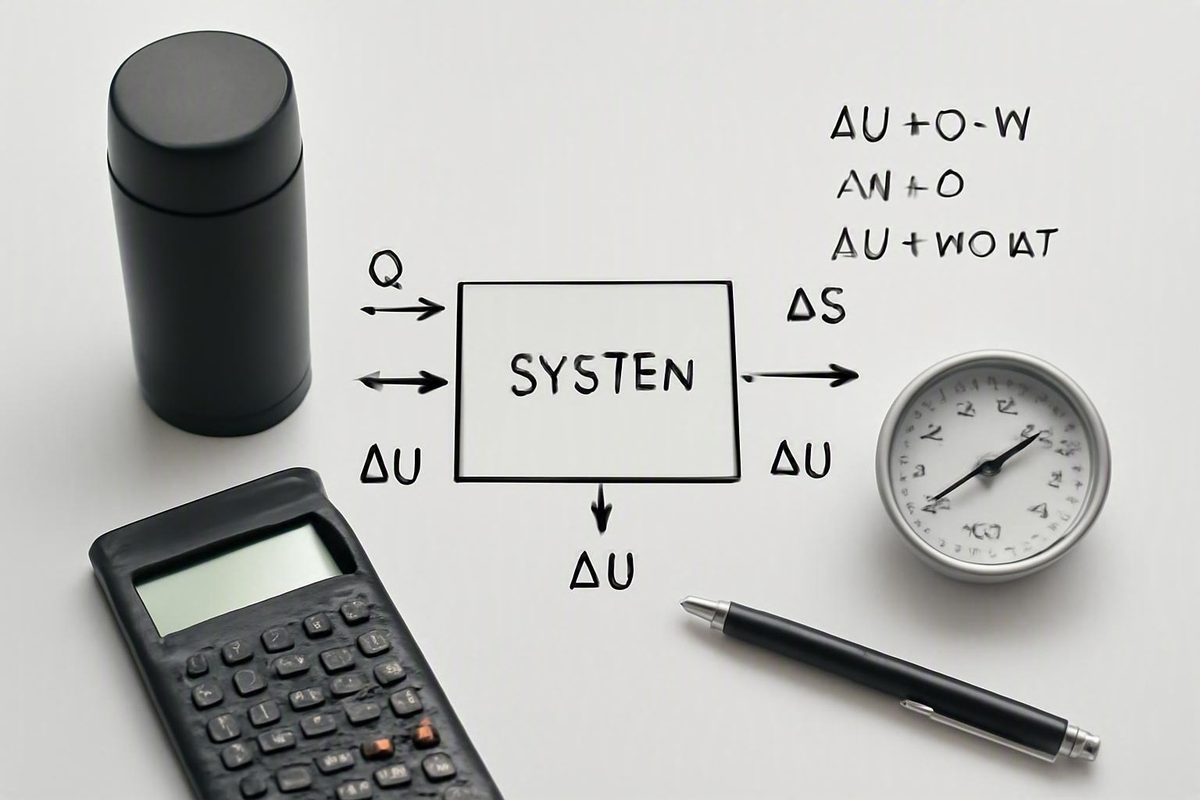
Thermodynamics can look like a collection of unfamiliar terms and equations. Its basic logic, however, follows a repeatable sequence:
- Choose the system and draw its boundary.
- Describe the system’s state with appropriate properties.
- Identify the process connecting the initial and final states.
- Track mass and energy crossing the boundary.
- Apply an energy balance with a declared sign convention.
- Use entropy to evaluate direction and irreversibility.
This sequence turns the basic concepts of thermodynamics into a connected analytical method rather than a vocabulary list.
What thermodynamics studies—and what it can tell us
Thermodynamics is the macroscopic study of energy and its transformations. Its central concepts include temperature, heat, work, internal energy, equilibrium, and entropy. It helps answer questions such as:
- How much energy must enter a system to produce a desired change?
- How much work can an engine deliver?
- Why does a hot object cool in a cooler room?
- Why must a refrigerator consume work?
- What limits the best possible performance of a power plant or heat engine?
The word macroscopic matters. Classical thermodynamics usually describes bulk material with measurable properties such as pressure, temperature, volume, and mass. It does not need to track the position and velocity of every molecule. Instead, it compares well-defined states and accounts for the energy transferred while a system changes between them. The University of Oxford’s introductory thermodynamics notes distinguish this bulk description from a microstate-level account and explain how equilibrium variables describe macroscopic systems.
Statistical thermodynamics provides a bridge to the microscopic world. It explains macroscopic behavior in terms of large collections of particles and their possible microscopic arrangements. Classical and statistical thermodynamics are therefore complementary: one describes bulk behavior directly, while the other helps explain how that behavior emerges from microscopic constituents.
Introductory equilibrium thermodynamics is especially useful for determining:
- Whether specified states are compatible with a chosen model
- How energy must balance
- Which direction a spontaneous process can take
- How heat and work differ
- The ideal performance limits of engines and refrigerators
- How much irreversibility accompanies a process
It generally does not, by itself, determine how quickly a change occurs. Thermodynamics may establish that a hot surface will transfer energy to cooler air, but heat-transfer analysis is needed to calculate the rate. Similarly, thermodynamics can indicate whether a chemical change is favorable under specified conditions, while kinetics addresses how quickly it proceeds.
This distinction is not absolute. Non-equilibrium and finite-time thermodynamics examine time-dependent behavior. The narrower point is that a standard introductory equilibrium analysis focuses primarily on states, balances, direction, and limits rather than detailed rates.
The same framework applies across many devices:
- A heating system transfers energy to maintain a desired indoor condition.
- An engine receives energy, produces work, and rejects some energy.
- A refrigerator consumes work to move heat from a colder region to warmer surroundings.
- A turbine receives flowing fluid and produces shaft work.
- A power plant connects several components into an energy-conversion cycle.
In each case, analysis begins by identifying the boundary, choosing the relevant properties, establishing the state, specifying the process, and then applying energy and entropy balances.
Systems, surroundings, boundaries, and control volumes
A thermodynamic system is the matter or region of space selected for analysis. Everything outside it is the surroundings. The surface separating the two is the boundary.
A boundary may be:
- Real, such as a metal tank wall
- Imaginary, such as a surface drawn across a pipe
- Fixed, as with a rigid container
- Moving, as with a piston face
- Permeable or impermeable to mass
- Open or closed to particular forms of energy transfer
The boundary is not merely a drawing convention. It determines which transfers must appear in the analysis. Moving the boundary can turn what was an internal interaction into a boundary-crossing transfer—or the reverse.
Open, closed, and isolated systems
| System model | Can mass cross? | Can energy cross? | Typical example |
|---|---|---|---|
| Open system or control volume | Yes | Yes | Turbine with fluid entering and leaving |
| Closed system | No | Yes | Sealed piston-cylinder |
| Isolated system | No | No | Idealized insulated, rigid, sealed container |
A closed system, sometimes called a control mass, contains a fixed amount of matter. Mass does not cross its boundary, but energy may cross as heat or work.
An open system, commonly analyzed as a control volume, is a selected region across whose control surface mass can flow. Because entering and leaving matter carries energy, the analysis must include both mass flow and energy transfer.
An isolated system exchanges neither mass nor energy with its surroundings. Perfect isolation is an idealization, although a sealed, rigid, effectively insulated container may approximate it over a useful interval. These classifications follow from the chosen boundary rather than from an object’s name, as explained in university treatments of thermodynamic systems and equilibrium.
An earlier archived overview of basic thermodynamic concepts also introduces these system categories. It is best read as supplementary background rather than as the sole authority for the definitions.
These labels belong to the model, not permanently to the equipment. The same device may be represented differently depending on the question being asked.
Four boundary-selection examples
1. Sealed piston-cylinder
Draw the boundary around the trapped gas. No gas crosses it, so the gas is a closed system. Energy may still cross as heat, and the moving piston permits pressure-volume work.
2. Turbine
Draw a control surface around the turbine casing, cutting across the inlet and outlet pipes. Fluid crosses that surface, carrying mass and energy. The turbine is therefore treated as an open system or control volume.
3. Insulated rigid container
A sealed container prevents mass transfer. A rigid wall prevents pressure-volume boundary work, while effective insulation greatly reduces heat transfer. If other energy transfers are negligible, the container can be modeled as approximately isolated.
4. Refrigerator
Its classification depends on the boundary:
- A boundary around a fixed quantity of refrigerant can define a closed system for part of an analysis.
- A boundary around the compressor usually creates an open control volume because refrigerant flows through it.
- A boundary around the appliance may include electrical work entering and heat crossing its outer surfaces.
- A boundary around the appliance plus the room makes many of the refrigerator’s heat transfers internal to the larger system.
Misconception check: Closed does not mean isolated
A closed system prohibits mass transfer, not energy transfer. A sealed bottle warming in sunlight is closed if no matter escapes, but it is not isolated because energy crosses its boundary.
Boundary choice is therefore the first major modeling decision. A useful boundary encloses the behavior of interest while leaving as few complicated transfers as possible.
Properties, states, equilibrium, and equations of state
A thermodynamic property is a measurable or calculable characteristic of a system. Examples include temperature, pressure, volume, mass, density, internal energy, enthalpy, and entropy.
A suitable set of properties describes a system’s macrostate. A microstate, by contrast, specifies microscopic information such as particle positions and momenta. An enormous number of microstates may be compatible with the same macrostate.
Intensive and extensive properties
Thermodynamic properties are commonly divided into two classes:
| Intensive properties | Extensive properties |
|---|---|
| Temperature | Mass |
| Pressure | Volume |
| Density | Internal energy |
| Enthalpy | |
| Entropy |
An intensive property does not scale directly with the amount of matter. An extensive property does.
The simplest test is imaginary division. Suppose a uniform equilibrium system is divided into two equal parts:
- Each part has half the mass and half the volume.
- Each part has half the total internal energy, enthalpy, and entropy.
- Each part may retain the same temperature, pressure, and density.
The qualification “may” is important. Division can expose gradients or produce nonuniform pieces. The test assumes a uniform system divided without otherwise disturbing it.
Specific volume, for example, is total volume per unit mass.
State functions and path independence
A state function is determined by the state, not by the route taken to reach it. Internal energy, enthalpy, and entropy are state functions. If a system moves from state 1 to state 2, its change in internal energy depends only on those endpoints.
Heat and work are different. They describe transfers during a process, so their values depend on the path between states.
An analogy is elevation. The elevation difference between two places depends only on the endpoints. The distance traveled depends on the route. Internal-energy change resembles the elevation difference; heat and work resemble route-dependent travel quantities.
What equilibrium means
A system is in thermodynamic equilibrium when there is no unbalanced tendency for its macroscopic condition to change. Depending on the system, this can require several simultaneous forms of equilibrium:
- Thermal equilibrium: no net heat transfer driven by internal temperature differences
- Mechanical equilibrium: no unbalanced pressure or force tendency causing macroscopic motion
- Chemical equilibrium: no net tendency for composition to change by reaction or diffusion
- Phase equilibrium: no net tendency for matter to shift between phases
A steady temperature reading alone does not prove complete thermodynamic equilibrium. A system could have a uniform temperature while a chemical reaction, phase change, diffusion process, or mechanical motion continues.
Equations of state
An equation of state relates equilibrium properties. For an ideal gas,
pV = nRT
where p is pressure, V is volume, n is amount of substance, R is the gas constant, and T is absolute temperature. This is an equilibrium ideal-gas model, not a universal relation for every substance; the assumptions and equilibrium role of equations of state are outlined in the Oxford thermodynamics notes.
Real gases can depart from ideal-gas behavior, especially when molecular interactions or finite molecular volume become important.
For a simple piston-cylinder containing a gas, pressure, volume, and temperature may provide enough information to identify a state once the amount of matter and material model are known.
The goal is not to collect every possible property. It is to choose enough independent properties, together with an appropriate material model, to specify the state.
Temperature, heat, work, and internal energy are not the same thing
These concepts are closely related, but they are not interchangeable.
Temperature is a state property associated with a system’s thermal condition. Among its roles, temperature establishes the spontaneous direction of heat transfer: in the absence of another effect, heat passes from higher temperature toward lower temperature.
Heat is energy transferred across a boundary because of a temperature difference.
In the principal mechanical example, a gas exerts force on a piston while the piston moves.
Internal energy is microscopic energy stored within the system. It can include microscopic kinetic energy, intermolecular potential energy, energy associated with chemical bonds, and molecular rotational, vibrational, electronic, or other internal modes. It excludes the kinetic energy of the system moving as a whole and the gravitational potential energy associated with its overall elevation. These distinctions between stored internal energy and boundary-crossing heat and work are summarized in an introductory lesson on internal energy and sign conventions.
Comparison of the four concepts
| Quantity | Meaning | Property or transfer? | State or path dependent? | Common symbol |
|---|---|---|---|---|
| Temperature | Describes thermal condition | Property | State dependent | T |
| Heat | Energy transferred because of a temperature difference | Transfer | Path dependent | Q |
| Work | Energy transferred through an organized interaction | Transfer | Path dependent | W |
| Internal energy | Stored microscopic energy | Property | State dependent | U |
A system contains internal energy. It does not contain a stock of heat or work. Heat and work describe energy crossing a chosen boundary during a process.
Once transferred, energy contributes to the system’s stored energy or leaves through another transfer. Its history does not remain tagged as a separate quantity called heat.
Why heat and work depend on the path
Imagine taking a gas in a piston-cylinder from the same initial state 1 to the same final state 2 by two different routes:
- Path A: Add substantial heat while allowing the gas to expand and do substantial work.
- Path B: Constrain the piston differently, producing less work, and add a different amount of heat.
Because the endpoints are identical, \Delta U is identical for both paths. The heat and work need not be the same. The first-law balance requires their difference to produce the same internal-energy change under the chosen convention.
Use precise transfer language
Avoid: “The body stores heat.”
Prefer: “Energy was transferred to the body as heat, increasing its internal energy.”
Avoid: “The system gained work.”
Prefer: “Work was done on the system,” or “Energy entered the system by work.”
This terminology prevents confusion when energy balances include several transfer modes.
The four laws of thermodynamics, from equilibrium to entropy
The laws are conventionally called the zeroth, first, second, and third laws. For a beginner, their useful conceptual order is:
- Establish temperature and thermal equilibrium.
- Conserve energy.
- Determine process direction and ideal limits.
- Describe limiting entropy behavior near absolute zero.
The numbering is conventional; scientifically, the important point is that the zeroth law provides the equilibrium foundation needed to compare temperatures.
Zeroth law: thermal equilibrium and thermometers
If system A is in thermal equilibrium with system C, and system B is also in thermal equilibrium with system C, then A and B are in thermal equilibrium with each other.
This transitivity permits temperature comparison. A thermometer acts as the third system: after reaching thermal equilibrium with an object, a calibrated property of the thermometer provides a temperature reading.
Concrete anchor: a thermometer reaching equilibrium with the object being measured.
First law: energy must balance
For a closed system, neglecting changes in the system’s bulk kinetic and potential energies, this article uses
\Delta U = Q-W
with the convention:
- Q>0: heat enters the system.
- Q<0: heat leaves the system.
- W>0: the system does work on the surroundings.
- W<0: work is done on the system.
Under this convention, heat entering tends to increase internal energy, while work performed by the system tends to decrease it. This form of the first law and the corresponding meanings of heat and work are consistent with the treatment in Britannica’s thermodynamics overview.
An alternative convention defines W as work done on the system:
\Delta U = Q + W
The physics is unchanged. The work symbol has simply been defined differently. Both forms are correct when their signs are applied consistently; the work-on-system convention is used in Khan Academy’s introductory thermodynamics treatment.
Sign-convention decision box
Before using a first-law equation, ask:
- Does positive Q mean heat entering or leaving?
- Does positive W mean work done by or on the system?
- Are kinetic and potential energy changes included or neglected?
- Is the equation for a closed system or a control volume?
Never copy an equation without copying its definitions.
Concrete anchor: heat supplied to a piston-cylinder can change stored internal energy while the expanding gas also performs work.
Second law: direction, irreversibility, and limits
Energy conservation alone does not identify which processes occur spontaneously. The first law would not, by itself, prohibit energy from passing spontaneously from a cold object to a hot one, provided total energy still balanced.
The second law supplies direction. Heat flows spontaneously from higher temperature to lower temperature. Moving heat in the opposite direction requires another effect, as in a refrigerator supplied with work. The second law also rules out a cyclic engine that extracts heat from a single-temperature source and converts all of it into net work without another consequence.
Entropy, S, is a state function used to evaluate energy dispersal, process direction, and irreversibility. Defining entropy only as “disorder” is inadequate because many thermodynamic processes do not map cleanly onto an everyday notion of messiness.
An entropy balance distinguishes two concepts:
- Entropy transfer: entropy crosses a boundary with heat or flowing matter.
- Entropy generation: entropy is produced within the accounting region by irreversibility.
S_gen\ge 0
A particular system’s entropy can nevertheless decrease. The complete accounting must include entropy transfer and generation.
For a reversible path,
dS = \delta Q_rev ÷ T
This is not a universal instruction to divide the actual heat transfer in every irreversible process by temperature. Because entropy is a state function, its change can be evaluated using a suitable reversible reference path even when the real process is irreversible. The direction-of-process and entropy principles underlying these statements are reviewed in Britannica’s discussion of the thermodynamic laws.
Concrete anchors: a hot object cooling in cooler air and a refrigerator using work to move heat in the opposite direction.
Third law: limiting behavior near absolute zero
A careful third-law statement concerns the limiting entropy of a perfect crystal as temperature approaches absolute zero, with qualifications concerning its minimum-energy state. It should not be shortened to “every substance has zero entropy at absolute zero.”
Real materials may require further qualifications involving crystal perfection, residual configurations, or ground-state degeneracy.
Concrete anchor: the limiting behavior of a perfect crystalline material as its temperature approaches absolute zero.
Thermodynamic processes and what remains constant
A thermodynamic process is a change from one state to another. The path is the sequence of intermediate states followed.
Process names generally identify a constraint or an absent transfer:
| Process | Defining condition | Piston-cylinder interpretation |
|---|---|---|
| Isothermal | Temperature remains constant | Heat and work may cross while controls maintain T |
| Adiabatic | No heat crosses the boundary | The piston may move, so work can still occur |
| Isobaric | Pressure remains constant | The piston moves against a constant effective pressure |
| Isochoric | Volume remains constant | The piston is fixed; no pressure-volume boundary work |
| Cyclic | Final state equals initial state | The gas completes a sequence and returns to its starting state |
Comparing four paths in one piston-cylinder
Consider a gas beneath a movable piston.
In an isothermal process, the gas remains at constant temperature. This does not mean that no energy crosses the boundary. Heat may need to enter or leave to offset work and maintain the specified temperature.
In an adiabatic process, no heat crosses the boundary. The gas can still do work or have work done on it. Its internal energy and temperature can therefore change.
In an isobaric process, pressure remains constant while the piston moves. Volume and temperature may change.
In an isochoric process, the piston is locked so the volume remains constant. Heat transfer can still change internal energy, temperature, and pressure.
The distinction between adiabatic and isothermal is especially important:
- Adiabatic specifies no heat transfer.
- Isothermal specifies no temperature change.
They answer different questions. During adiabatic expansion, a gas may perform work at the expense of internal energy and cool even though no heat leaves it.
Quasi-static, reversible, and irreversible processes
A quasi-static process proceeds through an idealized sequence of states sufficiently close to equilibrium that properties such as system pressure remain well defined along the path. This makes it possible to draw a meaningful pressure-volume curve for the system.
It generates no entropy.
Examples include:
- Motion with friction
- Heat transfer across a finite temperature difference
- Mixing
- Flow through a restriction
- Rapid, unrestrained expansion
- Viscous dissipation
Quasi-static does not automatically mean reversible. A piston can move extremely slowly and still experience friction. The system may remain close to mechanical equilibrium while generating entropy.
Likewise, a reversible process is more than merely “slow.” It must avoid all relevant irreversibilities. Reversibility is an ideal limit used for comparison, not a routine description of real equipment.
Cycles
A thermodynamic cycle is a sequence of processes that returns the system to its initial state. Because state functions depend only on the state,
\Delta U_cycle = 0
The same zero-net-change rule applies to every other state function.
Heat and work are not state functions, so their net values over a cycle need not be zero. Under the convention \Delta U=Q-W, a complete closed-system cycle with negligible changes in bulk kinetic and potential energies gives
Q_net = W_net
These cycle definitions and the return to the initial thermodynamic state are summarized in an introductory overview of thermodynamic processes.
The equality does not mean that no energy was transferred. It means that the system finishes the cycle with the same stored energy with which it began.
Pressure-volume work and a beginner’s energy-balance method
A pressure-volume, or p-V, diagram plots pressure vertically and volume horizontally.
A state appears as a point:
Pressure, p
    ↑
    │                    ● State 2
    │                 .´
    │              .´    Process path
    │           .´
    │   ● State 1
    └────────────────────────────→ Volume, V
A process appears as a path connecting state points. Different curves can connect the same endpoints, representing different sequences of intermediate pressure and volume.
For quasi-static pressure-volume work, using work done by the system as positive,
W = \intV_₁V_²p\,dV
The area under the process curve on a p-V diagram represents pressure-volume work. Because different paths can enclose different areas, work is path dependent. The quasi-static condition, integral, sign convention, and diagram interpretation are presented together in the University Physics open textbook’s treatment of pressure-volume work.
For a quasi-static constant-pressure process,
W = p(V₂-V₁)
This special case assumes that the relevant pressure remains constant along the quasi-static path. It is not a general replacement for the integral under an arbitrary pressure history.
For a rigid or isochoric process,
dV = 0
and therefore
W_pV = 0
This conclusion applies only to pressure-volume work.
A repeatable closed-system method
Use the following sequence for introductory energy-balance problems:
- Draw the boundary. Decide exactly what matter is inside.
- Identify the initial and final states. List known properties and state changes.
- List all boundary transfers. Include heat and every relevant work mode.
- Declare the sign convention. Do this before assigning numerical signs.
- State process assumptions. Examples include constant pressure, rigid volume, quasi-static motion, or negligible kinetic-energy change.
- Calculate work when applicable. Select an equation only after checking its assumptions.
- Apply the first law. Solve for the unknown transfer or energy change.
- Check units and physical sense. Under the convention used here, expansion work is positive and compression work is negative.
Symbolic constant-pressure piston example
Consider a closed system consisting of gas in a piston-cylinder. Assume:
- The piston expands quasi-statically.
- Pressure remains constant at p.
- Volume changes from V_1 to V_2, with V_2>V_1.
- Heat Q enters the gas.
- Changes in bulk kinetic and potential energies are negligible.
- Work done by the gas is positive.
The expansion work is
W = p(V₂-V₁)
The first law gives
\Delta U = Q-W
Substituting the work expression,
\Delta U = Q-p(V₂-V₁)
The interpretation must be conditional:
- If Q>W, the difference increases the gas’s internal energy.
- If Q=W, the internal energy does not change.
- If W>Q, the gas performs part of the work by decreasing its internal energy.
- Expansion work still leaves the system as energy transferred to the piston and surroundings.
Units must be consistent. Pressure multiplied by volume must be expressed in the same energy units used for Q and \Delta U.
Same endpoints, different paths
Suppose path A and path B connect the same initial and final equilibrium states:
\Delta U_A = \Delta U_B
If path A has a larger area under its p-V curve,
W_A>W_B
then the first law requires
Q_A>Q_B
by the same difference under this sign convention. The internal-energy change remains fixed by the endpoints, while heat and work vary with the path.
Compact equation box
Introductory equations and their assumptions
[ \Delta U=Q-W ]
Closed system; heat entering positive; work done by the system positive; bulk kinetic and potential energy changes neglected.
[ W=\intV_₁V_²p\,dV ]
Quasi-static pressure-volume work with a well-defined system-pressure path; expansion work positive.
[ W=p(V_2-V_1) ]
Quasi-static, constant-pressure pressure-volume work.
[ W = 0 ]
Rigid or isochoric boundary; applies only to pressure-volume work.
[ pV=nRT ]
Equilibrium ideal-gas model, using absolute temperature and consistent units.
[ dS=\delta Q_rev ÷ T ]
Reversible heat transfer or an equivalent reversible reference path; not a universal expression for actual irreversible heat transfer.
These sign conventions and first-law distinctions are also collected in the heat, work, and internal-energy lesson cited earlier, while the pressure-volume equations and their quasi-static assumptions are developed in the University Physics treatment.
Open systems add another mechanism: mass crossing a control surface carries energy with it. A turbine’s accounting must therefore consider inlet and outlet flows as well as heat and work. A full steady-flow energy equation requires definitions and assumptions beyond this closed-system introduction.
How the concepts explain engines, refrigerators, turbines, and home heating
The terminology becomes useful when mapped onto real equipment.
Heat engines
A heat engine operates in a cycle. It receives heat from a high-temperature source, converts part of that input into net work, and rejects the remainder to a lower-temperature sink.
High-temperature source
          │
          │ Heat input
          ▼
      Heat engine ─────→ Net work output
          │
          │ Rejected heat
          ▼
Low-temperature sink
Because the working substance returns to its initial state after each complete cycle, its net change in internal energy is zero. Net heat input therefore equals net work output under the sign convention used here.
The second law prevents complete cyclic conversion of heat from a single-temperature source into work with no other effect. Thermodynamic limits are comparison points, not promises of actual performance; the distinction between ideal reversible limits and real equipment is discussed in a Yale University Press essay on thermodynamics in practical systems.
Refrigerators
A refrigerator moves energy from its colder interior to warmer surroundings. That transfer does not occur spontaneously in that direction, so the appliance requires work—usually electrical input to a compressor.
Cold interior
     │
     │ Heat removed
     ▼
Refrigerator ← Electrical work
     │
     │ Heat rejected
     ▼
Warmer room
Boundary selection remains important. If the refrigerator and room are enclosed within one larger boundary, the appliance redistributes energy internally while its electrical input adds energy to the larger system.
Turbines
A turbine is usually analyzed as an open control volume. Fluid enters, changes condition, and leaves while the turbine delivers shaft work. The flowing mass carries energy across both inlet and outlet control surfaces.
A complete turbine calculation may involve several energy forms and detailed operating assumptions. At the introductory level, the essential point is that treating a turbine as a sealed closed system would omit the energy carried by the flowing fluid.
Heating and cooling systems
Thermodynamics explains possible states, required energy transfers, and performance limits for furnaces, boilers, heat pumps, air conditioners, stoves, and building systems.
Heat-transfer analysis answers a different set of questions: how rapidly heat crosses a wall, how insulation affects the rate, how air movement changes heat transfer, or how exchanger surface area influences performance.
Thermodynamic analysis therefore supports the design and comparison of engines, refrigeration equipment, building systems, and power-generation machinery. It is an accounting and feasibility framework for energy-using equipment, not merely a collection of abstract laws.
Mechanical Mentor’s About page describes an editorial focus on stoves, fireplaces, venting, and heat, informed by stated hands-on hearth and venting experience. That background can help frame practical equipment questions, but it is not a substitute for formal thermodynamic evidence or device-specific engineering requirements.
Safety and scope
This thermodynamic explanation is educational and should not replace appliance instructions, applicable product requirements, codes, permits, or inspections. Mechanical Mentor’s terms state that its material is for general reading and that combustion appliances and venting are code-governed, with permits and inspections addressing carbon-monoxide consequences.
The complete concept chain
Choose the system
        ↓
Draw the boundary
        ↓
Identify mass and energy crossings
        ↓
Describe state 1 with properties
        ↓
Specify the process path and assumptions
        ↓
Describe state 2
        ↓
Calculate heat and work where possible
        ↓
Apply a consistent first-law balance
        ↓
Evaluate entropy transfer and generation
        ↓
Judge direction, irreversibility, and ideal limits
This is the central method to retain: define the system and boundary; describe the state with suitable properties; identify the process and its assumptions; track heat, work, and mass transfers; apply a consistent first-law convention; and use the second law to assess direction and irreversibility.
Equations become useful only after their assumptions are stated. From this foundation, the natural next topics are enthalpy, control-volume energy balances, power and refrigeration cycles, free energies, phase equilibrium, and statistical thermodynamics.
Frequently asked questions about basic thermodynamics
What is the difference between heat and internal energy?
Heat is energy crossing a system boundary because of a temperature difference. Internal energy is microscopic energy stored in the system and is a state property.
A body can have internal energy, but it does not “contain heat” in the precise thermodynamic sense. If energy enters as heat, the system’s internal energy may increase, work may be produced, or both. The result depends on the process and energy balance.
Why do some books write the first law as ΔU = Q − W while others use ΔU = Q + W?
They define positive work differently.
If W means work done by the system,
\Delta U = Q-W
If W means work done on the system,
\Delta U = Q + W
Both equations express the same conservation principle. Before solving a problem, define what positive heat and positive work mean and preserve those definitions throughout the calculation.
Can an adiabatic process change temperature?
Yes. Adiabatic means that no energy crosses the boundary as heat. It does not mean that internal energy or temperature must remain constant.
During adiabatic expansion, a gas can perform work and lose internal energy, causing its temperature to fall. During adiabatic compression, work done on the gas can increase its internal energy and temperature.
Can a system’s entropy decrease without violating the second law?
Yes. Entropy may leave a system through heat transfer or flowing matter. If enough entropy leaves, the system’s entropy can decrease.
The second law requires nonnegative entropy generation, not an entropy increase in every selected system under every condition. The complete balance must include entropy transfer and entropy generation, or equivalently account for the combined system and surroundings.
What is the difference between a closed system and an isolated system?
A closed system does not exchange mass with its surroundings, but it may exchange energy as heat or work.
An isolated system exchanges neither mass nor energy.
A sealed piston-cylinder is closed but not isolated if it exchanges heat or moves its piston. A perfectly insulated, rigid, sealed container is the idealized isolated case.