
Chimney Cleaning Tools: Match the Brush, Rods, Vacuum and Access Method
Choose chimney cleaning tools by flue material, dimensions, deposits and access—and know when damage, glaze or roof risk makes DIY unsafe.
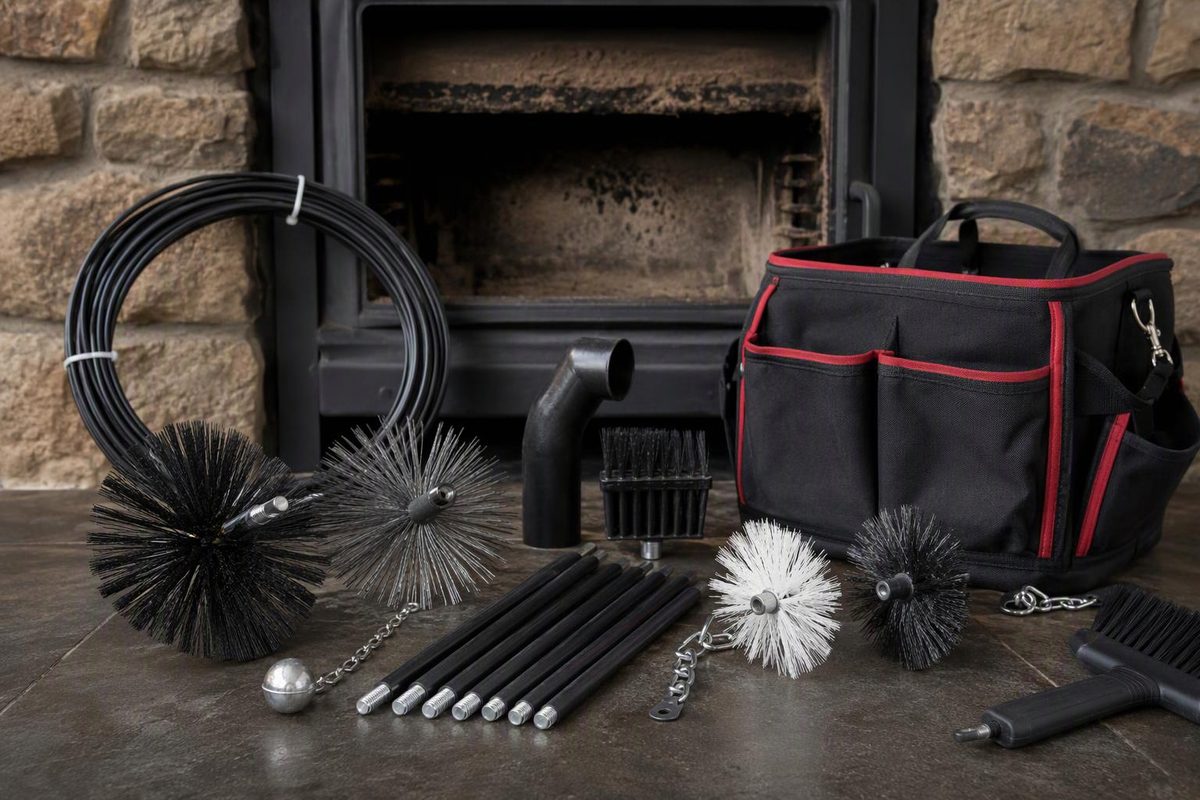
A chimney-cleaning kit is a system, not just a brush. The head must suit the flue, the rods must travel the full vent path, and the containment method must control the debris that comes down. Before buying tools, identify the appliance, chimney or liner manufacturer, flue material, inside dimensions, offsets and available cleanout points.
Cleaning instructions vary by product. DuraVent’s DuraPlus manual permits plastic, wood or steel brushes but warns against using anything that scratches its stainless-steel liner. Selkirk’s SuperVent/SuperPro guide specifies a properly sized plastic brush and warns that a metal brush may cause scratches and premature corrosion. Follow the instructions for the exact chimney or liner rather than treating a generic kit as universally compatible (DuraVent DuraPlus instructions; Selkirk SuperVent/SuperPro guide).
The core chimney-cleaning tools
| Tool | What it does | What to verify |
|---|---|---|
| Chimney brush or cleaning head | Agitates soot and brush-removable creosote | Flue shape, inside dimensions, liner material and permitted brush material |
| Compatible rods | Push, pull or rotate the head through the vent | Connection type, total reach, flexibility and suitability for known offsets |
| Fireplace or appliance seal | Contains loosened debris | A sealed way to pass a rod or vacuum hose into the work area |
| Vacuum approved for chimney soot | Captures loose material and helps control dust | The manual expressly permits the collected material; all specified filters are fitted and intact |
| Inspection light and mirror | Checks accessible surfaces, obstructions and progress | Compact equipment that can be secured against falling into the flue |
| Hand brush and scoop | Cleans the firebox, smoke shelf, cleanout or appliance chamber | Bristles and edges that will not damage refractory or appliance parts |
| Basic hand tools | Remove a cap, cleanout cover or baffle when instructions allow | Correct drivers or wrenches, plus any specified replacement fasteners or gaskets |
| PPE | Limits soot exposure | Eye protection, gloves, protective clothing and respiratory protection appropriate to the hazard |
Brush diameter and material need a particularly close match. Use the worksheet in Brushes for Chimney Cleaning: Size, Material & Rod Guide before choosing a head or rod connection.
An ash vacuum is not automatically a soot vacuum
“Ash vacuum,” “shop vacuum” and “soot-control vacuum” are not interchangeable labels. Read the machine’s instructions for both the material and the filter arrangement.
For example, the PowerSmith PAVC102 manual permits only material at or below 140°F, requires its filter to be installed and prohibits collecting carcinogenic or otherwise hazardous materials. NIOSH identifies chimney soot as a carcinogenic exposure. That manual therefore supports the hot-material warning, but it does not establish that this machine is suitable for collecting chimney soot (PowerSmith PAVC102 manual; NIOSH chimney-sweep guidance).
Use only a vacuum whose manufacturer expressly permits the material being collected, with every specified filter correctly installed. Never vacuum embers or material that may remain hot. A fitted opening seal and drop cloths provide additional containment. Do not use compressed air or a blower to clear soot into the house.
Respiratory protection is part of the plan
NIOSH identifies soot, silica from masonry or mortar, aerosolized bird and bat droppings, and organic vapors from some chemicals as chimney-work hazards. Its occupational guidance puts dust control—such as exhaust ventilation or large vacuums—ahead of relying only on a respirator. It also calls for at least an N95 filtering facepiece when workers handle dust-coated tools or empty vacuum debris (NIOSH chimney-sweep guidance).
That document is written for employers and chimney sweeps, but the hazards still explain why a disposable nuisance-dust mask is not an adequate default. Respirator selection depends on the contaminant, fit and product instructions. An N95 filters particles; it does not protect against chemical vapors. Unknown droppings, chemical cleaning or extensive masonry dust are reasons to stop and obtain qualified help rather than guessing at protection.
Wear eye protection, suitable gloves and dedicated or disposable work clothing. Bag dusty disposable items, and clean reusable tools without shaking soot into the room.
Optional tools for specific access problems
A drill-driven rotary system can clean from below and may negotiate some bends, but it is not an automatic upgrade. Confirm that its head suits the liner and that rod connection, drill speed, rotation and feed technique match the tool manual. One rotary-kit manual specifies a drill-speed range and warns against spinning rods without moving them because friction can heat and break the rods (rotary brush instructions). Aggressive rotary equipment is a poor choice around fragile clay, damaged liners, loose joints or unknown offsets.
A chimney camera can show whether a head reached an offset and whether visible deposits remain. A consumer camera does not make the work equivalent to a qualified chimney inspection; it may not reveal concealed damage or establish that the complete system is sound.
Smoke-chamber whips, scrapers and chains belong in a kit only after the surface and deposit have been identified. They are not general-purpose attachments for an unknown chimney.
Roof-access equipment is needed only when the selected cleaning method requires roof work. OSHA’s extension-ladder fact sheet is workplace guidance, but its basic precautions are useful: stable, level footing; a 4-to-1 setup angle; three feet of ladder above the landing; three-point contact; and tools carried in a belt or raised by a line rather than held while climbing (OSHA extension-ladder fact sheet). A steep, wet, icy, fragile or unusually high roof is a stop point, not a reason to improvise.
Match the kit to the complete cleaning path
Before starting, answer these five questions:
- Where will the brush enter? Through the appliance, a tee or cleanout, or the chimney top?
- Can the rods reach every section? Include connectors, offsets and the full vertical height—not just the chimney visible outside.
- Where will loosened material collect? A fireplace smoke shelf, stove baffle, tee cap or offset can retain debris.
- How will the debris be removed without releasing it indoors? Plan the seal, approved vacuum and waste container before brushing.
- How will the system be checked and reassembled? Account for caps, baffles, cleanout plugs, fasteners and gaskets.
CSIA says a complete fireplace-chimney sweeping includes both the flue and smoke chamber. It also notes that deposits loosened by chemical products may remain on a smoke shelf, baffle, catalytic combustor or offset. Chemical logs and powders do not replace mechanical cleaning and inspection (CSIA homeowner resources). The same principle applies to tools: dislodging a deposit is not enough if the kit cannot retrieve it.
Stop instead of choosing a more aggressive tool
Do not proceed with routine DIY brushing when you find:
- shiny, gummy or hard glazed creosote;
- cracked clay, displaced joints, holes, corrosion or a loose liner;
- evidence or suspicion of a chimney fire;
- an animal nest or blockage that cannot be removed without damaging the vent;
- an unknown factory-built chimney or liner with no compatible cleaning instructions;
- an inaccessible smoke chamber, offset or appliance passage; or
- a roof-access problem that cannot be controlled safely.
Glazed creosote is not simply stubborn soot. CSIA’s technical paper says tar glaze can resist mechanical cleaning and may require strong chemicals used by chimney professionals. Hard, brittle slag may require specialized impact tools or scrapers (CSIA chimney-fire paper). Applying more force can damage the flue without cleaning it.
After a suspected chimney fire, do not sweep and resume use. DuraVent’s instructions say to close the appliance’s draft openings, call the fire department and leave the chimney unused until it has been inspected for possible damage (DuraVent DuraPlus instructions).
Cleaning also does not replace inspection. CSIA quotes NFPA 211 guidance calling for chimneys, fireplaces and vents to be inspected at least annually, with cleaning and repairs performed when necessary. The U.S. Fire Administration advises having a chimney professionally inspected and cleaned each year (CSIA homeowner resources; USFA fireplace and wood-stove safety). A homeowner kit is best limited to a known, sound and accessible system with deposits that its approved brush can remove—not as a way to diagnose or overpower an unknown problem.