
Identify Your Chimney Flue and Know When to Stop Using It
Learn how a chimney flue differs from its liner and damper, what appliance compatibility requires, and which warning signs call for professional inspection.
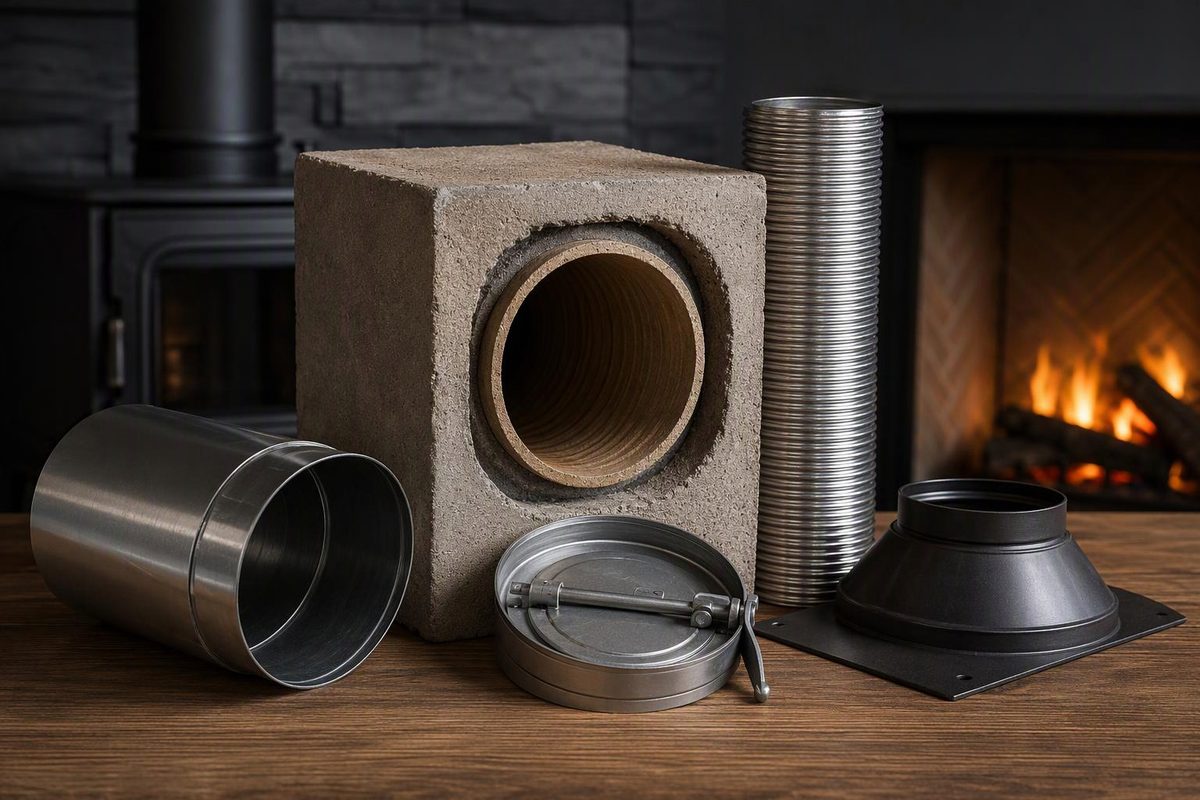
A chimney flue is the passage that carries combustion gases outdoors. The chimney contains that passage; the liner forms its inside surface. A fireplace damper is a movable plate or valve—not the flue itself. The 2021 International Mechanical Code definitions distinguish these components. Before using the connected appliance, an open passage alone is not enough: the flue also needs an intact lining, correct sizing and compatibility with that appliance.
Select the appliance and what you have noticed; the tool gives your next step, not a safety clearance.
Find Your Next Step
Compatibility not established
Identify the appliance first
Find the make, model, fuel and installation manual. Review the inspection record before deciding how to use or modify the flue.
An open passage does not establish correct sizing, intact lining or appliance compatibility.
This tool cannot inspect the flue or clear it for use.
Sources: CSIA homeowner, chimney-fire and post-fire guidance; CPSC CO guidance; 2021 IRC Chapter 10.
The Flue, Liner and Damper Have Different Jobs
| Part | Function | What to Establish |
|---|---|---|
| Chimney | Contains one or more flues | Masonry or factory-built system? |
| Flue | Carries exhaust outdoors | Which appliance does it serve? |
| Flue liner | Forms the inside surface and protects the surrounding structure | Material, size and condition? |
| Chimney connector | Joins an appliance to the chimney | Correct for this installation? |
| Fireplace damper | Opens or closes the exhaust path | Fully open before lighting? |
If you mean “How do I open the flue?”, you probably mean the damper. For a conventional open wood-burning fireplace, check that the damper is fully open before lighting, as CSIA’s homeowner guidance advises.
Do not apply fireplace-damper instructions to a stove or gas appliance without checking its manual. Our chimney damper guide explains the different arrangements.
Match the Flue to the Appliance Before Buying Parts
Start with the appliance’s make, model, fuel and installation manual—not the apparent size of the chimney opening.
For masonry chimneys, 2021 IRC Section R1003.11 requires a lining appropriate for the connected appliance’s listing and manufacturer instructions. It recognizes clay lining and listed lining systems, among other approved options, and sets separate provisions for gas and pellet appliances.
Factory-built chimneys must be listed and labeled, and installed and terminated according to their manufacturer’s instructions under R1005.1. These are model-code references; your building authority determines the locally applicable requirements. See 2021 IRC Chapter 10.
Before accepting a liner proposal, ask for:
- The appliance and fuel the liner is approved to serve.
- The required internal diameter or effective flue area.
- The insulation and clearance requirements for that system.
- The approved connection, support and termination components.
- Any required permits and inspections.
There is no universal chimney-flue size. An open masonry fireplace and a stove are sized differently. IRC R1003.15 addresses fireplace flue area using fireplace-opening dimensions, flue shape and, under one sizing method, chimney height. Appliance installations require their own applicable sizing rules. Those distinctions do not support choosing a liner diameter from a generic chart alone.
A larger passage is not automatically better. DuraVent’s DuraFlex SS flexible-liner instructions warn that incorrect liner sizing for high-efficiency appliances with low flue-gas temperatures can cause condensation and poor venting performance.
Those instructions also specify appliance limitations and insulation conditions. “Stainless steel” alone is not a complete specification, and requirements for this liner do not establish compatibility for every stainless liner. Use our stainless flue liner guide to review the whole system.
Cold-System Observations Can Find Problems, Not Clear the Flue
With the appliance off and the fireplace completely cold, gather the model information and previous inspection report. From a safe floor-level position, note any visible debris, fallen tile pieces, heavy deposits or damaged components. A flashlight check can reveal a problem, but it cannot clear the full flue for use.
Do not light a test fire to diagnose a suspected blockage, climb onto the roof for a first look or force a stuck damper.
Stop using the affected appliance and arrange professional evaluation if you find:
- Cracked or fallen liner tiles, warped metal or separated vent joints.
- Suspected nests or another obstruction.
- Heavy, shiny or tar-like deposits.
- Repeated smoke spilling into the room.
CSIA’s chimney-fire guidance explains that creosote is combustible and that chimney fires can crack tiles, displace mortar and damage metal systems.
Smoke spillage does not prove a blockage. House-pressure problems can also pull air and smoke down a flue, as CSIA’s homeowner guidance describes. Record when the symptom occurs; do not assume a new cap or cleaning alone will solve it.
An Active Fire or CO Alarm Requires Immediate Evacuation
If you suspect a chimney fire is happening now, leave the building and call 911. Loud roaring or cracking, intense heat, and flames or dense smoke from the chimney are possible signs, though some chimney fires are not obvious, according to CSIA’s chimney-fire guidance.
If a CO alarm sounds or you suspect CO poisoning, leave immediately and call 911 from outside. Do not stay inside to investigate, and do not reenter until responders permit it. Follow the CPSC’s CO emergency guidance.
Ask for Inspection, Not Just Sweeping
CSIA’s homeowner guidance cites NFPA 211’s recommendation for annual inspection, with cleaning, maintenance and repairs as needed—even for infrequently used systems. A complete fireplace sweeping includes the flue and smoke chamber, not merely the visible firebox. Chemical cleaning products are not a substitute for mechanical cleaning and inspection.
After a known or suspected chimney fire, keep the system out of use. CSIA’s post-fire guidance calls for professional evaluation and an internal video inspection after sweeping; damaged areas may be invisible from either end.
Ask the inspector to identify the flue’s appliance connection, lining material, deposits and defects, and to provide photographs and a written explanation of any recommended repair. Cleaning removes deposits. It does not repair a cracked liner or establish that the flue is suitable for a different appliance.