
Choose a Chimney Brush That Actually Fits Your Flue
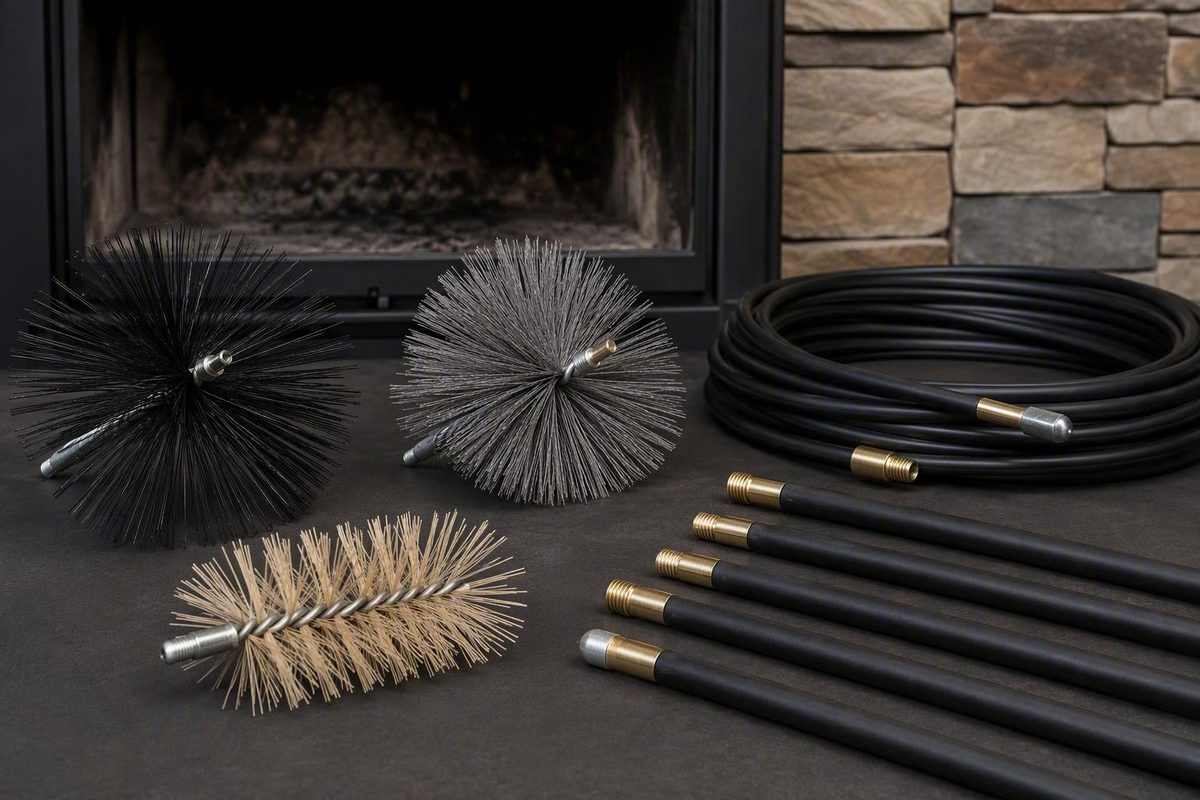
The best brushes for chimney cleaning are not defined by brand, price, or maximum stiffness. The right choice is a compatible brush-and-rod system selected for the flue’s liner material, internal shape and dimensions, bends, cleaning distance, access point, and connector standard.
That distinction matters because a masonry chimney may contain clay tile or a metal liner. A correctly sized brush may still be unsuitable for an offset or tee, and an appropriate head is unusable if the rods cannot follow the route, reach the termination, or connect securely.
Before ordering, check the appliance manual, liner instructions, and tool specifications. If you cannot identify the liner, map the route, or verify compatibility, stop treating the job as a simple brush purchase and seek qualified help.
Start Here: The Six-Part Chimney Brush Decision
Collect information in this order:
- Identify the flue or liner material.
- Determine its internal shape.
- Measure its internal dimensions.
- Map bends, offsets, transitions, and restrictions.
- Calculate the required cleaning reach.
- Verify the brush-to-rod connection.
Do not start with the chimney’s exterior. A brick chimney may contain clay flue tiles, a rigid metal liner, or a flexible metal liner. Likewise, the visible appliance collar does not necessarily reveal the size, shape, or construction of the complete flue.
Start with any available appliance records, liner documentation, installation paperwork, and product markings. Compare that information with the accessible parts of the system without dismantling components or entering an unsafe area. If the records are absent or conflict with what is visible, have the system identified rather than inferring its construction from the chimney exterior.
A quick selection matrix
| What is inside the chimney? | Starting point for brush selection | What to confirm |
|---|---|---|
| Metal or stainless-steel liner | Manufacturer-approved poly or nylon head | Permitted brush material, exact shape and size, and powered-use restrictions |
| Clay-lined masonry flue | Masonry-rated wire or another specifically approved head | Tile dimensions, joints, offsets, restrictions, and sizing instructions |
| Unlined masonry | Do not assume wire or poly is universally appropriate | Construction, condition, and permitted cleaning method |
| Unknown liner or flue | Confirm the system before buying | Material, condition, shape, dimensions, and access route |
This is a shopping framework, not a universal technical standard. Commercial guides commonly recommend poly or nylon for metal liners and wire for clay, brick, stone, or masonry. Those recommendations come primarily from manufacturers and retailers rather than independent comparative testing.
The head should also correspond to the flue’s internal cross-section. Round, square, rectangular, and oval heads are commercially available. Choosing the nearest familiar shape without measuring can provide poor contact in corners or create unnecessary resistance.
Treat the head and rods as separate purchasing decisions:
- The head must suit the liner, cross-section, dimensions, and permitted cleaning method.
- The rods must provide enough usable reach and negotiate the actual route.
- The fittings must form a manufacturer-approved connection.
- The assembled system must suit the complete cleaning path, not merely the principal vertical section.
Do not substitute a dryer-vent, pellet-stove, boiler, or other specialty brush simply because its diameter appears suitable. Retailers list these as distinct product categories, and a similar appearance does not establish compatible bristles, fittings, reach, or intended use.
Identify and Measure the Flue Before Buying
Measure the interior of the flue, not the chimney exterior, fireplace opening, or an assumed appliance size.
Record the primary dimensions as follows:
- Round flue: internal diameter
- Square flue: internal width and length
- Rectangular flue: internal width and length
- Oval, tapered, narrowing, or irregular flue: all safely accessible dimensions and the locations where they change
The supplied commercial guidance does not establish one universal measuring method for oval, tapered, or irregular flues. If no standard head closely follows the cross-section, obtain product-specific advice or qualified measurement.
Measure the route, not just the main flue
The largest and straightest section is only part of the selection problem. Account for accessible:
- Dampers
- Smoke-chamber transitions
- Offsets
- Tees
- Appliance outlets
- Connector-pipe transitions
- Changes between tile sections
- Narrowing areas
- Termination components that affect access
Matching the principal liner dimensions does not prove that the brush-and-rod assembly can traverse the complete route. If you cannot determine the internal path safely, do not infer it from exterior dimensions.
Exact size or slightly oversized?
Commercial guidance conflicts. A Rockford Chimney Supply guide recommends a brush one-half to one inch larger than the flue while warning that excessive oversizing can lodge the brush. Other retailer guidance recommends matching the flue’s internal dimensions exactly. These recommendations do not share a cited independent test method, so neither should be treated as a universal rule.Rockford’s chimney-brush sizing guidance
Use this process instead:
- Take accurate internal measurements.
- Identify the liner or flue construction.
- Check the liner manufacturer’s cleaning instructions.
- Check the selected brush manufacturer’s sizing instructions.
- Ask the manufacturer or a qualified supplier to resolve any conflict.
For example, a 6-inch round liner calls for evaluating a 6-inch round brush under the applicable product instructions—not automatically adding a fixed amount. An 8-by-12-inch rectangular flue calls for evaluating a correspondingly shaped head rather than assuming that a generic round brush will provide suitable contact.
RUTLAND lists its rectangular masonry brush in 6-by-10, 7-by-11, and 8-by-12-inch sizes and tells buyers to match the brush dimensions to the flue’s inside measurements. That is a product-specific instruction, not a sizing rule for every brush design.RUTLAND’s rectangular wire-brush specifications
A head that is too small may not contact the full surface effectively. An improperly oversized head may bind, become difficult to move, or conflict with the manufacturer’s instructions. Shape matters as much as nominal size: a round head is not automatically equivalent to a square or rectangular one of similar width.
Poly vs. Wire: Match the Bristles to the Liner
“Poly,” “nylon,” “wire,” and “flat wire” refer to materially different brush categories:
- Poly brushes use synthetic bristles such as nylon or polypropylene.
- Wire brushes use steel bristles.
- Flat-wire brushes use a stiffer wire profile marketed for more scraping action.
- Cleaning stars and specialist heads are sold in different materials and hardness categories for particular systems.
RUTLAND identifies its rectangular wire brush as a masonry-chimney tool and directs owners of metal flue liners to use a poly brush instead. Several retailer guides make the same broad distinction: poly or nylon for metal and stainless-steel liners, and wire for clay-lined masonry, brick, or stone. This remains commercial guidance, not independent evidence that one material is correct for every system.
Why sellers generally direct metal liners toward poly
Retailer guides warn that wire bristles may scratch or wear metal venting components. That warning is a reason to verify compatibility, not permission to assume that every synthetic brush is suitable for every metal liner.
For a metal system, confirm:
- Whether nylon, polypropylene, or another material is permitted
- Whether the liner is flexible or rigid
- Whether the selected head and coupling suit its dimensions
- Whether rotary cleaning is allowed
- Whether the appliance or liner instructions impose other restrictions
Wire is not automatically right for every masonry chimney
Clay-lined masonry is commonly associated with wire brushes in commercial guides, but “masonry chimney” is too broad to settle the choice. The chimney may be clay-lined, repaired, relined with metal, or unlined.
Commercial recommendations for unlined masonry are not consistent enough to support a universal brush choice. Confirm the construction and condition rather than defaulting to the stiffest available head.
Where flat wire and specialist heads fit
Flat-wire brushes are sold as stiffer and more aggressive than conventional wire brushes. That product description does not prove that they clean better in a particular chimney or that they are suitable for hard deposits. Use one only when the tool and flue instructions permit it.
Specialist catalogs also separate stars, boiler brushes, threaded brushes, and soft, medium, and hard heads. Wöhler, for example, lists these as distinct cleaning-tool categories, but its catalog does not provide a universal hardness-selection chart.Wöhler’s chimney and vent cleaning-tool categories
Before selecting a bristle type, confirm:
- The liner or flue construction
- The bristle material permitted by the liner manufacturer
- The appropriate head shape and stiffness
- The fuel and appliance cleaning instructions
- Whether powered rotation is permitted
- Whether the deposits are suitable for ordinary brushing
Choose Rods for Reach, Bends, and Control
Rod selection determines whether the chosen head can reach the complete cleaning path and remain controllable.
Calculate reach by adding the connected usable lengths of the rod sections. Do not rely only on a kit’s advertised total. Measure from the intended access point to the termination along the actual route. The supplied sources do not establish a universal allowance for extra working length, so follow the rod manufacturer’s instructions for the selected access method.
Stiff rods versus flexible rods
Commercial guides generally position:
- Stiffer fiberglass rods for relatively straight runs
- Flexible nylon or similar rods for bends, offsets, or tees
These are broad shopping categories, not guaranteed capabilities. Rod material alone does not establish bend capacity, coupling strength, maximum run, or suitability for rotary use.
The practical tradeoff is:
- A rigid rod may provide more thrust and directional control but may not negotiate a sharp change.
- A highly flexible rod may pass a bend but become difficult to push or control over a long run.
For a long chimney, check the rod diameter, stiffness, connection system, number of permitted sections, and manufacturer limits rather than buying only by nominal length. For a tight bend, narrowing passage, or tee, confirm that both the rod and head are approved for that geometry.
Common rod-system components
Depending on the system, listings may include:
- Three-, four-, five-, or six-foot extension rods
- Flexible leader rods
- Complete rod kits
- Reducers or adapters
- Pull rings
- Product-specific rotary heads
- Drill adapters for systems that expressly permit powered use
One Midwest Hearth listing displayed an 18-foot fiberglass kit made from six 3-foot rods, individual 3-foot fiberglass rods, and a 20-foot pellet-stove rod kit. These examples illustrate different modular configurations; they do not establish that a pellet-stove kit is suitable for a full-size chimney flue.Midwest Hearth’s brush and rod listings
Neither accessory is universal.
Threads, Couplings, and Adapters: Verify the Whole System
Connector compatibility is a mandatory pre-purchase check. Product listings in the supplied evidence use labels including:
- 1/4-inch PT
- 3/8-inch PT
- 1/4-inch NPT
- 1/4-inch NPSM
- 3/8-inch NPSM
- M10
- Pull-ring connections
- Reducers
- Proprietary button-lock systems
Similar names or nominal diameters do not establish interchangeability. Mix components only when the applicable tool manufacturer approves the exact combination.
Retail listings illustrate the variety. RUTLAND specifies a male 1/4-inch NPT connector for its rectangular brush; Midwest Hearth lists 1/4-inch and 3/8-inch NPSM accessories; Woodland Direct lists products using 1/4-inch and 3/8-inch PT labels; and Wöhler lists threaded M10 brushes. These are examples of different market labels, not proof of equivalence.Woodland Direct’s chimney brush and rod listings
Before ordering, record:
- Exact brush fitting
- Exact rod fitting
- Thread or connection gender where applicable
- Adapter or reducer model
- Brush and rod brand or system family
- Written manufacturer confirmation of compatibility
Accessories have specific roles:
- Reducers join approved components with different stated fitting sizes.
- Pull rings support compatible rope-based arrangements.
- Leader rods guide certain compatible assemblies.
- Proprietary locks connect only according to their system instructions.
Do not force a thread or treat partial engagement as proof of compatibility. If the manufacturer does not identify the components or adapter as compatible, choose a matched system.
Compact compatibility worksheet
| Field | Record before purchase |
|---|---|
| Brush head | Brand, model, material, shape, and size |
| Rod type | Brand, material, diameter, and stiffness |
| Connection label | Standard or system name, nominal size, and gender |
| Adapter or reducer | Exact approved model |
| Total usable reach | Sum of connected working lengths |
| Cleaning direction | Top-down, bottom-up, or approved pull method |
| Manufacturer confirmation | Manual page, written reply, or verified specification |
Complete the worksheet for the assembled system. Every extension and accessory should belong to the same approved arrangement.
Manual Brushes, Rotary Systems, and the Real Cost of a Kit
Conventional push-pull and drill-powered rotary systems are both sold for chimney cleaning. The supplied evidence does not establish that either is universally faster, safer, or more effective. Compare them by compatibility, geometry, access, instructions, included parts, and total cost.
Conventional push-pull systems
A conventional system generally combines:
- A shaped poly or wire head
- Connectable rods
- Any approved leader or adapter
- For certain products, an explicitly compatible pull-ring arrangement
The operator advances and withdraws the head manually. Even in a relatively uniform flue, rod stiffness and head shape must suit the route.
Rotary systems
A rotary system uses flexible rods and a rotating head. Drill speed, torque, rotation direction, attachment method, liner compatibility, and operating procedure must come from the manual for that exact product. The supplied evidence does not support generic drill settings.
Rockford Chimney Supply describes its SootEater system as suitable for flexible liners, chimney pipe, and clay flues and says it may be operated bottom-up or top-down. Treat that as the seller’s description of that product, not as universal compatibility for rotary equipment.Rockford Chimney Supply’s rotary and conventional systems
Compare complete-system cost, not head price
The brush head may be only one part of the purchase. Depending on the job, the shopping list can include:
- Brush or rotary head
- Enough compatible rods
- Leader rod
- Approved adapter or reducer
- Work-area containment
- Manufacturer-specified protective equipment
- Suitable cleanup equipment
- Shipping
The cited Midwest Hearth listing displayed round poly brushes from $22.95, round wire brushes from $25.95, an 18-foot fiberglass kit at $54.95, and a 24-foot rotary system at $238.95. These figures are listing snapshots, not current quotes.
Rockford listings displayed a round poly brush from $49.99 and a SootEater rotary system from $122.99. RUTLAND’s rectangular wire brush listing displayed $52.99. The figures varied by product and configuration and require rechecking before purchase.
At the upper end of the supplied examples, Lindemann listed a professional ceramic-liner power kit at $933.95.Lindemann’s professional chimney-sweeping equipment listings
These examples do not rank quality. Size, included rods, intended user, shipping, and availability make direct comparison difficult. Customer ratings, review counts, sponsored placements, and “best seller” labels also do not establish liner safety or compatibility.
Plan the purchase under one of three scenarios:
- Replace only the head. This may cost less if the existing rods, fittings, reach, and approvals are verified.
- Buy a complete manual system. Include the correct head, sufficient rods, approved adapters, containment, protective equipment, and cleanup supplies.
- Buy a product-specific rotary system. Include all required rods, heads, drill interfaces, containment, and protective supplies specified by its manual.
Know When a Different Brush Is Not the Answer
Ordinary brushing is not a universal response to every deposit or obstruction.
Loose soot and soft, dusty deposits differ from hard, shiny, resistant buildup. An eFireplaceStore buyer’s guide says hard, shiny deposits may require treatment before brushing, while also recommending professional help when the homeowner is unsure. That commercial guidance does not establish that a homeowner-applied chemical or more aggressive head makes removal appropriate.eFireplaceStore’s chimney-brush buyer’s guide
If hard or shiny buildup remains resistant, do not automatically escalate to flat wire, a scraper, or an unapproved rotary head. Obtain product-specific guidance or professional assessment.
Obstructions are diagnostic problems
Nests, fallen material, and unidentified blockages are not ordinary wall deposits. Specialist catalogs sell nest hooks, worm screws, scrapers, and related obstruction tools, but their availability does not establish that they are suitable for a homeowner or a particular liner.Rodstation’s specialist brush and obstruction-tool overview
Weak draft also warrants investigation rather than a larger brush. The retailer evidence identifies buildup, blockage, venting concerns, and damage as possible issues requiring assessment.
Stop-work conditions
Postpone the purchase or stop the cleaning attempt when:
- The liner material cannot be identified.
- The route cannot be measured or mapped.
- Cracks, separation, corrosion, or other damage are suspected.
- Roof access is unsafe.
- The flue changes direction more sharply than the tool instructions permit.
- A tool becomes stuck.
- Draft is weak or abnormal.
- Deposits are hard, shiny, or resistant.
- A nest or unidentified obstruction is suspected.
- Ordinary approved brushing does not produce a satisfactory result.
A visually clearer passage does not establish complete deposit removal or structural condition. Retailer guidance notes that professional sweeps may use video equipment to assess cleaning and look for cracks, but it does not indicate that every inspection includes a camera.Northline Express’s chimney-brush selection guide
Keep maintenance and diagnosis separate. If the symptom suggests damage, obstruction, or abnormal draft, seek an inspection rather than escalating the tool.
DIY Safety, Professional Help, and the Final Buying Checklist
General online guidance cannot determine whether a particular chimney is suitable for homeowner cleaning. The appliance instructions, liner documentation, tool manual, access conditions, and actual condition of the chimney govern that decision.
For its rectangular wire brush, RUTLAND directs users to extinguish the fire and ensure that the chimney is cold along its entire length before cleaning. Its directions also call for eye protection, gloves, an approved dust mask, work-area protection, and attention to roof, electrical, fire, and wire-injury hazards.RUTLAND’s preparation and safety directions
Follow the protective-equipment and containment instructions for the actual product and task. Keep debris isolated from the occupied area and use cleanup equipment specified as suitable by its manufacturer.
Top-down and bottom-up methods are both described by sellers, but neither is universally preferable. The appropriate direction depends on:
- Safe access
- Fireplace or appliance configuration
- Dampers, tees, and offsets
- Rod and head instructions
- Containment options
- Whether the selected system permits that direction
Avoiding roof access removes one difficulty but does not make every bottom-up procedure suitable. Conversely, a tool advertised for top-down cleaning does not make ladder or roof access appropriate for every user.
RUTLAND recommends annual inspection and cleaning by a certified chimney technician in the context of its product directions. That is the manufacturer’s recommendation, not evidence of one universal schedule for every chimney, appliance, fuel, and use pattern.
Professional help is prudent when:
- You cannot identify the liner.
- You cannot measure or map the path.
- Roof access is unsafe.
- The flue has difficult bends or narrowing sections.
- Draft is weak.
- Deposits are hard, shiny, or resistant.
- A nest or blockage is suspected.
- Liner or masonry damage may be present.
- You cannot verify tool compatibility.
- A rod or head becomes stuck.
Final pre-purchase checklist
Before ordering brushes for chimney cleaning, confirm:
- [ ] The liner or flue material is identified.
- [ ] Appliance and liner cleaning instructions have been checked.
- [ ] Internal shape is recorded.
- [ ] Internal dimensions are recorded.
- [ ] Dampers, offsets, tees, transitions, and narrow passages are considered.
- [ ] Brush material is permitted for the liner.
- [ ] Head stiffness and construction are permitted.
- [ ] Rod type suits the route.
- [ ] Connected usable rod length reaches the complete path.
- [ ] Brush, rods, adapters, and reducers have verified fittings.
- [ ] Manual or rotary use is permitted.
- [ ] The intended cleaning direction is supported.
- [ ] Required containment and cleanup equipment are available.
- [ ] Manufacturer-specified protective equipment is available.
- [ ] Price, shipping, specifications, and availability have been rechecked.
- [ ] Stop-work conditions have been reviewed.
After cleaning, remaining deposits, visible damage, abnormal draft, or unresolved uncertainty should lead to further assessment rather than an assumption that the chimney is ready for use.
Frequently Asked Questions
Can I use a wire chimney brush on a stainless-steel liner?
Commercial guides generally direct owners of stainless-steel and other metal liners toward a manufacturer-approved poly or nylon brush. RUTLAND specifically says to use a poly brush rather than its cited rectangular wire brush on a metal flue liner.
That does not make every poly head compatible. Confirm the liner manufacturer’s permitted brush material, size, construction, and cleaning method. If the liner cannot be identified, do not guess.
Should a chimney brush be the exact flue size or slightly larger?
The supplied guidance does not support one universal answer. Rockford recommends a brush one-half to one inch larger than the flue while warning against excessive oversizing; other seller and manufacturer guidance calls for matching the internal dimensions.
Measure accurately and follow the instructions for the specific liner and brush. A small head may provide inadequate contact, while an improperly oversized head may bind or conflict with product directions.
Are 1/4-inch, 3/8-inch, NPT, NPSM, PT, and M10 chimney rods interchangeable?
Do not assume so. Nominal diameter is only part of the connection description.
Record the exact fitting on both components and use only an adapter or reducer approved for that combination. Proprietary button-lock and pull-ring systems must be used according to their own instructions.
Are rotary chimney brushes better than conventional push-pull brushes?
The supplied evidence does not show that either system is universally better. A conventional system may suit a compatible shaped head and accessible route. A rotary system provides a different head and rod arrangement but introduces product-specific requirements for the drill interface, operating direction, rods, and liner.
Compare complete systems by compatibility, geometry, access, included components, instructions, containment needs, and total cost—not generic claims about speed or cleaning power.
When should I hire a professional instead of cleaning the chimney myself?
Seek qualified help when the liner is uncertain, access is unsafe, the route cannot be measured, the flue has difficult bends or narrowing sections, draft is weak, deposits are hard or shiny, a blockage is suspected, or liner or masonry damage may be present.
Professional assessment is also appropriate when cleaning appears incomplete, a tool becomes stuck, or the brush, rods, fittings, and method cannot be verified against the applicable instructions.
The purchase is not simply a choice among brush heads. Confirm the liner, measure the internal flue, match its shape, select rods for the route and total reach, and verify every fitting before ordering. Where sizing advice conflicts, follow the applicable appliance, liner, and tool manufacturers rather than a universal online rule. If the system remains uncertain or the problem involves abnormal draft, resistant buildup, suspected damage, or an obstruction, arrange a qualified chimney inspection instead of buying a more aggressive brush.