
Close Your Fireplace Damper Without Trapping Smoke or Carbon Monoxide
Wait until flames, embers, and hot coals are gone, identify the damper control, move it without force, then verify the plate is closed.
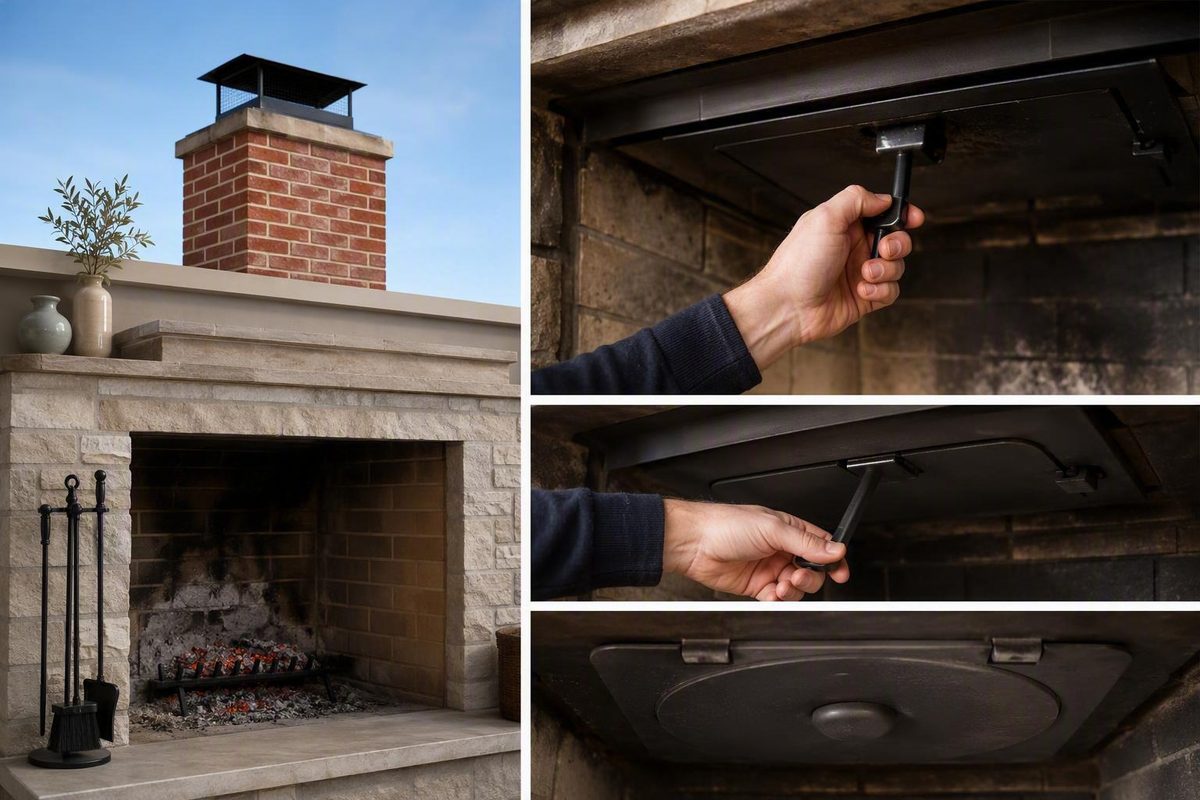
Quick Answer: Close the Damper, Not the Flue Passage
In ordinary fireplace language, “closing the flue” usually means moving the fireplace damper to its closed position. The flue** is the passage that carries smoke and combustion gases through the chimney. The damper** is the movable metal plate or closure that controls airflow through that passage.
For a conventional wood-burning fireplace, follow this sequence:
- Extinguish: Let the fire burn out completely.
- Cool: Wait until no flames, glowing embers, or hot coals remain and the fireplace has cooled.
- Identify: Find the actual damper control and check its markings or owner’s manual.
- Operate: Move the control in the specified closing direction without forcing it.
- Inspect: For a visible throat damper, use a flashlight to confirm that the plate moved closed. For a top-sealing damper, verify the control position as its manufacturer directs.
The damper must remain fully open while a wood fire, glowing embers, or hot coals remain. Closing or partly closing it during combustion can obstruct the exhaust path and allow smoke and combustion gases, including carbon monoxide, to enter the room (fireplace damper operating guidance).
Stop before attempting closure if the fireplace has gas logs, you cannot identify the control, a clamp prevents the damper from closing, or the appliance instructions require an open vent. Gas-log sets, inserts, wood stoves, and some factory-built fireplaces do not follow the same procedure as a conventional masonry wood fireplace.
This is general operating guidance, not a substitute for the instructions supplied with the installed fireplace, insert, stove, gas-log set, damper, or venting system. If those documents are unavailable or the system cannot be identified, leave the damper in its existing safe operating position and arrange an appropriate inspection.
Before Touching the Control: Pass the Safety Check
Do not move a wood-fire damper toward closed until all of the following are true:
- No flames remain.
- No embers are glowing.
- No hot coals remain.
- The fireplace and accessible controls have cooled.
- You have identified the control that operates the damper.
- No connected appliance requires the vent to remain open.
A fire is not necessarily finished when visible flames disappear. Coals can continue to smolder, so the absence of flames alone does not establish that closure is safe. Do not partly close the damper to retain heat while combustion continues; wood-fire guidance calls for the damper to remain fully open until the fire, embers, and coals are out (fireplace damper safety guidance).
The available evidence does not establish a universal number of minutes or hours after which hidden coals are guaranteed to be out. If you cannot confidently establish that combustion has ended, keep the damper fully open and wait longer. If uncertainty persists, obtain qualified help rather than using closure as a test.
Allow the firebox and accessible metal components to cool before inspecting them. Once they are cool, use work gloves and a flashlight to locate the plate and control. Fireplace components can remain hot after the visible fire ends, and closing too soon can retain residual smoke and carbon monoxide indoors (flue-closing and cooling guidance).
If the fireplace contains gas logs or another fuel-burning appliance, do not move the damper until you have identified the appliance and checked its instructions. Some vented gas-log installations require the damper to stay open and use a clamp to prevent full closure.
A functioning carbon-monoxide alarm provides supplementary warning, but it does not make early damper closure safe. It cannot replace an open exhaust path during combustion, correct appliance operation, or inspection of a system that is damaged or uncertain. General fireplace guidance recommends carbon-monoxide detection alongside proper damper operation and chimney inspection (fireplace inspection and carbon-monoxide guidance).
Identify the Damper and Its Control
A conventional throat damper is a metal plate near the top of the firebox, below the main flue passage. When open, it leaves a path for smoke to rise into the chimney. When closed, the plate lies across most of that path.
A top-sealing damper closes at the top of the chimney rather than above the firebox. It is commonly operated by a dedicated cable or handle accessible from the fireplace. Because the closure is at the chimney termination, it may not be visible from below.
Depending on the installation, the damper control may be:
- A lever
- A rigid handle
- One or more pull chains
- A rotary key or knob
- A cable attached to a bracket or handle
Do not assume every control near the fireplace operates the damper. A slider marked “air,” for example, may regulate combustion rather than close the chimney.
Before moving anything, look for:
- OPEN/CLOSED markings near the control.
- An operating label or tag inside or beside the fireplace.
- A manufacturer name and model number.
- The fireplace, insert, stove, gas-log, or damper owner’s manual.
- Visible movement of the damper plate when the identified control is moved.
There is no safe universal direction such as “left closes,” “pull toward the room,” or “use the shorter chain.” Published instructions describe different directions because the mechanisms differ. Some levers slide sideways, some handles push or pull, some keys rotate, and some cable systems latch against a bracket. The installed markings and instructions must determine the direction.
A throat damper, flue passage, and top-sealing damper also occupy different locations. In a typical cutaway view, the throat damper sits immediately above the firebox, the flue rises through the chimney, and the top-sealing closure sits at the termination. Any diagram used to identify these parts should also distinguish the damper control from nearby gas-valve and combustion-air controls.
If you cannot positively identify the damper control, stop. Do not experiment with unfamiliar keys, valves, levers, chains, or cables.
How to Close the Damper Step by Step
The following procedure applies only after you have established that the fireplace is cool, combustion has ended, and damper closure is permitted for the installed system.
1. Confirm that combustion has ended
Verify that no flames, glowing embers, or hot coals remain. Do not rely on elapsed time or the disappearance of visible flames alone.
If you cannot determine whether coals are still active, leave the damper fully open. There is no evidence-supported universal waiting period that applies to every wood fire.
2. Put on gloves and inspect with a flashlight
After the fireplace and accessible components have cooled, put on work gloves and shine a flashlight toward the upper firebox. Locate the metal damper plate and, where visible, trace its linkage to the control.
Keep the inspection limited to areas that are safely accessible from the room. Roof access and work inside inaccessible chimney spaces are not part of ordinary homeowner damper operation.
3. Check the labels and operate the identified control
Follow the installed markings and owner’s manual. Move the control slowly and only in its specified closing direction.
Lever or handle: Some mechanisms must be lifted, shifted, or released from a notch before they slide, pivot, push, or pull. Because lever arrangements differ, do not apply one movement rule to every fireplace.
Pull chains: Some systems use one chain to release the damper and another to close it. Chain length is not a universal identifier. Use labels, the installed instructions, and visible plate movement to determine what each chain does.
Rotary key or knob: Some worm-gear dampers close when turned clockwise, but that direction is not universal. Follow the manual and observe the plate. Stop when the mechanism reaches its normal closed position rather than continuing to tighten it.
Top-sealing cable: Some top-sealing systems close when the cable is pulled down and secured and open when it is released. A documented installation shows that arrangement in one wood-stove and masonry-chimney configuration, but other models may use different controls. Follow the instructions for the installed product rather than copying a configuration-specific demonstration (top-sealing damper demonstration).
4. Stop if the mechanism does not move normally
Stop if the control:
- Binds or grinds
- Requires excessive force
- Appears disconnected
- Moves without moving the plate
- Cannot be returned to its previous position
- Leaves the damper position uncertain
Do not use a tool for additional leverage. Evidence-based damper guidance recommends professional attention when a mechanism is difficult to move, missing, cracked, warped, or unable to seal rather than forcing it.
5. Verify the plate, not merely the handle
For a conventional throat damper, use the flashlight again. Confirm that the metal plate lies across the normal upward passage. If a substantial open route remains above it, the damper may not be closed.
A top-sealing damper generally cannot be confirmed by viewing the chimney-top closure from the firebox. Check its interior control position according to the installed product’s instructions. If operation remains uncertain, arrange an inspection; do not climb onto the roof as part of this procedure.
How to Tell Whether the Damper Is Fully Closed
For a cool, accessible conventional throat damper, direct visual inspection is the primary homeowner check:
- Put on work gloves.
- Stand at the fireplace opening.
- Shine a flashlight above the firebox.
- Locate the metal plate.
- Confirm whether it lies across the normal upward passage.
A closed throat damper generally presents a metal plate across the passage. An open damper leaves a visible route above the firebox into the chimney. This visual distinction is more useful than relying on a generic handle direction (visual damper-position guide).
Handle position alone is insufficient.
The following are only secondary clues:
- Less cool air entering the firebox
- Reduced airflow at the fireplace opening
- Less outside noise coming through the chimney
Wind, indoor pressure, outdoor temperature, and chimney condition can affect those clues. Their absence does not prove the damper is closed, and continuing airflow does not necessarily mean the control was operated incorrectly.
Do not light a match, candle, smoke source, or new fire merely to test an uncertain damper position. Starting a fire without first establishing that the damper is open can allow smoke to enter the room. If you cannot verify an open path before a fire or confirm closure afterward, have the system examined.
A traditional cast-iron throat damper may remain somewhat leaky even when properly closed. Rust, warping, damage, debris, poor seating, or gaps associated with an insert or liner can also allow drafts. Treat continuing airflow as a possible sealing or system-condition problem, not a reason to force the control.
After you have positively identified both positions, a reversible DAMPER OPEN / DAMPER CLOSED tag near the control can help household members track its status.
Before the next fire:
- Remove every temporary chimney or fireplace blocker.
- Move the damper to open.
- Visually confirm the exhaust path when the design permits.
- Follow the fireplace or appliance startup instructions.
Gas Logs, Inserts, and Fireplaces Without a Conventional Damper
Traditional wood-fireplace instructions cannot automatically be applied to gas logs, inserts, stoves, or factory-built fireplaces.
Vented gas logs
Vented gas logs may require the damper to remain open. Some installations use a C-clamp that prevents full closure. Never remove, loosen, relocate, or defeat such a clamp to stop a draft; available gas-log guidance identifies the clamp as a way of maintaining the required open damper position.
Consult the gas-log manual and installation documentation. If the model or installation cannot be identified, do not alter either the damper position or the clamp.
Unvented gas logs
Do not infer from the word “unvented” that damper closure is always permitted. Requirements depend on the particular appliance, its instructions, the fireplace configuration, and locally applicable requirements.
If the documentation is unavailable, have the installation identified before changing the damper or any attached hardware.
Factory-built or certified fireplaces
Some certified fireplaces use gasketed doors and combustion-air controls rather than a conventional flue damper. Other models have their own damper arrangements.
A combustion-air control is not automatically a chimney closure. Do not use a slider, knob, or lever as a flue damper unless the appliance instructions identify that function.
Wood-stove and fireplace inserts
An insert or stainless-steel liner may pass through the original throat-damper area.
Do not attempt to bend the original damper around a vent or place material into gaps. A top-sealing system may be considered for certain configurations, but product compatibility, cap installation, liner alteration, and roof work are outside routine homeowner operation and require system-specific evaluation.
Decision rule: If a fuel-burning appliance is connected to the flue, use the instructions for that appliance and its installed venting system. If those instructions are unavailable or the installation differs from them, stop and seek qualified assistance rather than applying generic fireplace directions.
What to Do If the Damper Is Stuck, Damaged, or Still Leaks
A damper that will not close may have:
- Loose soot or grime around accessible moving parts
- Rust or corrosion
- A cracked or warped plate
- A disconnected handle, chain, cable, or linkage
- A bent or binding mechanism
- A missing component
- A plate that moves but does not seat
- An insert or liner occupying the old damper area
Once the fireplace is completely cold, you may remove loose grime that is safely accessible around the visible control area. Do not reach into inaccessible chimney spaces or dismantle a mechanism whose operation is uncertain.
Do not force a seized lever, chain, key, knob, or cable. A difficult, damaged, or non-sealing damper warrants professional examination rather than additional force (damper and flue condition overview).
Arrange an appropriate chimney or hearth-system inspection when the damper is:
- Hard to move
- Visibly cracked, warped, or heavily corroded
- Missing or disconnected
- Inaccessible
- Uncertain in position
- Unable to open fully
- Unable to seat after limited accessible cleaning
A conventional cast-iron throat damper may leak some air even when closed. Continuing draft can also indicate damage, poor seating, gaps around an insert, or another leakage path. It does not establish that the control was moved incorrectly.
Keep air leakage separate from flue obstruction. A leaky damper is a comfort and system-condition problem. An obstructed exhaust path is a combustion-safety problem. Whenever a fireplace or connected appliance operates, the required exhaust route must be open and unobstructed; blocked flues can allow smoke and combustion gases to enter the home (blocked-flue safety discussion).
The supplied evidence does not establish one cleaning interval for every installation. It also does not support promising a particular percentage or dollar amount of energy savings from damper repair or a top-sealing system.
Damper Closure vs. a Chimney Balloon or Permanent Closure
“Closing the chimney” can describe three different goals:
| Goal | Method | Key limitation |
|---|---|---|
| Routine operation of a usable fireplace | Close the installed damper after combustion ends | The damper must be reopened before every fire |
| Seasonal draft reduction | Use a removable product documented for the specific installation | The product must be removed before use |
| Permanent decommissioning | Make property-specific changes to the fireplace and chimney | Requires professional evaluation and local review |
Routine damper operation
If the fireplace remains usable, ordinary operation means closing its functioning damper only after combustion has ended and the system has cooled. Before the next fire, reopen the damper and verify that the exhaust path is open.
Removable seasonal blocker
Chimney balloons, damper plugs, and flue blockers are separate products placed in or near a fireplace or chimney opening. They do not replace the installed damper, and generic guidance cannot establish that a particular blocker is compatible with a specific masonry fireplace, gas-log set, insert, pilot light, or factory-built unit.
Every temporary blocker must be removed before a fire is lit. Lighting a fire in a blocked chimney can create fire and smoke hazards, and all occupants should be told whenever the fireplace cannot be used (temporary fireplace-closure guidance).
A conspicuous notice at the fireplace or its controls is one practical way to communicate that a blocker is installed. The notice should make clear that the fireplace must not be used until the blocker has been removed.
Do not assume that household insulation, plastic, foam, plywood, fabric, or another improvised material is suitable for placement in a fireplace or flue. Select and use any removable product only under documentation that addresses the particular product and fireplace configuration.
Permanent decommissioning
Permanently taking a chimney out of service is not accomplished by simply shutting the damper. A property-specific project can involve:
- The fireplace opening
- The chimney termination and cap
- Moisture and ventilation
- Insulation
- Flue liners
- Connected appliances
- Structural condition
- Permits and inspection
- Locally applicable requirements
The supplied commercial sources do not offer one consistent method. One discusses comprehensive fireplace closure, while a chimney-service source advises against fully sealing the chimney and raises ventilation and moisture concerns (unused-chimney discussion). Because those positions are not interchangeable, generic instructions involving sealant, insulation, boarding, masonry, or blocking the chimney top are not appropriate here.
Have the complete system evaluated by a professional familiar with the fireplace, chimney, and any connected appliances. Consult the local authority responsible for permits or inspections before permanent alteration.
Use this checklist before any future fire:
- Remove every balloon, plug, cover, or blocker.
- Confirm that the damper is fully open.
- Confirm that the flue is unobstructed.
- Follow the fireplace or appliance instructions before ignition.
The safe operating sequence is straightforward: do not close the damper while combustion remains; let the fireplace cool; identify the actual damper and its model-specific control; move it without force; and verify the result. If the system includes gas logs, an insert, an unfamiliar control, a damaged damper, or a proposed permanent closure, stop and use system-specific documentation and qualified assistance rather than a generic directional shortcut.
Frequently Asked Questions
Which way do I move the chimney damper to close it?
There is no universal direction. Depending on the design, a damper may close by sliding a lever, pushing or pulling a handle, turning a key, pulling a chain, or securing a cable.
Look for OPEN/CLOSED markings and consult the owner’s manual. Move the identified control slowly while watching the throat-damper plate when it is visible. If you cannot identify the control or the mechanism binds, stop rather than experimenting or forcing it.
How long after a wood fire can I close the damper?
There is no reliable universal number of minutes or hours. Close the damper only after the flames, glowing embers, and hot coals are completely gone and the fireplace and accessible components have cooled.
The absence of visible flame is not sufficient. If you are uncertain whether combustion remains, leave the damper fully open and wait longer.
How can I tell whether the chimney damper is open or closed?
After a conventional fireplace has cooled, use a flashlight to inspect the top of the firebox. A closed throat damper generally shows a metal plate across the passage; an open damper leaves a visible route upward.
Do not rely only on handle position, cool airflow, or outside noise. Linkages can disconnect, plates can fail to seat, and environmental conditions can change what you feel or hear. For a top-sealing damper, use the manufacturer’s specified control-position check.
Can I close the damper if my fireplace has gas logs?
Not unless the gas-log instructions and installed system permit it. Vented gas logs may require the damper to remain open and may use a clamp to prevent complete closure. Do not remove or defeat that clamp.
Requirements for unvented gas logs are appliance- and installation-specific. Check the model’s instructions and installation documentation before changing the damper position.
Is it safe to use a chimney balloon or permanently block an unused flue?
A chimney balloon or plug is a removable draft-control product, not an ordinary damper. Generic guidance cannot establish compatibility with a particular fireplace or appliance. Any temporary blocker must be removed before a fire is lit, and every occupant should know when the fireplace cannot be used.
Permanent closure is more complex than installing a larger plug. It can involve connected appliances, moisture, ventilation, caps, liners, structural conditions, permits, inspections, and local requirements. Do not permanently obstruct a flue with improvised materials; obtain property-specific professional and local-authority guidance.