
Choose a Corner Electric Fireplace by Fit, Power and Heat
Check corner dimensions, heater clearances, outlet capacity and realistic heat output before choosing a freestanding or built-in electric fireplace.
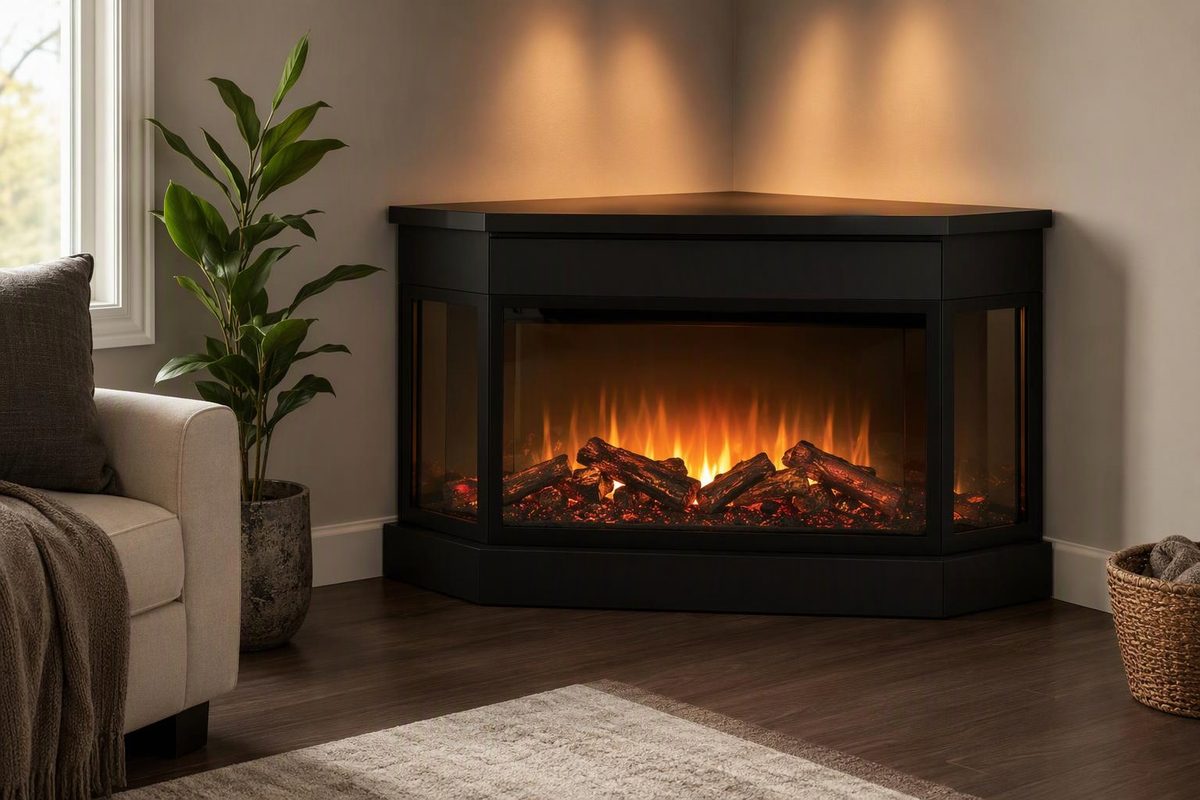
A corner electric fireplace is a good candidate when you want a flame display and supplemental heat without a combustion vent. The important checks are whether the complete assembly fits, the heater has clear airflow, and the electrical supply matches the model. A corner location does not reduce those requirements.
Start by separating two different products: a freestanding corner mantel and a built-in fireplace with an exposed glass side. They occupy different kinds of corners and involve different installation work.
1. Choose the installation type first
Freestanding corner mantel: A cabinet sits diagonally across a room’s inside corner and holds an electric firebox. This is the simpler option if you want to avoid opening walls, provided a suitable outlet is within reach. For example, the Real Flame Chateau Corner 5950E includes a mantel, firebox and six-foot cord, and plugs into a standard three-prong outlet.
Built-in corner fireplace: A recessed appliance presents its front and one exposed side at an outside corner of a framed wall or enclosure. Buy a model explicitly designed for that configuration. The North American Dimplex Ignite Bold manual shows front, left/right corner and bay configurations, with instructions for open- and closed-side trim.
Do not assume a firebox sold inside a furniture mantel can be enclosed in a wall. For example, the Real Flame 4199 specifications say that firebox is designed for Real Flame mantels, is not intended to be mounted or trimmed in, and needs rear access and airflow. Check the exact firebox supplied—not just the cabinet’s assembly sheet.
If you actually want to place an appliance inside an existing masonry fireplace, use the separate electric fireplace insert fit-and-power guide.
2. Measure the footprint, not just the front width
For a freestanding unit, obtain a dimensioned top view or assembly drawing. Record:
- The distance it occupies along each wall.
- Its projection from the corner into the room.
- Overall height and the widest mantel or base dimensions.
- Space for the plug and cord without pinching them.
- Nearby doors, curtains, seating and walking routes.
Tape the full outline on the floor before ordering. Include baseboards and any uneven wall angle; a cabinet designed for a square corner may not sit as shown in the photograph.
The Chateau’s manufacturer lists overall dimensions of 41 × 25.25 × 37.5 inches, but those three measurements alone are not a substitute for checking its corner footprint. The same product specifications limit mantel loading to 30 pounds and explicitly prohibit placing a TV on it.
For a built-in unit, use the manual’s framing dimensions, not the nominal screen size. Plan power routing and service access before closing the wall. The Ignite Bold manual also states that the appliance is not load-bearing: framing must carry the finish materials without pressing on the firebox.
3. Keep heater clearance separate from cabinet fit
Fitting against the walls does not mean furniture can sit against the heater outlet. Check the manual for combustible clearances, intake locations and discharge openings.
For example, the Ignite Bold manual requires furniture, bedding, clothing and curtains to remain at least three feet from the front. It also warns that the heater-outlet trim becomes hot and that air intakes and exhaust must not be blocked. That is a model-specific front clearance, not a universal framing gap for every electric fireplace.
Stop if the proposed corner puts a curtain or sofa inside the required clearance. Choose another location or appliance rather than relying on an automatic shutoff to compensate.
4. Verify the outlet and circuit
A plug that fits does not establish that the circuit has enough capacity. The Chateau is rated at 120 volts, 1,500 watts and 12.6 amps—a substantial load alongside other appliances.
Check the fireplace instructions for circuit requirements, and have an electrician assess an unknown or heavily shared circuit. The Ignite Bold manual recommends a dedicated, properly fused 15-amp circuit and requires one if regular breaker trips occur during heater operation. Do not repeatedly reset a tripping breaker and continue using the heater; have the cause assessed.
Plug cord-connected heaters directly into an appropriate wall outlet. The CPSC’s electric-space-heater guidance warns against extension cords and power strips; the Ignite Bold manual also prohibits extension cords for its optional plug kit. If the supplied cord cannot reach safely, budget for an electrician-installed outlet or choose another corner.
5. Set heat and running-cost expectations
Compare watts and BTU output before accepting a room-area claim. The Chateau lists 5,100 BTU/hour and describes its heating as supplemental. Whether that maintains your room temperature depends on heat loss through the walls, windows and air leakage—not simply floor area.
A larger flame display does not necessarily mean more heat. The Ignite Bold models are rated at 1,500 watts on 120 volts or 2,500 watts on 240 volts. The higher output requires the specified 240-volt hardwired installation; it is not available by plugging the unit into an ordinary 120-volt receptacle.
For a 1,500-watt appliance running continuously at full rated power:
Hourly cost = 1.5 kW × your electricity rate per kWh.
At an illustrative $0.20/kWh, that is $0.30 per hour, or $1.20 for four hours. Thermostat operation changes actual consumption; flame-only operation uses less power than heating.
Before buying, have the exact model number, the applicable cabinet and firebox instructions or built-in installation manual, a taped footprint and a workable power plan. Select the flame appearance and finish only after those checks pass.