
Choosing a Gas Heating Stove: Vent Type, Fuel and Usable Heat
Compare freestanding gas heating stoves by vent type, natural gas or propane costs, heating range and controls before planning an installation.
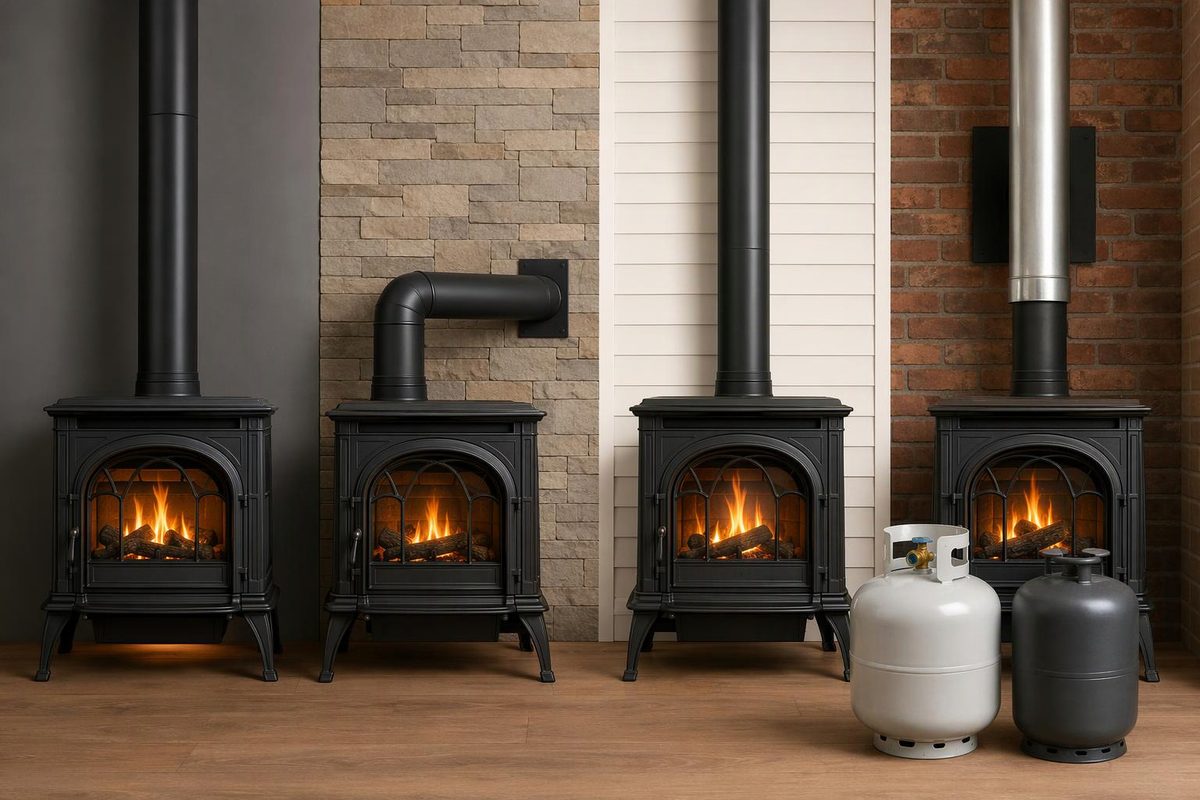
Gas heating stoves are freestanding room-heating appliances, available in natural-gas and propane configurations. They provide a visible fire without a built-in fireplace enclosure, but the vent route and required clearances still determine where they can go. Regency’s gas-stove overview illustrates the category, including steel and cast-iron designs.
This guide concerns heating stoves—not kitchen ranges. Never use a gas cooking stove or oven to heat the house; CPSC’s carbon-monoxide guidance makes that distinction explicit.
First decide what the stove must heat
A gas stove is worth considering when you want controlled heat in an occupied room or connected living area, rather than the enclosure work associated with a built-in fireplace.
Before choosing capacity, tell the installer whether the goal is:
- Supplemental heat: making one cold living area comfortable while retaining central heating.
- Regular space heating: meeting the assessed heat loss of the intended area.
- Outage heat: keeping an occupied area warm without household electricity.
Do not assume a stove’s advertised heating area means it will warm bedrooms behind closed doors. Ask how heat will reach each space. Have the installer assess the proposed location and building layout, not just the stove’s rating.
Choose the venting category before the finish
Similar-looking stoves can require fundamentally different installations.
| Stove type | What to establish before purchase |
|---|---|
| Direct vent | An approved route for outdoor combustion air and exhaust, with permitted pipe lengths, elbows and termination location. |
| Natural vent/B-vent | An approved vertical exhaust route and satisfactory draft—not merely an existing chimney opening. |
| Vent-free/unvented | Local permission, the model’s room and use restrictions, and the indoor-air implications of releasing combustion products indoors. |
A direct-vent stove draws combustion air from outdoors and exhausts outdoors. For example, the Regency U39-13 uses a coaxial system: exhaust travels through the inner passage and combustion air through the outer passage. Its installation manual requires a separate, approved vent system and prohibits common venting with another appliance.
A natural-vent stove is not interchangeable with that arrangement. The Jøtul GF 300 BV manual, dated July 2010, for instance, specifies Type B vent or a listed flexible gas liner and prohibits horizontal termination. That is a model example, not a universal pipe specification; obtain the manual matching the exact stove you are considering.
Vent-free models omit an outdoor exhaust, but that does not make them an installation shortcut. EPA identifies unvented gas heaters as indoor sources of carbon monoxide, nitrogen dioxide and particles; combustion also produces water vapor. For a new installation, start the comparison with direct-vent equipment rather than treating “no chimney needed” as the deciding benefit.
Do not buy until the installer confirms both the approved vent route and the installed footprint. That footprint includes stove and pipe clearances, floor requirements, ceiling or alcove limits, and service access—not just the body dimensions. These requirements are model-specific; the U39-13 manual provides separate clearance diagrams and flooring conditions. Check permits and installation restrictions with the local building authority before committing.
Natural gas or propane: compare configuration and running cost
First establish which fuels can be supplied at the property. Have the installer assess supply capacity alongside the home’s existing gas loads. For tank, regulator and propane-specific planning, see our propane heating-stove guide.
“Available for natural gas or propane” does not mean the fuels can be swapped at the connection. The U39-13 manual restricts operation to the gas shown on the rating plate unless a certified conversion kit is used. Installation and conversion belong with qualified personnel.
Put both fuels on the same energy basis
A price per therm and a price per gallon are not directly comparable. EIA’s conversion table lists one therm as 100,000 BTU and a sample propane heat content of 91,452 BTU per gallon.
For a stove burning 30,000 BTU/h of fuel input, calculated high-fire consumption is approximately:
| Fuel | Consumption per burner-hour |
|---|---|
| Natural gas | 0.30 therm |
| Propane | 0.328 gallon |
Multiply that consumption by your actual fuel rate. At hypothetical rates of $1.50 per therm and $2.50 per gallon, the fuel cost would be about $0.45 and $0.82 per high-fire hour, respectively. These are arithmetic examples, not current prices or equal useful-heat comparisons.
To compare different stoves, include their fuel-specific efficiency using the same test metric. Also separate usage charges from service fees, tank charges, delivery conditions and installation costs. Thermostat cycling, flame settings and pilot operation change actual consumption; an hour with the stove switched on is not necessarily an hour at maximum input.
Compare the heating range—not just maximum BTU
Fuel input measures energy burned. It is not the same as heat delivered to the room. Obtain the rated output or relevant efficiency information, and have the installer compare it with the intended area’s heat loss.
Check the minimum setting as carefully as the maximum. As one concrete example, the U39-13 manual lists input ranges at 0–2,000 feet elevation of 26,000–38,000 BTU/h for natural gas and 30,000–38,000 BTU/h for propane. The same headline maximum therefore does not mean the same low-fire behavior. The manual lists different ratings for its high-elevation configurations; these figures are not sizing recommendations.
Ask whether the controls simply cycle the burner or also modulate flame height. If outage heat matters, confirm exactly which functions remain available: burner operation, ignition, remote control and blower are separate questions. Have the installer demonstrate the model’s approved outage procedure. See how gas-heating design determines outage operation.
Ask for a complete installed proposal
A useful quote identifies the exact model and fuel, approved vent system and route, required clearances, gas-supply work, electrical needs, permits, commissioning and service schedule. Include any chimney work and floor or wall alterations—not just the stove price.
Keep required hot-glass barriers installed; the U39-13 manual warns that its glass can cause burns and requires the supplied barrier. Follow the appliance’s maintenance schedule rather than treating gas heat as maintenance-free.
Install and maintain CO alarms according to their instructions and local requirements. CPSC recommends alarms with battery power or battery backup on every level and outside sleeping areas. If a CO alarm sounds, move everyone outside and call emergency services; do not reenter until responders give permission. CPSC alarm guidance.
If you smell gas: Do not try to light the stove, operate electrical switches or use a phone inside. Leave the building immediately and call the gas supplier from outside; if the supplier cannot be reached, call the fire department. The manufacturer’s emergency instructions apply before any troubleshooting.