
What That Black Fireplace Residue Means—and What to Do Next
Sticky or glazed residue, deposits outside the firebox, rapid recurrence and gas-appliance buildup call for assessment or material-specific service.
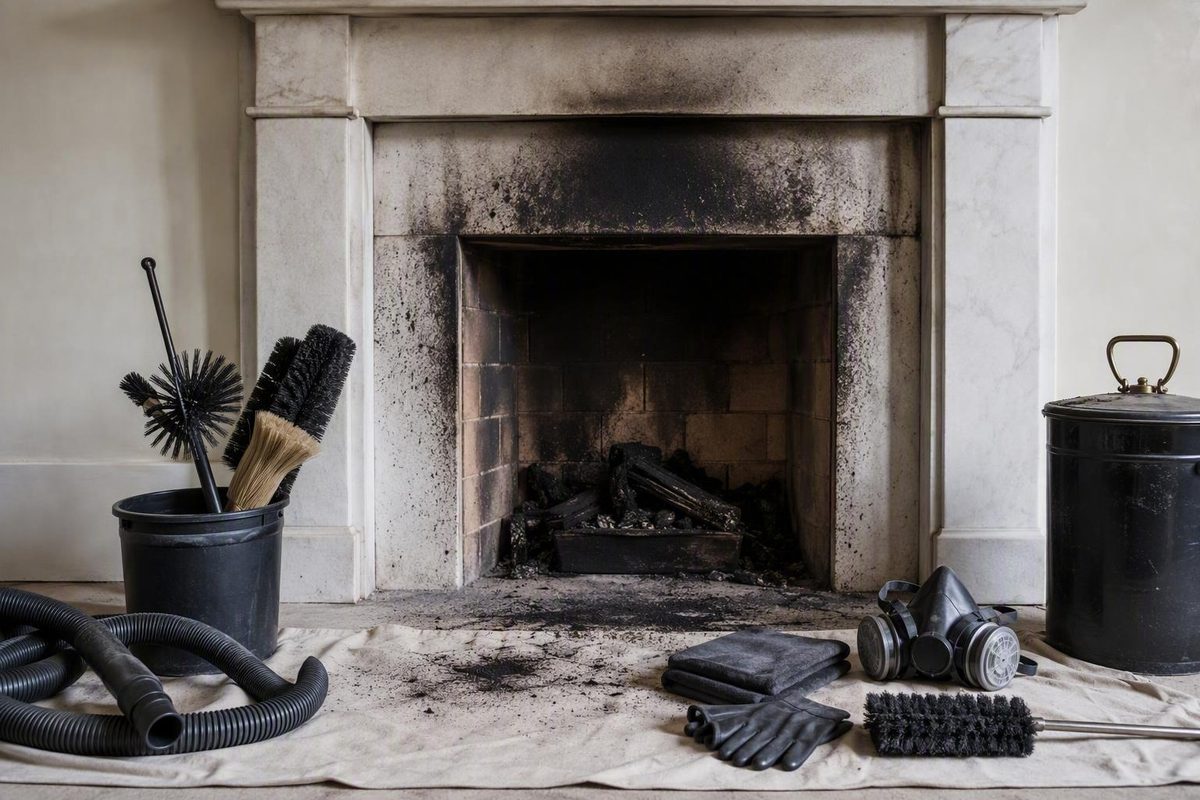
Black residue around a fireplace is not automatically a cleaning problem. Before choosing a brush or chemical, identify the likely deposit, note where it appears, and consider the fuel and appliance involved.
Light, loose fireplace soot on sound, accessible firebox masonry may be suitable for cautious DIY removal. The situation changes when residue is sticky or glazed, appears outside the opening, returns quickly, comes from a gas appliance, or accompanies smoke spillage, odors, moisture, or damaged masonry.
The available cleaning guidance comes largely from fireplace-service companies, retailers, and product manufacturers rather than comparative testing or independent standards. Treat the procedure below as a conservative framework. The fireplace or appliance manual, cleaner label, material-specific instructions, and requirements applicable to the installation take priority.
First identify the black deposit
“Soot” is often used casually for every dark fireplace deposit, but several materials can look similar. The distinction matters because ash, loose soot, oily smoke film, and wood creosote do not respond to the same treatment.
Soot is a generally black or dark-brown combustion deposit associated with incomplete combustion. Depending on the fuel and burning conditions, it may appear powdery, flaky, or oily. It can settle on firebox walls, brick faces, mortar joints, dampers, doors, and nearby finishes. Creosote, by contrast, is a tar-rich residue associated primarily with incomplete wood combustion. Commercial chimney guidance distinguishes these materials while noting that combustion deposits may collect on the damper, smoke chamber, and flue liner before falling into the firebox. Full Service Chimney explains the basic soot-creosote distinction and where deposits may collect.
Ash is the noncombustible residue left after fuel burns. In a wood-burning fireplace, it is usually gray or pale, although it can contain dark unburned fragments and loose soot.
Creosote can be loose or flaky, but it may also become sticky, hardened, shiny, or glazed. If questionable flakes came from the damper, smoke chamber, or flue rather than the visible firebox wall, do not confidently classify them as harmless surface soot.
Oily smoke residue may look black or brown but smear when disturbed instead of lifting as dry powder. Smearing is a screening clue, not a reliable field test of chemical composition. Stop dry rubbing if it spreads the stain, and do not assume that adding water will solve it.
Efflorescence is different again. White, chalky, or crystalline material on masonry may be associated with moisture movement rather than combustion. A masonry-cleaner manufacturer’s guidance distinguishes carbon and oily smoke residue from white efflorescence and recommends inspecting brick, mortar, coatings, and existing deterioration before cleaning. PROSOCO describes how soot and moisture-related deposits behave differently on masonry.
Use four clues together:
| Clue | What to observe | What it may suggest |
|---|---|---|
| Color | Black, dark brown, gray, white, rust-colored, or mixed | Black or brown may be soot, smoke film, or creosote; gray may be ash; white powder may be efflorescence |
| Texture | Loose, powdery, flaky, oily, sticky, hard, shiny, or glazed | Loose powder may permit conservative dry removal; smearing, sticky, or glazed material needs a different response |
| Location | Firebox floor, walls, damper, above the opening, mantel, room surfaces, or chimney exterior | Location helps separate ordinary firebox residue from possible smoke spillage, deposits falling from above, or moisture |
| Fuel and appliance | Wood, gas, pellet, oil, insert, stove, or open fireplace | Fuel and appliance type determine which deposits are plausible and which instructions apply |
These are screening clues, not definitive identification criteria. Old smoke staining, rust, moisture, paint discoloration, and previous repairs can complicate the appearance. A visual check from the hearth also cannot establish the condition of concealed chimney areas.
Early decision rule
Do not proceed as though the material were ordinary surface soot if it is sticky, shiny, tar-like, hardened, glazed, deep in the system, or difficult to reach. If the identity or origin remains uncertain, assessment is safer than increasingly aggressive cleaning.
Why soot forms—and why its location matters
Soot is associated with incomplete combustion. Possible contributors include inadequate airflow, poorly prepared wood, weak draft, venting trouble, blockage, or appliance operation that does not match the manufacturer’s instructions. A stain cannot identify which contributor applies.
A small amount of loose soot inside a wood-burning firebox may occur during normal use. There is no universal quantity that can be judged acceptable without considering the fireplace, fuel, operating pattern, deposit condition, and concealed venting system.
Some deposits originate above the visible firebox. Material may collect on the damper, smoke chamber, or flue liner and later loosen and fall. Finding flakes in the firebox therefore does not establish that the deposit began—or ends—on the firebox wall.
Location is often more informative than the mere presence of black material:
- Inside a wood-burning firebox: Light powder may be ordinary residue, although texture, amount, and recurrence still matter.
- On the damper or smoke shelf: Material may have collected in the smoke path or fallen from higher in the system.
- Above the fireplace opening: Smoke may be escaping past the opening instead of moving consistently into the chimney.
- On the mantel or nearby wall: Treat a new, growing, or recurring mark as a diagnostic warning rather than routine dirt.
- Elsewhere in the room: Stop disturbing the residue and consider whether smoke or soot is escaping from the appliance or venting system.
- Near the cap or running down exterior masonry: Dark drainage may be combustion residue carried by moisture, but appearance alone cannot determine its source.
Soot above an opening does not prove one particular defect. Plausible contributors include the damper, flue condition, chimney configuration, combustion-air supply, room pressure, blockage, fire-building practices, or interaction with exhaust equipment. Commercial chimney guidance identifies mantel staining and dark drainage near the cap as reasons for further investigation, but it does not establish a single diagnosis from either sign.
Record when the mark appears, which appliance was operating, the weather, any odors or visible smoke, and whether doors, windows, or exhaust fans were in use. Renters can photograph recurring stains and report them to the owner or property manager rather than treating the issue solely as housekeeping.
Gas-fireplace warning
Do not assume soot from a gas fireplace is ordinary cosmetic dirt. Soot can be associated with incomplete combustion of gas as well as other fuels, so pause cleaning and consult the appliance manufacturer’s operating and service instructions rather than diagnosing the cause from the stain alone.
For any surface-cleaning procedure the manufacturer permits, use the shutdown steps specified for that appliance. One cleaner manufacturer’s gas-fireplace procedure begins by turning off the gas valve, but that instruction applies to its stated procedure and is not a universal substitute for the appliance manual. Simple Green provides separate wood- and gas-fireplace procedures, including its stated gas-valve step.
Do not remove or rearrange burners, ports, embers, media, synthetic logs, or other appliance components unless the applicable manufacturer instructions expressly authorize that task and explain correct reassembly. A brick-cleaning procedure is not a gas-appliance service procedure.
Stop-work signs to check before cleaning
Pause before cleaning when the residue may be evidence of a larger problem. The purpose is not to preserve every stain indefinitely; it is to avoid erasing a useful symptom, spreading contamination, or damaging a surface that does not fit a routine cleaning method.
Stop cosmetic work and arrange an appropriate inspection, repair assessment, appliance service, or material consultation when you find:
- Smoke entering the room during startup or operation
- Black staining that repeatedly develops above the opening or on the mantel
- Soot appearing elsewhere in the room
- Soot associated with a gas fireplace
- An unusual, persistent, or newly developed odor
- Suspected flue blockage, debris, or an animal nest
- Water entry, damp masonry, efflorescence, rust, or staining after storms
- Dark liquid or drainage near the chimney cap or exterior
- Evidence or suspicion of a previous chimney fire
- Sticky, tar-like, hardened, shiny, or glazed deposits
- Heavy, deep, or inaccessible buildup
- Loose, soft, or spalling brick
- Crumbling or missing mortar
- Cracks, shifted masonry, or loose components
- Painted, sealed, unusually soft, or historic masonry whose treatment is unknown
Commercial chimney-service guidance identifies smoke entering the home, unusual smells, cracks, loose brick, blockages, nests, and storm damage as conditions that warrant professional attention. These signs do not prove a specific failure, but they support shifting from cosmetic work to diagnosis. A1 Professional Home Services lists warning conditions associated with chimney inspection or cleaning decisions.
Different concerns require different expertise. Smoke spillage or suspected blockage may call for fireplace and chimney assessment. Gas-appliance soot requires appliance-specific instructions and service guidance. Soft or historic brick may require a masonry conservator rather than a general cleaner.
With painted or sealed masonry, the immediate question is not simply whether a cleaner removes soot. It is whether the treatment is permitted for the coating. If the finish is unidentified, damaged, or valuable, stop before wet cleaning.
When soot appears outside the firebox, cosmetic cleaning should generally wait until its source has been considered. Removing the mark does not correct weak draft, smoke spillage, combustion-air problems, or venting trouble, and it can make recurrence harder to track.
Never try to remove chimney deposits by deliberately burning them out. Commercial chimney guidance explicitly advises against using fire as a chimney-cleaning method. Full Service Chimney warns against attempting to burn chimney deposits out.
This guide intentionally gives no deposit-thickness threshold and no universal service schedule. Deposit type and condition, appliance instructions, inspection findings, use, and applicable requirements are more meaningful than a single number.
Prepare the cold fireplace and contain the mess
Fine soot spreads easily. Preparation often determines whether a small firebox job remains a small job.
First, make sure the fireplace, ash, grate, and removable material are fully cold. Follow the appliance manual’s shutdown and ash-removal instructions rather than relying only on the absence of flames or the surface appearance. Masonry-cleaning guidance likewise calls for a cold firebox and dry removal of loose material before liquids are introduced.
Prepare the room before disturbing the deposit:
- Move rugs, upholstered furniture, baskets, firewood, and decorative objects away from the work area.
- Protect the hearth extension and adjacent flooring with secure coverings.
- Cover nearby furniture and other surfaces that could collect airborne dust.
- Keep children and pets outside the work area.
- Set out collection containers and cleaning tools in advance.
- Provide the ventilation specified by the cleaner label without creating a strong air current that carries soot through the room.
Wear gloves, eye protection, and work clothing suitable for the task. This is baseline preparation, not a complete protective-equipment specification. A cleaner label or appliance procedure may require additional precautions.
Remove logs, grates, doors, screens, or other components only when the appliance instructions permit removal and explain how to return them correctly. Do not treat ordinary removable firebox parts as permission to disassemble burners, venting, baffles, or appliance-specific media.
Handle loose ash gently. Avoid dropping it from height, sweeping vigorously, or shaking a loaded dustpan. If the appliance instructions permit shoveling, move small quantities without creating a dust cloud.
Do not assume an ordinary household vacuum is suitable for fireplace soot or ash. Commercial chimney guidance describes specialized containment and vacuum equipment for chimney work, while other fireplace-cleaning sources mention vacuums without establishing that every household machine is appropriate. Use a vacuum only when its manufacturer identifies it as suitable for the fully cold material and expected particle load; otherwise, choose another controlled collection method. Portland Fireplace & Chimney explains the containment and access limits associated with DIY chimney cleaning.
Keep collected residue contained. One commercial fireplace-versus-chimney guide recommends placing fully cold ash in a lidded metal container away from combustible materials. Treat that as one containment approach, then follow the appliance instructions and ask the responsible local authority how the material should be disposed of. AirFlow Solutions describes cold-ash containment and distinguishes firebox cleaning from chimney sweeping.
Keep used wipes, coverings, and cleaner residue from spreading through the room. Disposal of cleaning liquid, filters, and contaminated materials should follow the product instructions and guidance from the responsible local authority; the supplied evidence does not establish one universal disposal method.
For a gas fireplace, use only the shutdown and surface-maintenance procedure stated in its manual. If soot prompted the cleaning attempt, do not use cleaning alone as proof that the underlying condition has been resolved.
A conservative method for light soot on sound bare masonry
This method is deliberately narrow. It applies only to light, accessible residue on sound, bare, unpainted, and unsealed brick or mortar.
It does not apply to damaged, soft, historic, painted, or sealed masonry; unidentified coatings; natural stone; glass; metal; synthetic logs; gas burners; or concealed chimney surfaces.
1. Inspect before touching the stain
Confirm that the residue appears loose rather than sticky, oily, hardened, or glazed. Check brick faces and mortar joints for cracks, spalling, softness, movement, dampness, and previous coatings.
If you cannot identify the surface or determine whether it has been sealed, place the project on hold. Do not assume that simple water absorption proves compatibility with a cleaner.
2. Remove loose material dry
Begin with the least aggressive practical method. Gently direct loose soot toward a collection point with a nonabrasive hand tool, or collect it with equipment specifically suitable for fine, fully cold residue.
Work slowly. Vigorous brushing can launch soot into the room or push it into mortar joints. If the deposit smears rather than lifting, stop and reassess it.
3. Do not begin by wetting the wall
Porous brick and mortar can absorb soot-laden moisture. Introducing water before removing loose carbon may enlarge the stain or move particles deeper into the pores.
Dry removal may not make the masonry look clean immediately. Its purpose is to reduce the amount of loose carbon available to migrate during later treatment. The supporting masonry guidance recommends inspection, dry removal, controlled sections, limited rinsing, and avoidance of aggressive scrubbing or flooding. PROSOCO outlines a dry-first process for soot-stained brick fireplaces.
4. Choose a substrate-compatible cleaner
Select a product whose instructions expressly permit its use on the specific brick and mortar, in the intended indoor setting. Read the complete label before beginning.
Follow the label for:
- Dilution
- Application method
- Dwell time
- Ventilation
- Protective equipment
- Temperature limits
- Rinsing or neutralization
- Disposal
- Restrictions involving metals, glass, paint, sealers, or nearby finishes
Failure of one product does not establish that a stronger chemical is appropriate.
5. Patch-test and let the test dry
Use the intended dilution, tool, dwell time, and rinse method, then let the area dry before deciding whether to continue.
Evaluate more than stain removal. Look for color change, whitening, darkening, roughness, softened mortar, sheen changes, residue, or a visible edge around the test area.
The available evidence does not establish a universal patch-test size or waiting period. Product instructions and material-specific guidance control. If no inconspicuous test area exists—or the masonry is unusual, valuable, or historic—seek specialist advice.
6. Clean in manageable sections
Apply cleaner only to an area you can control within the labeled dwell time. Avoid saturating a large wall and then rushing to scrub or rinse it.
Agitate gently with a compatible hand tool. The goal is to lift residue without wearing away brick faces or digging into mortar joints. If success requires forceful or prolonged scrubbing, stop rather than escalating automatically.
7. Rinse only as required
Follow the cleaner’s directions. Use enough controlled rinsing to remove loosened residue and any cleaner that the instructions say must be removed, but do not flood the wall.
Keep runoff away from flooring and adjacent finishes. Replace dirty rinse material rather than spreading soot-laden water over the masonry.
8. Let the masonry dry before judging it
Do not repeat the treatment merely because a damp section still appears stained.
Once dry, compare the treated area with the patch test and surrounding masonry. A second conservative pass may be reasonable if the product permits it and the first treatment caused no adverse change. Repeated aggressive cycles are not.
A faint, deep-set shadow may be safer to accept than a perfectly clean-looking patch achieved by abrading brick or eroding mortar. Cosmetic uniformity is not worth permanent material loss.
This procedure intentionally does not prescribe detergent, salt, vinegar, TSP, or a named commercial product. Published household recipes exist, but the supplied evidence does not establish comparative effectiveness or broad compatibility across masonry types and finishes.
Choose methods by material—not by stain alone
Use the following table as a triage and exclusion matrix, not as proof that one method is safe for every material in a category.
| Surface | Does the bare-masonry procedure apply? | Appropriate next step | Stop if |
|---|---|---|---|
| Sound bare brick and mortar | Potentially, for light accessible residue | Inspect, remove loose residue dry, then patch-test a cleaner expressly permitted for the substrate | Deposit smears, damage appears, or the patch test fails |
| Soft, spalling, deteriorated, or historic masonry | No | Obtain material-specific guidance before wet cleaning | Before routine cleaning begins |
| Painted or sealed masonry | No | Identify the coating and follow its care instructions | Coating is unknown, damaged, or changes during testing |
| Natural stone | No | Identify the stone and finish, then obtain stone-specific instructions | Stone or finish is unknown |
| Fireplace glass | No | Follow the appliance or door manufacturer’s procedure | Instructions are unavailable or the glass is damaged |
| Metal, grates, and doors | No | Follow the component instructions; remove parts only if permitted | Material, finish, or reassembly procedure is uncertain |
| Synthetic gas logs and media | No | Use only manufacturer-authorized maintenance | Soot is present or instructions do not authorize the task |
Common cleaning options also require different levels of caution:
- Soap or detergent: Sometimes proposed for light soot on brick, but formulas vary and porous masonry may retain residue. Do not treat it as a universal formula.
- Soot erasers or dry-cleaning sponges: May be an option for some dry surface deposits, but the supplied evidence does not establish compatibility across fragile finishes, coatings, or oily residues. Test only where material guidance allows.
- Specialty masonry cleaners: Potentially useful when labeled for the identified substrate and deposit. “Masonry cleaner” does not mean suitable for every brick, mortar, stone, sealer, or indoor application.
- Vinegar: Acidic. The available household recipe does not establish universal compatibility with mortar, stone, metal, coatings, or sealers.
- TSP: Strongly alkaline. It requires complete product-specific instructions for handling, ventilation, application, rinsing, and disposal.
- Other acids or strong alkalis: Do not use without explicit product and substrate guidance.
- Powered brushes: They increase mechanical force and are not a conservative substitute for controlled hand cleaning.
An older fireplace-retailer article presents soap, soot erasers, commercial cleaners, powered brushes, and TSP as escalating options, while identifying TSP as alkaline and telling readers to follow product directions. It provides no comparative testing or broad material-compatibility evidence, so its list should not be treated as a validated hierarchy. FireSide Hearth & Home describes these commonly suggested options and their stated precautions.
Never mix cleaners. If a mild, compatible treatment fails, the stain may be deep, oily, misidentified, or embedded in material that should not be cleaned more aggressively.
Fireplace cleaning is not chimney sweeping
The fireplace zone includes the firebox, hearth, visible surfaces, damper, smoke shelf, and doors where present. These are the areas a homeowner can ordinarily see and may be able to maintain from the room, subject to the appliance instructions.
The chimney zone includes the smoke chamber, flue, liner, crown, cap, concealed offsets, blockages, joints, and other areas ordinary surface cleaning does not reach.
Removing ash and light soot from the firebox does not:
- Inspect the full liner
- Clear concealed creosote
- Remove hidden nests or debris
- Confirm that offsets are open
- Identify every crack or failed joint
- Diagnose water entry
- Establish the condition of the cap, crown, or exterior masonry
- Show whether a previous chimney fire caused concealed damage
This is also the central limitation of DIY chimney brushing: a brush affects only the surfaces it touches. Commercial chimney guidance notes that smoke shelves, smoke chambers, offsets, liner damage, failed joints, and moisture problems may remain unassessed after homeowner brushing.
The most defensible DIY scope is therefore narrow: fully cold ash or light, accessible surface soot on sound materials, using methods allowed by the appliance and surface-care instructions.
Seek professional assessment for:
- Sticky, hardened, tar-like, or glazed deposits
- Heavy or inaccessible buildup
- Weak draft or smoke entering the room
- Recurring soot outside the firebox
- Suspected blockage
- Water intrusion or storm damage
- Cracked, loose, or deteriorated masonry
- Suspected previous chimney-fire damage
- A system whose condition is unknown or has not been inspected recently
- Any task requiring roof access or deep flue access
Inspection and sweeping are related, but they are not interchangeable. An inspection evaluates the system’s condition and helps define needed work. Sweeping removes deposits and debris within an agreed scope. Commercial fireplace-service guidance similarly separates visible firebox maintenance from smoke-chamber, flue, obstruction, and liner work.
When hiring a chimney or fireplace professional, ask scope-based questions:
- Which areas will be cleaned: firebox, smoke shelf, smoke chamber, flue, cap, or all of them?
- Which components and areas will be inspected?
- How will soot and dust be contained?
- Will inaccessible areas and the liner condition be assessed?
- Will findings be documented with notes or images?
- Are obstruction removal and deposit removal included?
- Are masonry, liner, cap, or water repairs evaluated and priced separately?
- Does the service include appliance-specific work or only the masonry chimney?
- What finding would cause the work to stop or require a different scope?
Do not choose solely by a promise to make the fireplace “clean.” Define whether you need surface cleaning, sweeping, inspection, appliance service, masonry restoration, or a combination.
Reduce soot without hiding a recurring fault
Prevention begins with operating the appliance as designed rather than repeatedly cleaning symptoms.
For a wood-burning fireplace or approved wood appliance:
- Use dry, seasoned wood suitable for the appliance.
- Maintain the combustion airflow required by the manufacturer.
- Build and operate fires according to the manual.
- Do not close down airflow contrary to the instructions to make a fire last longer.
- Remove fully cold ash as the appliance instructions require.
- Maintain permitted air passages and removable components.
- Arrange periodic chimney inspection and respond to the findings.
Dry wood, adequate airflow, and ash management can help reduce soot accumulation, but they cannot correct a blocked, damaged, poorly drafting, or incorrectly configured venting system.
If soot repeatedly returns above the opening, do not make increasingly frequent wall cleaning the maintenance plan. Have the draft, damper, chimney, combustion-air conditions, and other relevant parts of the installation evaluated. Clean the remaining stain only after addressing its source, using a method appropriate for the affected masonry, paint, stone, wood, or other finish.
Follow the instructions for every applicable component: fireplace, insert, stove, venting system, liner, doors, glass, cleaner, and replacement parts. Clearances, servicing procedures, operating requirements, and approved materials vary. Check with the responsible authority if the planned work may be subject to permits or inspection requirements.
Periodic inspection should not be converted into an unsupported universal sweeping interval. Whether sweeping is needed depends on the inspection findings, deposit type and condition, appliance instructions, use, and requirements applicable to the installation.
Mechanical Mentor describes its coverage as including stoves, fireplaces, venting, and heat, drawing on stated hands-on hearth and venting experience. That background can help frame practical questions, but decisions should remain tied to the appliance manual, material instructions, applicable requirements, and evidence from the actual installation.
If the soot issue involves a pellet appliance rather than an open fireplace, use appliance-specific instructions. Pellet venting, sealing, configuration, and maintenance fall outside this masonry-fireplace procedure; the site’s pellet-stove venting guide offers contextual information, but the stove and vent manufacturers’ instructions remain controlling.
Frequently asked questions
What is the difference between fireplace soot and creosote?
Soot is generally a black or dark-brown deposit associated with incomplete combustion. It may appear powdery, flaky, or oily and can occur with wood, gas, or other fuels.
Creosote is a tar-rich residue associated primarily with incomplete wood combustion. It may be flaky, sticky, hardened, or glazed. Light, loose soot on an accessible, sound firebox surface may permit cautious dry-first cleaning; sticky, shiny, tar-like, hardened, or glazed material should not be treated the same way.
Ash differs from both: it is the noncombustible residue left after fuel burns. Because visible appearance cannot establish conditions higher in the chimney, uncertain material from the smoke chamber or flue warrants assessment rather than confident field identification.
Why is soot appearing above my fireplace opening or on the mantel?
The stain may indicate that smoke is escaping past the fireplace opening rather than moving consistently through the chimney. Plausible contributors include weak draft, inadequate combustion air, blockage, a damper or venting problem, room-pressure effects, or operating conditions.
The stain alone cannot identify the cause. If it is new, recurring, or accompanied by smoke or unusual odors, pause cosmetic cleaning and arrange evaluation of the fireplace and venting. Once the source has been addressed, clean the remaining mark with a method compatible with the affected finish.
Can I vacuum fireplace soot with a household vacuum?
Do not assume so. The supplied sources mention vacuuming and specialized containment but do not establish that an ordinary household vacuum is suitable for fine soot or ash.
Use a vacuum only if its manufacturer expressly identifies it as suitable for the fully cold material being collected and explains the required setup, filtration, collection, emptying, and disposal. A filtration label by itself does not establish compatibility with fireplace ash or soot.
If suitability cannot be confirmed, use another controlled dry-removal method permitted for the surface or hire a service with appropriate containment equipment.
Can I clean soot from fireplace brick with vinegar, detergent, or TSP?
Possibly in a narrowly defined application, but none is a universal fireplace-brick formula.
Detergent formulas vary and may require substantial rinsing. Vinegar is acidic. TSP is strongly alkaline and requires complete product-specific guidance for handling, ventilation, application, rinsing, and disposal. The available commercial articles do not establish broad compatibility across brick, mortar, stone, paint, sealers, glass, metal, or gas-appliance components.
For sound bare masonry, remove loose soot dry first. Then select a cleaner expressly permitted for the brick and mortar, follow its label, test an inconspicuous area, allow it to dry, and check for both stain removal and material change. Never mix cleaners.
Can I burn a hot fire to remove soot or creosote from the chimney?
No. Do not deliberately try to burn chimney deposits out.
A hot fire is not a controlled substitute for deposit removal or chimney inspection. It also cannot establish whether the liner, smoke chamber, joints, cap, or concealed areas are sound. If you suspect soot or creosote buildup in the chimney, arrange an appropriate inspection and cleaning assessment instead.
The practical decision rule is simple: identify the deposit, look at where it appears, and address the cause before chasing the stain. Light, loose soot on sound, accessible surfaces may allow cautious dry-first cleaning. Residue outside the firebox, gas-appliance soot, rapid recurrence, smoke spillage, damaged masonry, or sticky and glazed deposits should shift the task from cosmetic cleanup to qualified assessment or material-specific service.