
Flue Gas Is Combustion Exhaust—not Just Visible Smoke
Understand what flue gas contains, how heat and moisture affect it, and why clear exhaust does not prove a heating appliance is safe.
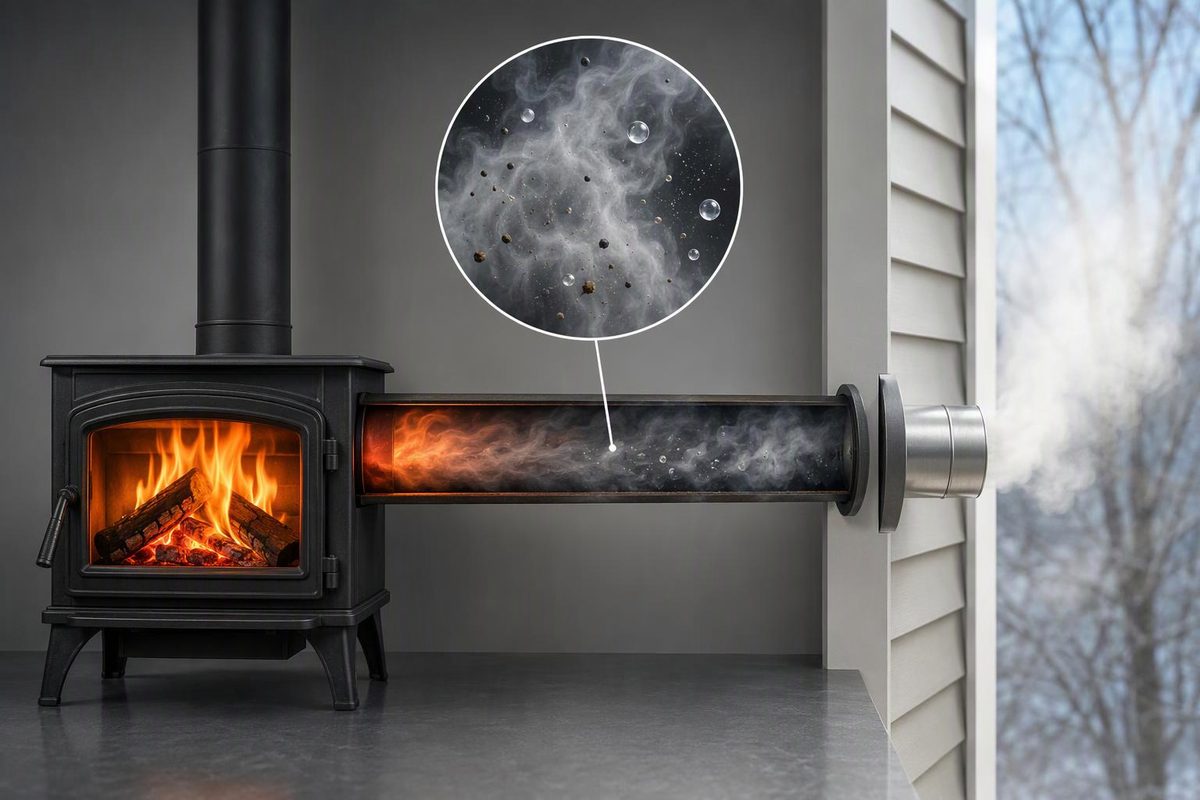
Flue gas is the exhaust produced when fuel burns in an appliance. In a home, that can mean the exhaust from a gas furnace, boiler, water heater, fireplace, or wood or pellet stove. It contains combustion products mixed with gases from the air used for burning; depending on the fuel and combustion conditions, it can also carry particles and unburned material.
The terms describe different things: fuel gas is the natural gas or propane supplied to a burner; flue gas is the exhaust after combustion. The chimney flue is the passage that carries exhaust, not the gas itself.
What is in flue gas?
There is no single composition that fits every appliance. Fuel, air supply, burner operation and operating load all affect the mixture. For combustion using ordinary air, the main gases—and an important hazardous byproduct—include:
| Component | Where it comes from and why it matters |
|---|---|
| Nitrogen (N₂) | Mostly enters with combustion air and passes through the appliance. It accounts for a large share of the exhaust. |
| Carbon dioxide (CO₂) | Forms when carbon in the fuel burns completely. It is not the same gas as carbon monoxide. |
| Water vapor (H₂O) | Forms during combustion of hydrogen-containing fuels. It can become liquid condensate as the exhaust cools. |
| Oxygen (O₂) | Remains when more air is supplied than the theoretical amount needed to burn the fuel. Its concentration helps technicians assess the air–fuel balance. |
| Carbon monoxide (CO) | Forms through incomplete combustion. It is poisonous, colorless and odorless. |
The combustion principles and major constituents are described in the EPA-hosted Boiler Tune-Up Guide; the CPSC carbon monoxide fact sheet explains CO production and hazards.
Those are not the only constituents. Natural-gas exhaust can contain nitrogen oxides, unburned hydrocarbons and small amounts of particulate matter. Gas combustion is not emissions-free simply because it produces little visible smoke. EPA’s natural-gas combustion reference identifies these emissions and how combustion conditions affect them.
Wood smoke is a complex mixture of gases and fine particles. More efficient burning produces less smoke, but the particles that remain can harm respiratory and cardiovascular health, as explained in EPA’s wood-smoke guidance.
Why heat and moisture matter
Flue gas carries heat away from the appliance. Its temperature reflects both combustion and how much heat the appliance has extracted before the exhaust leaves. Consequently, there is no universal “normal flue gas temperature” for all home heaters.
In a natural-draft system, hot exhaust relative to outdoor air helps establish the upward flow. A condensing appliance deliberately extracts enough heat for some water vapor to become liquid, recovering heat that would otherwise leave with the exhaust. These are different operating designs—not interchangeable temperature targets. PNNL’s gas-boiler guide explains natural draft and condensing operation.
Condensate is not necessarily clean water. Condensing gas boilers produce acidic condensate and need provisions for its collection and disposal. That is an expected feature of a condensing appliance, not a reason to assume water appearing in any chimney or vent is normal. See PNNL’s condensing-boiler guide.
Moisture also affects test reports: a wet-basis gas concentration includes water vapor in the sample; a dry-basis concentration excludes it. The same exhaust can therefore give different percentages depending on the reporting basis. Compare like-for-like readings, not just the printed number. The boiler tune-up guide explains this distinction.
Clear exhaust does not prove safe combustion
Visible smoke is only part of the exhaust stream. Because CO cannot be seen or smelled, the absence of smoke or odor cannot establish that an appliance is operating safely. Combustion assessment requires appropriate instruments and appliance-specific interpretation—not a visual check alone.
Install battery-operated CO alarms or alarms with battery backup on every level of the home and outside sleeping areas, following their manufacturer’s instructions. Alarms are not a substitute for proper appliance installation and maintenance.
If a CO alarm sounds, or you suspect CO poisoning, get everyone outside to fresh air and call 911. Do not stay inside to locate the source, and do not re-enter until emergency responders give permission. A malfunctioning appliance must be serviced by trained personnel before it is used again. These are the CPSC’s recommended actions.