
How Much Firewood Is Actually in a Rick?
A customary stack is 4 feet high and 8 feet long. Volume ranges from 32 cubic feet at 12 inches deep to 64 cubic feet at 24 inches.
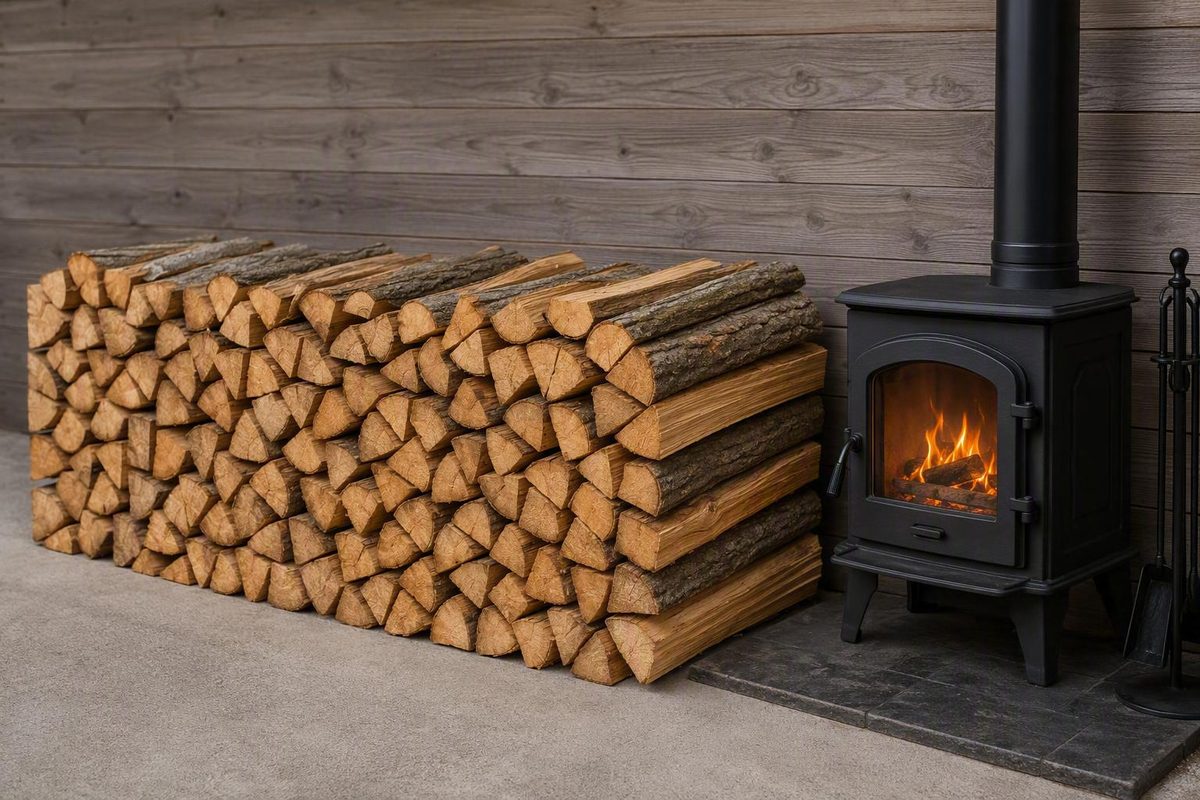
The short answer: A rick is usually 4 feet high by 8 feet long by one log length deep
A rick of wood usually means one stacked row of firewood measuring 4 feet high and 8 feet long, with a depth equal to the length of each piece. Because that depth can vary, “rick” is an informal, regional term rather than a fixed-volume measurement. A typical example uses 16-inch logs, producing a stack that measures 4 feet high, 8 feet long, and 16 inches deep, according to this rick-and-cord measurement comparison.
For that common 16-inch example:
- Height: 4 feet
- Length: 8 feet
- Depth: 16 inches, or 1⅓ feet
The stacked volume is:
4 ft × 8 ft × 1⅓ ft = approximately 42.7 cubic feet
A full cord contains 128 stacked cubic feet and is commonly arranged as a pile 4 feet high, 8 feet long, and 4 feet deep. Therefore, a 42.7-cubic-foot rick is approximately one-third of a cord—but only when the rick is 16 inches deep. The cord definition and customary dimensions support that comparison.
Quick answer
- A rick customarily has a 4-foot-by-8-foot face.
- Its depth generally follows the log length.
- With 16-inch logs, it contains about 42.7 stacked cubic feet, or one-third of a cord.
- The word “rick” alone does not guarantee that quantity; the depth must also be stated.
The distinction between the face and the depth is the key. The 4-foot height and 8-foot length describe only the front of the stack. They do not show how far the wood extends backward.
Two piles can therefore look like ricks from the front but contain substantially different amounts. A 4-by-8-foot row made from 24-inch pieces is twice as deep as the same face made from 12-inch pieces, so it occupies twice the stacked volume.
“Stacked cubic feet” refers to the total space occupied by the arranged stack, including the ordinary gaps between irregular pieces. It does not mean that the pile contains that many cubic feet of solid wood with every air space removed.
The concise answer is:
A rick is usually a 4-foot-high by 8-foot-long row of firewood whose depth equals one log length. With 16-inch logs, it contains about 42.7 stacked cubic feet, but another log length produces a different volume.
Why a rick does not have one fixed volume
Volume requires three dimensions: height, length, and depth. The term “rick” usually suggests a customary height and length, but its depth ordinarily depends on the length of the firewood.
Consider four stacks that each have a 4-foot-by-8-foot face:
- A row of 12-inch logs is 1 foot deep.
- A row of 16-inch logs is 1⅓ feet deep.
- A row of 20-inch logs is 1⅔ feet deep.
- A row of 24-inch logs is 2 feet deep.
The face area remains 32 square feet, but the changing depth changes the volume. Commercial firewood references describe ricks with depths ranging from 12 to 24 inches and emphasize that the offered dimensions should be confirmed rather than inferred from the name alone (Old Potters’ terminology comparison).
This is also why the familiar statement “a rick is one-third of a cord” needs a qualification. It assumes all of the following:
- The stack is 4 feet high.
- The stack is 8 feet long.
- The pieces are 16 inches long.
- The stack is one piece deep.
Change the third dimension and the cord fraction changes.
Regional usage creates additional uncertainty. Some sellers use “rick” and “face cord” for the same single-row configuration. Others may use related terms such as “rank” or “rack.” Even where the names are treated as interchangeable, sellers may cut their wood to different lengths.
The stated dimensions should therefore take precedence over the label. If a seller defines a rick as 4 feet high, 8 feet long, and 18 inches deep, calculate the quantity from those dimensions rather than substituting a 16-inch assumption.
Several shortcuts cannot define the volume of a rick:
- Weight: Equal-volume stacks may weigh differently because species and moisture condition vary.
- Split count: Pieces differ in length, thickness, and shape.
- Price: A quoted price does not identify the size of the stack.
- Truck capacity: A truckload depends on bed dimensions, side height, loading method, and empty space.
- Burn time: The term does not guarantee a number of fires or heating hours.
- Number of rows: A row is not a complete quantity unless its height, length, and depth are known.
The practical rule is simple: treat “rick” as a customary description of a stack, not as a guarantee of a specific volume.
How to calculate the cubic feet in any rick
Use the general volume formula:
Stack height in feet × stack length in feet × stack depth in feet = stacked cubic feet
All three dimensions must be expressed in feet. If the depth is stated in inches, divide it by 12 before multiplying.
Step-by-step calculation for 16-inch logs
Suppose a stack measures 4 feet high, 8 feet long, and 16 inches deep.
- Convert the depth to feet:
16 ÷ 12 = 1⅓ feet
- Multiply the dimensions:
4 × 8 × 1⅓ = 42⅔ cubic feet
- Round the result:
Approximately 42.7 stacked cubic feet
- Convert the stack to a cord fraction:
42⅔ ÷ 128 = ⅓ cord
The underlying 4-by-8-by-16-inch dimensions, 42.7-cubic-foot volume, and 128-cubic-foot cord definition are also presented in this firewood cord-size guide.
Volume table for a customary 4-by-8-foot face
The table below assumes every stack is exactly 4 feet high and 8 feet long. Only the depth changes. The figures are calculated from the stated dimensions and the 128-cubic-foot cord benchmark.
| Stack depth | Depth in feet | Calculation | Stacked volume | Fraction of a full cord |
|---|---|---|---|---|
| 12 inches | 1 ft | 4 × 8 × 1 | 32 cu ft | 1/4 cord |
| 16 inches | 1⅓ ft | 4 × 8 × 1⅓ | About 42.7 cu ft | 1/3 cord |
| 20 inches | 1⅔ ft | 4 × 8 × 1⅔ | About 53.3 cu ft | 5/12 cord |
| 24 inches | 2 ft | 4 × 8 × 2 | 64 cu ft | 1/2 cord |
The relationship is linear. If the face remains unchanged, doubling the depth doubles the volume. That is why a 24-inch-deep row contains twice the stacked volume of a 12-inch-deep row.
Shortcut for a 4-by-8-foot face
When the face is exactly 4 feet by 8 feet, the fraction of a cord can be calculated with this shortcut:
Fraction of a cord = depth in inches ÷ 48
The shortcut works because a customary full-cord arrangement has a 4-by-8-foot face and a total depth of 48 inches.
Examples:
- 12 ÷ 48 = 1/4 cord
- 16 ÷ 48 = 1/3 cord
- 20 ÷ 48 = 5/12 cord
- 24 ÷ 48 = 1/2 cord
To calculate cubic footage directly from the depth in inches:
Stacked cubic feet = 32 × depth in inches ÷ 12
In that formula, 32 is the face area in square feet:
4 ft × 8 ft = 32 sq ft
What if the stack is not 4 feet by 8 feet?
Do not use the depth-divided-by-48 shortcut unless the face is exactly 4 feet high by 8 feet long. Use the general volume formula instead.
For example, consider a stack that is 3.5 feet high, 7 feet long, and 18 inches deep. This is an arithmetic example, not a standard rick size.
First convert the depth:
18 ÷ 12 = 1.5 feet
Then calculate the volume:
3.5 × 7 × 1.5 = 36.75 stacked cubic feet
Finally, calculate the cord equivalent:
36.75 ÷ 128 ≈ 0.287 cord
The stack is therefore about 28.7% of a full cord. Calling it a rick would not change the result; the measured dimensions control the calculation.
If a pile is uneven, measurements can provide a rough estimate, but they should not be presented as an official measurement procedure. For a purchase, establish with the seller how the quoted stacked quantity will be measured and who is responsible for stacking it.
Rick vs. face cord vs. full cord
A full cord is a fixed quantity of 128 stacked cubic feet. One customary arrangement is 4 feet high by 8 feet long by 4 feet deep, although another orderly arrangement can represent the same total volume.
A rick usually means a single row with a 4-by-8-foot face and a depth equal to one log length. Its total volume can therefore vary.
A face cord often describes a similar single-row stack. In many markets, “rick” and “face cord” refer to the same practical configuration, but they should not be treated as universal synonyms. Some sources define a face cord specifically around 16-inch pieces, while regional use of “rick” may allow a different depth. A manufacturer’s cord and face-cord guide describes the familiar 16-inch face cord as one-third of a full cord.
| Term | Customary dimensions | Volume | Key qualification |
|---|---|---|---|
| Rick | Often 4 ft high × 8 ft long × one log length deep | Variable | Informal term; confirm the depth |
| Face cord | Often 4 ft high × 8 ft long × one log length deep | About 42.7 cu ft with 16-inch logs | Usage may vary by seller or region |
| Full cord | Commonly 4 ft high × 8 ft long × 4 ft deep | 128 cu ft | Fixed total stacked volume |
| Half cord | Any orderly stack totaling half a cord | 64 cu ft | Defined by total volume, not one required shape |
| Quarter cord | Any orderly stack totaling one-quarter cord | 32 cu ft | Defined by total volume, not one required shape |
The visual comparison is easiest with 16-inch wood:
One 16-inch row:    4 ft × 8 ft × 16 in = about 1/3 cord
Two 16-inch rows:   4 ft × 8 ft × 32 in = about 2/3 cord
Three 16-inch rows: 4 ft × 8 ft × 48 in = 1 full cord
Three rows that are each 16 inches deep create a combined depth of 48 inches, or 4 feet:
4 ft × 8 ft × 4 ft = 128 cubic feet
Changing the log length changes that comparison. A single 24-inch-deep rick with the same 4-by-8-foot face contains:
4 ft × 8 ft × 2 ft = 64 cubic feet
That is one-half of a cord, not one-third. The example demonstrates why the word “rick” cannot automatically be converted into a fixed cord fraction.
When comparing terminology, separate two questions:
- What does the seller call the stack?
- How many stacked cubic feet does it contain?
The second answer allows a meaningful quantity and price comparison.
How many ricks make a full cord?
Three ricks make one full cord only when each rick has a complete 4-foot-by-8-foot face and is 16 inches deep.
For stacks with the same 4-by-8-foot face, divide the customary 48-inch full-cord depth by the depth of one rick:
Ricks per cord = 48 inches ÷ rick depth in inches
The resulting conversions—four 12-inch ricks, three 16-inch ricks, approximately 2.4 20-inch ricks, or two 24-inch ricks per cord—are supported by published comparisons of variable rick depths (Fire Pit Surplus guide).
| Depth of each rick | Volume of each rick | Calculation | Ricks per full cord |
|---|---|---|---|
| 12 inches | 32 cu ft | 48 ÷ 12 | 4 |
| 16 inches | About 42.7 cu ft | 48 ÷ 16 | 3 |
| 20 inches | About 53.3 cu ft | 48 ÷ 20 | 2.4 |
| 24 inches | 64 cu ft | 48 ÷ 24 | 2 |
Example: 12-inch logs
A 12-inch-deep stack is 1 foot deep:
4 × 8 × 1 = 32 cubic feet
Four same-size stacks contain:
4 × 32 = 128 cubic feet
Therefore, four 12-inch-deep ricks make one cord, assuming each has the complete 4-by-8-foot face.
Example: 16-inch logs
A 16-inch-deep stack contains 42⅔ cubic feet:
4 × 8 × 1⅓ = 42⅔ cubic feet
Three such stacks contain:
3 × 42⅔ = 128 cubic feet
Using 42.7 in the multiplication can produce a small rounding difference. Using the exact 16-inch depth, three rows total 48 inches exactly.
Example: 24-inch logs
A 24-inch depth equals 2 feet:
4 × 8 × 2 = 64 cubic feet
Two such stacks contain:
2 × 64 = 128 cubic feet
Thus, two 24-inch-deep ricks make one full cord.
What does “2.4 ricks” mean for 20-inch wood?
A 20-inch-deep rick with a 4-by-8-foot face contains 53⅓ cubic feet. Dividing 128 by 53⅓ gives 2.4.
This does not require a seller to arrange the order as an awkward number of complete rows. It means that two full 20-inch ricks contain 106⅔ cubic feet, leaving 21⅓ cubic feet—or 40% of another same-size rick—to reach 128 cubic feet.
Do not multiply a seller’s number of loads, racks, or rows until the dimensions of each unit are known. Three 12-inch-deep rows total 96 cubic feet, while three 24-inch-deep rows total 192 cubic feet. The conversion must be based on measured volume, not terminology.
How to compare firewood offers sold by the rick
Before agreeing to buy a rick, ask the seller what the term means for that specific transaction.
Confirm:
- The stacked height
- The stacked length
- The stack depth
- The length of the individual pieces
- The resulting stacked cubic footage
- The quantity as a fraction of a 128-cubic-foot cord
- Whether the quoted quantity is defined by a finished stacked measurement
- Who will stack the wood for measurement
- Whether delivery and stacking charges are included in the price
Ask for dimensions even if the seller uses “face cord,” “rank,” “rack,” or “truckload.” Those names may be familiar locally, but they are not as precise as three measured dimensions.
A loose truckload should not be converted directly into stacked cubic feet using an assumed universal ratio. Instead, establish with the seller whether the offer promises a finished stacked quantity and how that quantity will be verified.
Compare the price per stacked cubic foot
Use this formula:
Price per stacked cubic foot = quoted price ÷ verified cubic feet
Suppose Seller A offers a 4-by-8-by-16-inch stack for $150. These prices are hypothetical examples, not typical market rates.
The stack contains approximately 42.7 cubic feet:
$150 ÷ 42.7 ≈ $3.51 per stacked cubic foot
Now suppose Seller B offers a 4-by-8-by-24-inch stack for $210. That stack contains 64 cubic feet:
$210 ÷ 64 ≈ $3.28 per stacked cubic foot
Seller B’s price per rick is higher, but its calculated price per cubic foot is lower because the offered stack is deeper. Comparing prices per cubic foot and confirming all three dimensions is also recommended in this rick-versus-cord buying guide.
Compare the full-cord-equivalent price
Another option is to convert each quote to an equivalent price for 128 cubic feet:
Full-cord-equivalent price = quoted price × 128 ÷ verified cubic feet
Using the same hypothetical offers:
Seller A: $150 × 128 ÷ 42.7 ≈ $450 per cord equivalent
Seller B: $210 × 128 ÷ 64 = $420 per cord equivalent
This calculation does not determine which wood is the better purchase overall. It isolates the price of the measured stacked volume.
Other factors may affect the value of an offer:
- Wood species
- Moisture condition
- Piece length and split size
- Delivery distance
- Whether stacking is included
- Whether the pieces fit the intended stove or fireplace
- Consistency and cleanliness of the load
Those factors can affect suitability and price, but they do not change the mathematical volume of a measured stack.
If you have questions about which units or transaction practices apply where you live, consult the weights-and-measures authority for your jurisdiction rather than relying on a seller’s interpretation from another location.
Common rick-measurement mistakes to avoid
Omitting the depth
Saying that a rick measures “4 feet by 8 feet” describes only its face. It does not establish volume.
Always ask for the third dimension.
Assuming every rick equals one-third of a cord
A one-third-cord rick assumes a 4-by-8-foot face and a 16-inch depth. Shorter pieces produce less stacked volume, while longer pieces produce more.
The one-third figure is a common example, not a universal definition.
Treating rick and face cord as identical everywhere
The terms often describe the same type of single-row stack, but seller and regional usage can differ.
Treat either term as the beginning of a measurement question, not the final answer.
Comparing prices per rick without checking dimensions
A higher-priced rick is not necessarily more expensive per unit of wood. It may simply be deeper.
For a useful comparison:
- Calculate each stack’s cubic footage.
- Divide each price by its verified cubic footage.
- Compare species, moisture condition, delivery, and stacking separately.
Using split count as the quantity
Pieces vary in length, thickness, diameter, and shape. One stack may contain many small splits while another contains fewer large ones.
Piece count can help with inventory, but it does not provide a dependable cord comparison.
Defining a rick by weight
Wood species and moisture condition affect weight. Two equal-volume stacks can therefore weigh differently, and equal-weight loads can occupy different volumes.
Weight may matter for transportation, but it does not establish a rick’s customary dimensions.
Treating a truckload as a measured rick
A truckload depends on the bed dimensions, side height, loading method, and whether the pieces are stacked or tossed.
Do not assume that a truckload equals one rick or a specific number of stacked cubic feet.
Confusing the advertised name with the delivered quantity
A label cannot make a short or shallow stack larger. If wood advertised as a rick is ultimately stacked to dimensions other than those quoted, calculate the actual volume from its height, length, and depth.
The repeatable check is:
- Get all three dimensions: height, length, and depth.
- Calculate stacked cubic feet: multiply the dimensions after converting each to feet.
- Find the cord equivalent: divide the stacked cubic footage by 128.
Frequently asked questions
How many cubic feet are in a rick of wood?
There is no single volume for every rick because the depth usually follows the length of the pieces.
For a customary 4-foot-high by 8-foot-long face, the calculated volume is 32 cubic feet at a 12-inch depth, about 42.7 cubic feet at 16 inches, about 53.3 cubic feet at 20 inches, and 64 cubic feet at 24 inches. The commonly quoted 42.7-cubic-foot answer assumes 16-inch logs.
Is a rick of wood always one-third of a cord?
No. A rick is one-third of a cord only when it measures 4 feet high, 8 feet long, and 16 inches deep.
With the same face, a 12-inch depth is one-quarter cord and a 24-inch depth is one-half cord. The depth must be verified before making the conversion.
Are a rick and a face cord the same thing?
They often describe the same kind of single-row firewood stack, typically 4 feet high, 8 feet long, and one log length deep. However, the terms are not used identically in every region or by every seller.
Ask for the actual dimensions rather than assuming either label guarantees a particular depth.
How many ricks are in a full cord when logs are 12, 16, or 24 inches long?
Assuming every rick has a complete 4-foot-by-8-foot face:
- 12-inch logs: Four ricks equal one cord.
- 16-inch logs: Three ricks equal one cord.
- 24-inch logs: Two ricks equal one cord.
The calculation is the customary 48-inch full-cord depth divided by the depth of one rick.
What measurements should I confirm before buying firewood by the rick?
Confirm the stacked height, stacked length, stack depth, individual piece length, total stacked cubic footage, and cord-equivalent quantity.
Also establish whether the quote is based on a finished stacked measurement, who will stack the wood, and whether delivery and stacking are included. Keep those service details separate from the measured volume.
The bottom line
A rick names a customary type of firewood stack, not a guaranteed volume. The familiar 4-foot-high by 8-foot-long by 16-inch-deep example contains about 42.7 stacked cubic feet, or one-third of a cord, but that answer applies only when the pieces are 16 inches long.
Settle any purchase with three numbers: height, length, and depth. Multiply them—with every dimension converted to feet—to find the stacked cubic footage. Then divide that result by 128 to find the full-cord equivalent.