
What a Proper Gas Fireplace Check Must Cover
Learn what a gas fireplace inspection should cover, when to stop using the unit, and why dedicated appliance service goes beyond a home inspection.
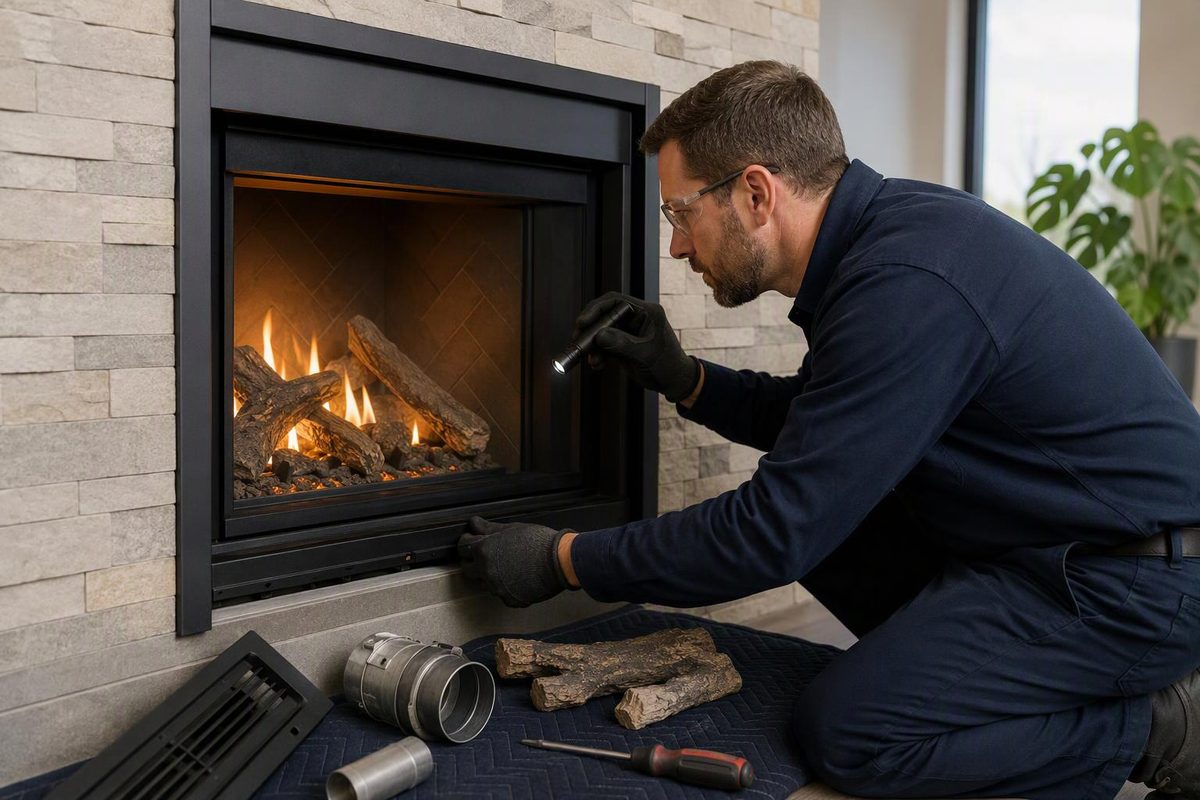
A useful gas fireplace inspection covers the appliance, combustion components, fixed glass and the vent or chimney—not merely whether the flames turn on. Stop using the fireplace immediately for a gas odor, a carbon-monoxide alarm, damaged fixed glass or recurring soot; otherwise, use the exact model’s manual to determine the inspection scope and interval.
Start with the owner’s manual. Inspection tasks differ among direct-vent fireplaces, B-vent units, gas inserts and listed vent-free appliances. The rating plate provides the model, serial number and fuel type needed to locate the correct manual. If the vent arrangement is uncertain, first identify how the gas fireplace is designed to vent.
Choose the condition, fireplace type and reason for inspection to see the appropriate next step.
Gas Fireplace Inspection Planner
The default result assumes no immediate hazard, an unknown vent design and routine service or an unknown history.
Identify the appliance, then arrange model-specific service
Do not treat a successful test fire as an inspection.
Photograph the rating plate, obtain the exact manual and identify the vent design. Ask a qualified technician to inspect the appliance and every accessible part of its vent or chimney path before relying on it.
This default route applies when there is no immediate hazard and the fireplace or vent type is unknown.
Source: Inspection actions and examples are limited to the owner-manual, CPSC, Con Edison and InterNACHI guidance cited in the article.
Stop Before Inspecting if There Is an Immediate Hazard
Do not operate the fireplace when:
- You smell gas or hear hissing near the appliance or supply piping.
- A carbon-monoxide alarm sounds.
- Anyone develops headache, dizziness, nausea, confusion or unusual fatigue while the fireplace is running.
- Fixed glass is cracked, broken, loose or missing.
- Soot appears rapidly, returns after cleaning or accumulates outside the firebox.
If you suspect a gas leak, leave immediately with everyone else. Do not operate a switch, phone, appliance or anything else that could create a spark while inside. Call 911 or the gas utility from a safe location, following local instructions. Con Edison’s gas-leak guidance gives that sequence and warns against touching electronics before leaving.
For a CO alarm or suspected CO exposure, move outdoors, call emergency services and do not re-enter until responders permit it. The CPSC’s carbon-monoxide guidance says not to reuse a malfunctioning appliance until trained personnel service it. It also explains that a CO alarm is added protection, not a substitute for appliance and vent maintenance.
Use the Model’s Inspection Interval
Use the interval in the manual for the exact model. Annual professional inspection is common, but the manual controls. For example, a 2026 Majestic owner’s manual calls for inspection before use and at least annually by a professional service person. Its schedule assigns annual checks of the glass seal, logs, firebox, control compartment, pilot and burner to a qualified technician.
Arrange an inspection before use when:
- The service history is unknown.
- The home or fireplace has just been purchased.
- The fireplace has sat unused for a long period.
- Renovation, roofing or siding work may have affected the vent termination.
- The unit has been moved, converted between fuels or repaired.
- Ignition is delayed, flames look different, the pilot repeatedly fails or the fireplace shuts down unexpectedly.
A Professional Inspection Should Cover the Whole System
The model’s service literature supplies the actual checklist. Before booking, ask whether the visit includes the following—not merely glass cleaning and a brief test fire.
Appliance Identification and Installation Review
The technician should record the model, serial number and fuel shown on the rating plate, then use the corresponding manual. Visible clearances, the safety barrier, air openings and service access should be checked.
An insert installed in an existing fireplace may also need a separate evaluation of its liners and the underlying chimney.
Firebox, Glass and Media
The inspection should look for damaged glass, a deteriorated gasket, failed latches, corrosion, perforation or warped firebox surfaces. Logs, stones or other media must be the approved components and remain in their specified positions; misplaced media can obstruct ignition or cause flame impingement and soot.
The Majestic maintenance schedule cited above assigns annual glass-and-gasket, log and firebox inspections to a qualified technician. It also warns not to operate that fireplace with its fixed glass removed, cracked, broken or scratched, and requires its latches to be properly engaged. Apply the instructions for your model rather than assuming every glass assembly is removed or secured the same way.
Burner, Pilot, Ignition and Controls
A complete service inspection normally includes cleaning accessible dust and debris, checking burner ports and alignment, inspecting the pilot or flame-sensing components, and observing ignition and flame carryover.
The Majestic service schedule also directs its technicians to verify inlet and manifold gas pressure and check accessible gas-carrying components for leaks. Those are instrumented service tasks, not adjustments to make by eye.
A burner that lights with a bang, hesitates before flame travels across it or produces recurring soot needs diagnosis before further use. Gas-fireplace soot is not automatically a cleaning problem.
Venting and Termination
For a vented fireplace, the appliance and vent function as one system. Exposed sections and the outdoor termination should be examined for separation, corrosion, damaged sealing and obstruction by nests, leaves, vegetation, snow or later construction.
The Majestic manual, for example, assigns seasonal checks of exposed venting and the termination cap to the homeowner and annual appliance work to a qualified technician. That schedule applies to the models covered by that manual, so use your own model’s instructions.
The vent route affects who can inspect the full system. A hearth or gas-appliance technician may cover an accessible direct-vent system. An insert with liners running through a masonry chimney may also require a chimney professional with suitable access and equipment.
CPSC guidance recommends professional annual heating-system service and checks of chimneys and flues for blockage, corrosion, disconnections and loose connections.
Operational Test and Written Findings
After reassembly, the technician should verify ignition, stable operation and shutdown using the model’s controls. Ask for written findings that distinguish:
- Conditions observed
- Cleaning or adjustments completed
- Repairs required before use
- Areas not accessible or outside the quoted scope
- Parts or further testing recommended
“Passed” is less useful than a record of what was inspected.
A Home Inspection Is Not Appliance Service
Do not assume a pre-purchase home inspection included dedicated fireplace service. Scope varies by contract and jurisdiction.
Under InterNACHI’s general home-inspection standard, an inspector examines readily accessible and visible fireplace and chimney portions but is not required to inspect the flue or vent, seals or gaskets, operate a gas insert, light a pilot, assess draft or dismantle components.
If a home inspector recommends specialist evaluation—or notes that the unit was not operated—arrange dedicated gas-fireplace service before relying on it.
Homeowners Can Make Limited Visual Checks
With the fireplace off and fully cool, a homeowner can:
- Photograph the rating plate and obtain the exact owner’s manual.
- Check that the required safety screen is present and secure.
- Keep louvers and air openings free of lint and stored objects.
- View an accessible outdoor termination from the ground for leaves, nests, snow, damage or new construction blocking it.
- Note glass damage, corrosion, soot patterns and ignition behavior without dismantling gas components.
- Test and replace CO alarms according to their manufacturers’ instructions.
Do not move logs or media unless the manual expressly provides a homeowner procedure. Do not probe burner ports, alter an air shutter, adjust gas pressure, dismantle a valve or improvise a leak test.
If there is no gas odor and the issue is only how to start the unit, identify the controls and follow the exact lighting instructions.
Hire for the Appliance and Vent in Front of You
Begin with the manufacturer or an authorized dealer and verify any gas-fitting license required locally. NFI Gas Specialist certification is another relevant credential: the published NFI curriculum covers valves, ignition systems, burners, fuel delivery, venting and troubleshooting.
A credential alone does not define the visit’s scope. Ask whether the individual technician services your specific brand and whether the quoted inspection includes the entire vent or chimney path. For an insert, confirm whether the technician will evaluate its liners and whether a separate chimney inspection is needed.