
Choose the Burner That Fits How You Actually Cook
Sealed burners generally keep routine messes on the cooktop. Some open models let round-bottom woks sit closer to the flame, but performance varies by model.
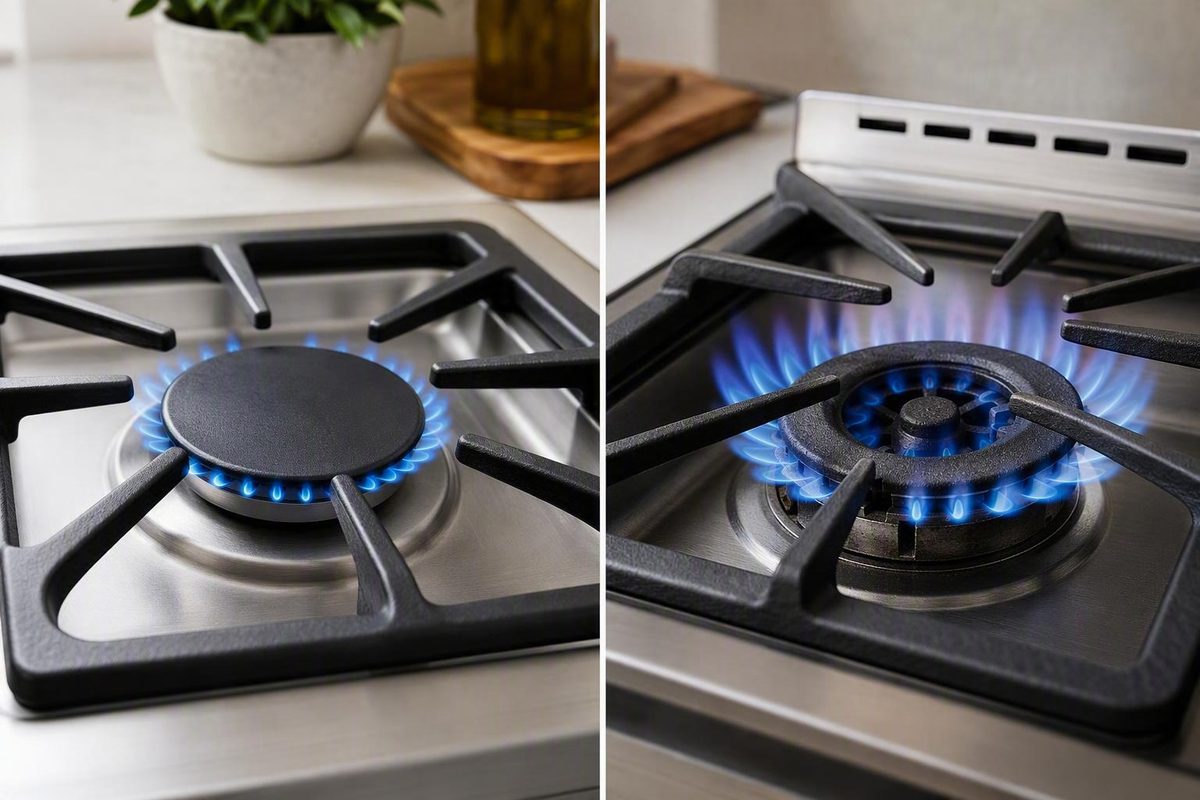
Choose the burner that fits how you actually cook.
The short answer: neither burner design wins every kitchen
For most households, a sealed burner is the practical default. It generally keeps crumbs, splatter, and modest boilovers on the upper cooktop, making routine wipe-downs more convenient. An open burner deserves serious consideration when you frequently use a round-bottom wok, value a particular direct-flame arrangement, or have found a model whose output and flame pattern suit your cookware.
These are category tendencies, not guarantees. “Sealed” and “open” primarily describe construction and spill management. Neither label proves that an appliance will boil faster, sear better, simmer lower, heat more evenly, or require less total maintenance.
The old shorthand—sealed means convenient but weak, open means powerful but demanding—is especially unreliable. Premium sealed burners can offer substantial maximum output and specialized low-heat controls. One third-party comparison lists a premium sealed system at 23,000 BTU and a BlueStar open burner at 25,000 BTU, but these are manufacturer-derived input ratings rather than results from a controlled, matched-product test (see the model-specific comparison).
Use this matrix as a starting point:
| Your priority | Start by examining | Why |
|---|---|---|
| Everyday family meals | Sealed burners | Routine splatter and crumbs usually remain on the upper surface |
| Sauces and delicate low-heat work | Specific sealed and open models | The low-heat method and control range matter more than the category |
| Frequent round-bottom-wok cooking | Verified wok-compatible burners | Certain open designs position a wok close to a concentrated flame |
| Steak searing and rapid boiling | High-output models of either type | Input, flame footprint, grate height, and pan fit all matter |
| Very low cleanup tolerance | Sealed burners | Light everyday messes are generally easier to reach |
| Willingness to perform deeper cleaning | Either type | An accessible open tray may be acceptable if the burner supports valued tasks |
| Frequent use of small saucepans | A compact flame pattern | A wide flame can miss the center or wrap around the pan |
| Occasional stir-frying | A strong sealed burner with suitable cookware | It may meet the need without an open lower tray |
The best buying process has two stages. First, identify what matters most: wok fit, high-output behavior, low-heat control, routine cleanup, installation fit, or serviceability. Second, compare exact models on those characteristics. Do not reject an otherwise suitable appliance solely because a retailer placed it in the “wrong” burner category.
What sealed and open burner actually mean
A sealed burner uses the cooktop structure, a barrier, or a raised area around the burner to keep most spills at the cooking surface. The practical distinction is that food and liquid do not have an obvious route into a lower drip tray.
An open-tray burner leaves a path around or beneath the burner into a lower area. Crumbs, grease, and boilovers may fall into a drip tray or burner compartment. Some appliances provide removable burner heads and trays; others make the lower area less accessible.
Unfortunately, open burner is not a consistent marketing term. It may refer to:
- An open spill path
- An uncapped burner head
- A particular high-output configuration
- A pro-style appliance with removable trays
- Some combination of those features
An owner discussion about BlueStar appliances illustrates this ambiguity: participants use “open” for both the spill route and an uncapped star-shaped burner while also distinguishing semi-sealed arrangements. The discussion is useful for identifying terminology problems, but its technical explanations and performance opinions remain anecdotal (review the terminology discussion).
It helps to separate four design attributes:
- Sealed versus open-tray: Where do spills go?
- Capped versus uncapped: Is there a removable cap above the burner ports?
- Ring versus star or radial geometry: Where are the ports, and what flame footprint do they form?
- Single versus dual-stack operation: Does the burner use one set of ports across its control range or separate levels or stages?
These attributes can appear in different combinations. A sealed burner can use circular, star-like, or radial geometry. An open-tray design may have capped or uncapped components. A dual-stack burner is not automatically powerful, precise, sealed, or easy to clean merely because it has two levels of ports.
Some products are described as semi-sealed. Their trays rise toward the burner and restrict spills without creating the continuous upper basin associated with a fully sealed design. Removable parts may still provide access from above. This middle ground is another reason not to infer construction or performance from a category label.
Before buying, inspect the exact appliance’s parts diagram, installation instructions, and cleaning procedure. Identify the burner head, cap, igniter, drip tray, and cooktop basin. A retailer’s filter may help you find products, but model documentation should determine what you will actually remove, clean, and reinstall.
Power and speed: why maximum BTU does not settle the comparison
It states the rate of fuel input at maximum operation. It does not directly measure how much heat reaches the cookware or how quickly a particular pan will boil water.
Useful pan heating also depends on:
- Burner-port geometry
- Flame diameter and direction
- Distance between the flame and cookware
- Grate height and shape
- Pan-base diameter
- Cookware material and thickness
- Whether the pan is flat, curved, or warped
- The selected burner setting
- How much flame and heat extend beyond the cookware
Consider a wide flame ring under a small saucepan. Even with a large input rating, part of the flame may extend beyond the pan base. A lower-rated burner with a compact flame footprint could place more useful heat beneath that particular pan. Change to a broad stockpot, and the relationship may reverse.
Model-specific figures show why category assumptions fail. BlueStar’s 2016 promotional article stated that its Platinum open burner was rated at 25,000 BTU (read the dated manufacturer claim). That is a historical claim about one manufacturer’s product, not proof that open burners universally achieve or exceed that output.
A BlueStar RCS forum discussion, by contrast, presented the open configuration at approximately 15,000 BTU and the sealed configuration at approximately 21,000 BTU (see the model discussion). The figures were reported in an owner forum rather than a current manufacturer specification sheet, so they should be treated as an anecdotal, model-specific counterexample—not verified current specifications. Even with that limitation, the discussion demonstrates why “open always means higher input” is not a safe shopping assumption.
A lower-rated burner may also suit a particular vessel if its flame placement and grate arrangement are effective. An open burner that positions a round-bottom wok close to a concentrated flame may work well for that task even when another burner carries a larger maximum rating. Conversely, a powerful burner may be useful under a stockpot but awkward under a butter warmer.
When comparing two ranges, ask questions tied to real tasks:
- How quickly does this exact model boil a stated volume of water in the same pan?
- Were the water volume, starting temperature, cookware, lid use, and fuel conditions consistent?
- How well does the burner recover after food is added?
- Does it brown food across the usable pan area?
- Does the flame stay beneath the cookware at the settings you will use?
- Can it maintain the low heat required by your sauces and long simmers?
- Is the claim based on a manufacturer rating, a showroom demonstration, a repeatable test, or an owner impression?
A matched showroom demonstration can be more useful than comparing labels, provided the appliances use comparable cookware, water volume, starting conditions, and procedures. It still will not answer every question—particularly simmer stability and pan uniformity—but it brings the comparison closer to actual use.
Maximum BTU belongs on the specification sheet. It should not be the sole selection criterion.
Woks, searing, simmering, and small pans
Cooking performance is where the sealed-burner-versus-open-burner debate becomes most task-specific. A design that works well with a round-bottom wok may be inconvenient for a tiny saucepan. A burner that maintains a delicate sauce may not provide the flame placement wanted for aggressive stir-frying.
Round-bottom woks
Certain open-burner ranges suit round-bottom woks because their normal grate can be removed and the wok can sit closer to the burner. BlueStar has promoted this arrangement for particular open-burner products, along with a concentrated flame pattern.
Do not infer that every open burner works this way. Confirm the permitted configuration in the exact model’s documentation, including whether the standard grate may be removed and whether a dedicated wok grate or ring is specified. If the documentation does not describe the setup, do not rely on a salesperson’s statement that owners commonly improvise it.
Sealed burners can also support wok cooking. A flat-bottom wok may work effectively on a strong sealed burner, while some appliances may have a model-specific support or accessory. The meaningful question is not simply whether the burner is sealed; it is whether the documented setup places the flame effectively beneath the wok you intend to use.
Searing and rapid boiling
High maximum input and concentrated-flame arrangements are common reasons to consider particular open-burner ranges. Neither searing nor rapid boiling belongs exclusively to open burners, however. A suitable sealed burner may perform either task effectively.
For searing, assess how the burner heats the portion of the pan holding the food. Cookware construction also changes the result.
For boiling, compare repeatable results using the same pot, water volume, starting temperature, and lid practice. An unmatched maximum-input number cannot establish which appliance will be faster in your kitchen.
Simmering and delicate sauces
There is no reliable category-wide winner for simmering. Commercial sources disagree: some characterize open burners as more responsive and precise, while others favor sealed burners for delicate cooking. Because these claims come from retailer or manufacturer content rather than equivalent laboratory comparisons, the disagreement is a reason to test the exact control system rather than choose by label (compare one retailer’s characterization).
Premium sealed systems may use dual-stack burners or pulsed low-heat operation. Those methods are not interchangeable:
-
A steady low flame operates continuously at reduced input.
-
A temperature claim describes a measured or targeted temperature rather than fuel input.
- A minimum BTU claim may use a different definition or procedure from another manufacturer’s figure.
A pulsed low-heat figure cannot be ranked directly against a steady-flame rating without considering cycling behavior, cookware, food mass, and test conditions. For sauce work, observe whether the burner prevents scorching and maintains a stable result with the pan you expect to use.
Small pans
Small cookware exposes the mismatch that can occur between burner size and pan size. As a wide ring burner is turned up, flames may spread outside the base of a narrow saucepan. The pan’s outer area may then receive stronger heating than its center, and flames may extend around the sides.
Choose a burner whose flame remains beneath the pan at the required setting. If you regularly use a milk pan, moka pot, or butter warmer, take the base diameter to the showroom. A range with several impressive large burners may still need one compact burner for those vessels.
Task-based comparison
| Cooking task | What to prioritize | Likely starting point |
|---|---|---|
| Round-bottom wok use | Documented support, permitted grate arrangement, flame concentration, stability | A verified wok-compatible burner |
| Flat-bottom stir-frying | Useful heat under the base and responsive controls | Strong models of either type |
| Steak searing | Pan-area heating, recovery after food is added, suitable cookware | High-output models of either type |
| Rapid boiling | Matched boil test, pot diameter, flame containment | Compare exact models |
| Delicate sauces | Low-setting behavior, control resolution, pan fit | Low-heat systems of either type |
| Long simmers | Stable low heat and suitable control behavior | Test the exact burner |
| Small saucepans | Compact flame footprint beneath the base | A dedicated small burner or adaptable geometry |
Cookware fit is part of burner performance. Treat the burner, grate, and pan as one heating system rather than three unrelated purchases.
Cleanup depends on what spilled and where it went
Sealed burners normally make routine surface cleaning more convenient. Light oil splatter, crumbs, and modest boilovers generally remain around the burner rather than dropping immediately into a lower tray.
Open burners provide another destination for the mess. Food and liquid may reach a tray, burner area, or removable component, creating more pieces to inspect and potentially clean.
But “sealed is always easier” is too simplistic. A removable open-burner tray can make some large spills manageable because the mess collects on an accessible part. Meanwhile, residue may bake onto an upper cooktop surface or gather around burner components. Owner reports describe both easy-cleaning open trays and sealed surfaces with stubborn residue, although those experiences vary by appliance, material, cooking habits, and tolerance for discoloration (see the mixed owner reports).
A better comparison begins with the spill:
| Spill scenario | Sealed-burner tendency | Open-burner tendency | What matters most |
|---|---|---|---|
| Light oil splatter | Usually remains on the upper surface | May reach a tray near an opening | Surface access and grate removal |
| Dry crumbs | Can be wiped away when accessible | May fall into the lower area | Tray design and crevices |
| Grease accumulation | May collect or bake around upper components | May collect in the tray and burner area | Material, access, and cleaning frequency |
| Starchy overflow | Often remains above but may dry into a film | May spread through a lower tray | Spill volume and containment |
| Sugary boilover | May harden on the upper surface | May reach multiple lower components | Surface material and the model’s cleaning procedure |
Model-level details may matter more than the category:
- Tray access: Does the tray lift out without tools?
- Crevices: Are there narrow seams that trap liquid?
- Cooktop material: What cleaning products and methods are allowed?
- Grate weight: Can the intended user lift each grate comfortably?
- Burner disassembly: How many caps, heads, rings, or inserts must come off?
- Igniter exposure: Is the ignition area easy to inspect and clean?
- Part orientation: Is it obvious how each component must be reinstalled?
- Tray containment: Where would a substantial overflow travel?
Owner reports can identify frustrations omitted from product summaries, but they cannot establish a universal cleaning schedule. A routine that works for one household may not suit another household cooking different foods at a different frequency.
Informal owner routines do not override model-specific cleaning instructions.
Use this in-store cleanup inspection:
- Ask the salesperson to confirm that the display is safe to handle.
- Lift a grate using the same motion you would use at home.
- Identify where spilled liquid would travel.
- Check whether a lower tray is removable and whether tools are required.
- Count the loose parts associated with one burner.
- Locate the igniter and inspect the surrounding crevices.
- Remove and replace components only as the model instructions describe.
- Read the cleaning section of the use-and-care manual.
- Confirm the permitted cleaners, pads, soaking methods, and dishwasher practices.
- Decide whether you would realistically complete that routine after the foods you cook.
Cleanability is an interaction among spill type, appliance construction, and user effort—not a single checkbox beside “sealed” or “open.”
Installation, ventilation, maintenance, and total ownership
Compare the complete appliance and project, not an assumed category premium. Open burners often appear on pro-style products, but burner construction alone does not establish the price. Width, ovens, controls, finishes, grates, brand positioning, delivery, and service support may all affect cost.
The supplied comparison evidence is not sufficient to prescribe a gas-line size, ventilation capacity, clearance, conversion procedure, or other installation rule for either burner category. Some pro-style appliances may have requirements different from an existing residential range, but those requirements must be taken from the selected model’s current documentation and assessed for the actual home. A third-party buying guide also cautions that fuel and installation implications vary by appliance rather than following a universal sealed-versus-open rule (review the model-focused installation discussion).
For every candidate, obtain the exact model number and verify its documented requirements for:
- Fuel type
- Permitted conversion, if any
- Total appliance input and individual burner ratings
- Electrical supply
- Clearances and surrounding surfaces
- Ventilation
- Cabinet and countertop conditions
- Anchoring or anti-tip components
- Location-specific restrictions stated by the manufacturer
- Delivery access
- Local installation and service availability
This article is a buying framework, not an installation specification. Use the current instructions supplied for the appliance and the requirements that apply to the home rather than a generalized online rule.
Maintenance deserves equal attention. Compare:
- The number of burner caps or heads
- Access to igniters
- Availability of removable trays
- Replacement-part availability
- Warranty terms
- Cleaning exclusions
- Fuel-conversion conditions
- Local service coverage
A design that appears easy to service offers little practical benefit if parts are difficult to obtain or no nearby technician supports the brand.
The evidence supplied for this comparison does not establish that either burner category is inherently safer. It also does not support category-wide claims about emissions, certification, or carbon-monoxide performance. Safety and installation must therefore be evaluated at the complete-appliance and site level, using the exact model documentation and appropriately qualified local guidance.
Avoid generalized estimates for fuel-supply changes, ventilation work, or long-term repair savings. Those costs depend on the appliance, existing utilities, cabinetry, location, and labor involved. Obtain a model-specific assessment before treating the appliance price as the total project cost.
How to compare burners in a showroom
A showroom visit is most useful when you bring cookware dimensions, cooking priorities, and the exact constraints of the installation space. Marketing phrases such as “restaurant power,” “precision simmer,” and “easy clean” identify claims to investigate—not verified results.
Heat and control
- Record the maximum input of every burner, not just the strongest.
- Ask how the minimum heat is achieved.
- Determine whether low heat uses a steady flame, pulsed operation, separate ports, or another method.
- Do not compare unlike low-heat figures as though they were equivalent.
- Observe flame diameter at low, medium, and high settings if a demonstration is available.
- Check whether the control provides useful adjustment across the knob’s travel.
- Ask for measured boil, sear, or simmer results and the conditions used.
Geometry and cookware fit
- Identify whether the burner is circular, star-shaped, radial, single-stack, or dual-stack.
- Examine the distance between the burner ports and cookware.
- Check grate height and pan stability.
- Compare the flame footprint with your smallest saucepan.
- Place your largest everyday frying pan or stockpot on the grate.
- Check whether large pans crowd controls or neighboring burners.
- Observe whether flames stay beneath the base at the settings you expect to use.
Wok support
If you use a round-bottom wok, ask:
- Does the model documentation describe round-bottom-wok use?
- May the standard grate be removed?
- Is a dedicated wok ring or grate specified?
- What wok dimensions and shapes are supported?
- Does the approved arrangement hold the wok securely?
- Can neighboring burners and controls still be used as intended?
Do not accept “people do it all the time” as a substitute for written model instructions.
Cleanup and handling
- Trace the spill route into any lower compartment.
- Remove and replace the tray, cap, head, and grate as directed.
- Count the parts involved in cleaning a substantial spill.
- Inspect seams, corners, fasteners, and the igniter area.
- Check whether each grate is manageable for the person who will clean it.
- Confirm the permitted cleaners, soaking methods, and dishwasher practices.
- Ask whether replacement caps, trays, igniters, and grates are stocked.
Retailer guidance often characterizes sealed burners as lower-maintenance and open burners as suited to frequent high-heat or wok cooking. Even that guidance recommends choosing around cooking habits rather than declaring a universal winner (review the retailer comparison).
Installation and ownership
Before ordering, collect and review:
- Installation instructions
- Use-and-care manual
- Fuel and electrical requirements
- Ventilation instructions
- Warranty terms
- Parts diagrams
- Local service availability
- Delivery dimensions
- Cabinet, countertop, and clearance requirements
Prioritize credibly measured or consistently demonstrated model performance over category labels. If the seller cannot provide the relevant documentation or explain the low-heat method and spill path, delay the decision until those points can be verified.
Which burner type fits each kind of cook?
For a household preparing weeknight meals, soups, pasta, eggs, sautéed vegetables, and occasional sauces, begin with sealed-burner models. They usually provide the most convenient arrangement for wiping up routine messes. Still compare flame size, control feel, grate handling, and service support; an awkward sealed design does not become convenient merely because of its label.
If controlled low-temperature sauce work is central to your cooking, examine premium sealed systems with dual-stack or specialized low-heat operation. Also consider any open model that demonstrates stable low control. The goal is a burner that behaves properly with your saucepan and food, not a categorical victory for sealed burners.
For frequent round-bottom-wok use, investigate a burner with documented wok support and an accessible cleaning arrangement. Certain open models are strong candidates because they can place the wok close to a concentrated flame, but the intended grate configuration must be confirmed for the exact appliance.
For steak searing and rapid boiling, compare high-output examples of both types. Combine the input rating with flame footprint, grate distance, cookware fit, and repeatable task performance. A larger rating has little practical value if its advantages appear only with cookware you do not own.
Occasional wok users should first test whether a strong sealed burner and flat-bottom wok meet the need. If a model-specific accessory is offered, examine its documented arrangement as well. A purpose-designed open burner may be worthwhile when those alternatives do not provide the desired fit or flame placement.
Buyers sensitive to maintenance should look beyond the upper surface.
Use a weighted scorecard for the final comparison. Assign weights totaling 100, then rate each appliance from 1 to 5.
| Decision factor | Example weight | Questions to score |
|---|---|---|
| Primary cooking tasks | 25 | Does it suit sauces, boiling, searing, or wok cooking? |
| Cookware compatibility | 15 | Do its flame patterns fit your smallest and largest pans? |
| Cleanup tolerance | 20 | Where do spills go, and can you handle the grates and trays? |
| Low-heat control | 10 | Is the control method suitable for your food and cookware? |
| Installation fit | 10 | Do the documented requirements fit the home? |
| Service and parts | 10 | Is local service available, and can parts be obtained? |
| Total project budget | 10 | What will the appliance, delivery, installation, and required alterations cost? |
Change the weights to fit your kitchen. A dedicated wok cook may give cookware compatibility and high-heat behavior half the total score. A busy household may place most of the weight on routine cleaning, service access, and versatile burner sizes.
The sealed-versus-open label is a starting point, not a verdict. Choose sealed when convenient surface cleanup and everyday use dominate. Consider open when a particular model provides the wok support, flame placement, or high-heat behavior you will use regularly. Before buying, compare the exact burner’s flame pattern, low-heat method, cookware fit, spill path, cleaning procedure, installation requirements, and service support.
Frequently asked questions
Do open burners always have more BTUs than sealed burners?
No. Open burners are often marketed around high output, but individual ratings overlap. In the model-specific BlueStar RCS forum discussion, the open configuration was presented at approximately 15,000 BTU and the sealed configuration at approximately 21,000 BTU. Those figures are anecdotal and model-specific rather than verified current specifications.
BTU is also a fuel-input rating, not a direct measurement of heat delivered to a pan. Compare flame footprint, grate height, cookware fit, and repeatable task results alongside the maximum number.
Can a sealed burner work with a wok?
Yes. A sealed burner can work with a flat-bottom wok when the burner, grate, and wok dimensions are compatible. Some appliances may also document a model-specific wok support.
Certain open models offer a distinctive arrangement because their normal grates can be removed and a round-bottom wok can sit closer to the flame. That feature is model-specific. Confirm the permitted configuration rather than assuming either burner category is automatically compatible.
Which burner type is better for simmering?
Neither type wins universally. Commercial sources conflict over whether open or sealed burners provide greater precision. Premium sealed systems may use dual-stack or pulsed low-heat controls, while some open-burner products are promoted for broad adjustment.
Compare the exact burner with your cookware. Determine whether its lowest setting is steady or pulsed, observe how it maintains the food, and avoid ranking steady-flame BTU figures, pulsed-input figures, and temperature claims as equivalent measurements.
Are open burners harder to clean?
Usually for light splatter and crumbs, because debris can reach a lower tray or burner area. Sealed burners generally keep those everyday messes on the upper cooktop.
The answer is less certain after a large spill. Some open burners have accessible removable trays, while residue can harden on an upper surface. Tray removal, crevices, grate weight, surface material, loose parts, and spill type are more useful indicators than the label alone.
Is a sealed burner safer than an open burner?
The supplied evidence does not establish an inherent safety advantage for either category. It also does not justify universal claims about installation, ventilation, certification, or emissions based solely on whether a burner is sealed or open.
Evaluate the complete appliance and use only the exact model’s instructions for installation, operation, cookware arrangements, component assembly, and maintenance. Do not treat a category comparison as a substitute for appliance-specific or locally applicable guidance.