
Which Furnace Vent Do You Have? Start With the Furnace Type
Distinguish furnace exhaust, combustion-air intake and room registers. Learn how gas, oil and electric furnaces differ before changing venting.
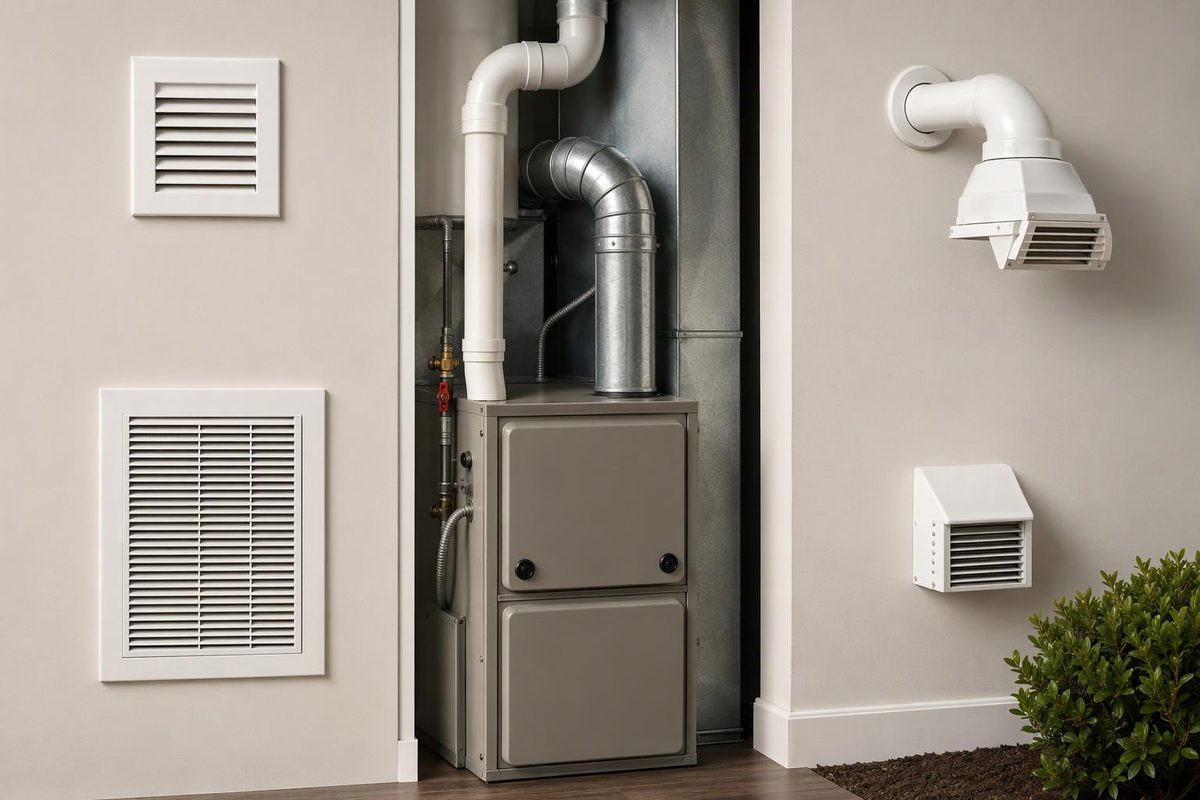
A fuel-burning furnace vent carries combustion gases outdoors. It is not the same system as the supply registers and return grilles that circulate air through your rooms. Gas and oil furnaces need combustion venting; an electric-resistance furnace does not, because it does not burn fuel. Carrier’s furnace comparison explains that distinction.
The practical question is not simply “Where is the furnace vent?” It is which pipe carries exhaust, where combustion air comes from, and what venting the exact furnace permits.
Match the vent to the furnace type
These are identification clues, not approval to reuse or replace a pipe:
| Furnace type | Exhaust arrangement to look for | Combustion-air arrangement |
|---|---|---|
| Conventional noncondensing gas furnace, often an 80% model | Metal connector leading to an approved vent or lined chimney; Category I systems generally vent vertically, unless equipped with an approved power venter | Air supplied to the furnace space, sometimes through dedicated outdoor-air openings or ducts; do not assume there must be a second pipe connected to the furnace |
| Condensing gas furnace | Approved corrosion-resistant vent pipe, often plastic, terminating through a wall or roof | May use a separate outdoor-air intake or an approved arrangement taking combustion air from the furnace space |
| Oil furnace | Metal connector to a suitable chimney, or a specifically approved sidewall vent system | Air supplied to the burner as the furnace and vent-system instructions require |
| Electric-resistance furnace | No combustion exhaust pipe | No combustion-air intake; supply and return ductwork still carry room air |
The PG80ESAA/PG80ESLA noncondensing furnace manual documents Category I chimney and vent arrangements. The Carrier 59SC5B condensing furnace manual documents outdoor exhaust with several combustion-air options. For oil, the Thermo Pride OL6 manual permits either a correctly sized chimney or a specified sidewall kit—not an improvised wall outlet.
Metal does not automatically mean B vent, and plastic does not automatically mean approved furnace venting. Identify the furnace model and pipe markings before choosing components. If you have a listed Type B gas vent, our B vent pipe guide covers that system’s separate requirements.
Why some furnaces have one pipe and others have two
On a condensing gas furnace, the intake and exhaust serve different jobs:
- Exhaust pipe: takes the products of combustion outdoors.
- Combustion-air intake: brings air to the burner. It is not a return-air duct or a whole-house fresh-air supply.
In a direct-vent, two-pipe arrangement, combustion air comes directly from outdoors and exhaust goes outdoors. In a permitted non-direct-vent, one-pipe arrangement, exhaust still goes outdoors, but combustion air comes from the area around the furnace. That space must have an adequate air supply; a single pipe does not make the furnace “vent-free.” The 59SC5B manual’s venting section describes both arrangements, plus a ventilated-space intake option.
A concentric termination can combine the intake and exhaust into one wall or roof penetration while keeping their passages separate, as shown in these manufacturer’s concentric-kit instructions. One visible terminal therefore does not necessarily mean a one-pipe furnace installation. Match the termination to the appliance; see how to choose a concentric vent kit.
Do not identify a pipe by touching it, smelling its discharge or briefly covering its opening. Trace accessible piping visually and compare it with the model’s installation diagram.
What to check before changing a furnace vent
Record the full furnace model number, photograph accessible pipe markings, and locate the installation manual. Have a qualified installer confirm locally required permits and inspections, then verify:
- Approved pipe and joints. The material, fittings, cement or mechanical connections must be approved for that furnace and jurisdiction. “PVC” alone is not a complete specification. Maintain the required clearances to combustible materials throughout the route.
- Diameter and route. Pipe size, total run and elbows must fit the applicable sizing method. A furnace outlet diameter is not, by itself, a complete vent design.
- Drainage and support. A condensing system needs the specified condensate drainage, pipe pitch and supports. Do not straighten a sloped pipe merely to make it look level.
- Termination location. Check the correct diagram for the intake/exhaust arrangement, including snow level, windows, doors, air inlets and nearby exhausts. Direct-vent and non-direct-vent clearance tables may differ.
The 59SC5B instructions illustrate these model-specific checks and distinguish U.S. material requirements from Canadian listed-system requirements. The noncondensing manual addresses metal venting and its clearances. These are North American examples, not universal furnace specifications.
Replacing a furnace can affect the water heater’s vent
If the old furnace and water heater shared a chimney, switching the furnace to separate condensing venting leaves a different load on that chimney. The remaining appliance’s venting may need resizing or other correction. Ask the contractor to evaluate it rather than simply disconnecting the furnace and leaving the water heater unchanged. Both the noncondensing and condensing furnace manuals flag this replacement issue.
Stop points for an existing installation
A disconnected, visibly damaged or obstructed exhaust is not a homeowner trial-and-error repair. Stop using the furnace and arrange qualified service. Keep checks to accessible areas; do not climb onto the roof or dismantle piping to identify it.
If a CO alarm sounds, or you suspect carbon-monoxide poisoning, leave immediately and call emergency services from outside. Do not stay to find the faulty vent or re-enter until responders permit it. The CPSC’s carbon-monoxide guidance also recommends annual professional heating-system inspection, including flues and chimneys, and working CO alarms on every level and outside sleeping areas.