
Before Buying a Ventless Propane Heater, Check the Room
A ventless propane heater still needs combustion air. Check local approval, room restrictions, fuel supply, clearances and CO protection before buying.
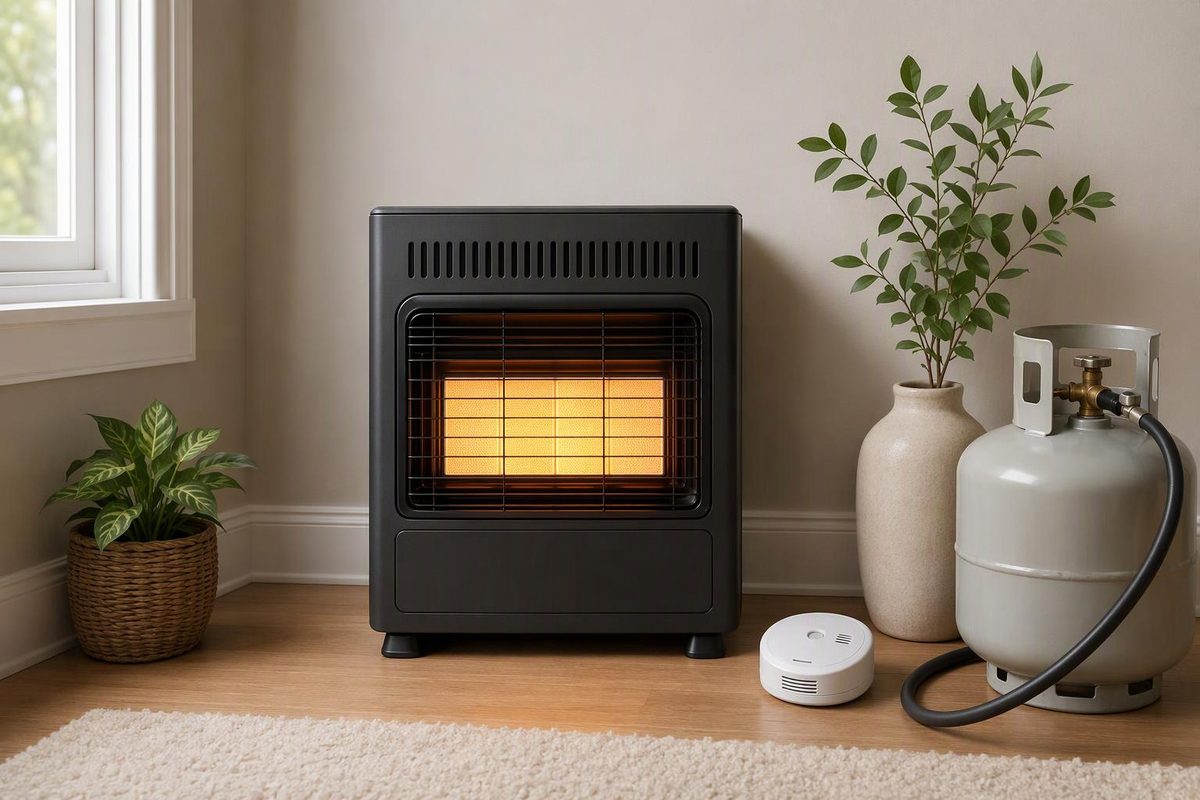
A ventless propane heater, also called vent-free or unvented, burns propane without sending exhaust through a chimney or flue. It uses oxygen from the room and releases combustion products into that room. “No vent pipe” does not mean “no ventilation required.” The manufacturer’s manual still requires adequate combustion and ventilation air. Dyna-Glo’s blue-flame heater manual makes that distinction explicitly.
Before comparing price or advertised heating area, check whether the exact heater is permitted in your location and suitable for the intended room.
1. Verify indoor approval and room restrictions
Start with the rating plate and the manual for the exact model—not merely the words “propane heater” in a listing.
Check:
- Fuel: The rating plate must identify propane/LP. Do not assume a natural-gas model can be converted.
- Intended use: Confirm that it is an indoor residential room heater. A portable camping or construction heater is not automatically an equivalent replacement.
- Location: Read restrictions for bedrooms, bathrooms, garages, manufactured homes and recreational vehicles.
- Local acceptance: Ask the building or mechanical-code office whether that model and installation are allowed and what permits or inspections apply.
For example, the Dyna-Glo BF-series manual prohibits field fuel conversion, prohibits bathroom installation, and allows bedroom installation only for its BF10 series under stated conditions. It also warns that state and local rules may prohibit or restrict vent-free heaters. Those are model-family instructions, not permission for another heater.
Sleeping is a separate stop point: Even where a small model’s manual permits bedroom installation, CPSC says never to operate an unvented fuel-burning appliance in a room where people are sleeping. CPSC’s carbon monoxide fact sheet also says portable fuel-burning camping equipment must not be used inside a home, garage, vehicle or tent unless specifically designed for enclosed-space use with safe-use instructions.
2. Check combustion air—not just square footage
Advertised heating coverage answers a different question from whether the building can supply combustion air. Room height, communicating spaces, other fuel-burning appliances and building tightness all matter.
The Dyna-Glo manual uses a confined-space screening method of 50 cubic feet per 1,000 Btu/hr of aggregate appliance input. Under that method, a 20,000 Btu/hr heater alone corresponds to:
20 × 50 = 1,000 cubic feet, or 125 square feet with an 8-foot ceiling.
That calculation is not a recommended heating area or installation approval. The worksheet includes other applicable fuel-burning appliances, but excludes direct-vent appliances; qualifying adjoining spaces must communicate as the manual specifies. Unusually tight construction requires additional fresh air even when room volume appears adequate. Have the installer apply the exact manual and locally adopted requirements. Source: Dyna-Glo manual, combustion-air section.
Do not substitute “I’ll crack a window” for this assessment. EPA recommends additional ventilation while using an unvented heater, but that general advice does not establish the required opening size or make a prohibited installation acceptable. EPA’s combustion-products guidance.
3. Plan the propane supply and clearances
An indoor-rated heater does not mean its supply cylinder belongs indoors. The Dyna-Glo manual requires propane supply tanks outdoors and specifies a minimum 100-pound tank capacity for that heater family. Do not assume a barbecue cylinder and a convenient hose are suitable. Your model may have different supply requirements. Source: Dyna-Glo safety instructions.
Have a qualified installer verify the tank, regulator arrangement, inlet pressure, piping capacity, shutoff and leak testing. An appliance regulator does not eliminate the need for supply-pressure regulation: the Dyna-Glo manual’s gas-connection section requires an external regulator and expressly warns against connecting directly to an LP supply.
Measure the proposed location against the manual’s clearance diagram. Check ceiling and sidewall distances, furniture and curtain separation, mounting hardware, floor protection and service access. Do not borrow clearances from a visually similar heater. Garages also require attention to ignition sources, flammable vapors and vehicle impact protection. Source: Dyna-Glo installation and safety sections.
4. Account for moisture and indoor pollutants
Vent-free heating leaves water vapor indoors. Dyna-Glo’s manual estimates approximately one fluid ounce (30 mL) of water per 1,000 Btu of gas input: about 20 fluid ounces during an hour at 20,000 Btu/hr. It identifies these heaters as supplemental heat, not a primary heating system. Source: manual’s water-vapor and installation sections.
Existing window condensation or persistent dampness is therefore a reason to reconsider the choice—not treat added moisture as a benefit.
CO is not the only concern. EPA identifies unvented gas space heaters as sources of combustion pollutants, including carbon monoxide and nitrogen dioxide; children and people with asthma or other respiratory diseases are particularly susceptible to nitrogen dioxide exposure. EPA guidance.
If you want propane heat without intentionally releasing combustion exhaust indoors, investigate a listed direct-vent appliance. Direct vent draws combustion air from outdoors and discharges exhaust outdoors, as the Dyna-Glo combustion-air section explains. Our propane stove selection guide covers the broader fuel-and-venting decision.
5. Understand the shutdown device and stop signs
An oxygen-depletion sensor (ODS) is part of the heater’s safety-pilot system and shuts the heater down if insufficient fresh air is available. It does not replace a room CO alarm. Never bypass it. If the pilot unexpectedly goes out, do not repeatedly relight the heater; the Dyna-Glo manual calls for fresh outside air before relighting and service if shutdowns continue. This is different from normal thermostat cycling, when the main burner switches off but the pilot remains lit. Arrange professional inspection before use and at least annually. Source: Dyna-Glo safety-pilot, operation and maintenance instructions.
Install battery-operated CO alarms, or alarms with battery backup, on every level and outside sleeping areas, following their instructions. Alarms supplement—not replace—correct installation and maintenance.
If a CO alarm sounds, or anyone develops headache, dizziness, nausea or confusion suggesting CO exposure, get everyone outside immediately and call 911. Do not stay inside troubleshooting, and do not re-enter until responders permit it. Seek prompt medical attention for suspected exposure. A malfunctioning appliance must be serviced before reuse. CPSC’s emergency guidance.
If you smell gas, do not light the heater or operate electrical switches or phones indoors. Leave and call the gas supplier from outside; if you cannot reach them, call the fire department. Dyna-Glo’s gas-odor instructions.