
A Small Wood Burning Stove Needs More Than a Small Corner
Choose a small wood burning stove by clearances, chimney requirements, usable heat output and log size—not just its outside dimensions.
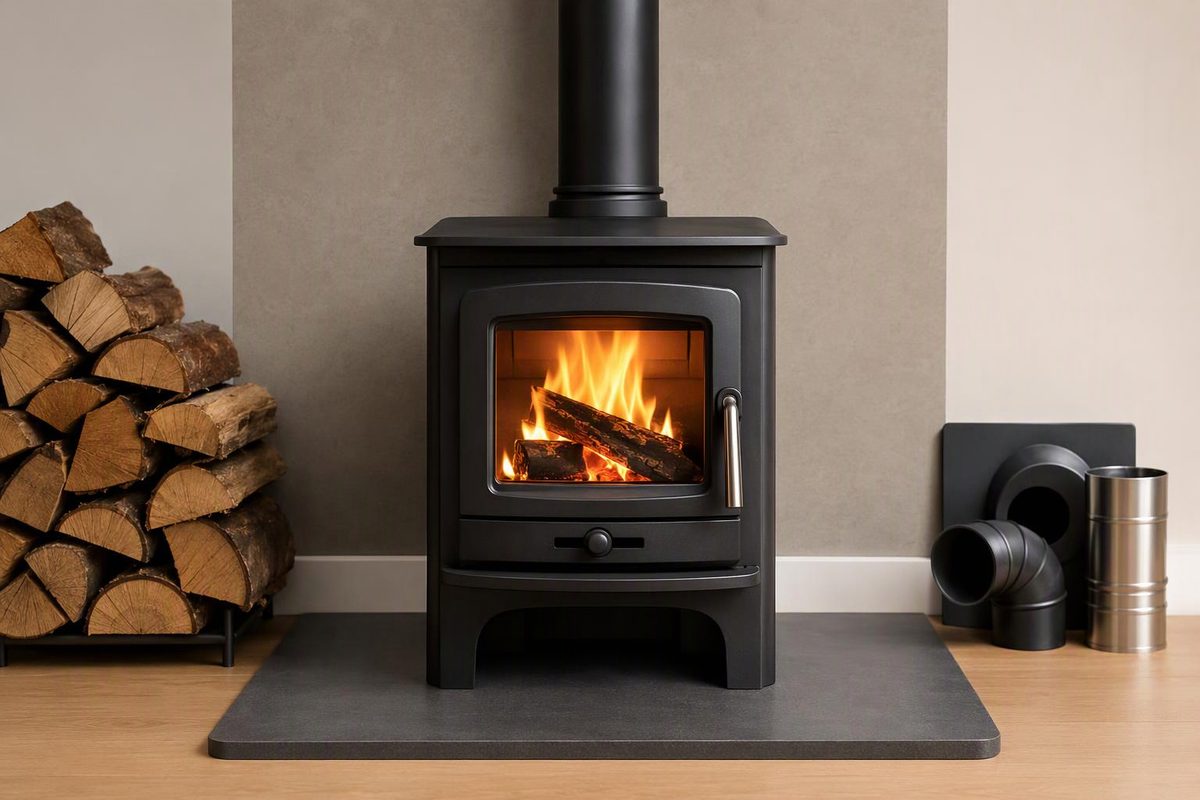
A small wood burning stove must pass two separate checks: it must fit safely in the building, and its heat output must suit the space. A narrow stove can still require substantial wall clearance or produce too much heat for a well-insulated room.
Start with the exact appliance label, matching installation manual and proposed chimney route—not a photograph or an “up to” square-foot rating. The examples below use U.S. and Canadian specifications; installation approval depends on your local requirements.
1. Check the installed footprint first
The stove’s width and depth describe only the appliance. Before buying, draw a floor plan showing:
- The stove body and loading-door swing.
- Required rear, side, corner and ceiling clearances.
- The connector pipe and its separate combustible clearances.
- The hearth’s required dimensions and construction.
- Nearby furniture, curtains, firewood storage and walking routes.
Use the manual’s diagram for your actual configuration. Parallel-wall, corner, alcove and manufactured-home installations may have different requirements. Single-wall and double-wall connectors can also produce different allowable layouts. Both the stove and connector clearances must be satisfied independently, as the Drolet Spark II N manual explains in Section 3.
Check whether the hearth needs ember protection only or specified thermal protection. For example, the Spark II N requires continuous noncombustible floor protection but no R-value; that is a model-specific requirement, not permission to use the same hearth under another stove. Its manual also provides different floor-protection dimensions for Canada and the United States. See Section 4.
Do not assume decorative tile or brick lets you move the stove closer to a combustible wall. Clearance reductions require an approved arrangement, as the manual’s clearance and shield sections explain. If the layout works only by ignoring a clearance or improvising a shield, stop and revise it before purchasing.
2. Match the heat to the room—not just the house area
The Wood Heat Organization uses a firebox volume below 2 cubic feet as a rough small-stove category, suitable for a large room or small seasonal cabin. It also stresses that firebox shape and usable volume create exceptions. This is a shopping convention, not a safety classification or guaranteed heating capacity. Its buying guide explains the limitations.
Give a hearth dealer or heating professional these details:
- The area and ceiling height you actually want to heat.
- Insulation, windows and noticeable air leakage.
- Local winter conditions.
- Whether the room opens into adjoining spaces or sits behind narrow doorways.
- Whether you want occasional evening heat, backup heat or sustained winter heating.
A square-foot rating cannot account for all those differences. The same stove can serve very different areas in a mild climate and a cold one, and partitioned rooms limit heat distribution. Maximum BTU figures are also poor stand-alone comparison tools because manufacturers may use different fuels and test conditions. Wood Heat discusses both problems.
For a small, efficient home, ask specifically about the stove’s low-output operation, and have its suitability checked against the space’s heat loss. Do not plan to control an oversized stove by keeping it smoky and smoldering: EPA’s archived guidance warns that smoldering fires are generally neither safe nor efficient, and SBI’s operating guide explains how smoky fires accelerate creosote accumulation. EPA burning guidance; SBI guide, Section 5.3.
3. Read one compact stove’s specifications carefully
The Drolet Spark II N, model DB03402, illustrates why “small” needs qualification. Manufacturer information checked October 6, 2026 lists:
| Specification | Published value |
|---|---|
| Outside dimensions, width × depth × height | 18½ × 29¾ × 28¾ inches |
| Overall firebox volume | 1.85 cubic feet |
| EPA loading volume | 1.67 cubic feet |
| Tested overall heat output rate, minimum to maximum | 18,782–71,262 BTU/h |
| Maximum log length | 17 inches, loaded north–south |
| Flue outlet and recommended connector diameter | 6 inches |
| Maximum burn time | Up to 5 hours |
These values come from the September 21, 2026 model manual. The distinction between overall and loading volume matters: the manual says overall volume includes buffer space and is not intended as a loading measure. It also says maximum burn time varies with fuel, draft, heat loss, climate and other conditions.
The tested minimum output is about 5.5 kW. It is a test result, not a promise that the stove will hold that output in your room. Use it to prompt a sizing discussion rather than assuming that a narrow body means gentle heat.
Use this as a specification-reading example, not a universal recommendation. An “up to five hours” claim does not promise overnight heating, and a compact body does not prove suitability for a tiny room.
4. Confirm the chimney and fuel supply
A small stove still needs a compatible solid-fuel chimney. SBI’s guide requires a listed factory-built chimney or a code-compliant lined masonry chimney, prohibits sharing its flue with another appliance, and explains that straight-up venting through the heated building generally performs best. Connector pipe is not interchangeable with the chimney system. Have an existing chimney assessed before treating it as usable. See the SBI safety and venting requirements.
Also compare the stove’s log limit with the wood you can reliably obtain and store. If your delivered logs are too long, cutting them becomes a recurring chore. Burn dry fuel: EPA’s archived best-practice guidance recommends moisture below 20%, checked with a moisture meter. EPA fuel guidance.
5. Get a complete installation quote
Before committing, request a quote that identifies the exact stove, connector, chimney or liner, hearth, any approved shields, required combustion-air provisions, permits and inspection. Ask local building or fire officials about restrictions and notify your insurer; the SBI owner’s guide recommends these checks.
For a U.S. purchase, check the exact model in the EPA Certified Wood Heater Database and verify its separate safety listing. Our EPA-certified stove verification guide covers that distinction.
If either the approved installation footprint or the stove’s heating suitability remains unresolved, settle it before paying for the appliance.