
Choose a Modern Wood Burning Stove That Fits the Installation
Look beyond contemporary styling: check a modern wood stove’s clearances, chimney, heat ratings, combustion controls and maintenance before buying.
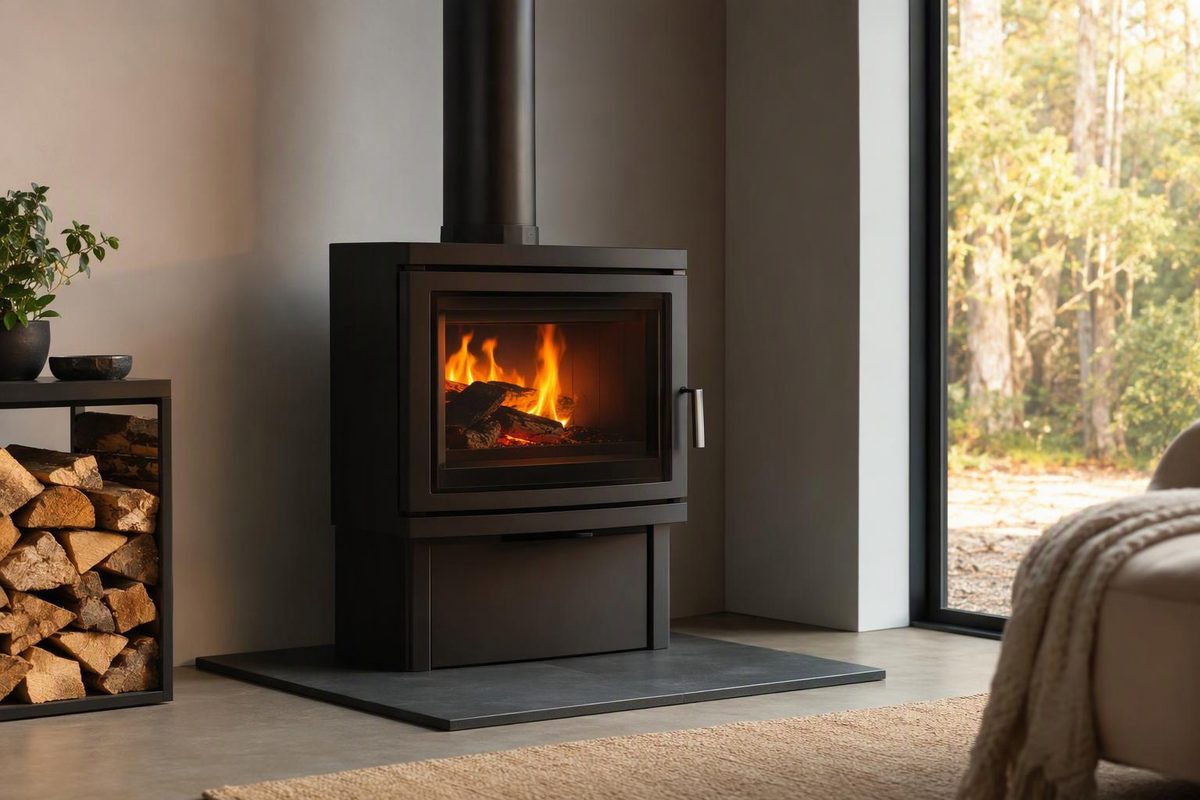
A modern wood burning stove can mean two different things: a contemporary-looking appliance or a stove with newer combustion technology. Those are separate choices. A tall body, large glass door or colored side panels tells you about the design—not whether the stove suits your chimney, room or heating needs.
For a U.S. installation, start with the exact appliance’s safety listing, installation manual and EPA certification. Then compare heat output and operating requirements. Choose the appearance from the models that pass those checks.
1. Check the installed space before the stove’s appearance
Get the current manual for each candidate and sketch the installation, including:
- Stove clearances: rear, side and corner distances for your actual configuration.
- Connector clearances: the stovepipe’s required separation from combustible materials, which is a separate check.
- Floor protection: required dimensions and whether the manual calls for ember protection or thermal protection.
- Chimney route: outlet diameter, ceiling or wall passage, supports and termination.
- Combustion air: whether the appliance or local rules require an outside-air connection.
A slim stove body does not establish a small installed footprint. The hearth and clearances can decide whether it fits.
For example, the Pacific Energy Neo 1.6 LE2 manual gives different clearance arrangements for single- and double-wall connectors and different floor-protection dimensions for the United States and Canada. It specifies noncombustible ember protection for that model; that is not a hearth specification to transfer to another stove. This model is an illustration, not a product recommendation.
Stop if the proposed layout depends on an unverified clearance reduction. Do not assume a decorative wall finish counts as an approved heat shield. Have the installer identify the permitted shielding arrangement and confirm it with the building authority.
2. Establish the chimney plan
The visible pipe above a freestanding stove is only part of the exhaust system. Confirm what connects it to an approved chimney and how the system passes through the building.
The Neo 1.6 LE2 manual, for instance, calls for a suitable lined masonry chimney or a listed high-temperature chimney system, specifies a 6-inch flue for optimal performance and prohibits sharing a chimney flue with another appliance. It also prohibits running its connector through concealed spaces, floors or ceilings. These are model-specific installation requirements, not details to settle after buying the stove.
If reusing a masonry chimney, arrange professional cleaning and inspection before treating it as usable, as that manual directs. Ask the installer to document its condition, liner compatibility and any required changes. For an existing fireplace, first decide whether you need an insert or a freestanding stove; do not assume either will fit or be approved. The Neo example specifically prohibits installation in a fireplace.
Check installation permits, inspection requirements and local wood-burning restrictions with the building and air-quality authorities before ordering.
3. Separate emissions, efficiency and heat output
These ratings answer different questions:
| Rating | What to use it for |
|---|---|
| EPA particulate emissions, in grams per hour | Comparing certified smoke-emission results |
| Overall HHV efficiency | Comparing how much fuel energy reaches the heated space on the same higher-heating-value basis |
| Tested heat-output range, in Btu/h | Assessing the appliance’s tested heating capability |
| Advertised peak output | A separate claim whose test basis needs checking |
Overall efficiency is not the same as combustion efficiency: the latter does not tell you how much heat reaches the home. EPA’s archived efficiency guidance explains that distinction and notes that actual efficiency varies with fuel, operation and installation.
The EPA Certified Wood Heater Database allows searches by manufacturer or model, combustion type, efficiency and emissions, and identifies certification to the 2020 Step 2 limits. Check the exact model rather than relying on a family name or “clean-burning” sales language.
Do not size the stove from its largest advertised output number alone. As of October 7, 2026, Pacific Energy’s Neo 1.6 LE2 product page lists 54,000 BTU for cordwood alongside 30,150 BTU for EPA test fuel. Its manual explains that the tested output range comes from specified test fuel and burn rates. Those numbers are not interchangeable promises of sustained heat in your home.
Bring a floor plan, insulation information, climate details and your intended heating role to the sizing discussion. Distinguish occasional room heating from daily supplemental or primary heating. Our wood-stove efficiency guide covers rating comparisons in more detail.
4. Choose controls you will actually use
Modern certified stoves commonly use secondary combustion, a catalyst or both. EPA’s archived wood-appliance guidance explains the basic differences:
- Non-catalytic: uses a hot, insulated combustion path and added combustion air; avoids catalyst servicing.
- Catalytic: passes smoke through a coated combustor that supports combustion at lower temperatures; requires catalyst care and eventual replacement.
- Hybrid: combines secondary combustion and a catalyst; retains catalyst maintenance requirements.
Read the startup, reload and low-burn instructions before choosing. Ask the dealer to demonstrate the air control, bypass if fitted, temperature indicators and ash removal.
If outage heating matters, check electrical dependencies too. “Wood-burning” does not guarantee every feature is electricity-free: the Neo 1.6 LE2 has powered combustion management, but its manual describes manual-air-control operation within safe and certified limits during a complete power failure. Verify the outage procedure for whichever model you choose.
5. Check fuel and service access before committing
Compare recommended log length—not just the maximum—and make sure you can comfortably load the stove without striking the glass. Ask about replacement availability for gaskets, firebrick, baffles, glass and any catalyst or electronic controls.
Plan dry firewood storage as part of the purchase. EPA’s archived wood-burning guidance recommends moisture below 20%, checked with a moisture meter, and warns against wet wood and smoldering fires. New combustion technology does not remove the need for suitable fuel or chimney maintenance.
Request an itemized installed quote covering the stove, approved connector and chimney components, hearth, air supply, building penetrations, permits and inspection. Before first use, have the installation checked and get a walkthrough of the exact operating manual. Install and maintain smoke and carbon-monoxide alarms; Massachusetts fire-safety guidance also emphasizes these protections for homes using wood heat.