
What EPA Certification Proves—and What It Does Not
Verify an EPA-certified wood stove by its permanent label and database record, then check sizing, safety listing, chimney requirements and local rules.
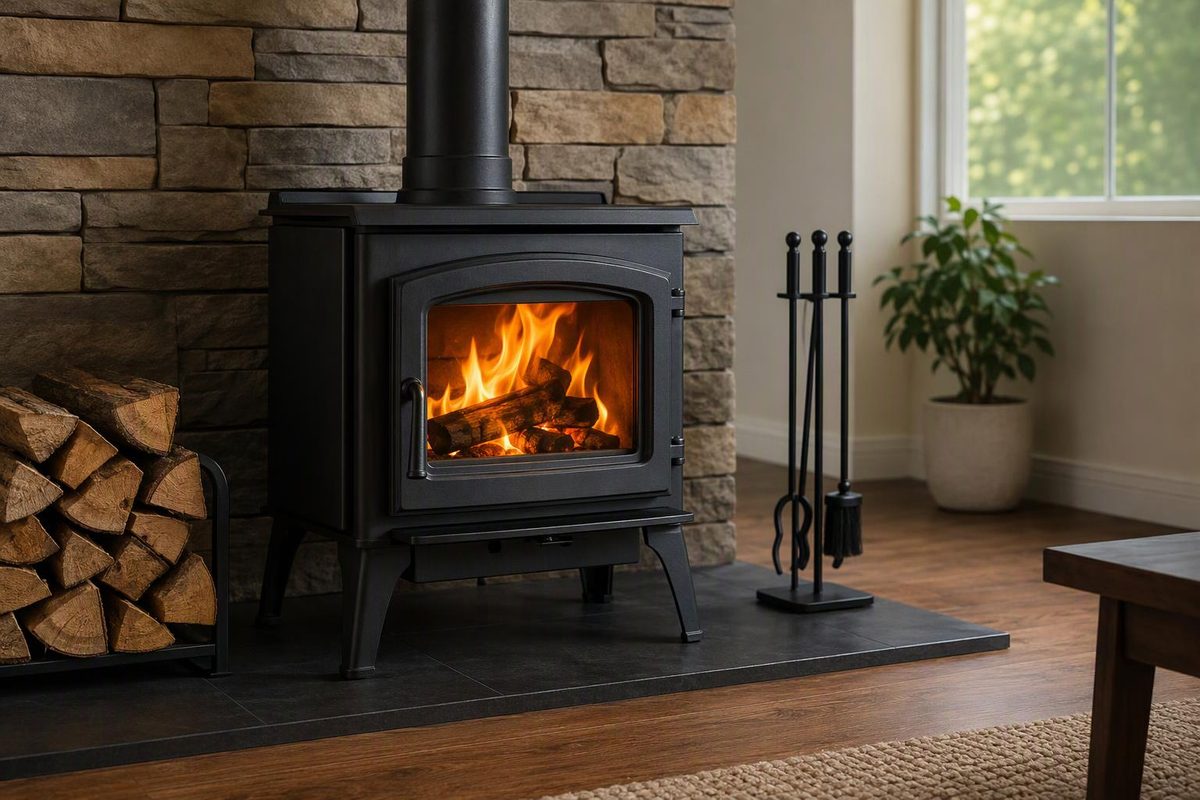
An EPA-certified wood-burning stove belongs to a model line tested under the federal residential wood-heater program and certified to meet the particulate-emissions standard that applied to it. Certification matters, but it is not approval of the stove’s size, chimney or installation.
Before buying, match the exact model to EPA’s database and permanent label, then obtain its manual. Separately confirm the safety listing required by the manual or local authority, along with the clearances, hearth protection, chimney design and permits.
What EPA certification means
For affected wood heaters manufactured or sold at retail for use in the United States on or after May 15, 2020, the federal particulate limit is:
- 2.0 grams per hour under the standard crib-wood test method; or
- 2.5 grams per hour under the cordwood alternative compliance option.
Crib wood is standardized dimensional lumber assembled for testing; cordwood is typical firewood. Because the test fuels and limits differ, do not use the two emissions numbers as a direct model-to-model ranking without checking the test method. The limits are set out in 40 CFR 60.532, while EPA’s archived consumer explanation describes the difference between crib wood and cordwood (EPA).
An older used stove may still be EPA-certified under an earlier standard without meeting the 2020 limits. The label’s test standard and date matter.
EPA certification addresses emissions from a model line. It does not establish that:
- the stove is correctly sized for the house;
- its clearances work in the proposed location;
- the existing chimney is sound, compatible or correctly sized;
- the hearth supplies the required ember or thermal protection;
- the installation satisfies the manual, safety listing, local code or permit requirements; or
- the stove qualifies for a rebate or tax credit.
Emissions certification and safety certification are separate. Oregon DEQ, for example, warns that a UL safety label is not an EPA or Oregon emissions label (Oregon DEQ). Verify both kinds of information where the appliance instructions and jurisdiction require them.
How to verify a stove before paying for it
1. Match the exact model in EPA’s database
Search the EPA Certified Wood Heater Database by manufacturer and model. EPA says the database includes heater type, efficiency, emissions rate, test fuel and whether a heater meets the 2020 Step 2 limits.
Match the complete model designation—not merely the brand, product family or appearance. Similar-looking variants can have different certification records and installation instructions. Save the result with the sales paperwork.
As of September 28, 2026, EPA’s database page had been updated on September 4, 2026. It is a better current starting point than the agency’s Burn Wise consumer pages, which EPA stopped updating on October 30, 2025.
2. Read the permanent certification label
Current federal rules require an affected heater to carry a durable label in a readily visible or accessible location. The label identifies the manufacturing month and year, model, serial number, certification-test emissions value, test method and standard met (40 CFR 60.536). Labels on older certified appliances may use an earlier format.
For a used stove, photograph the complete label before arranging transport. Stop and resolve the discrepancy if:
- the emissions label is missing, illegible or appears altered;
- its model differs from the seller’s description or EPA record;
- another data plate identifies a different variant; or
- the seller says an uncertified stove can be certified after purchase.
Certification occurs during manufacture. A homeowner cannot have an unlabeled stove certified later, according to consumer guidance from both Oregon DEQ and the Washington State Department of Ecology.
3. Obtain the exact manual and safety-listing information
A new affected heater offered for commercial sale must be accompanied by an owner’s manual. Federal rules require that manual to cover installation guidance—including stack height, location and draft—as well as fuel, operation and maintenance. Installing or operating an affected heater inconsistently with its label and manual is prohibited under 40 CFR 60.538.
Record the model’s requirements for:
- connector and chimney diameter;
- permitted chimney construction and minimum height;
- clearances, including any reductions allowed with listed shielding;
- hearth dimensions and thermal rating, if specified;
- approved accessories, such as a blower or outside-air kit;
- mobile-home installation, if relevant; and
- catalyst operation and replacement parts, if applicable.
If the manual is unavailable or cannot be matched confidently to the stove, do not design a vent system around that appliance.
Choose for the building, not the maximum BTU claim
A marketing square-foot range is only a starting point. Climate, insulation, air leakage, ceiling height, floor plan and whether the stove supplies primary or supplemental heat all affect the load. Oversizing can encourage prolonged low burns; undersizing can tempt the operator to overfire the stove.
Compare the model’s tested heat-output range and firebox capacity with a defensible heat-loss estimate. Also consider how the combustion system affects operation:
- Non-catalytic stoves use firebox insulation, baffles and preheated secondary air. They do not require catalyst maintenance.
- Catalytic stoves route smoke through a combustor and can burn cleanly at lower rates, but the catalyst requires correct operation, inspection and eventual replacement.
- Hybrid stoves combine a catalyst with secondary combustion.
EPA describes those technologies in its wood-appliance guidance. A lower certified emissions rate can help compare models tested by the same method, but it cannot compensate for poor sizing or an incompatible installation.
Check the chimney and local rules before ordering
A stove’s flue-collar diameter does not prove that an existing chimney is suitable. Confirm the chimney’s type, condition, effective height, internal dimensions, clearances and liner requirements. A masonry chimney may need a correctly sized and insulated liner; a factory-built chimney must use compatible listed components. The planning sequence in How to Install a Woodburner Stove and the component checks in A Stainless Flue Liner Must Match the Whole System cover these decisions in more detail.
Ask the building department and air-quality authority about permits, inspections, appliance restrictions and burn curtailments. Federal certification does not override stricter state, tribal or local rules. Washington regulates which devices may be sold or transferred and directs owners to local building departments for installation requirements. Oregon prohibits the sale of uncertified stoves and generally requires an uncertified stove or insert to be removed, destroyed and reported when a home is sold (Oregon DEQ).
Those are state examples, not national rules. They show why a used stove that appears acceptable under the federal program may still be unlawful to transfer or install locally.
Avoid two certification mistakes
“EPA-certified” does not automatically mean “eligible for a federal tax credit.” Emissions certification and incentive eligibility use different tests. The federal biomass stove credit described by ENERGY STAR required at least 75% higher-heating-value efficiency and applied to eligible products purchased and installed from January 1, 2023, through December 31, 2025 (ENERGY STAR). As of September 28, 2026, do not budget around that expired credit. Check current state, utility and local incentives separately.
An EPA record is not permission to modify the stove. Federal rules prohibit operating or selling a heater with its original catalytic element removed or deactivated, and prohibit physical alterations that exceed the tolerances of its certificate. Do not drill the firebox, defeat an air control or substitute unapproved internal parts. Match replacement baffles, air tubes, catalyst assemblies and stove firebrick to the current manual and parts diagram.
Before purchase, assemble four matching records: the permanent emissions label, EPA database entry, exact owner’s manual and required safety-listing information. Resolve any conflict with the manufacturer and the authority having jurisdiction before buying or installing the stove.