
How to Check an Accessible Gas Connection Without Mistaking a Bubble Test for Proof of Safety
No bubbles means only that no leak was detected on surfaces fully coated, directly visible and observed under the test conditions.
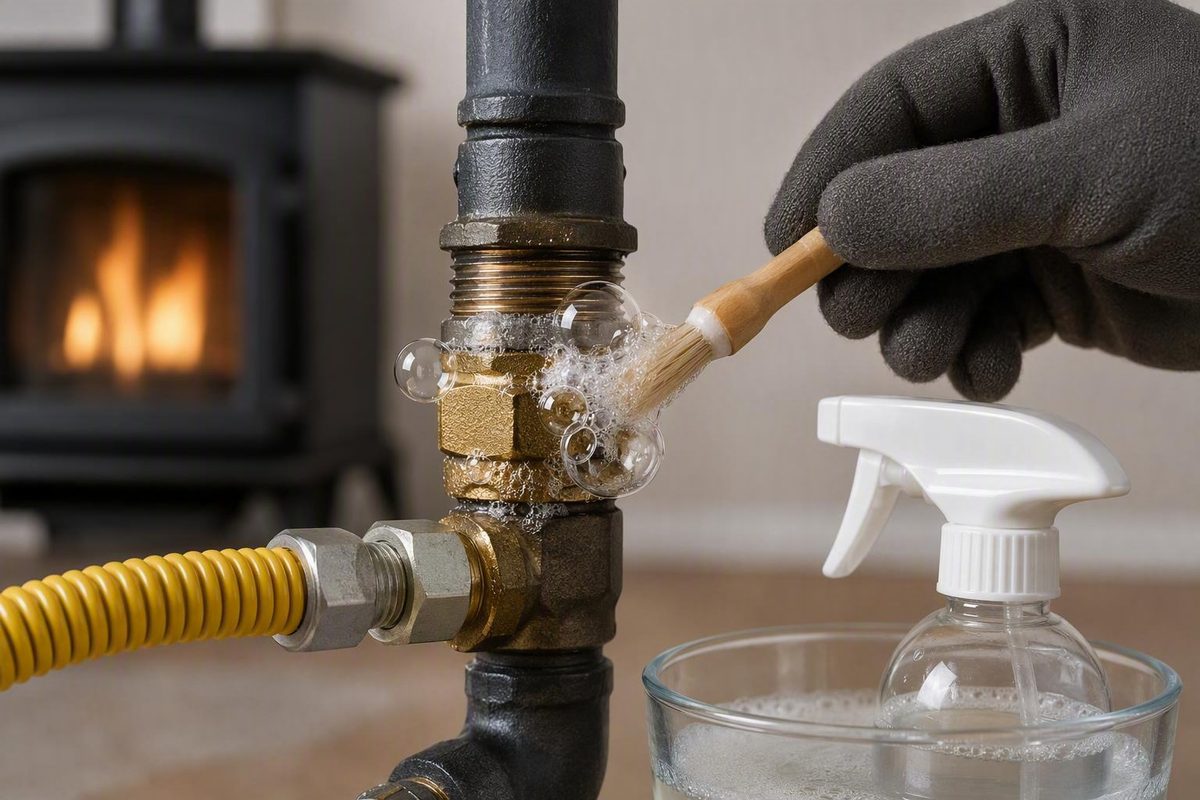
A soapy water gas leak test—more accurately called a bubble test—can help screen a visible, accessible connection during a routine equipment check. It is not a substitute for emergency action, a whole-system inspection, or a professional pressure test.
The distinction matters. A newly attached outdoor propane cylinder may be an appropriate candidate for a manufacturer-permitted bubble check. A building with a persistent gas odor, hissing, unexplained physical symptoms, or a suspected hidden leak is not.
This article synthesizes general consumer and manufacturer guidance. Much of the available evidence comes from equipment manufacturers, energy suppliers, and commercial service providers rather than a single governing safety standard. Your gas utility’s emergency instructions, local requirements, and the manuals for the appliance, cylinder, regulator, connector, and detector solution take priority.
Before You Test: Decide Whether to Leave Instead
Emergency decision: leave rather than test
Do not search for the source, apply leak-check solution, or pressurize equipment if you notice:
- A strong or persistent gas odor
- Hissing or another sound of escaping gas
- Unexplained headache, dizziness, nausea, confusion, or similar symptoms near gas-burning equipment
- Visible equipment damage accompanied by gas odor
- Any other sign suggesting a significant or active leak
Move occupants away from the affected area. From a safe location, contact the applicable gas utility, propane supplier, emergency service, or fire department. Do not operate light switches, phones, appliances, flames, smoking materials, or vehicles near the suspected leak. Do not re-enter merely to shut off the supply. Unexplained symptoms do not prove that unburned fuel gas is leaking—they may indicate carbon monoxide exposure or another emergency—but they are a reason to leave and obtain assistance rather than continue testing. Consumer emergency guidance similarly prioritizes evacuation, avoiding potential ignition sources, and calling from safety instead of searching for a leak yourself (Constellation’s natural-gas emergency guidance).
If a portable-cylinder valve or another approved shutoff is immediately accessible, close it only when the equipment instructions permit that action and you can do it without remaining in or returning to a potentially hazardous area. “Shut off the gas” is not an instruction to approach damaged equipment or re-enter a building you have already left.
A bubble test belongs on the routine-maintenance side of that decision line. A typical example is checking the exposed connections on an outdoor barbecue immediately after attaching a propane cylinder, provided that:
- There is no gas odor or hissing.
- Nobody is experiencing unexplained symptoms.
- The cylinder, hose, regulator, and connectors have no known serious damage.
- The equipment manual permits a liquid bubble test.
- Every test point can be coated, illuminated, and watched without dismantling anything.
- The system can be pressurized exactly as the manufacturer specifies while all burners and appliance controls remain off.
Do not use this procedure to investigate a suspected leak behind a wall, underground, inside an appliance, or within fixed household piping. Do not transfer a barbecue-cylinder procedure unchanged to a furnace, boiler, water heater, fireplace, stove, gas meter, or building gas line.
Emergency instructions from your utility, propane supplier, fire service, or local authorities override this article. Equipment and detector-product instructions also override every general step below.
What the Bubble Test Can—and Cannot—Tell You
A bubble test works by forming a liquid film over a pressurized surface. If gas escapes through a defect or imperfect seal, it can create new bubbles at that path. Bubbles that repeatedly emerge from one point and then grow, persist, or multiply indicate a possible leak.
That makes the method a localized surface-screening tool. It is not equivalent to:
- A pressure test of an entire piping system
- Inspection of concealed components
- Electronic combustible-gas detection
- Tracer-gas testing
- An appliance safety inspection
- Authorization to place equipment into service
- Certification that a system is leak-free
Where both the equipment instructions and applicable local requirements permit liquid application, possible test points may include exposed cylinder connections, valves, regulator connections, hoses, unions, pipe fittings, flexible connectors, and appliance supply connections.
The complete relevant surface must remain visible during the test. You need to be able to coat it, keep the solution in place, illuminate it, and watch for bubbles generated at a particular point. Guidance for accessible joints recommends coating the full circumference because testing only the side facing you can miss the actual escape path (Texas Quality Plumbing’s accessible-joint guidance).
A bubble test cannot evaluate:
- Piping behind walls, floors, ceilings, or cabinetry
- Buried or underground lines
- Internal appliance valves, manifolds, burners, or controls
- A leak on an uncoated side of a fitting
- A connection obscured by insulation, panels, shields, or structural parts
- An intermittent leak that is inactive under the test conditions
- A component that cannot safely be wetted
Portable propane and fixed natural-gas systems also require separate judgment. A portable-cylinder check generally involves an outdoor appliance, a user-operated cylinder valve, and a defined connection sequence. Fixed piping may have concealed branches and require different inspection or testing methods. Instructions for one system should not be assumed to apply to the other.
Choose a Compatible Leak-Check Solution
The available guidance does not establish one universal homemade soap-to-water recipe. Instead, published examples vary substantially:
- One commercial guide describes using only a few drops of liquid soap in water (Gold Coast Leak Detection’s instructions).
- One propane-component manufacturer specifies one part dishwashing liquid to three parts water (Cavagna Group’s propane-cylinder procedure).
- Another consumer guide suggests an approximately equal-parts mixture (Texas Quality Plumbing’s mixture guidance).
Those are source-specific recipes—not proof that one concentration is correct for every appliance, regulator, seal, metal, gas, temperature, or test orientation.
Use this order of preference:
- The appliance manual: Check the approved test method, allowed solution, sensitive components, and cleanup instructions.
- Cylinder and regulator instructions: Confirm where liquid may be applied and how the assembly may be pressurized.
- Your propane supplier or gas utility: Follow its instructions for the equipment and location.
- A purpose-made detector label: Use the product only for the listed gases, materials, temperatures, and applications.
- A homemade mixture: Use one only when the relevant equipment guidance permits it and provides enough information to determine compatibility.
Do not dilute a purpose-made detector unless its label directs you to do so. Some detector liquids are intended to be used undiluted and then removed with water or a damp cloth. That is product-specific guidance, not a general rule for every detector (Oatey’s detector-liquid application instructions).
Solution behavior matters as much as concentration. A thin liquid may run off a vertical or overhead joint before bubbles develop.
Some detector manufacturers claim that their formulated products cling longer or work better over oily surfaces than ordinary dish-soap mixtures. Treat those statements as manufacturer claims unless independently corroborated. A purpose-made detector may still be the appropriate choice when its label and the equipment instructions approve it, but the product must be used exactly as directed.
Do not assume that every household cleaner is chemically compatible with every valve, seal, hose, regulator, connector, or metal. Avoid improvising with laundry products, multipurpose cleaners, degreasers, solvents, or products with unknown additives. More foam does not necessarily make the test more sensitive or safer.
Oxygen and medical-gas equipment are excluded
Do not apply this household procedure to oxygen, medical-gas, breathing, or specialized industrial-gas equipment. Manufacturer guidance for those systems calls for a specifically approved oxygen-compatible, low-residue, noncorrosive leak-check product rather than an ordinary household soap mixture (Ratermann’s medical- and oxygen-gas product guidance).
If oxygen or medical gas is involved, stop and consult the equipment supplier or an appropriately qualified technician. Approval for propane or natural gas does not establish approval for oxygen service.
Routine Portable-Propane Connection Check: Step by Step
This procedure is limited to an outdoor portable-cylinder appliance, such as a barbecue, when there is no odor, hissing, unexplained symptom, or known serious damage. The equipment instructions must permit a bubble test and allow the assembly to be pressurized while all appliance controls and burners remain off.
If a warning sign appears at any stage, stop. Do not continue merely to finish the checklist.
1. Start with the gas off
Place the appliance in its normal, stable outdoor operating position. Set every appliance control and burner to off, and begin with the cylinder valve closed.
Remove nearby flames and smoking materials before handling the system. Do not light a burner to determine whether gas is flowing. This check observes coated connections while the appliance remains unlit.
2. Read the equipment instructions
Confirm:
- Whether the manufacturer permits a liquid bubble test
- Which connections may be wetted
- Which solution or detector is allowed
- How the cylinder must be attached
- How the assembly may be pressurized
- Whether the cylinder should remain open or be closed after an uneventful check
- How residue must be removed
If the manual prohibits user testing, specifies a particular detector, or directs you to a service provider, follow that instruction instead.
3. Inspect before applying liquid
Look closely at the accessible cylinder connection, connector seal, regulator, hose, and appliance connection. Check for:
- Cracks, splits, cuts, abrasion, or scorching
- Kinks or crushing
- Deformation or damaged threads
- Missing, displaced, or visibly damaged seals
- Dirt or foreign material at the connector
- Corrosion or other deterioration
- Loose supports or signs that a component has been pulled
- Damage caused by heat, impact, animals, or storage
Do not use a bubble test to overrule visible damage. A cracked hose or damaged connector does not become acceptable because no bubbles appear during one check. Keep visibly damaged equipment out of service and follow the manufacturer’s replacement or service instructions. Commercial barbecue guidance likewise recommends replacing visibly damaged hoses or connectors rather than relying on a bubble test to clear them (Fixed Today’s portable gas-component inspection guide).
This is a visual check of user-accessible components, not a repair procedure.
4. Prepare an approved solution
Use only the solution permitted by the relevant instructions. If mixing is required, mix gently rather than deliberately creating a container full of foam.
Choose an application tool only if the equipment and solution instructions permit it. A controlled brush, dauber, sponge, or spray application may be appropriate in a particular procedure, but spraying should not be treated as general approval to wet vents, electrical components, or appliance openings.
Prepare enough solution to cover the complete circumference of each approved, accessible connection.
5. Apply the solution before pressurizing
With the cylinder valve closed and all appliance controls and burners off, coat each approved location. A typical portable-cylinder sequence is:
- The cylinder valve connection
- The regulator inlet connection
- Other exposed regulator joints specifically approved for testing
- The hose and its end fittings
- The appliance supply connection
Cover the complete accessible circumference rather than only the side facing you. Keep liquid away from regulator vents, burner openings, electrical parts, and other prohibited areas.
Coating an exposed hose may reveal bubbles at a damaged surface only where the liquid remains in place and visible. It does not replace the visual inspection.
6. Pressurize only as directed
For the cited portable-cylinder procedure, the solution is applied first. The appliance controls and burners remain off while the cylinder valve is opened slowly, pressurizing the connection assembly without operating the appliance. The procedure covers the accessible connections from the cylinder valve through the regulator and hose to the appliance connection (Cavagna Group’s propane-cylinder test procedure).
Do not assume that this sequence applies to another appliance or to fixed piping. Never pressurize equipment that smells of gas, is hissing, has serious visible damage, or cannot be handled exactly as its instructions require.
7. Watch each coated point
Observe the assembly without lighting or operating the appliance. Look for bubbles that newly emerge from a specific point, not suds already created by the application tool.
Inspect the entire coated circumference under adequate ambient light. If anything during the check causes you to suspect an active leak, do not operate nearby electrical equipment to improve the lighting.
A small leak may not create a large bubble cluster immediately. Watch for repeated formation, growth, persistence, or multiplication rather than making an instant judgment.
8. Apply the stopping rules
Stop immediately if:
- New bubbles repeatedly form or grow at one location.
- You smell gas.
- You hear hissing.
- A component shifts, cracks, or otherwise appears damaged.
- Anyone develops unexplained symptoms.
- You become uncertain whether the assembly can be handled safely.
Do not proceed to the next connection simply to complete the test. Do not light the appliance to confirm the result.
9. Finish an uneventful check
If there is no odor, hissing, visible damage, or repeatable bubble growth, leave or close the cylinder valve exactly as the appliance manual directs. Remove the residue only where and how the equipment and solution instructions permit, then dry the components.
This result means only that no leak was observed on the coated, visible surfaces under those conditions. It does not certify the cylinder, regulator, hose, appliance, or broader fuel system as leak-free.
How to Read the Result Without Being Fooled by Foam
The central question is not merely, “Are there bubbles?” It is, “Are new bubbles being generated repeatedly at one specific point?”
A positive indication commonly behaves like this:
- A small bubble appears at a precise location.
- It expands while remaining attached there.
- Another bubble forms after the first moves or breaks.
- Bubbles persist or multiply without further spraying or brushing.
- The behavior returns at the same point after permitted reapplication.
Any repeatable bubble growth is enough to treat the connection as suspect. Do not wait for dramatic foam, classify the indication as a “minor” leak, or continue watching to see how large the bubbles become.
These observations do not by themselves establish a leak:
- Foam created while shaking, spraying, sponging, or brushing
- A layer of existing suds that does not regenerate at one point
- Liquid clinging motionlessly to the fitting
- A sheet of solution sliding downward
- Foam dripping from a lower edge after being applied above
- Isolated bubbles carried across the surface by runoff or wind
The difference is generation at a source point. Application foam begins with the solution. A possible leak creates new bubbles after application as gas passes through the liquid film.
There is no single universal observation time in the available household guidance. One detector manufacturer says a very small leak may require at least one minute to create an observable cluster, but that statement is specific to its product guidance and is not a validated standard for every soap mixture, fitting, gas, pressure, or temperature (Oatey’s guidance on observing small-leak bubbles).
Follow the detector label or equipment instructions for timing. If no time is specified, do not treat the immediate absence of bubbles as conclusive. Conversely, odor, hissing, symptoms, or another warning sign calls for stopping and leaving—not prolonged DIY observation.
Do not estimate leak severity from bubble size, speed, or foam intensity. Visible behavior can vary with the solution, film thickness, pressure, surface shape, contamination, temperature, and application method. The supplied evidence does not establish a reliable household conversion from bubble appearance to leak rate.
Most importantly:
No bubbles means only that no leak was detected on the surfaces that were fully coated, directly visible, and observed under the test conditions.
It does not mean the whole system is safe.
Why a Negative Test Can Miss a Leak
A bubble test depends on several conditions being right simultaneously: gas must be escaping during the check, the liquid must cover the actual path, the film must remain in place, and the resulting bubbles must be visible. Failure at any point can produce a false negative.
The leak may be too small or slow to show promptly
A small or slow leak may take longer to form a visible bubble. It may also produce bubbles that are difficult to distinguish in poor light or against an irregular fitting.
That is why a brief negative result should not be treated as proof of safety.
Coverage may be incomplete
Gas follows the actual escape path, not the side of a fitting that is easiest to reach. If the back, underside, or upper edge remains dry, a leak there cannot create bubbles in the test liquid.
If you cannot coat and see the complete relevant area without dismantling equipment, the location is not suitable for this household procedure.
The solution may run off
Gravity can pull a low-viscosity solution away from vertical or overhead joints.
The surface may disrupt bubble formation
Contamination may interfere
Dirt, grease, water, threading oil, or cleaning residue may prevent the liquid from adhering evenly. Adding more household cleaner does not necessarily solve the problem and may introduce compatibility or cleanup concerns.
Commercial technical commentary identifies runoff, poor access, low visibility, irregular edges, and solution behavior as limitations of bubble testing. Because the publisher sells leak-detection equipment, its performance discussion should be read as commercially interested technical guidance rather than an independent comparison (INFICON’s discussion of bubble-test limitations).
The leak may be intermittent
A bubble check performed under other conditions may not reproduce the problem.
Do not intentionally operate, heat, flex, or stress equipment to make a suspected leak appear. An intermittent concern requires appropriate professional assessment.
The leak may be elsewhere
A negative result says nothing about surfaces you did not coat or could not see. It cannot rule out leakage:
- Behind a wall or appliance
- Under a floor or underground
- Within an appliance
- At another branch of fixed piping
- Around an inaccessible valve or connector
- From a damaged component outside the inspected area
For example, if you coat an accessible fitting and see no growing bubbles but the gas odor persists, the odor controls the response. Do not add more solution, open the valve farther, or move on to other fittings. Leave and contact the utility, propane supplier, or emergency service from a safe location.
Professional assessment is appropriate when warning signs persist, another test has failed, the suspected location is hidden, fixed household piping is involved, an appliance-internal problem is possible, or you cannot confidently identify and coat the relevant connection.
What to Do When Bubbles, Odor, or Hissing Appear
Any repeatable new bubble growth makes the connection suspect. Stop testing immediately. Do not ignite or operate the appliance.
For a portable cylinder, close the cylinder valve only if the equipment instructions permit it and doing so will not increase your exposure. If reaching the valve would require entering an affected area, leaning over damaged equipment, or remaining near escaping gas, move away instead.
From a safe location, contact the appropriate propane supplier, gas utility, emergency service, fire department, or authorized technician. Keep the equipment out of service until the appropriate professional has inspected it and cleared it for use. Propane-component guidance similarly says that a system producing bubbles, odor, or escaping-gas sounds should not be reused until it has received qualified inspection.
Do not respond by:
- Tightening a fitting while it is pressurized
- Dismantling the connection to investigate
- Adding tape, sealant, adhesive, or another improvised material
- Replacing internal valve or regulator parts
- Bending or repositioning a hose to stop bubbles
- Lighting the appliance to see whether it operates
- Repeating the test after an unexplained positive result
- Returning equipment to service because the bubbles later stopped
The bubble location identifies a suspect surface point. It does not establish whether the cause is a damaged seal, contaminated connector, defective valve, cracked body, incorrect component, installation problem, pressure issue, or another condition. Follow the manufacturer’s service instructions and check which work must be handled by an authorized or appropriately qualified person in your location.
| Outcome | Immediate response | What the result means |
|---|---|---|
| Growing or repeatedly forming bubbles | Stop. Do not operate the appliance. Close a portable-cylinder valve only if safe and permitted. Move away and arrange qualified assistance. | A leak is possible at that point; the cause and severity remain unknown. |
| Gas odor but no bubbles | Treat the odor as controlling. Leave and call the utility, propane supplier, or emergency service from a safe location. | The leak may be hidden, elsewhere, intermittent, or missed by the test. |
| Hissing or unexplained symptoms | Stop and leave as appropriate. Avoid potential ignition sources and call from safety. | These are warning conditions for emergency action, not continued DIY testing. |
| No indication during a permitted routine check | Finish according to the manual, remove permitted residue, and dry the components. | No leak was detected on the coated, visible surfaces; this is not whole-system proof. |
These stop-work, safe-shutoff, and qualified-inspection precautions are consistent with propane-cylinder manufacturer guidance for a positive bubble test or other leak indication.
Cleanup, Detectors, and Situations That Need a Professional
After an uneventful check, remove residue only as the equipment and solution instructions permit. Depending on those instructions, this may involve clean water or a damp cloth followed by thorough drying. Do not direct rinse water into vents, electrical parts, appliance openings, or enclosed controls.
Cleanup matters because residue remains on the tested components and can create a slippery surface. Commercial technical commentary also warns that soap film at very small leak sites may interfere with some later tracer-gas work, so tell a technician what product was used if follow-on testing is needed (INFICON’s cleanup and follow-on testing cautions).
If you used a purpose-made detector, follow its label for dilution, dwell time, removal, rinsing, storage, and material compatibility. Do not substitute general dish-soap cleanup advice. If the label requires undiluted use, do not add water simply to make the product easier to rinse.
Arrange professional assessment for:
- Fixed household gas piping
- A recurring or persistent gas odor
- Any inaccessible, concealed, buried, or appliance-internal location
- A failed pressure test
- A damaged valve, regulator, cylinder, hose, or connector
- Bubbles observed during testing
- An intermittent concern
- A result you cannot confidently interpret
- Equipment whose instructions prohibit user testing
- Work subject to local permit, inspection, authorization, or licensing requirements
Electronic combustible-gas detection, professional pressure testing, and tracer-gas testing serve different purposes. An electronic instrument may help screen an area or locate fuel gas. Tracer-gas methods support other forms of leak location. Method selection and interpretation should be left to someone qualified for the equipment and situation; the available evidence does not support ranking these methods with a universal performance claim.
A carbon-monoxide alarm does not detect leaking natural gas or propane. Fuel-gas detectors are designed for unburned combustible gas, while carbon-monoxide alarms detect carbon monoxide associated with combustion problems. These are different hazards requiring devices approved for the specific purpose (Constellation’s explanation of fuel-gas and carbon-monoxide detection).
Follow equipment manuals, utility instructions, detector labels, local requirements, permits, and inspection rules. General-reading material cannot account for every appliance, material, fuel, jurisdiction, or installation.
The practical rule has three parts:
- Leave rather than test when there is strong or persistent odor, hissing, unexplained symptoms, or another active-leak warning.
- Use a bubble test only for a permitted routine check of exposed, accessible connections.
- Treat growing bubbles—or continuing odor despite no bubbles—as a reason to stop, keep the equipment out of service, and call the appropriate professional.
A bubble test may identify a suspect location on a coated surface. It cannot certify an entire gas system as safe.
What is the correct soap-to-water ratio for a gas leak test?
There is no universally supported ratio across all appliances and components. Published examples range from a few drops in water to one part dishwashing liquid with three parts water or an approximately equal-parts mixture.
Use the ratio specified by the appliance, cylinder, regulator, supplier, or detector instructions. If a purpose-made detector is required, follow its label; some products are intended to be used undiluted. Do not assume that a stronger or foamier mixture is more effective or compatible.
Should I use soapy water if I already smell gas?
Not when the odor is strong, persistent, unexplained, or otherwise suggests an active leak. Do not search for the source or pressurize the system. Leave the affected area, avoid switches, phones, appliances, flames, smoking materials, and vehicles nearby, and contact the utility, propane supplier, or emergency service from a safe location.
A bubble test is for a permitted routine check when active-leak warning signs are absent—not a reason to remain near suspected escaping gas.
Does no bubbling prove that there is no gas leak?
No. It means only that no leak was observed on the surfaces that were fully coated, visible, and watched under the test conditions.
A slow, intermittent, hidden, inaccessible, contaminated, poorly coated, or elsewhere-located leak may produce no visible result. If odor or another warning sign persists, leave and seek professional assistance rather than repeating the test.
Can I tighten or repair a connection after bubbles appear?
Do not improvise a repair. Stop testing, do not operate the appliance, and close a portable-cylinder valve only if doing so is safe and permitted. Keep the equipment out of service and contact the propane supplier, gas utility, equipment service provider, or an appropriately qualified technician.
Bubbles identify a suspect point but do not reveal the cause or establish the correct repair. Commercial portable-gas guidance likewise recommends professional assistance rather than homeowner repair after a positive indication (Fixed Today’s positive-test response guidance).
Will a carbon-monoxide alarm detect leaking natural gas or propane?
No. A carbon-monoxide alarm is designed to detect carbon monoxide, not unburned natural gas or propane.
Fuel-gas leakage and carbon monoxide from incomplete combustion are distinct hazards. Use alarms or detectors approved for the particular hazard, install and maintain them according to their instructions, and never use the absence of an alarm as permission to ignore gas odor, hissing, unexplained symptoms, or growing test bubbles.