
How to Recognize a Possible Propane Leak and Get Everyone to Safety
Headache, dizziness and nausea can occur, but they also overlap with carbon monoxide. Odor, hissing and frost are separate warning signs. Leave first.
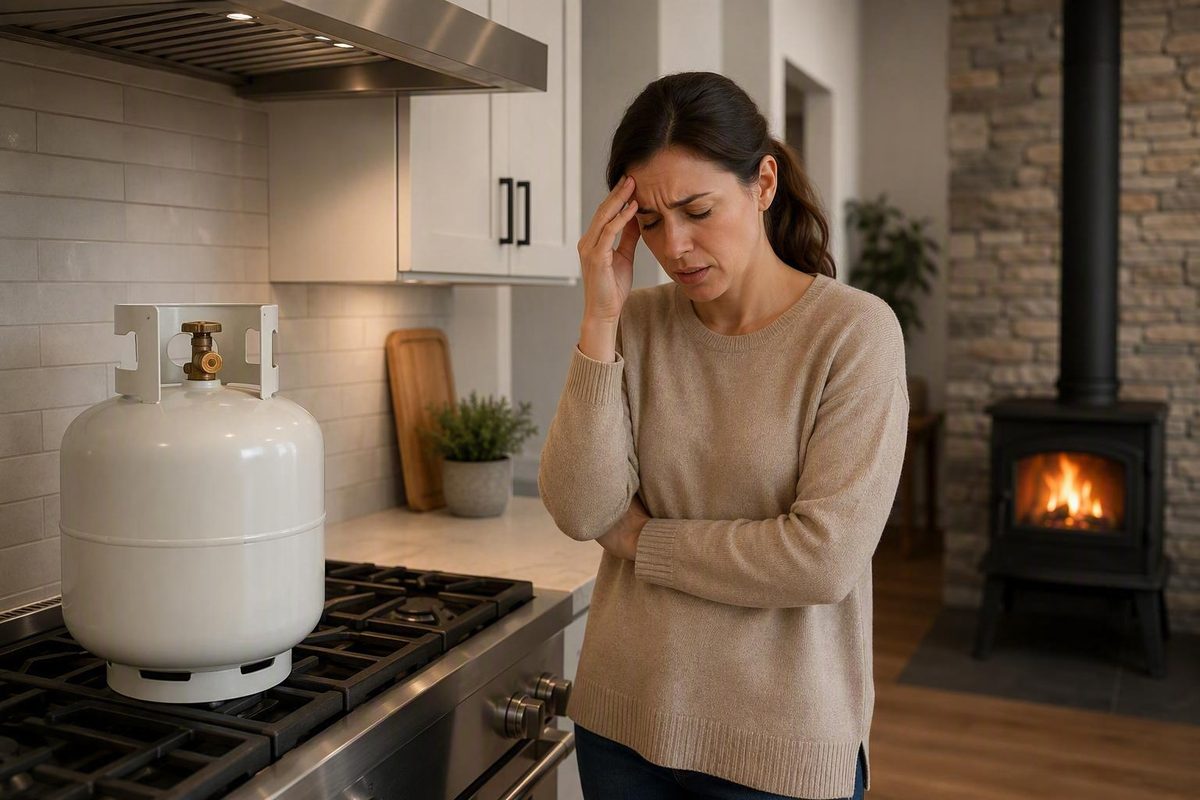
Possible propane leak symptoms include headache, dizziness, nausea, weakness, drowsiness, coughing, and difficulty breathing. These symptoms are nonspecific: they cannot confirm a propane leak or distinguish unburned propane from carbon monoxide or an unrelated illness.
If you smell propane, hear hissing, see frost on propane equipment, receive a gas alarm, or develop concerning symptoms near propane equipment, do not stay inside to investigate. Leave first and call for help from a safe location.
Suspect a propane leak? Leave before trying to confirm it
Emergency checklist
- Get everyone out immediately, including pets.
- Do not use anything that could create a flame or spark in or near the suspected leak area.
- Call emergency services and your propane supplier from a safe location.
- Stay outside until emergency personnel or the propane provider says it is safe to return.
- Do not restart appliances or reopen the propane supply until the system has been inspected and cleared.
Propane emergency guidance advises immediate evacuation, avoidance of ignition sources, and calls to emergency services and the propane supplier only after occupants have reached safety. It also advises waiting for professional clearance before returning after a suspected propane leak.
While leaving, do not strike a match, smoke, light a candle, or operate any flame. Do not turn lights, appliances, fans, or other electrical equipment on or off. Avoid using a phone, starting a vehicle, operating a garage-door opener, or doing anything else that could produce a spark while you are in or immediately around the suspected leak area.
Do not search for the leak, approach hissing equipment, inspect a frosted regulator, or perform a bubble test inside. Do not delay evacuation to open windows or otherwise ventilate the building. During an active suspected leak, the priority is to get people out without operating equipment or remaining in the potentially hazardous area.
If the tank valve is outdoors, shutting it may be appropriate only when it can be reached and operated without entering a building, approaching the suspected leak, passing through a gas cloud, or otherwise remaining in danger. Closing the valve is optional—not a step worth taking at personal risk. If there is any doubt, leave it alone and let trained responders handle the fuel supply. Propane tank guidance likewise limits valve shutdown to situations in which it can be done safely without delaying evacuation.
Once everyone is safely away, call the local emergency number or fire department and notify the propane supplier. Give them the address and describe the odor, alarm, equipment condition, and any symptoms. Follow their directions and stay outside even if the odor fades or everyone begins to feel better.
Uncertainty is not a reason to wait. A warning clue does not have to prove a leak before you act. Evacuation protects people while responders determine whether the problem is escaping propane, carbon monoxide, faulty equipment, or another hazard.
Leak warning signs and exposure symptoms are not the same thing
A leak sign is something noticed in the surroundings, fuel system, or appliance. An exposure symptom is a physical effect experienced by a person.
Keeping those categories separate prevents two dangerous assumptions: that a headache proves propane is leaking, or that the absence of symptoms proves there is no leak.
| Environmental or equipment clues | Possible human symptoms |
|---|---|
| Rotten-egg, skunk-like, or sulfurous odor | Headache |
| Hissing or whistling near a tank, line, regulator, connection, or appliance | Dizziness or lightheadedness |
| Frost or unusual moisture on propane equipment | Nausea or vomiting |
| Damaged, loose, or corroded equipment | Weakness or fatigue |
| Dead or dying vegetation near outdoor equipment | Drowsiness |
| Unexpectedly high propane use | Coughing |
| Weak flames or poorer appliance performance | Difficulty breathing |
| Soot near an appliance, suggesting a combustion problem | Confusion, collapse, or loss of consciousness in a severe event |
These environmental clues and physical effects are reported as possible propane-leak or exposure warnings, but they are not diagnostic tests. Supplier safety guidance identifies odor, hissing, damaged equipment, dying vegetation, and symptoms such as headache, dizziness, nausea, and breathing difficulty as reasons to evacuate and request help rather than continue investigating.
Headache, nausea, fatigue, and dizziness occur with many illnesses and overlap with carbon-monoxide poisoning. A hissing sound, weak flame, damaged component, or unhealthy patch of vegetation can also have another explanation. Neither category independently proves that propane is responsible.
That pattern still cannot identify the substance involved.
Do not remain inside to compare symptoms, determine who feels worst, or collect more evidence. If an environmental warning or cluster of symptoms creates a credible concern, get everyone into fresh air and make the necessary calls from safety.
Possible propane-exposure symptoms, from early warning signs to emergencies
Inhaled propane can replace oxygen in the lungs, making breathing difficult or impossible. Possible effects include headache, dizziness, lightheadedness, weakness, coughing, nausea, vomiting, abnormal heartbeat, slow or shallow breathing, convulsions, and loss of consciousness, according to MedlinePlus guidance on propane exposure.
The effects depend on the type and extent of exposure.
| Possible symptoms | Emergency warning signs |
|---|---|
| Headache | Difficulty breathing |
| Dizziness or lightheadedness | Slow or shallow breathing |
| Nausea or vomiting | Marked confusion or disorientation |
| Weakness or unusual fatigue | Convulsions |
| Drowsiness | Collapse |
| Coughing | Loss of consciousness |
| Feeling generally unwell near propane equipment | Failure to improve promptly after reaching fresh air |
| Abnormal heartbeat sensation | Severe or rapidly worsening symptoms |
Difficulty breathing, confusion, convulsions, collapse, slow or shallow breathing, and unconsciousness require immediate emergency assistance. Call from a safe location. Do not send an untrained person back into a potentially flammable or oxygen-deficient area to retrieve someone; tell the emergency dispatcher that a gas or airborne hazard may be involved.
Concentrated unburned propane is dangerous partly because it can displace the air needed for breathing. As less oxygen is available, a person may become disoriented, lose consciousness, or die. At the same time, escaping propane can create a serious fire or explosion hazard.
Moving into fresh air is an immediate protective action, not complete treatment for a severe exposure. Someone who is struggling to breathe, confused, convulsing, unconscious, or not improving promptly needs emergency medical assessment even after being moved outside.
Symptoms cannot establish that propane caused an illness. They also cannot identify the tank, fitting, line, regulator, or appliance from which gas may be escaping. Locating the problem requires properly equipped responders or a qualified propane professional after the area has been made safe.
What a propane leak may smell, sound, or look like
Propane is naturally odorless. Propane supplied as household fuel is normally odorized to provide a recognizable warning smell, commonly compared with rotten eggs or skunk spray.
Treat that odor as an evacuation signal—not an invitation to follow the smell to its source. Even a faint or intermittent unexpected odor warrants action.
Other possible clues include:
- Hissing or whistling: Gas escaping under pressure may produce a sound near a tank, cylinder, line, regulator, fitting, or appliance.
- Frost or excess moisture: Unusual frost, ice, or condensation on a tank, regulator, valve, or line may accompany a release or equipment problem.
- Visible damage: Corrosion, dents, loose connections, damaged hoses, cracked lines, or disturbed equipment may indicate an unsafe fuel system.
- Dead or dying vegetation: An unexplained patch near underground piping, a tank, or other outdoor propane equipment can be a warning clue.
- Unexpected fuel consumption: Propane disappearing much faster than normal, without a corresponding change in use, may indicate lost fuel.
- Poor appliance performance: A weak flame, repeated shutdown, or poorer-than-normal operation can indicate a fuel-supply or appliance problem.
These clues are possible warnings, not proof. Frost and poor appliance performance can have causes unrelated to leakage. Unusually high propane use and weak appliance performance are nevertheless recognized as reasons to stop and assess equipment safely in propane leak-check guidance.
Soot requires separate treatment. It does not prove that raw propane is escaping. Because abnormal combustion may be associated with carbon-monoxide risk, do not attempt burner or vent adjustments during a suspected emergency.
The absence of a recognizable odor does not establish safety. Odor may be unnoticed, and other credible warnings—such as hissing, frost, damaged equipment, symptoms, or a gas alarm—still require a safety response. Propane safety guidance specifically identifies non-odor clues and warns that the characteristic smell may not always be apparent during a possible leak.
Never lean toward a hissing valve to listen more closely or touch frosted equipment to inspect it. Move away and report what you observed from a safe location.
Raw propane and carbon monoxide are different hazards
Propane equipment can be associated with three related but distinct dangers:
- Fire or explosion: Escaping propane may ignite when it reaches a flame, spark, or another ignition source.
- Oxygen displacement: A concentrated release of unburned propane may reduce the oxygen available for breathing.
- Carbon-monoxide poisoning: Burning fuel can produce carbon monoxide, especially when equipment is faulty, poorly maintained, or inadequately vented.
Raw propane can escape from a tank, hose, line, fitting, regulator, valve, or appliance without creating carbon monoxide. Carbon monoxide is produced through combustion. It can come from burning propane, but it can also come from other fuels.
| Feature | Unburned propane | Carbon monoxide |
|---|---|---|
| Typical source | Leak from a tank, line, fitting, regulator, hose, valve, or appliance | Combustion from an appliance, engine, generator, fireplace, heater, stove, or other fuel-burning equipment |
| Odor | Naturally odorless, but household propane is normally odorized with a rotten-egg or skunk-like warning smell | Colorless and odorless |
| Primary dangers | Fire, explosion, and oxygen displacement at high concentrations | Poisoning caused by impaired oxygen delivery in the body |
| Possible symptoms | Headache, dizziness, nausea, weakness, drowsiness, coughing, breathing difficulty, confusion, convulsions, or unconsciousness | Headache, dizziness, weakness, nausea or vomiting, chest pain, shortness of breath, confusion, sleepiness, or unconsciousness |
| Suitable alarm | Propane or combustible-gas detector intended for the environment | Carbon-monoxide alarm |
| Immediate response | Leave without creating sparks; call emergency services and the supplier from safety | Move into fresh air, evacuate, and obtain urgent medical help |
Carbon monoxide has no color or odor. A rotten-egg smell is associated with odorized propane, not CO. Carbon monoxide can come from burning propane and other fuels, particularly when appliances or engines are not adequately vented. Possible symptoms include headache, weakness, dizziness, nausea or vomiting, shortness of breath, confusion, sleepiness, and loss of consciousness, according to Mayo Clinic carbon-monoxide guidance.
Because the symptom lists overlap, headache or nausea cannot tell you which hazard is present.
If a propane-burning heater, stove, furnace, water heater, generator, or other appliance is operating and occupants become ill, leave immediately whether or not anyone smells fuel. Treat a sounding CO alarm the same way: evacuate even if the air smells normal.
Why one alarm cannot cover both propane and carbon monoxide
A standard carbon-monoxide alarm does not detect raw propane. A propane-gas detector does not replace a CO alarm. The devices monitor different hazards, as propane safety guidance explains in its comparison of propane and carbon-monoxide detection.
This distinction has two important consequences:
- A silent CO alarm does not make a propane odor, hissing sound, frosted component, or gas-detector alarm safe to ignore.
- A sounding CO alarm requires evacuation even when there is no propane smell, because carbon monoxide itself has no odor.
Choose detection equipment intended and appropriately listed for the specific hazard and environment. Follow the detector manufacturer’s instructions for selection, location, mounting, testing, power supply, environmental limits, and end-of-life replacement, together with applicable local requirements. Do not rely on one generic online placement height or distance for every detector, building, vehicle, or installation.
Alarms are backups, not substitutes for sound equipment, proper installation, servicing, ventilation, or emergency response. A detector can lose power, reach the end of its service life, malfunction, or be installed somewhere its manufacturer does not approve.
For carbon-monoxide risk reduction, the CDC recommends working CO alarms near sleeping areas and annual servicing of fuel-burning household equipment by a qualified technician in its household CO safety guidance. Test and replace each alarm according to its instructions rather than assuming an installed unit remains operational indefinitely.
If any gas or CO alarm sounds, do not remain inside to see whether it resets. Leave, account for everyone, and call for help from safety.
When to call 911, Poison Control, or the propane supplier
Call emergency services immediately from a safe location if anyone has:
- Difficulty breathing
- Slow or shallow breathing
- Sudden confusion or marked disorientation
- Convulsions
- Collapsed
- Lost consciousness or cannot respond
- Severe or rapidly worsening symptoms
- Symptoms that do not improve promptly after reaching fresh air
An unconscious or unresponsive person needs immediate emergency medical help. Do not re-enter a potentially contaminated or flammable building to attempt a rescue unless you are trained and equipped for that environment. Tell the dispatcher that propane, carbon monoxide, or another airborne hazard may be involved.
In the United States, Poison Help is available at 1-800-222-1222 for exposure-specific guidance. MedlinePlus provides that national number and advises emergency help for an actual exposure, especially when the person does not improve promptly after reaching fresh air in its propane emergency information. Severe symptoms call for 911; do not wait for Poison Control advice before requesting emergency responders.
Notify the propane supplier after evacuating. Calling the supplier does not replace emergency services when people are ill, gas may be accumulating, or there is an immediate fire or explosion risk.
Liquid propane contact is a different emergency from inhaling propane gas. Because liquid propane is extremely cold, contact can cause a frostbite-like injury. Obtain prompt medical or Poison Control guidance rather than improvising treatment.
Symptoms that improve outdoors still deserve careful attention. Improvement may heighten concern about an indoor airborne hazard, but it does not reveal whether propane, carbon monoxide, or something else was responsible. It also does not prove that medical evaluation is unnecessary after a serious exposure.
After the emergency: inspection, clearance, and prevention
Return only when emergency personnel or the propane provider explicitly says the area is safe. Do not rely on a fading odor, a silent alarm, open doors, or feeling better outside. Propane emergency guidance states that occupants should remain away and should not reopen the propane supply until professionals provide clearance after the suspected leak.
Affected propane equipment and appliances should remain off until the cause has been identified and the system inspected by a qualified professional. Do not reopen the tank valve, relight pilots, reset equipment, or try an appliance “just once” to see whether the problem returns.
A post-incident inspection may need to address:
- Tanks and cylinders
- Valves, regulators, hoses, and fittings
- Aboveground and underground fuel lines
- Appliance connections
- Burners and ignition systems
- Combustion air and venting
- Signs of damage, corrosion, movement, or improper installation
- Alarm condition and installation
Do not attempt do-it-yourself repairs to damaged fuel lines, regulators, valves, burners, controls, or combustion venting. Follow appliance manuals, detector instructions, equipment listings, applicable codes, permit requirements, and professional inspection requirements. Generic repair or placement advice cannot account for every system.
Emergency response must also be separated from routine maintenance. During a planned, safe inspection of an outdoor cylinder connection, a purpose-made leak-detection solution—or thick soapy water where the equipment instructions allow it—may reveal bubbles at a cylinder-valve or regulator connection. That method is for controlled outdoor checks, not for investigating a suspected active indoor leak. If gas is already suspected indoors, evacuate instead.
A practical prevention checklist includes:
- Arrange regular professional inspection of propane tanks, lines, fittings, appliance operation, and venting.
- Have fuel-burning household equipment serviced annually.
- Have damaged, corroded, loose, or questionable connections addressed by a qualified professional.
- Operate propane appliances only as their manufacturers direct.
- Never defeat safety controls or use combustion equipment in a location for which it is not approved.
- Install propane detection where appropriate, following the specific product instructions and local requirements.
- Maintain separate, working carbon-monoxide alarms.
- Investigate unexplained fuel consumption or declining appliance performance rather than continuing normal use.
- Teach everyone in the household that an unexpected propane odor or gas alarm means leave first, call second.
Frequently asked questions
Can you have propane leak symptoms without smelling propane?
Yes. A missing or unnoticed odor does not establish that an area is safe.
Headache, dizziness, nausea, fatigue, coughing, or breathing difficulty near propane equipment should be treated seriously even if no one smells fuel. Because those symptoms overlap with carbon-monoxide poisoning and unrelated medical problems, they cannot diagnose propane exposure. Leave the area and seek appropriate emergency or medical help rather than staying to determine the cause.
Does a carbon-monoxide detector detect a propane leak?
No. A standard CO alarm detects carbon monoxide, not raw propane. Propane and CO detectors monitor different gases.
Use a propane or combustible-gas detector intended for the relevant environment where appropriate, and maintain separate carbon-monoxide alarms for combustion-related risk. Follow each manufacturer’s installation and maintenance instructions. A silent CO alarm is not evidence that a suspected propane leak is safe.
Should I turn off the propane tank valve if I suspect a leak?
Only if the valve can be reached and operated without entering, approaching, or remaining in danger. Do not pass through a suspected gas cloud, move toward hissing or frosted equipment, or delay evacuation to reach it.
If there is any uncertainty, leave the valve alone. Get everyone away, call emergency services and the propane supplier from safety, and allow trained responders to control the fuel supply.
When should I call 911 or Poison Control for propane exposure?
Call 911 immediately for difficulty breathing, confusion, convulsions, collapse, slow or shallow breathing, unconsciousness, inability to respond, rapidly worsening symptoms, or failure to improve promptly in fresh air.
For a less urgent exposure question in the United States, use the Poison Help number given in the emergency section above. Do not delay emergency services to contact Poison Control when severe symptoms are present.
Can I use soapy water to check for a propane leak?
A leak-detection solution or thick soapy water may be used at certain outdoor cylinder-valve and regulator connections during a planned, controlled inspection. Follow the equipment manufacturer’s procedure and stop using equipment that does not pass the check.
Do not use soapy water to investigate an active suspected indoor leak. If you smell propane, hear hissing, receive an alarm, or notice another credible warning, evacuate without searching for the source. Call emergency services and the propane supplier from a safe location.
Possible symptoms and environmental clues are warnings, not diagnostic tests. If propane or carbon monoxide may be present, leave immediately without operating potential ignition sources. Call for help from a safe location, stay outside until professionals provide clearance, and keep affected equipment off until it has been inspected.