
What Temperature Should Your Home’s Water Heater Actually Use?
A factory preset is not a universal standard, and a thermostat label does not prove that water reaches every faucet at precisely that temperature.
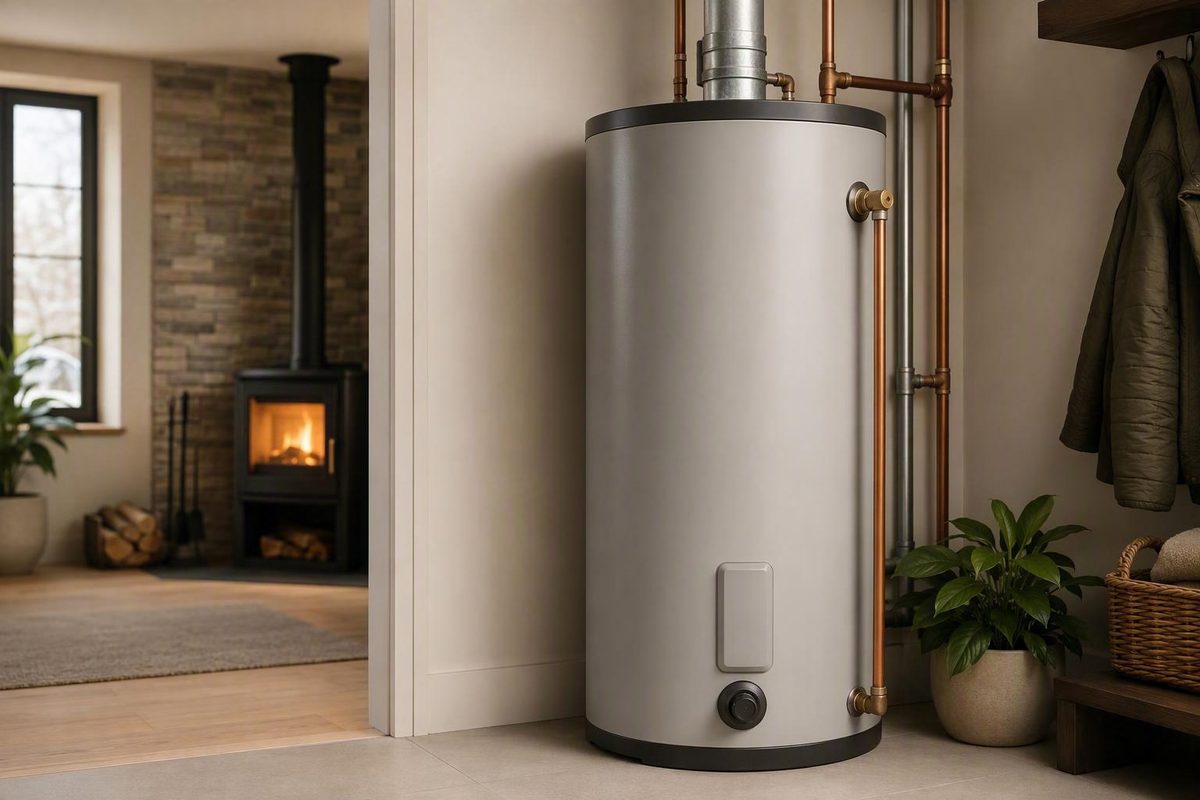
The short answer: start with 120°F for most homes
For most households, 120°F (49°C) is the sensible starting point. It generally provides comfortable hot water while reducing scald risk and standby heat loss compared with a 140°F setting. A. O. Smith recommends 120°F for most homes and says it presets its own water heaters to that temperature, although that manufacturer-specific policy should not be generalized to every brand or model (A. O. Smith’s water-heater temperature guidance).
The broader residential range commonly discussed is 120°F to 140°F, but the available evidence does not establish which setting is statistically most common in occupied homes. The lower end is the practical recommendation for an ordinary household; settings closer to 140°F are conditional choices that require closer attention to scalding, plumbing design, health concerns, appliances, energy use, mixing controls, and local rules.
The word “typical” can mean three different things:
- The usual recommendation: commonly 120°F as a residential starting point.
- A factory preset: the manufacturer’s initial control position, which varies by product.
- An observed household setting: what occupants actually use after installation, adjustment, service, or a change in ownership.
These are not interchangeable. A factory preset is not a universal standard, and a thermostat label does not prove that water reaches every faucet at precisely that temperature.
The central trade-off is straightforward. A 120°F setting generally reduces scald risk and the energy needed to keep stored water hot. Hotter storage can support a deliberate Legionella-control strategy, offset some distribution heat loss, and increase the usable amount of mixed hot water from a tank. But it also raises scald risk and ordinarily uses more energy.
A sound decision distinguishes among:
- The temperature selected on the heater.
- The temperature maintained inside a storage tank.
- The temperature delivered at sinks, tubs, and showers.
For a household without a special risk factor or appliance requirement, begin around 120°F, measure the result at a representative faucet, and investigate unexpected performance before turning the thermostat higher.
120°F versus 140°F: what changes when the setting goes up?
Moving from 120°F to 140°F affects more than shower comfort. It changes scald exposure, storage heat loss, effective tank capacity, bacterial-control considerations, and the safeguards that may be appropriate. The comparison below reflects residential guidance that treats 120°F as the usual starting point and hotter settings as situation-dependent (Style Crest’s water-heater temperature guidance).
| Consideration | Around 120°F | Around 140°F |
|---|---|---|
| Scald risk | Lower than at 140°F, although the water can still injure and actual outlet temperature matters | Materially greater, making uncontrolled delivery more hazardous |
| Energy use | Generally lower standby heat loss in a storage heater | Generally higher because the stored water is kept farther above the surrounding temperature |
| Bacterial-control considerations | A practical household setting, but not a complete Legionella-control strategy | Can be part of a system-level strategy when distribution temperatures, stagnation, and mixing are also addressed |
| Available mixed hot water | Less cold water can be blended into a given tank volume before the mixture becomes too cool | Hotter stored water can be blended with more cold water, increasing effective mixed-water capacity |
| Dishwasher compatibility | Suitable for many appliances, particularly those that heat water internally | May be useful when the appliance manual requires hotter inlet water |
| Likely safeguards | Verify fixture temperature and maintain existing anti-scald controls | Professionally selected mixing or anti-scald controls may be appropriate to limit delivery temperature |
Why 120°F usually comes first
A 120°F setting is especially attractive when reducing burn risk is a priority. In homes with young children, frail older adults, or anyone who may have difficulty reacting promptly to hot water, attention should focus on what actually reaches showers, tubs, and sinks—not only the tank dial.
Lower storage temperature also generally means less standby heat loss. The exact energy effect depends on insulation, ambient conditions, heater type, fuel or power source, hot-water use, and plumbing layout. A universal savings percentage or annual dollar estimate would therefore be misleading. The narrower conclusion is reliable: under otherwise comparable conditions, maintaining the same tank at 120°F ordinarily requires less energy than maintaining it at 140°F.
When 140°F may be considered
A 140°F setting is not an equally suitable universal alternative. It may be considered when a household has:
- A documented appliance requirement.
- Significant heat loss through the distribution system.
- Unusual or heavy simultaneous demand.
- A system-level reason to pursue hotter storage for Legionella control.
Those situations call for an assessment of storage temperature, delivered temperature, plumbing conditions, and protective controls—not merely a hotter thermostat position.
Hotter storage can increase effective capacity. Because stored water above the desired shower temperature can be blended with cold water, a fixed tank can produce a greater volume of usable mixed water.
That benefit has limits. Turning up the thermostat may conceal:
- An undersized heater.
- A failed electric heating element.
- Sediment or mineral accumulation.
- A faulty thermostat.
- A mixing-control problem.
- Heat loss along long piping.
- A demand pattern the system was not designed to serve.
If hot-water availability has steadily declined, diagnose the cause rather than compensating with progressively hotter storage.
What about 130°F?
An intermediate setting may appear to split the difference, but 130°F is not a universally validated compromise. Its suitability depends on the heater, plumbing, occupants, outlet safeguards, appliance requirements, and reasons for considering a higher temperature.
Thermostat scales may also be approximate, and tank temperature can vary as the heater cycles. Treat 130°F as another setting to measure and verify—not as an automatic best answer between 120°F and 140°F.
Scald prevention and Legionella control are different safety problems
Scald prevention and Legionella control can pull a hot-water system in different directions. Scald prevention favors limiting the temperature people encounter. Legionella control may favor warmer conditions in parts of the storage and distribution system. No single thermostat number eliminates both risks in every home.
Hotter water can cause injury more quickly. That makes fixture temperature particularly important for children, older adults, people with reduced sensation or mobility, and anyone unable to move away from hot water promptly. Exposure severity also depends on duration and individual vulnerability, so generic burn-time charts should not be treated as guarantees.
Legionella requires a system-wide view. The EPA says the bacteria grow best at 80°F to 120°F and discusses controlling growth by keeping plumbing water above 124°F or below 80°F. For home hot-water systems, it says a thermostat setting at or above 140°F can often help maintain temperatures above 124°F throughout the plumbing. The EPA also identifies people age 50 or older, smokers, immunocompromised people, and people with certain chronic illnesses as more susceptible to infection (EPA guidance on Legionella in indoor water systems).
That discussion presents 140°F as a Legionella-control strategy, not a universal direction for every home. Temperature at the heater is only one factor. Stagnation, low-use branches, pipe heat loss, recirculation performance, system layout, and mixing conditions can affect temperatures elsewhere in the plumbing.
A household with someone at elevated susceptibility should consult current public-health guidance and qualified plumbing or healthcare professionals as appropriate. A general article cannot prescribe an individualized temperature based on a person’s medical history.
Hotter storage with cooler delivery
One system-design option is to store water at a higher temperature and use a thermostatic mixing valve to blend it with cold water before delivery.
This separates two goals:
- Storage or distribution can remain hotter where the system design calls for it.
- The mixing control can reduce the temperature delivered to users.
A mixing valve is not an automatic guarantee against scalding. It must be suitable for the system, installed in the correct location, adjusted properly, and maintained. Manufacturer instructions and qualified professional guidance should govern selection and installation, especially where hotter storage is being used to balance bacterial-control and burn risks (guidance on water-heater settings and thermostatic mixing valves).
Verify the rules that apply to the property before changing the system. Where a household faces both elevated Legionella susceptibility and elevated burn vulnerability, professional system assessment is preferable to trial-and-error thermostat changes.
Tank setting, stored temperature, and faucet temperature are not the same
A thermostat setting is not necessarily the temperature measured at a tap. Understanding the three relevant values prevents repeated adjustments based on the wrong assumption.
1. Thermostat setting
This is the selected control position. It may appear as a digital number, a graduated scale, or a label such as “Low,” “Hot,” or a letter. Mechanical dials and labels can be approximate and should not be treated as calibrated faucet readings.
2. Stored-water temperature
This is the actual temperature inside a storage tank. It can vary over time as the heater cycles.
3. Delivered fixture temperature
This is the water that reaches a sink, shower, or tub. It directly determines comfort and scald exposure. It may differ from the selected setting because of:
- Heat loss along the piping.
- Intentional mixing with cold water.
- A central or fixture-level mixing control.
- A faucet or shower temperature limit.
- Sediment or mineral buildup.
- A failed electric element.
- A thermostat or other control problem.
- Unusually cold incoming water affecting recovery and demand.
A thermostatic mixing valve intentionally delivers water cooler than the stored water. A control problem can also contribute to water that is unexpectedly cool, hot, or inconsistent. Commercial technical guidance similarly identifies pipe heat loss, sediment, failed elements, thermostat faults, and cold incoming water as possible causes of unexpected delivery temperatures (Style Crest’s troubleshooting overview).
Testing a representative faucet is therefore necessary before adjusting the heater again. If a tank is set around 120°F but one shower is much cooler than a nearby sink, the shower valve or local piping may be responsible. If every fixture is too cool, heater performance or a central mixing control becomes more likely.
Unexpectedly scalding water, severe fluctuations, or persistent inadequacy may indicate an equipment or control fault. Repeatedly raising the thermostat can increase risk without correcting the underlying problem.
How to check the actual hot-water temperature
Do not infer faucet temperature from the dial. Use a reliable thermometer to test the delivered water while avoiding direct contact with a potentially scalding stream.
A model-agnostic test works as follows:
- Choose a representative fixture. A commonly used sink is usually convenient. Avoid a fixture with a known local temperature limit unless that fixture is the concern.
- Use a suitable, reliable thermometer. Position it so you can read the flowing water without putting your hands in the stream.
- Run the hot water until the reading stabilizes. The first water from the pipe may not represent heater output.
- Measure carefully. Keep children and other occupants away from the test area.
- Repeat the reading if it fluctuates. More than one measurement can reveal unstable performance.
- Record the result. Note the fixture, time, selected setting, and measured temperature.
A nearby faucet can provide a useful comparison with heater performance because the pipe run is shorter. A distant fixture can reveal distribution heat loss. Comparing both may be more informative than measuring only one location; published residential guidance also recommends checking delivered temperature with a thermometer rather than relying on the control label (Aire Serv’s temperature-checking guidance).
After adjusting a storage water heater, let it complete the heating or stabilization period specified in its manual before retesting. There is no universal wait time: recovery varies with tank volume, power or fuel input, incoming-water temperature, controls, usage, and model.
Their settings, response, flow requirements, and verification procedures are model-specific. Follow the unit manual rather than applying a tank-heater waiting procedure.
If the measured temperature remains substantially different from the selected setting, stop making repeated upward adjustments. Determine whether the mismatch affects every fixture, whether it changes over time, and whether the system includes a mixing control. Persistent discrepancies warrant troubleshooting or professional service.
Household factors that may justify a different approach
The best approach depends on who uses the water, how the plumbing is configured, what the appliances require, and whether the system has functioning mixing controls. Residential guidance consistently treats occupant vulnerability, appliance requirements, demand, and pipe loss as reasons to evaluate the default recommendation rather than apply it blindly (Constellation Home’s water-heater temperature overview).
| Household or system factor | Practical response |
|---|---|
| Young children, frail older adults, or others vulnerable to burns | Start conservatively and verify actual outlet temperature; inspect existing anti-scald protection |
| Elevated Legionella susceptibility | Obtain a system-level assessment covering storage, distribution, stagnation, mixing, energy use, and local rules |
| Dishwasher requirements | Read the appliance manual and determine whether it heats incoming water internally |
| Heavy simultaneous demand | Check heater capacity and condition before increasing temperature |
| Long plumbing runs | Compare near and distant readings and consider suitable pipe insulation |
| Existing mixing controls | Identify what each control serves and account for it when interpreting fixture readings |
Burn-vulnerable occupants
Where a household includes young children, frail older adults, or someone with reduced sensation, mobility, or response ability, actual fixture temperature deserves priority. A tank setting alone cannot confirm that a shower or bath is being delivered at an appropriate temperature.
Check tubs and showers as well as sinks. Where hotter storage is required elsewhere in the system, a properly selected temperature-limiting control may provide protection that a tank adjustment alone cannot.
Elevated Legionella concerns
A system-level assessment should consider:
- Whether hot water remains warm enough throughout the plumbing.
- Whether there are stagnant or rarely used branches.
- Whether a recirculation system is operating as intended.
- Whether long pipes lose substantial heat.
- Whether a central mixing valve lowers distribution temperature.
- Whether the household includes someone at elevated susceptibility.
- What current public-health guidance and local rules require.
Hotter storage may be one part of the response, but it also increases energy use and scald risk. Storage, distribution, stagnation, mixing, and outlet protection must be considered together.
Dishwasher needs
Dishwashers vary. Many models heat water internally during part of the cycle, while others rely more heavily on the incoming supply.
Check the dishwasher’s installation and operating manual for its required inlet-temperature range. Do not assume that every model requires water supplied at 130°F or 140°F. If hotter inlet water is required, consider how the plumbing and mixing controls will manage fixture-level scald risk elsewhere.
Heavy demand and repeated shortages
Hotter storage can increase usable mixed-water volume, but shortages do not automatically justify raising the thermostat. First determine whether the heater:
- Is appropriately sized for peak demand.
- Has lost usable capacity because of sediment.
- Has a failed element or thermostat.
- Is recovering normally.
- Is serving new or higher-demand fixtures.
- Is losing excessive heat through the piping.
- Has a mixing control that is not operating as intended.
If several showers, laundry, and dishwashing occur at once, the problem may be legitimate peak demand. If performance has deteriorated without a change in usage, a fault or maintenance problem is more likely.
Long pipe runs
Water cools as it travels through piping, particularly over long runs or through cold spaces. Suitable hot-water pipe insulation can reduce this loss.
Measure at both nearby and distant fixtures.
Existing mixing controls
Determine where each mixing control is located and what it serves. If one fixture behaves differently from the others, investigate its local control before changing the water heater.
There is no sound basis in the supplied evidence for routinely changing water-heater temperature by season. Seasonal changes in incoming-water temperature can affect recovery and delivered performance, but that is a reason to observe and diagnose the system—not to adopt an automatic hotter-in-winter schedule.
Adjustments differ for electric, gas, and tankless heaters
Begin with the heater’s model number and manual. Controls, labels, shutdown procedures, allowable settings, access requirements, and recovery behavior vary significantly.
Electric tank water heaters
A conventional dual-element electric tank generally has upper and lower thermostats. They ordinarily should be set consistently unless the model instructions say otherwise.
Accessing the controls may expose hazardous electrical components. Isolate power exactly as the manufacturer directs before opening an access area, and replace required insulation and covers as instructed. Anyone who cannot positively identify and isolate the correct electrical supply should use a qualified professional. Do not alter wiring or bypass safety controls (water-heater adjustment and electrical-safety guidance).
Gas tank water heaters
Gas controls and ignition systems vary by model. Some heaters use mechanical dials; others have electronic ignition, status indicators, or model-specific setup procedures. Dial labels may represent approximate ranges rather than exact temperatures.
Generic instructions for manipulating a gas valve or relighting a pilot should not be treated as universal. Follow the heater’s own procedure and use a qualified professional for ignition failures, gas-control problems, repeated shutdowns, or uncertainty. Do not alter combustion components or defeat a safety device (model-specific gas and water-heater adjustment guidance).
Tankless water heaters
Many tankless heaters use electronic controls, but permitted temperatures and adjustment procedures differ by model and installation.
Use the manufacturer’s procedure to make and verify a change. An electronic display does not by itself prove that every fixture receives precisely the displayed temperature.
Mixing and anti-scald hardware
Adding or changing mixing hardware is a plumbing-system modification, not merely a comfort adjustment. Valve selection depends on its intended function and compatibility with the system. Installation should follow the valve and heater manufacturers’ instructions and applicable local plumbing or building requirements.
Regardless of heater type:
- Do not bypass safety controls.
- Do not alter combustion components.
- Do not treat approximate dial labels as calibrated readings.
- Do not apply another model’s adjustment procedure.
- Do not open electrical or gas-control areas unless qualified.
- Retest delivered temperature after the heater has stabilized as its manual directs.
When temperature trouble points to a repair problem
A thermostat change is appropriate only when the heater is functioning normally and the selected temperature genuinely does not meet the household’s needs. Stop adjusting and seek qualified help for:
- Leaks around the heater, tank, connections, or valves.
- Repeated circuit-breaker trips.
- Gas-control, pilot, or ignition problems.
- Inability to change or maintain the selected temperature.
- Unexpectedly scalding water.
- Sharp or unexplained temperature fluctuations.
- Complete or repeated failure to heat.
- Unusual popping, banging, or other new noises.
- A persistent mismatch between the selected and measured temperature.
- A mixing control that will not adjust or produces unstable delivery.
Sediment, mineral buildup, failed electric elements, thermostat faults, pipe heat loss, and mixing-control problems can all resemble an unsuitable thermostat setting. Leaks, strange noises, repeated breaker trips, pilot problems, and persistent heating failures are also recognized reasons to stop adjusting and obtain service (water-heater troubleshooting and service guidance).
Do not repeatedly raise the thermostat to compensate for steadily declining performance. That can increase stored-water temperature and scald exposure without restoring normal capacity.
Before requesting service, record:
- The heater make and model.
- The selected setting.
- Readings from nearby and distant fixtures.
- Whether every fixture or only one is affected.
- When the problem occurs.
- Whether demand recently changed.
- Any leak, noise, breaker, ignition, or error-code symptoms.
- Whether central or fixture-level mixing controls are present.
A qualified professional can evaluate storage temperature, fixture delivery, thermostat operation, heating components, mixing controls, pipe loss, system sizing, and code compliance together.
The practical decision is compact: use 120°F as the ordinary starting point, verify the delivered temperature with a thermometer, investigate household-specific exceptions, and obtain professional help before adopting hotter storage or opening hazardous controls.
Frequently asked questions
Is 120°F hot enough for a home water heater?
For most households, yes. It is the usual practical starting point for balancing comfort, energy use, and reduced scald risk. Confirm the delivered temperature because the control setting and faucet temperature may differ (residential water-heater temperature guidance).
A different approach may be warranted for a documented appliance requirement, unusual demand, substantial pipe heat loss, or a system-level Legionella strategy.
Should I set my water heater to 140°F to prevent Legionella?
Not automatically. The EPA says a setting at or above 140°F can often help keep household plumbing above 124°F, but it presents this as a Legionella-control strategy rather than a universal residential setting. Stagnation, distribution temperature, plumbing design, and susceptible occupants also matter (EPA guidance on Legionella in the indoor environment).
Because hotter water increases scald risk and energy use, households with elevated concerns should seek current public-health and qualified professional guidance.
Can I store water at 140°F but deliver cooler water at the faucet?
Yes. A properly selected thermostatic mixing valve can blend hotter stored water with cold water to reduce the delivered temperature.
The valve must be appropriate for the system, correctly installed, adjusted, and maintained. Follow manufacturer instructions, professional guidance, and applicable local requirements.
Do both thermostats on an electric water heater need the same setting?
On a conventional dual-element electric tank, the upper and lower thermostats generally should be set consistently unless the model manual directs otherwise.
Access can expose hazardous voltage. Isolate power exactly as the manufacturer directs, or call a qualified professional if you cannot verify safe isolation (A. O. Smith’s electric-water-heater guidance).
Why is my faucet temperature different from the water-heater setting?
The selected setting, stored-water temperature, and delivered faucet temperature are separate values. Differences can result from approximate thermostat calibration, normal cycling, pipe heat loss, cold-water mixing, fixture limits, mixing controls, sediment, a failed element, or another control problem.
Compare readings at nearby and distant fixtures after the heater has operated normally. If the temperature remains substantially different, becomes unstable, or is unexpectedly scalding, investigate the equipment and controls instead of repeatedly increasing the thermostat.