
Find the Fault Without Making the Problem Worse
Check hazards first, isolate one outlet versus the whole home, record codes, test external causes, and learn which warning signs mean stop.
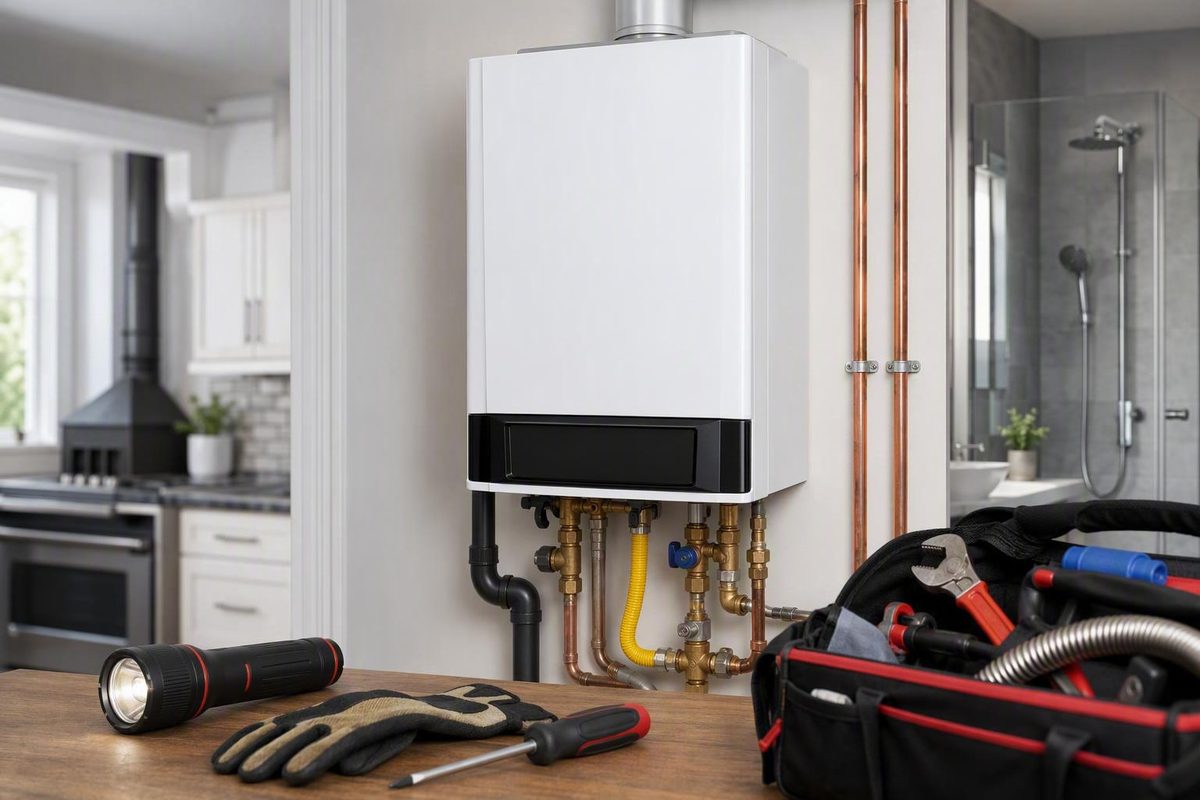
Tankless water heater troubleshooting works best as a process of elimination—not a hunt for a part to replace. Start by checking for hazards, determine whether the problem affects one outlet or the whole home, and record any error code. Then check only external supplies, accessible valves, settings, demand, flow, and visible exterior vent conditions.
This guide covers observation and non-invasive homeowner checks. It does not cover internal repairs, gas-line testing, combustion adjustment, energized electrical diagnosis, burner cleaning, heating-element work, or control-board repair.
Start Here: Safety Triage and the Limits of DIY Troubleshooting
A tankless water heater may involve gas, combustion, electricity, hot surfaces, pressurized plumbing, and water hot enough to scald. The order of troubleshooting therefore matters: look for reasons to stop before trying to restore operation.
Stop troubleshooting if you suspect a gas leak. Obtain help from the gas supplier or an appropriately qualified professional. Do not loosen fittings, test gas components, open the burner area, or continue trying to ignite the heater. Water-heater manufacturer guidance treats suspected gas leakage as a condition for stopping troubleshooting and seeking professional assistance (A. O. Smith safety guidance).
Shut the heater down and arrange qualified service when there is an active leak, suspected freeze damage, recurring lockout, persistent ignition failure, visible electrical damage, or a breaker that has tripped repeatedly. Commercial troubleshooting guidance likewise identifies leaks, recurring errors, freezing-related problems, and persistent shutdowns as conditions requiring professional attention (Plumb Pros tankless problem guide).
Do not open or work on:
- Gas trains, regulators, or burners
- Sealed combustion sections
- Igniters or flame-detection components
- Control boards or sensors
- Heating-element compartments
- Energized electrical panels
- Internal plumbing or heat-exchanger connections
- Safety switches or other protective controls
Do not dismantle venting, alter gas piping, clean burners, probe electrical circuits, bypass safety controls, or attempt sealed-component repairs. Generic homeowner observations cannot safely distinguish among gas-pressure, ignition, combustion, venting, electrical, sensor, and control faults.
An appliance reset is not a diagnosis. Record the complete code before resetting anything, then follow only the reset procedure authorized by the exact model manual. If the fault returns, stop resetting and arrange service; manufacturer troubleshooting guidance similarly directs users to the model instructions and recommends professional diagnosis when a code comes back (Noritz troubleshooting guide).
An appliance control reset is also different from operating a circuit breaker. If a breaker has already been reset and trips again, leave it off and obtain qualified electrical diagnosis. A recurring trip may indicate an underlying electrical problem (Synergy Companies’ no-hot-water guide).
Before maintenance or service, find the manual for the exact model number, not merely the brand or product family. Installation requirements, permitted user maintenance, reset procedures, freeze protection, venting, warranty terms, and service instructions can vary by model. Local permit, inspection, and code requirements may also vary, so check with the applicable local authority when installation or venting work is involved.
Finally, confirm that the instructions apply to a tankless appliance. Anode-rod inspection, generic tank draining, and other storage-water-heater procedures generally do not belong in a tankless troubleshooting workflow.
The Five-Minute First Check
The first check should narrow the problem without opening the heater.
-
Test more than one hot-water outlet. If only one faucet or shower is affected, the problem may be in that fixture or its branch plumbing. A clogged aerator, showerhead, cartridge, or mixing device is possible; one bad outlet does not prove that the heater has failed.
-
Define the symptom precisely. Record whether you have no heat, consistently lukewarm water, repeated hot-cold cycling, weak hot-side flow, shutdowns, leakage, or a display code. Note when the symptom began and whether it is constant or intermittent.
-
Record what changed. Consider recent freezing weather, plumbing work, maintenance, power interruptions, fuel-supply changes, or adjustments to temperature and recirculation settings.
-
Capture the complete display message. Photograph it or write down every character before switching off the appliance or using an authorized reset. Error-code meanings vary among brands, models, and model years.
-
Confirm electrical power. Check whether the display is on and whether a dedicated breaker is tripped. Do not operate a breaker if there is visible electrical damage or moisture around electrical equipment. If the breaker has already been reset and trips again, leave it off for qualified diagnosis.
-
Confirm accessible water valves are fully open. Check only clearly identified, safely accessible valves. Do not force a stuck, corroded, or damaged valve.
-
For a gas model, check only the external supply. Verify that the normal fuel supply appears available and that the accessible service valve is in its normal open position. Do not loosen, test, adjust, or repair gas components.
-
Check the set temperature. Record the current setting and whether anyone recently changed it. Do not try to conceal an unresolved performance problem by setting the heater excessively high.
-
Run a controlled one-fixture test. Turn off all other hot-water uses. Open one hot-water faucet at a steady, practical flow. Observe whether the burner or heating indicator activates, whether flow is weak only on the hot side, whether the temperature stabilizes, and whether the heater shuts down or displays a code.
The one-fixture test helps separate several broad possibilities:
- If one fixture works normally but performance declines when another hot-water use begins, simultaneous demand is implicated.
- If only one outlet is affected, investigate that fixture or branch plumbing.
- If every outlet is affected and the heater never indicates a call for heat, adequate flow, supply, or control authorization may be missing.
- If the heater starts and then repeatedly shuts down during steady flow, record the timing and display information for service.
Before calling a technician, assemble this worksheet:
| Information | What to record |
|---|---|
| Appliance identity | Brand, exact model, and serial number |
| Energy source | Natural gas, propane, or electric |
| Fault information | Full code or display message, preferably with a photo |
| Symptom | No heat, lukewarm water, cycling, low flow, shutdown, or leak |
| Scope | One outlet, several outlets, or every outlet |
| Demand | Fixtures running when the problem occurred |
| Test result | What happened with one fixture running alone |
| History | Last maintenance, filter care, descaling, or repair |
| Conditions | Recent freezing weather, outage, or plumbing work |
| Warning signs | Noises, odors, visible damage, or moisture |
| Actions taken | Any shutdown, appliance reset, or breaker operation |
No Hot Water: Follow the Correct Path for Gas or Electric
A powered display does not prove that a heater can heat water. The appliance still needs adequate water flow, open valves, control authorization, and—depending on its type—fuel and successful ignition or sufficient electrical heating operation.
Start both gas and electric paths the same way:
- Record the complete display code.
- Confirm accessible water valves are open.
- Check the temperature setting.
- Verify that the fixture supplies enough steady flow to request heat.
- Test one hot-water fixture with every other hot-water use off.
- Observe whether the heating or burner indicator activates.
Manufacturer guidance lists interrupted supplies, closed valves, ignition failure, and system errors among the possible causes of no hot water. These are possible categories, not confirmation that any particular component has failed.
Gas-fired units
If a gas-fired unit has electrical power but delivers cold water, possible causes include:
- Interrupted external fuel supply
- A closed external gas or water valve
- Insufficient water flow to trigger operation
- Ignition or flame-detection failure
- Blocked combustion air or exhaust
- Safety lockout
- Internal sensor or control failure
Homeowner checks should remain external: confirm normal fuel availability, observe the accessible service-valve position, record the display, and inspect only a safely accessible exterior vent termination. Do not open the cabinet to inspect the burner, igniter, flame sensor, regulator, or gas train.
Ignition and flame faults can involve gas pressure, gas-line sizing, regulators, combustion conditions, venting, ignition components, burners, electrical supply, or controls. A generic visual check cannot safely determine which of those conditions is responsible. Persistent ignition or flame failure belongs with a qualified technician.
If the exterior vent termination is safely visible from the ground, look for obvious snow, nests, debris, damage, or disconnected piping. Do not insert tools, remove vent sections, alter clearances, or climb into an unsafe position. Blocked or improperly installed venting can contribute to overheating or shutdown.
Electric units
For an electric tankless heater, confirm whether the display has power and note whether a dedicated breaker is tripped. Do not remove covers or attempt to inspect heating components.
Possible internal causes include a failed heating component, wiring problem, temperature sensor, safety device, or control fault. Those possibilities require model-specific diagnosis. Do not perform energized voltage, resistance, or current tests unless you are appropriately qualified and following applicable service documentation.
If a breaker has already been reset and trips again, leave it off. Repeated operation does not identify or correct the underlying electrical fault.
Could the unit be frozen?
Freezing may stop flow, prevent operation, or damage water-carrying components. If freezing is plausible, shut down the heater. If cracked piping or internal damage may be present, leave the water off and arrange an inspection. Freezing-related malfunctions and leaks are identified as conditions requiring professional attention in tankless service guidance.
Do not assume that resumed flow proves the heater escaped damage. Do not use improvised thawing methods, pressure-test the appliance, or open it for an internal post-freeze inspection.
Compact no-hot-water decision path
- If there is a gas concern, active leak, visible electrical damage, repeated breaker trip, or suspected freeze damage, stop and arrange service.
- Record the complete code, exact model, and serial number.
- Confirm electrical power, accessible water valves, temperature setting, and external fuel availability where applicable.
- Test one fixture at a steady flow with all other hot-water uses off.
- On a gas model, visually check only safely accessible exterior vent conditions.
- Use an appliance reset only when the exact model manual authorizes it.
- If the fault persists or returns, stop resetting and arrange qualified service.
Lukewarm Water, Hot-Cold Cycling, and the Cold-Water Sandwich
“Temperature problem” can describe three different patterns. Identifying the pattern prevents unrelated remedies from being mixed together.
Consistently lukewarm output
Water that remains lukewarm may indicate excessive simultaneous demand, an incorrect setting, reduced heat transfer, restricted flow, challenging incoming-water conditions, or an internal heating problem.
Begin with an overload test: turn off every other hot-water use and run one outlet at a steady flow. If the water becomes properly hot and stable, the combined demand may have exceeded the heater’s available output.
That result does not automatically prove the installation is undersized. Check the exact model’s rating information and temperature-rise documentation before reaching a sizing conclusion. Available output varies with operating conditions, including incoming-water temperature and the requested outlet temperature. Colder incoming water can change perceived performance without proving that a component has failed.
Repeated hot-cold cycling during steady use
Cycling during an uninterrupted shower or steady faucet draw is different from a brief piping delay. Plausible causes include:
- Insufficient or restricted flow
- A clogged inlet filter
- Mineral scale
- Water-pressure fluctuation
- Incorrect settings
- Demand near or beyond available capacity
- Interrupted ignition on a gas model
- Sensor or control problems
Watch the display and heating indicator during the one-fixture test. If the indicator repeatedly turns off while fixture flow remains steady, record the timing and any code. That observation helps a technician, but it does not identify a failed component by itself.
If cycling stops when other hot-water loads are removed, simultaneous demand is implicated. If it continues with one fixture at steady flow, a flow restriction, maintenance condition, ignition fault, sensor problem, or control issue becomes more plausible. Persistent cycling—or cycling accompanied by recurring codes—requires professional diagnosis.
A brief hot-cold-hot sequence
A cold-water sandwich commonly describes hot water remaining in the piping, followed by unheated water, followed by newly heated water after the heater responds. Manufacturer guidance describes this sequence as residual hot water in the line being followed by cold water before newly heated water reaches the outlet (Eccotemp common-problems guide).
Do not assume every burst of cold water is a cold-water sandwich. A recurring hot-cold pattern during uninterrupted flow is more consistent with another operating problem.
Plumbing layout and recirculation design may change the delay or temperature pattern. Recirculation is not a universal cure, and diagnosing its controls, check valves, and piping is system-specific. Use the heater and recirculation-system documentation or have the system assessed as a whole.
Low Hot-Water Pressure and Failure to Activate
A tankless heater responds to water flow. If flow through the appliance is too low for that model, it may not initiate or sustain heating. There is no safe universal activation-flow figure; use the exact model documentation.
First compare hot and cold flow at several outlets:
- One fixture has weak hot flow: Suspect a local aerator, showerhead, cartridge, mixing valve, or branch restriction.
- Every fixture has weak hot flow but normal cold flow: Suspect a restriction at the heater or somewhere along the hot-water side.
- Both hot and cold are weak: The problem may be broader than the water heater.
Normal cold-water pressure combined with weak hot flow narrows the search, but it does not locate the obstruction. Possible causes include a partially closed valve, clogged heater inlet filter, mineral buildup, fixture debris, or a hot-side plumbing restriction.
The inlet filter is a screen intended to keep sediment and debris from reaching internal components. It may become obstructed, particularly where hard-water deposits or well-water debris are present.
Inspect or clean the filter only when the exact manual identifies it as homeowner-accessible and gives complete instructions for:
- Power or fuel shutdown
- Water isolation
- Pressure relief
- Safe access
- Correct cleaning
- Seal inspection and reassembly
- Leak checking after restoration
Do not improvise a filter-removal procedure. A water connection may be pressurized or contain hot water, and incorrect reassembly can create a leak.
Hard water can contribute mineral deposits, while well water may carry sediment or debris. Either condition can contribute to restriction without proving where that restriction is located. If accessible fixture checks and manual-approved filter care do not restore flow—or if valve positions cannot be verified safely—arrange plumbing or tankless-heater service.
Scale, Filters, and Capacity: Three Problems That Can Look Alike
Scale, filter obstruction, and excess demand can all produce inadequate hot water. Their symptom patterns overlap, so use the following table to organize observations rather than to diagnose a component conclusively.
| Symptom pattern | Plausible cause | Safe observation | Next action |
|---|---|---|---|
| Performance has gradually declined; hot flow or temperature stability may also be reduced | Mineral scale | Review water hardness, maintenance history, and whether several outlets are affected | Follow the exact manual’s maintenance guidance or schedule professional descaling |
| Hot-side flow is weak throughout the home; the heater may fail to activate at lower fixture flow | Clogged inlet filter or another restriction | Compare hot and cold flow; check whether the manual identifies a user-accessible filter | Perform only manual-approved filter care; seek service if the restriction remains |
| One fixture works, but performance declines when a second hot-water use begins | Temporary overload | Turn off other hot-water uses and retest one fixture steadily | Reduce simultaneous demand and compare conditions with the model’s rating data |
| One fixture alone remains lukewarm or cycles despite steady flow | Scale, restricted flow, incorrect setting, ignition, sensor, or control issue | Record the setting, code, indicator behavior, and flow pattern | Arrange diagnosis if external checks do not resolve it |
| Only one faucet or shower is weak or cool | Fixture or branch-plumbing issue | Compare nearby fixtures and hot-versus-cold flow | Inspect accessible fixture components or call a plumber |
Calcium and magnesium in hard water can form deposits where water is heated and interfere with heat transfer. Scale may be associated with reduced output, restricted flow, or unstable temperatures, but it should not be declared the cause without supporting observations. The inlet screen, by contrast, is intended to keep sediment and debris out of internal components (Mother Modern Plumbing’s component overview).
A clogged filter primarily restricts water movement. Because inadequate flow may prevent activation, filter obstruction can resemble an ignition or heating failure even when the original problem is hydraulic.
Capacity problems usually appear under combined demand and improve when one fixture runs alone. That is evidence of temporary overload. Confirming an undersized installation requires the exact model rating, incoming-water conditions, required outlet temperature, actual fixture demand, fuel or electrical supply, and installation configuration. One poor shower is not enough to establish that the heater is undersized.
There is no reliable universal flushing schedule for every tankless heater and water condition. Maintenance frequency should follow the exact manufacturer’s instructions while accounting for water hardness, well-water sediment, usage, installation, previous scale, and warranty terms.
Professional descaling is the better choice when:
- The manual does not authorize homeowner flushing
- Required isolation valves are absent or unfamiliar
- The correct shutdown or restoration procedure is unclear
- Warranty conditions are uncertain
- Leakage, internal damage, or recurring codes are present
- The homeowner cannot complete every step confidently
Error Codes, Shutdowns, Ignition Faults, and Venting Alerts
An error code is useful only when matched to the correct documentation. The same number may mean different things across brands, models, and model years.
Use this workflow:
- Photograph or write down the full code and accompanying message.
- Find the data label and record the exact brand and model.
- Retrieve the manual for that model.
- Read the manufacturer’s definition and required response.
- Follow only the checks or appliance-reset procedure assigned to the user.
- If the code returns, stop resetting and arrange diagnosis.
Codes may indicate ignition, flame detection, airflow, exhaust, overheating, electrical supply, water flow, sensor, or control problems. Those categories do not necessarily identify the failed part. An ignition code, for example, may reflect a supply problem, airflow condition, electrical interruption, combustion issue, or failed component.
For an airflow or exhaust alert, visually inspect safely accessible exterior terminations for snow, nests, debris, obvious damage, or disconnected piping. Exterior obstructions and damaged or improperly connected venting are recognized possible contributors to airflow-related faults.
Do not:
- Dismantle vent piping
- Change vent termination locations or clearances
- Open a sealed combustion chamber
- Clean a burner
- Adjust fuel pressure
- Bypass a switch or safety control
- Probe a sensor or control board
- Continue resetting a returning fault
Blocked or incorrectly installed venting can contribute to ignition failure, overheating, or shutdown. An exterior visual check cannot establish that combustion or venting is safe.
Escalate repeated shutdowns, persistent ignition or flame failure, recurring codes, suspected dirty combustion components, sensor or control faults, and suspected gas-pressure problems. Manufacturer guidance recommends professional diagnosis for recurring errors, ignition concerns, leaks, and repeated shutdowns.
Give the technician:
- Exact model and serial number
- Full code and a photo of the display
- Symptom and timing
- Fixtures operating when the fault occurred
- Whether one fixture works alone
- Recent weather, especially freezing conditions
- Appliance-reset and breaker-operation history
- Maintenance and descaling history
- Any noises, odors, moisture, or visible vent damage
Leaks, Freezing, and Other Conditions That Need Prompt Service
Active leakage, suspected freeze damage, and repeated breaker trips are stop conditions rather than ordinary DIY troubleshooting tasks.
Possible leak sources include loose connections, worn gaskets, installation defects, or a cracked heat exchanger. Looking at a puddle generally cannot distinguish among those possibilities.
If a leak cannot be readily traced to an accessible external plumbing connection—or if internal damage is possible—shut off the water only through a clearly identified, safely accessible isolation valve and call a plumber or qualified tankless technician. Service guidance advises shutting off water and calling a plumber when a tankless leak cannot be readily traced (Paschal tankless troubleshooting resource).
If you cannot identify or operate the appropriate valve safely, do not force an unfamiliar valve. Seek help with isolation.
A condensing model may also produce condensate. Do not assume moisture beneath it is definitely normal condensate or definitely a plumbing leak. Distinguishing a blocked, disconnected, or leaking condensate path from a water-side leak may require model-specific inspection.
Suspected freezing
Freezing can cause malfunction, shutdown, or damage to water-carrying parts. Prevention depends on correct installation and the manufacturer-approved freeze-protection provisions for that model and climate.
If freezing is suspected:
- Shut down the heater.
- Leave the water off when cracked piping or internal damage may be present.
- After thawing, look only for visible leakage.
- Arrange professional inspection before returning a possibly damaged heater to service.
Do not use improvised thawing methods, conduct a pressure test, or open the appliance for an internal post-freeze inspection unless you are qualified and following approved procedures.
Repeated breaker trips
A recurring breaker trip may indicate an underlying electrical problem. If a breaker has already been reset and trips again, leave it off and arrange qualified diagnosis. Do not treat repeated breaker operation as a repair.
Before the service call, take photos of:
- The complete unit and surrounding area
- The moisture location
- Any visible damage
- The display and error code
- Exterior vent conditions, if safely accessible
Also record recent outdoor temperatures, when the leak or trip began, code history, and whether water or electrical power has been isolated.
Prevent Repeat Problems and Decide on the Next Step
Preventive work should be based on the exact manual, not a universal checklist copied from another heater.
A model-appropriate maintenance plan may include:
- Descaling or flushing at the prescribed interval
- Cleaning a homeowner-accessible inlet filter as directed
- Visually checking exterior vent terminations
- Inspecting accessible plumbing connections for moisture or corrosion
- Maintaining approved freeze protection where relevant
- Scheduling professional combustion, electrical, or internal checks when required
Timing varies with manufacturer requirements, water hardness, sediment, usage, installation details, previous maintenance, and warranty terms. Generic schedules should not override the documentation for the installed model.
Keep a permanent record containing:
- Model and serial number
- Installation and service dates
- Error-code history
- Filter and descaling work
- Water-quality concerns
- Freeze events and power outages
- Replaced components
- Recurring symptoms and the conditions that trigger them
Warranty conditions differ among products. Before opening the appliance, flushing it, using chemicals, or arranging a non-authorized repair, check the warranty and maintenance documentation for the exact model.
Repair versus replacement should be a quote-based evaluation rather than a generic age rule. Consider:
- Warranty coverage
- Whether the fault is isolated or recurring
- Heat-exchanger condition
- Parts availability
- Unit age
- Installation defects that must also be corrected
- Quoted repair cost
- Replacement and installation quote
- Whether the existing model meets actual demand under local conditions
There is no supported universal age, repair-cost percentage, or number of failures that automatically requires replacement. Ask the technician to identify the affected system, explain what the quote includes, and clarify whether the proposed work addresses the underlying cause or only the immediate symptom.
Stop and arrange qualified service for:
- Active leakage
- A suspected gas problem
- A breaker that trips again
- Recurring lockout or shutdown
- Persistent ignition or flame failure
- An error code that returns after a manual-authorized response
- Suspected freeze damage
- An internal component, sensor, or control fault
- Unresolved loss of hot-water flow
- Any diagnosis requiring access to gas, combustion, energized electrical, or sealed compartments
Frequently Asked Questions
Can I reset my tankless water heater safely?
Use an appliance reset only when the exact model manual authorizes it, and follow that procedure precisely. Record the complete error code first.
If the fault returns after the prescribed response, stop resetting and arrange service. Do not reset a heater with an active leak, suspected gas issue, visible electrical damage, possible freeze damage, or recurring breaker trip.
Remember that an appliance control reset is not the same as operating a circuit breaker. A breaker that trips again should be left off for qualified diagnosis.
Why does my tankless water heater work at one faucet but not with several fixtures running?
The combined demand may exceed the heater’s available output under current conditions. Turn off all other hot-water uses and test one fixture at a steady flow. If performance becomes normal, simultaneous demand is implicated.
That does not automatically prove the installation is undersized. Compare actual demand, incoming-water conditions, requested outlet temperature, and installation configuration with the exact model’s rating information. Also consider whether a restriction or maintenance issue has reduced available performance.
How often should a tankless water heater be flushed?
There is no reliable universal interval. Follow the exact manufacturer’s instructions and account for water hardness, well-water sediment, usage, installation, maintenance history, and warranty conditions.
If the manual does not authorize homeowner flushing, the necessary isolation-valve arrangement is absent, or you are not confident about shutdown, pressure relief, chemical handling, and restoration, use a qualified service provider. Flushing is associated with scale removal, but a generic schedule should not override model-specific requirements (Plumber Magazine maintenance overview).
Why is hot-water pressure low while cold-water pressure is normal?
That pattern suggests a restriction at the heater or somewhere in the hot-water piping, but it does not identify the restriction’s exact location. Possibilities include a clogged inlet screen, scale, a partially closed valve, fixture debris, or another hot-side plumbing restriction.
Compare several fixtures. If only one is affected, start with that fixture. If every hot outlet is weak, check accessible valve positions and perform filter care only when the exact manual provides a homeowner procedure. Persistent low flow requires service.
When should I stop troubleshooting and call a licensed technician?
Stop for an active leak, suspected gas leakage, recurring shutdown or lockout, persistent ignition failure, returning error code, suspected freeze damage, repeated breaker trip, visible electrical damage, or unresolved low flow.
Also stop whenever diagnosis would require opening gas, burner, combustion, heating-element, electrical, sensor, control-board, or sealed-component compartments.
Before calling, record the model and serial number, full code, affected fixtures, one-fixture test result, recent weather, maintenance history, reset history, and any noises, odors, visible damage, or moisture.
The safest tankless water heater troubleshooting sequence is also the most useful: determine whether the problem is local or whole-house, record the display code, and check only external supplies, accessible valves, settings, steady flow, simultaneous demand, and visible exterior vent conditions. Then consult the exact model manual. If the fault recurs, a breaker trips again, ignition fails, water leaks, freezing may have caused damage, or diagnosis requires opening gas, combustion, electrical, or control compartments, stop and arrange qualified service.