
Steel Wood Stove: What the Welded Body Changes
Understand steel wood stove construction, heat-delivery tradeoffs, overfiring damage, maintenance checks and what to inspect before buying used.
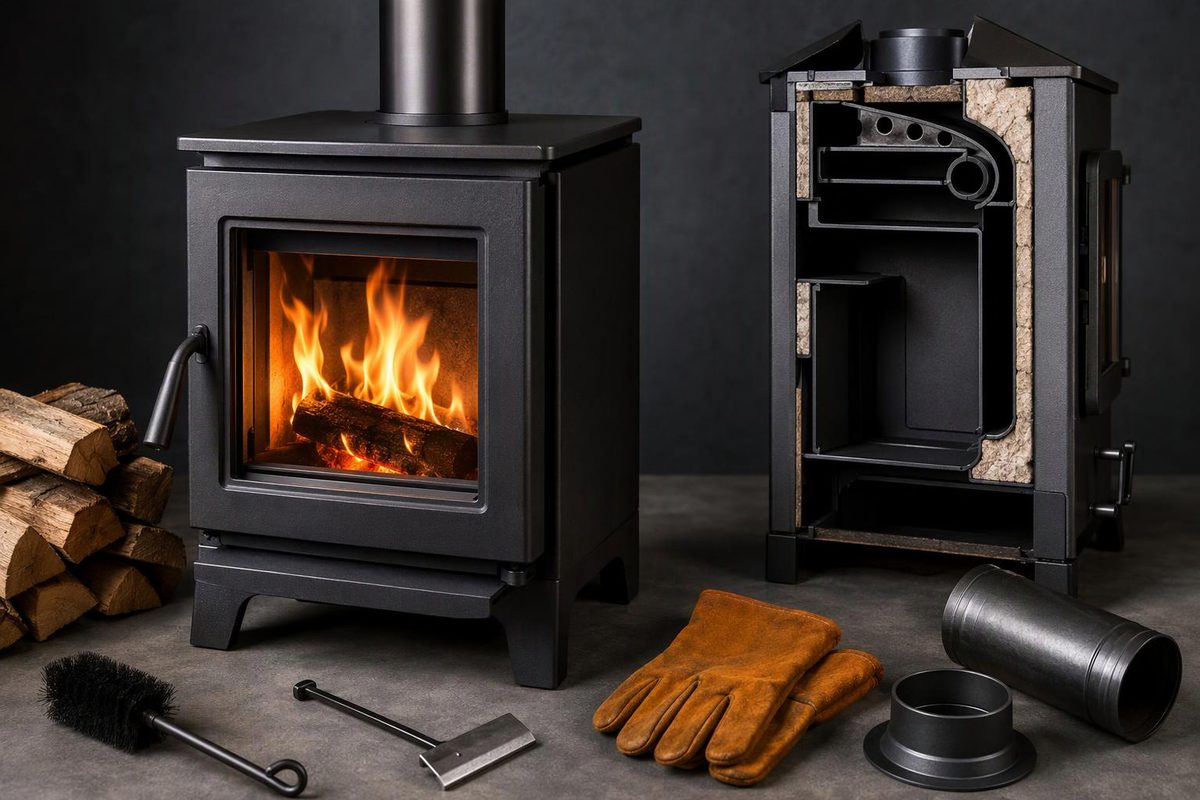
A steel wood stove generally uses a welded steel body around the firebox—a construction type described in University of Missouri Extension’s stove guide. Its practical appeal is that construction, not a guarantee of greater efficiency, longer burns or immunity from damage. Before comparing materials, establish that the exact stove’s clearances, hearth requirements and chimney arrangement work in your home and meet local installation requirements.
What “steel” actually describes
The body material does not describe every component. Drolet’s wood-stove guide identifies a carbon-steel body, stainless-steel secondary-air tubes, refractory firebrick and a separate insulating baffle. Its Escape 1800 specifications also list a cast-iron door frame. A steel stove can therefore contain several materials, each doing a different job. See the manufacturer’s materials guide and Escape 1800 manual.
Appearance can be misleading in the other direction. Pacific Energy’s Alderlea line has a steel firebox wrapped in cast iron. Decorative outer panels are not necessarily the wall containing the fire. Check the construction description and parts diagram rather than identifying the stove by its styling. Pacific Energy explains its cast-iron-over-steel construction.
Also ask where a quoted steel thickness applies. Drolet advertises a 5/16-inch steel top on the Escape 1800, reinforced with a stainless-steel heat shield. That is a top specification, not a claim that every wall and internal part has the same thickness.
Benefits—and the limits of the material
A welded shell uses permanent seams rather than separable body-panel joints. Those seams are not joints you routinely dismantle and reseal. However, the loading door, glass and any ash-cleanout seals still require attention. Welded construction does not make the appliance maintenance-free.
A painted finish can be renewed. For its painted stoves, Drolet permits repainting with the specified heat-resistant paint after surface preparation. That offers a way to renew a damaged finish, but paint cannot repair corrosion damage or a cracked weld. Cleaning and painting must be done cold. Drolet’s maintenance instructions describe the process.
Heat delivery depends on the whole assembly. Shielding changes how much heat reaches the room through direct radiation versus warm-air convection. A jacketed steel stove can feel different beside a chair than an exposed-body stove. The non-commercial Wood Heat Organization’s structural-design guidance distinguishes shielding from body material and does not treat plate steel versus cast iron as a heating-performance advantage.
Do not choose steel solely on claims that it “heats faster” or “burns longer.” Those claims need a model-specific basis. For fuel use, compare efficiency ratings and usable heat output, not the metal name.
Steel can still deteriorate under excessive heat. Drolet warns that too much combustion air can produce uncontrollable temperatures and seriously damage the stove and chimney; a reddish glow indicates overheating. It also warns against leaving the air intake fully open for entire burn cycles. A thicker top is not permission to overfire. Drolet’s operating guide.
Maintenance: inspect more than the outer box
With the stove cold, use the exact manual’s inspection schedule and parts diagram. The durable-looking shell can hide worn internal components.
| Check | What requires attention |
|---|---|
| Firebrick or refractory panels | Broken, displaced or missing pieces; replace according to the manual rather than substituting an arbitrary brick. |
| Baffle, supports and air tubes | Cracks, burned-out sections, excessive corrosion or distortion; confirm that everything is correctly seated after chimney cleaning. |
| Door and glass gaskets | Sagging, displacement or damage; verify door adjustment and use the specified replacement gasket. |
| Painted surfaces | Damaged finish or rust; establish the condition of the metal before treating the problem as cosmetic. |
Drolet says internal firebox components wear over time and warns that a cracked or missing baffle can create unsafe temperatures. Pacific Energy’s Alderlea T5 LE maintenance checks identify corrosion, burned-out sections and excessive warping as inspection concerns. Some baffle distortion is allowed on that particular model—so do not apply one universal “perfectly flat” rule to every stove.
For lining replacement, follow the model-specific firebrick selection process. Stove-body maintenance also does not replace chimney maintenance: Drolet’s guide calls for at least annual chimney cleaning and inspection, with more frequent checks and cleaning as needed for creosote accumulation.
Before buying a used steel stove
Photograph the model and serial-number label, obtain the matching manual, and inspect both the exterior and accessible firebox components. Stop the purchase or return-to-use process if you find a cracked seam, burned-through metal, substantial corrosion or unexplained body distortion. Have the manufacturer or a qualified stove technician assess it; do not assume a welding patch or fresh paint establishes safe condition. Drolet warns that component modifications can create hazardous conditions and requires advance consultation for planned changes.
Read warranty terms just as carefully as steel specifications. In the Escape 1800 manual dated October 16, 2026, lifetime parts coverage for the combustion chamber applies to welds only; carbon-steel combustion-chamber components have separate two-year parts coverage. The warranty excludes corrosion, distortion and overfiring damage, and is not transferable. Those are model-specific terms, but they illustrate why “steel body” and “lifetime warranty” are not promises that every part lasts indefinitely. Escape 1800 warranty.