
Before You Try to Recover More Heat From a Wood Fire
One user reported heavy creosote above a reclaimer after five months and enough blockage to interfere with startup. Compare risks across exchanger types.
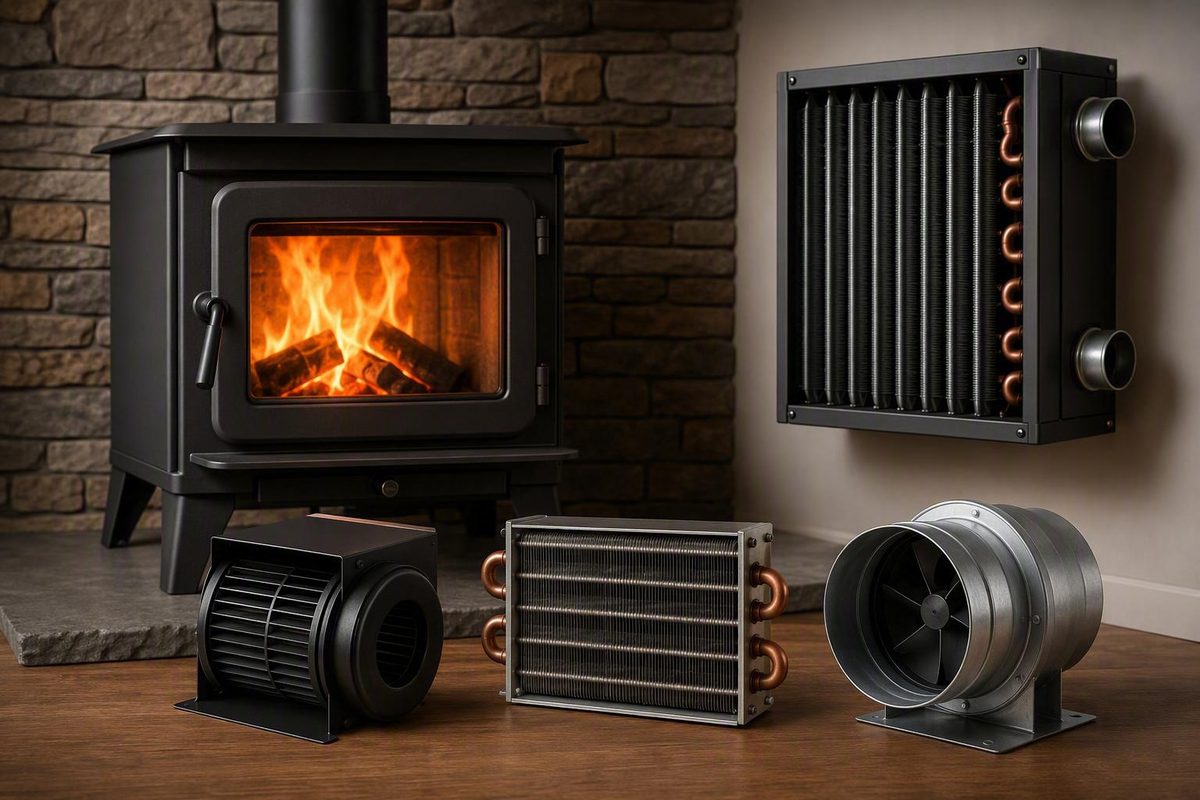
A wood stove heat exchanger is not one standardized product. The phrase may describe a blower that circulates room air around a stove, a device that extracts heat from the stovepipe, or a hydronic component designed for an outdoor wood boiler or wood furnace.
Those products solve different problems:
- A stove blower redistributes heat already entering the room.
- A flue reclaimer deliberately removes heat from combustion exhaust.
- A water-to-air coil, plate exchanger, side-arm exchanger, or unit heater relies on circulating hot water that a conventional room stove usually does not provide.
Before comparing products, identify:
- The heat source: a conventional indoor room stove, an indoor wood furnace, or an outdoor wood boiler.
- The heat destination: room air, forced-air ductwork, another water loop, domestic water, pool or spa water, or a dedicated hydronic space heater.
That distinction is more useful than an advertised BTU figure. It determines whether you are considering a simple air-circulation accessory, a change to the combustion vent, or a complete water-based heating system.
This article is therefore a terminology, compatibility, and specification guide—not a transferable design for modifying a stove, chimney, or plumbing system. The available catalog and forum evidence can identify product categories and questions to ask, but it cannot establish that a particular retrofit is approved or safe.
First, identify what “wood stove heat exchanger” means in your project
Start with the appliance, not the accessory.
A conventional wood stove is normally used as a room heater. It releases heat from its exterior by radiation and natural convection, sometimes assisted by a compatible blower. An indoor wood furnace supplies a central distribution system. An outdoor wood boiler heats water that is circulated to one or more exchangers inside a building.
Most hydronic exchanger catalogs use broad terms such as “wood furnace,” “wood boiler,” or “wood heating.” That language does not establish that a coil is suitable for attachment to an ordinary indoor stove. For example, an outdoor-boiler exchanger catalog groups water-to-air coils, plate exchangers, unit heaters, and other components intended to transfer heat from circulating boiler water. It does not document compatibility with conventional room stoves.
It also helps to distinguish three functions:
- Heat redistribution moves heat that the stove is already releasing into the room. A compatible electric blower or stove-top fan is the common example.
- Flue heat recovery removes additional heat from combustion exhaust.
- Hydronic distribution moves heat through water from a boiler or furnace to a coil, plate exchanger, radiator, or unit heater.
A stove blower is therefore not equivalent to a stovepipe reclaimer. The blower moves room air along the stove exterior or through a factory-designed heat jacket. A reclaimer is installed in the exhaust path and cools the flue gases as it transfers heat into the room.
Likewise, a plenum coil for an outdoor boiler is not a water jacket for a room stove. The plenum coil expects a controlled supply of circulating hot water. It does not provide a method for safely collecting heat at the stove, maintaining circulation, accommodating expansion, or managing continued heat production during a power or pump failure.
Use the intended destination to narrow the category:
| If you want to heat… | Begin by investigating… | Primary compatibility question |
|---|---|---|
| The stove room or adjacent rooms | A stove-compatible blower, stove-top fan, or room-air circulation | Does the stove manufacturer permit the accessory or airflow arrangement? |
| Forced-air ductwork | A water-to-air plenum coil supplied by a wood boiler or hydronic furnace | Are water temperature, flow, blower airflow, pressure drop, and plenum dimensions defined? |
| A secondary heating-water loop | A liquid-to-liquid plate exchanger | Are both fluids, temperatures, flows, pressures, and pressure drops known? |
| Domestic water | A purpose-rated plate or side-arm exchanger within a reviewed plumbing system | Are fluid separation, temperature control, expansion, pressure, and applicable plumbing requirements addressed? |
| A workshop or garage | A hydronic unit heater supplied by a boiler loop | Can the source, pump, piping, controls, and heater serve the calculated load? |
| Pool or spa water | An exchanger selected for the actual application and water chemistry | Are its materials, permitted fluids, flow requirements, and cleaning needs suitable? |
If you cannot identify both the appliance and the heat destination precisely, product comparison is premature.
The main exchanger types and what each one actually does
These categories all move heat, but they are not interchangeable or necessarily approved for the same appliances.
Compatible stove blower
A stove blower is ordinarily sold and specified as an air-circulation accessory, not as a hydronic or flue-gas heat exchanger. It is generally an electric fan mounted at the rear or bottom of a compatible stove. It moves room air around the firebox exterior or through a heat jacket rather than supplying combustion air to the fire. A commercial explanation of wood-stove blower operation describes this forced-convection arrangement, although compatibility still must be confirmed from the stove’s own documentation.
A blower may improve heat distribution. That does not establish that it increases combustion efficiency, total stove output, or burn time. Some stoves have factory mounting points and heat jackets; others do not.
Flue-mounted air reclaimer
Unlike a stove blower, it intentionally changes the thermal and physical conditions in the venting path. Apparent fit with a connector-pipe diameter does not establish that the stove, connector, chimney, or accessory manufacturer permits the configuration.
Water-to-air coil
A water-to-air exchanger contains tubes carrying hot water and fins that provide air-side surface area. In a typical outdoor-boiler application, the coil sits in a forced-air furnace plenum. The furnace blower moves air across the fins while boiler water circulates through the tubes.
The water and air remain separate. Actual output depends on conditions on both sides of the coil, including water temperature and flow, entering-air temperature, airflow, and pressure drop.
Water-to-water plate exchanger
A plate exchanger transfers heat between two liquid circuits. Alternating channels carry the fluids through a stack of thin plates. The circuits remain physically separate while heat passes through the plate material.
This arrangement can separate an outdoor-boiler circuit from a radiant-floor loop, baseboard system, another boiler circuit, or a domestic-water arrangement. Fluid separation alone does not make every model suitable for potable water. Materials, ratings, permitted applications, connections, operating limits, and cleaning requirements remain model-specific.
Side-arm domestic-water exchanger
A side-arm exchanger is a hydronic product category marketed for transferring boiler heat to water associated with a storage tank. Some seller descriptions refer to natural thermosiphon circulation on the tank side. That is a product description, not proof that passive circulation will provide adequate flow in a particular installation.
A side-arm unit also does not turn a room stove into a boiler. It presupposes a suitable source of circulating hot water and a complete domestic-water system.
Hydronic unit heater
A hydronic unit heater combines a hot-water coil with a fan to heat a room, garage, workshop, or similar space. It is a heat destination within a boiler system, not ordinarily an attachment to a conventional room stove.
| Exchanger type | Heat source | Transfer medium | Usual heat destination | Electricity or circulation requirement | Key sizing inputs | Principal concerns |
|---|---|---|---|---|---|---|
| Stove blower | Exterior of a compatible room stove | Room air | Stove room or adjacent space | Usually electricity; some stove-top fans are heat-powered | Stove compatibility, mounting, airflow, room layout | Incorrect fit, noise, dust movement, service access |
| Flue air reclaimer | Combustion exhaust | Flue gas to room air | Room containing the vent | Often an electric fan | Appliance and vent approval, draft conditions, vent configuration, accessory documentation | Exhaust cooling, restriction, deposits, changed venting configuration |
| Water-to-air coil | Circulating boiler water | Water to air | Forced-air ductwork | Water circulation and furnace blower | Heat load, plenum size, airflow, water temperature and flow, pressure drops | Air bypass, inadequate pump or blower capacity, leakage, freezing, control interaction |
| Plate exchanger | Primary hot-water circuit | Liquid to liquid | Secondary heating loop or domestic-water arrangement | Circulation on one or both sides | Temperatures, flows, fluids, pressure drops, connection sizes | Fouling, corrosion, fluid compatibility, insufficient flow, application suitability |
| Side-arm exchanger | Boiler-water loop | Liquid to liquid | Storage-tank arrangement | Boiler circulation plus the designed tank-side circulation method | Tank arrangement, temperatures, flows, materials, ratings | Scaling, overheating, stagnation, uncertain passive flow |
| Hydronic unit heater | Boiler-water loop | Water to air | Room, garage, or workshop | Pump and electric fan | Zone heat load, entering-water temperature, flow, fan performance | Noise, freeze exposure, maintenance, electrical and control requirements |
The shared word “exchanger” does not make these products substitutes for one another.
Why extracting heat from a wood flue demands caution
Forum participants have proposed a possible sequence in which cooler exhaust contributes to weaker draft or deposit formation, followed by further restriction and changed stove behavior. The reports illustrate a mechanism worth investigating, but they do not establish that every reclaimer will cause that outcome.
One forum user reported operating a reclaimer on a six-inch wood-burning exhaust for five months, then finding heavy creosote above the device and enough blockage to interfere with startup. Another participant described draft loss after a little more than five weeks of continuous burning and reported a creosote-blocked spark arrester. The accounts appear in a discussion of creosote above a heat reclaimer, but they are personal reports rather than controlled tests or inspection findings.
Important variables were not documented. The thread does not provide measured flue temperatures, fuel moisture, combustion settings, baseline draft, complete chimney geometry, deposit measurements, or an evaluation of other possible causes. Participants attributed the problems to cooling by the reclaimer, but that interpretation was not independently verified.
A separate stovepipe-exchanger forum discussion raises similar concerns about draft, creosote, water heating, and changes to the venting arrangement. It provides opinions and personal experience, not an authoritative code ruling, manufacturer approval, or validated design.
Because the supplied evidence is anecdotal, it does not support a universal minimum flue temperature, draft value, or cleaning interval. Those details must come from documentation applicable to the exact stove, connector, chimney, fuel, accessory, and installation.
Before considering any device in the exhaust path, obtain and compare:
- the stove manual;
- the connector-pipe and chimney instructions;
- the proposed accessory’s model-specific instructions and listing information;
- the appliance manufacturer’s position on the modification;
- the local permitting or inspection authority’s requirements;
- the insurer’s requirements; and
- an assessment of the complete venting system by a qualified hearth professional.
Pay particular attention to whether the accessory changes the configuration described in the appliance or chimney instructions. Successful operation during a few fires is not equivalent to documented compatibility.
If startup, draft, smoke behavior, deposits, or alarm activity changes after a vent modification, do not treat the change as proof that the system merely needs adjustment. Consult the applicable appliance and vent instructions and obtain qualified hearth or inspection assistance. The supplied forum evidence can identify those observations as warning examples, but it cannot prescribe a universal response for every appliance.
Water near a stove adds a different set of failure modes
Moving room air around a stove and circulating water through a heated component are fundamentally different projects. A small room-air fan can stop while the stove continues releasing heat by radiation and natural convection.
Forum discussions about stove-assisted water heating repeatedly raise concerns involving overheating, steam, pressure, leakage, and uncertain circulation. They also discuss thermosiphon systems, storage tanks, pumped loops, and flue-mounted coils. However, a recent wood-stove heat-exchanger discussion contains personal estimates and unresolved questions rather than a validated layout or complete failure analysis.
For that reason, the appropriate output of early research is not a pipe diagram. It is a list of questions for the relevant professionals:
- A hearth professional should evaluate whether the appliance and venting arrangement permit the proposed heat collection method.
- An HVAC or hydronic designer should evaluate heat output, circulation, pressure drop, controls, and system response to loss of flow.
- A licensed plumber should evaluate any connection involving domestic water.
- The authority having jurisdiction should identify applicable permits and inspections.
At minimum, the reviewed design needs to define:
- whether each circuit is open or closed;
- whether circulation is pumped, passive, or a designed combination;
- how the system accommodates heated-water expansion;
- how pressure is managed;
- where continued heat can go if circulation or controls fail;
- what happens during stagnation or blocked flow;
- how leaks will be detected and contained;
- how exposed equipment is protected from freezing;
- whether the metals, fluids, and treatment chemicals are compatible;
- how corrosion, scaling, and fouling will be managed;
- how domestic water remains separated from unsuitable fluids; and
- how delivered-water temperature is controlled.
These are discussion points, not a complete design standard. The supplied evidence does not establish pipe sizes, tank volumes, relief settings, flow rates, or component placement for a particular installation.
Open versus closed circuits affects the questions that must be answered about pressure, expansion, oxygen exposure, corrosion, and fluid management. The label alone does not establish whether a system is acceptable.
Passive versus pumped circulation is also installation-specific. A seller’s description of a side-arm exchanger as using thermosiphon circulation does not prove that a particular coil, tank, piping route, and elevation relationship will provide enough flow under every firing condition.
Domestic water creates another boundary. An appropriate plate exchanger can keep boiler water in one circuit and potable water in another. Outdoor-boiler catalogs market this arrangement, but the exchanger still must be purpose-rated and incorporated into a reviewed plumbing system. Fluid separation does not by itself control delivery temperature, manage pressure, prevent fouling, or establish compliance.
Domestic-water preheating should therefore be treated as an appliance-specific and plumbing-specific project—not as a simple coil retrofit. A concept that does not explain its response to pump loss, power failure, valve closure, freezing, or a fully heated storage tank is not ready for product selection.
Where hydronic exchangers fit in outdoor wood-boiler systems
Hydronic exchangers fit most naturally where the heat source was designed to heat and circulate water.
In a typical outdoor-boiler arrangement, insulated underground piping carries heated water from the boiler to a house, shop, or other load. A return line carries cooler water back. Pumps, controls, and exchangers then deliver heat to one or more destinations.
For a forced-air system, boiler water passes through a water-to-air coil in the furnace plenum. The existing furnace blower moves air across the coil and distributes the warmed air through the ducts. HeatMasterSS describes this basic path in its outdoor-furnace forced-air guide. The guide is manufacturer material and expressly says it does not cover every installation issue.
For a secondary hydronic loop, a plate exchanger transfers heat from the outdoor-boiler circuit to another liquid circuit. Cataloged applications include radiant floors, baseboard systems, and other hot-water heating arrangements.
For domestic water, a purpose-rated exchanger can maintain a physical boundary between boiler water and household water. That is one component of the system, not a complete plumbing design.
Hydronic unit heaters are another cataloged destination. They use a fan to move room air across a hot-water coil and may serve a garage, workshop, or outbuilding. Pool and spa exchangers are also sold, but catalog availability is not evidence that a model suits every water chemistry, pump, or pool system.
| Heat destination | Exchanger category commonly used | Information needed first | Common system-level constraint |
|---|---|---|---|
| Forced-air ductwork | Water-to-air plenum coil | Building heat load, plenum dimensions, airflow, water temperature and flow | Blower and pump must handle the exchanger’s added resistance |
| Secondary heating loop | Plate exchanger | Temperatures, flows, fluids, and pressure drops on both sides | Available temperature difference may limit output |
| Domestic water | Purpose-rated plate or side-arm exchanger | Potable-water status, tank arrangement, demand, temperatures, materials, local requirements | Temperature, expansion, pressure, fouling, and fluid separation |
| Pool or spa water | Application-specific liquid exchanger | Water chemistry, heating load, flows, materials, cleaning access | Corrosion, scaling, seasonal shutdown, and equipment compatibility |
| Direct room heating | Hydronic unit heater | Room design load, entering-water temperature, flow, fan performance | Noise, freezing, electrical supply, and control sequencing |
These examples concern outdoor boilers and hydronic wood furnaces. They should not be generalized to a conventional room stove merely because both heat sources burn wood.
Why dimensions, plate count, and headline BTU ratings are not enough
Retail catalogs make exchangers appear easy to compare. Water-to-air coils are organized by face dimensions and advertised output. Plate exchangers are organized by plate dimensions and plate count. Those details identify products, but they do not provide enough information to size a system.
One retailer lists water-to-air models from a seller-rated 12-by-12-inch, 60,000-BTU coil through a 24-by-24-inch, 240,000-BTU coil. The same catalog lists 5-by-12-inch plate exchangers from 10 to 100 plates, with advertised outputs from 20,000 to 250,000 BTU. These are seller-provided figures in a wood-furnace exchanger catalog, and the visible listings do not provide all operating conditions needed for direct comparison or project sizing.
For a water-to-air coil, usable output depends on conditions including:
- entering-water temperature;
- water flow;
- entering-air temperature;
- airflow through the coil;
- water-side and air-side pressure drop;
- fin and tube condition;
- air bypass around the coil;
- available temperature difference; and
- installation within the duct.
For a plate exchanger, the relevant conditions include:
- entering temperature on both circuits;
- required leaving temperature on both circuits;
- flow through each side;
- pressure drop through each side;
- fluid properties;
- plate material and construction;
- fouling condition; and
- the available temperature difference between circuits.
Physical size also creates tradeoffs. A coil that is too small for the plenum may permit air to bypass the fins. A plate exchanger selected only by plate count may have unsuitable connections, materials, pressure loss, or permitted applications.
Prices, discounts, stock labels, and shipping offers are time-sensitive and do not improve technical suitability. Compare costs only after identifying models that meet the documented operating conditions.
A credible supplier selection should provide:
- the exact manufacturer and model;
- complete rating conditions;
- expected output at the proposed temperatures and flows;
- air-side and water-side pressure-drop data, where applicable;
- compatible fluids and materials;
- pressure and temperature limits;
- connection details;
- installation and maintenance requirements; and
- applicable listing or certification information, including an identifiable issuing organization.
Treat phrases such as “high efficiency,” “maximum heat transfer,” or “rated for more BTUs than you need” as incomplete unless they are accompanied by defined test conditions and model-specific data.
A practical specification worksheet for a hydronic exchanger
Begin with the building, not the catalog.
The first number should be the design heat load of the building or zone. The first description should be the heat destination.
This worksheet organizes information for a supplier, HVAC professional, plumber, or hydronic designer. It is not an engineering sizing formula.
Project definition
- What is the exact make and model of the wood boiler or hydronic furnace?
- Is the source an outdoor boiler, indoor boiler, or purpose-built hydronic furnace?
- What building or zone will be served?
- What is the design heat load?
- Is the destination forced air, a secondary hydronic loop, domestic water, a pool or spa, or a unit heater?
- Is this the only heat source for the load, or is backup heat available?
For a water-to-air coil
Gather:
- furnace or air-handler make and model;
- plenum internal width and height;
- available straight duct length;
- location of any air-conditioning coil;
- location of temperature sensors or limit controls;
- available blower airflow at the relevant external static pressure;
- entering-air temperature;
- entering-water temperature;
- available water flow;
- target leaving-air and return-water temperatures;
- allowable air-side pressure drop;
- allowable water-side pressure drop;
- pipe size and connection requirements;
- installation, inspection, cleaning, and repair access; and
- the proposed method of preventing air bypass.
Do not assume the existing blower has reserve capacity for another coil. Do not assume the existing circulator can provide the required flow through underground piping, fittings, valves, the exchanger, and the rest of the circuit. Ask the HVAC or hydronic designer to verify both.
For a plate exchanger
Gather:
- primary-circuit entering and target leaving temperatures;
- secondary-circuit entering and target leaving temperatures;
- available or required flow on both sides;
- allowable pressure drop on both sides;
- fluid in each circuit, including glycol or treatment chemicals;
- open- or closed-loop status of each circuit;
- whether either side contains potable water;
- expected scaling or fouling conditions;
- required connection sizes and types;
- pressure and temperature limits of both systems;
- cleaning and replacement access; and
- the controls that start and stop circulation.
Materials must be checked against the actual fluids and application. Catalog examples include stainless-steel plate exchangers and water-to-air coils with copper tubes and aluminum fins, but those examples do not establish suitability for every open loop, treated-boiler circuit, glycol mixture, potable-water system, pool, or spa.
Documentation to request before purchase
Require:
- a current model-specific data sheet;
- performance data at defined temperatures and flows;
- air-side performance where applicable;
- pressure-drop curves or tables;
- maximum and minimum operating limits;
- permitted fluids and water-quality requirements;
- materials of construction;
- orientation and clearance requirements;
- cleaning and maintenance instructions;
- control requirements;
- freeze-protection provisions;
- warranty conditions; and
- verifiable listing or certification information, if applicable.
A supplier should be able to explain why the exact model fits the stated conditions. A headline capacity without rating conditions is not a complete selection.
Installation, controls, maintenance access, and safer alternatives
For an outdoor-boiler plenum coil, HeatMasterSS recommends matching the exchanger closely to the plenum’s internal dimensions, supporting it securely, and sealing gaps that would let air pass around the fins. The same manufacturer guide advises keeping the hot-water coil away from an air-conditioning A-coil and temperature sensors that could be affected by its heat.
That guidance applies to the manufacturer’s outdoor-furnace context. It is not a complete installation specification. The furnace and exchanger instructions, blower performance, duct configuration, local requirements, and service clearances still need to be reconciled.
A commonly described control concept coordinates:
- the thermostat’s call for heat;
- circulation of boiler water;
- confirmation that sufficiently warm water is available;
- operation of the main furnace blower; and
- backup furnace operation when boiler heat is unavailable.
That sequence describes normal operation. It does not, by itself, resolve pump failure, blocked flow, frozen piping, sensor failure, loss of power, or excess heat. Those responses require project-specific review.
Use this pre-purchase and pre-installation sequence:
- Identify the appliance category. Confirm whether the source is a room stove, wood furnace, or hydronic boiler.
- Read the appliance instructions. Determine whether the proposed use and connections are permitted.
- Read the chimney or vent instructions. This is essential if the combustion-exhaust system would change.
- Obtain exact accessory documentation. Matching dimensions or pipe diameter are not approval.
- Verify performance data. Confirm output and pressure drop at the intended conditions.
- Contact the local authority. Ask which permits, inspections, and requirements apply.
- Consult the insurer. Do not assume a modification has no effect on its requirements.
- Assign the right professional. Use a hearth professional for vent compatibility, an HVAC or hydronic designer for performance, and a licensed plumber for domestic-water work.
- Document abnormal-condition responses. Ask what happens during power loss, pump or blower failure, blocked flow, freezing, or control malfunction.
- Plan commissioning and service access. The completed system must be measurable, inspectable, cleanable, and repairable.
Maintenance access should accommodate:
- inspection of the chimney and connector where an approved venting change exists;
- cleaning of dust and debris from coil fins;
- leak inspection at exchangers, valves, fittings, and piping;
- verification that airflow and water circulation remain unobstructed;
- inspection for corrosion, scaling, or fouling;
- checks for freeze damage where equipment is exposed; and
- service or replacement of pumps, controls, sensors, and fans.
Maintenance intervals should come from the applicable appliance, chimney, exchanger, and system documentation rather than a generic schedule.
Before extracting heat from a flue, ask whether the comfort problem can be addressed with less intervention. If the stove room is hot while nearby rooms remain cool, investigate:
- a factory-approved blower;
- a compatible stove-top fan;
- low-speed room-air circulation;
- moving cooler floor-level air toward the stove room;
- opening or correcting blocked transfer paths; or
- reducing building heat loss.
If the goal is lower domestic-hot-water cost, compare the complete stove-based project with a heat-pump water heater or another purpose-built option. Include design, controls, plumbing, maintenance, auxiliary electricity, backup operation, and abnormal-condition protection—not only the exchanger’s purchase price. This is an alternative to evaluate, not a guaranteed best choice for every building.
Use this final stop/go check:
- Proceed to detailed design only when the appliance category and heat destination are clear, manufacturer documentation supports the arrangement, model-specific performance data are available, and the relevant professionals and local authority can review it.
- Stop and reconsider if the concept depends on attaching an outdoor-boiler component to a room stove, inserting a homemade device into a flue, trusting an unexplained BTU figure, or assuming passive circulation will be adequate.
- Do not improvise while appliance approval, vent compatibility, operating limits, circulation requirements, or local acceptance remain unresolved.
The decision rule is simple: identify the appliance and where the heat needs to go, then separate room-air redistribution from flue or hydronic heat recovery. For an outdoor wood boiler, select an exchanger from complete performance data and verified system conditions. For a conventional indoor stove, do not assume boiler components or homemade flue devices are compatible. If approval, rating information, professional review, and local acceptance cannot be established, investigate a compatible blower, improved room-air circulation, or another purpose-built heating option.
Does a wood stove blower count as a heat exchanger?
A blower assists convective heat transfer by moving room air along a stove’s hot exterior or through its heat jacket. In ordinary product terminology, however, it is an air-circulation accessory—not a hydronic or flue-gas heat exchanger.
It does not normally carry water or intercept flue gases, and it should not be confused with a combustion-air fan. Use only a blower documented as compatible with the specific stove.
Can a stovepipe heat exchanger cause creosote buildup?
Forum users have reported heavy creosote and blocked exhaust components after operating flue reclaimers, and participants attributed those events to exhaust cooling and reduced draft. The reports lack the measurements and complete installation details needed to prove a single cause, so they are warning examples rather than evidence that every reclaimer will produce the same result.
A proposed flue device should be checked against the stove, connector-pipe, chimney, and accessory instructions. Apparent operation does not establish approval or long-term compatibility.
Can an outdoor wood-boiler heat exchanger be connected to an indoor wood stove?
Do not assume so. Outdoor-boiler water-to-air and plate exchangers are components within circulating hydronic systems. Their catalogs do not establish that a conventional room stove can safely or permissibly serve as the water-heating source.
Physical fit does not answer how heat will be collected, how circulation will be maintained, or how the system will respond to continued firing when flow or controls are unavailable. Proceed only if appliance-specific documentation and the relevant hearth, hydronic, plumbing, and local reviews support the complete arrangement.
How do I size a water-to-air heat exchanger for a furnace plenum?
Start with the building or zone design heat load. Then document the plenum’s internal dimensions, available blower airflow, entering-air temperature, boiler-water temperature, water flow, target leaving conditions, and allowable air-side and water-side pressure drops.
The coil should be selected from model-specific performance data at those conditions. Its dimensions must limit air bypass without imposing more resistance than the blower can handle, and the circulator must be able to serve the complete water circuit.
Do not size a plenum coil solely from face dimensions or an advertised BTU figure.
Can a plate heat exchanger keep boiler water separate from domestic water?
Yes. An appropriate plate exchanger can transfer heat through metal plates while keeping boiler water and domestic water in separate channels.
That physical separation is only one system requirement. The exact exchanger must be suitable for the fluids, temperatures, pressures, and potable-water application. A licensed plumber should evaluate the surrounding domestic-water arrangement and applicable local requirements rather than treating the exchanger as a stand-alone shortcut.