
Two Hazards, Two Sensors: How to Build the Right Alarm Coverage
A smoke-only alarm cannot detect carbon monoxide. Shape, location, display and test sound do not establish CO capability. The hazard label does.
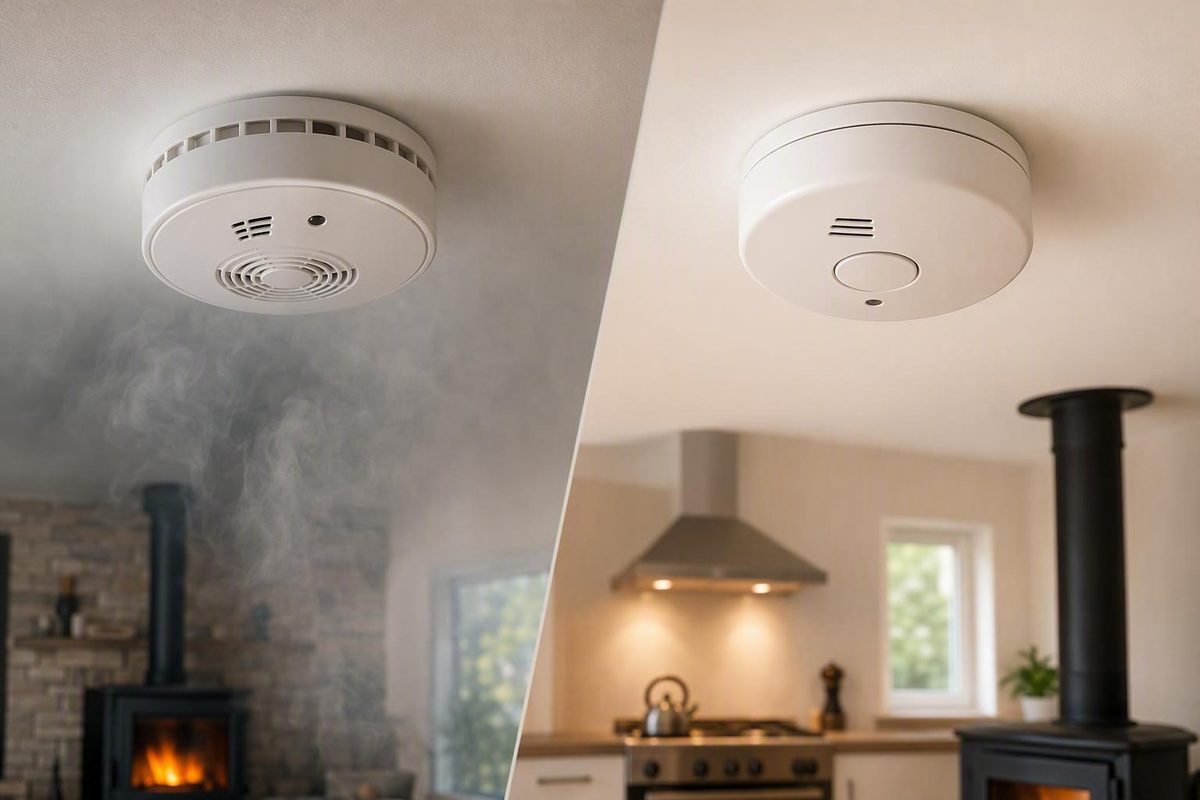
A carbon monoxide alarm and a smoke alarm are not competing versions of the same device. A smoke alarm responds to smoke or airborne combustion particles associated with fire. A carbon monoxide alarm responds to carbon monoxide gas.
The practical question is not which device wins the carbon monoxide vs smoke detector comparison. It is how to provide both forms of detection in all required locations. That may mean separate alarms, combination smoke-and-CO alarms, or a mixture of the two.
Scope and safety note: This article primarily reflects U.S. guidance. Product listings, installation rules and legal requirements vary by location. Always follow the exact alarm manual and applicable local requirements; general guidance cannot replace a product’s listed instructions, permits or inspections.
Carbon monoxide vs smoke detector at a glance
A smoke-only alarm cannot detect carbon monoxide, and a CO-only alarm cannot detect smoke. Similar housings, indicator lights, test buttons and sounds do not make the devices interchangeable. The label must explicitly identify smoke, carbon monoxide or both.
The U.S. Environmental Protection Agency treats smoke and CO alarms as protection against separate hazards and recommends both. Its guidance calls for CO detection on each floor, with particular attention to whether a warning near sleeping areas will wake occupants. EPA residential CO-alarm guidance
| Comparison point | Smoke alarm | Carbon monoxide alarm |
|---|---|---|
| Hazard detected | Smoke or combustion particles associated with fire | Carbon monoxide gas |
| Common sensor | Photoelectric, ionization or multiple smoke-sensing inputs | Commonly electrochemical |
| What it does not detect | A smoke-only unit does not detect CO | A CO-only unit does not detect smoke and should not be assumed to detect combustible gases |
| Principal placement priority | Bedrooms, approaches to sleeping areas and every home level; generally on a ceiling or permitted high-wall location | Every required level and locations where occupants, especially sleepers, can hear the warning; mounting depends on the model |
| Immediate purpose of warning | Prompt occupants to escape a possible fire | Prompt occupants to move to fresh air and seek emergency help for a possible CO condition |
Homes can provide both protections in several ways:
- Install separate smoke and CO alarms.
- Install combination alarms containing both smoke and CO sensing capabilities.
- Use combination units where the two coverage plans overlap, then add single-purpose alarms elsewhere.
- Use battery-powered, hardwired or other permitted formats where the products, electrical system and local rules allow them.
There is also a terminology distinction. Consumers often call any residential alarm a “detector.” In NFPA terminology, however, a smoke detector is a sensor connected to a building fire-alarm system. A smoke alarm is a self-contained device that senses smoke and provides its own occupant notification. A combination smoke-and-CO alarm contains distinct sensing capabilities for both hazards. NFPA’s explanation of residential alarm types
“Smoke detector” is understandable in ordinary conversation. When buying or auditing equipment, rely on the product label, model information and manual—not its everyday name, shape or store category.
What each alarm senses and how the sensors differ
Smoke and CO can originate from the same combustion event, but they are different warning signals.
A smoke alarm responds to particles suspended in the air. A CO alarm responds to a particular gas. Carbon monoxide is colorless and odorless, so occupants cannot depend on seeing or smelling it. Because the hazards have different physical signatures, they require different sensors.
Photoelectric smoke sensing
A photoelectric alarm uses a light-based sensing chamber. When smoke enters, it changes how light reaches the sensor and may cause the alarm to activate.
Photoelectric alarms are generally more responsive to smoky, smoldering fires. Such fires may produce substantial smoke before large visible flames develop.
Ionization smoke sensing
An ionization alarm uses an ionized sensing chamber and monitors changes that occur when combustion particles enter it. Ionization alarms are generally more responsive to fast, flaming fires.
Neither technology is universally superior. A future fire’s behavior cannot be predicted solely from the room where an alarm is installed. Fuel, ventilation, ignition source and fire development all affect what reaches the sensor.
Dual-sensor and multicriteria smoke alarms
A dual-sensor smoke alarm combines photoelectric and ionization smoke detection in one device. That broadens the fire signatures it is designed to recognize, but it does not automatically add carbon monoxide detection.
A multicriteria smoke alarm may evaluate several inputs—such as smoke and heat information—using an algorithm. Its precise inputs and capabilities depend on the model. “Multicriteria” does not guarantee earlier detection or complete freedom from cooking-related nuisance alarms. NFPA describes the response differences between ionization and photoelectric sensing and notes that multicriteria technology is not necessarily faster at detecting fires. NFPA smoke-alarm types
Terminology check: A dual-sensor smoke alarm contains two smoke-sensing technologies. A combination smoke-and-CO alarm contains smoke detection and carbon monoxide detection. Neither term proves the other capability. Read the hazards listed on the product.
Carbon monoxide sensing
Electrochemical sensing is common in residential CO alarms. In simplified terms, the sensor produces an electrical response when exposed to carbon monoxide, and the alarm’s electronics evaluate that response using the device’s programmed criteria.
A CO alarm is not waiting for visible smoke. It monitors for carbon monoxide over time according to its design. An appliance malfunction, combustion problem or venting failure can therefore create a CO condition without filling a room with visible smoke.
The reverse is also possible. A fire may produce enough airborne smoke to activate a smoke alarm without the CO alarm meeting its activation criteria. Detection depends on what reaches each sensor, in what concentration and for how long. No alarm can warn until the relevant hazard reaches its sensor and meets the device’s alarm criteria.
Why homes need both forms of protection
Smoke alarms address fire detection. They cannot warn about a smoke-free carbon monoxide buildup unless the product also contains a CO sensor.
Potential residential CO sources include:
- Furnaces and boilers
- Fuel-burning water heaters
- Fireplaces and wood, pellet or gas stoves
- Fuel-burning ranges and ovens
- Vehicles operating in or near an attached garage
- Portable generators
- Charcoal or fuel-burning grills
- Other engines, heaters and combustion equipment
An equipment malfunction is only one possible pathway. Fuel-burning appliances, improper venting, attached-garage exhaust, grills and generators are among the residential considerations identified in installation guidance. Lowe’s smoke-and-CO overview
Use a household inventory rather than asking only whether the property has natural-gas service:
- Space heating: Is there a furnace, boiler, room heater, wood stove, pellet stove or gas fireplace?
- Water heating: Does the water heater burn gas, oil or another fuel?
- Cooking: Are any cooking appliances fuel-burning?
- Fireplaces and chimneys: Is there an open or enclosed fireplace, stove, chimney or vent?
- Garage exposure: Is a garage attached, below living space or close to doors, windows or air intakes?
- Backup power: Is a portable or permanently installed fuel-burning generator present?
- Other combustion: Are grills, engines, heaters or workshop equipment used on or near the property?
- Nearby pathways: Could exhaust from adjoining spaces or nearby equipment enter the dwelling?
An all-electric house is not automatically free of CO exposure. It may still have an attached garage, fireplace, generator or grill, or be exposed to nearby combustion equipment.
A standard residential CO alarm should not be assumed to detect natural gas, propane or methane. Some products include additional combustible-gas sensing, but the label must specifically identify that capability. If another gas hazard requires monitoring, use an appropriately listed alarm for that gas.
Appliance installation, maintenance, venting and proper operation remain separate parts of the safety plan.
Separate alarms or a combination unit?
A combination smoke-and-CO alarm can monitor both hazards because it contains dedicated smoke and carbon monoxide sensing capabilities. Combination products are available in battery-powered and hardwired configurations.
Where smoke and CO coverage overlap, one combination unit may provide:
- Fewer housings on a ceiling or wall
- One installation point
- One device to identify and test at that location
- Potentially simpler interconnection within a compatible system
- Voice or display identification on models offering those supplemental features
The limitation is placement: one physical location must satisfy the requirements for both functions.
A hallway near bedrooms may be a logical overlap point if it is an appropriate smoke-alarm location, provides an audible CO warning for sleeping occupants and complies with the combination alarm’s installation instructions. Elsewhere, the smoke and CO coverage maps may not align. One combination unit cannot be stretched into covering additional rooms or levels beyond the required coverage.
A mixed system is often practical:
- Combination alarms at positions where smoke and CO coverage overlap
- Smoke-only alarms inside bedrooms and at other required fire-detection locations
- CO-only alarms where additional CO coverage is needed
- Compatible interconnected devices where whole-home notification is required or desired
Do not assume a combination alarm is inherently better or worse than two separate units. Model performance, third-party certification, placement, audibility, power source, required coverage and system compatibility all matter. Independent testing also treats smoke-only, CO-only and combination products as distinct categories rather than assuming category names establish performance. Consumer Reports detector testing
Use this decision sequence:
- Map every required smoke-alarm position.
- Map every required CO-alarm position.
- Identify where the two maps overlap.
- Choose appropriately certified combination or single-purpose devices for each position.
- Verify that each model’s permitted mounting method works at the selected location.
- Confirm power, backup-power and interconnection requirements.
- Verify compatibility before connecting anything to an existing alarm network.
- Check the requirements that apply to the property.
Remember: “dual-sensor smoke” is not shorthand for “combination smoke and CO.”
Where smoke, CO, and combination alarms should go
There is no universal placement rule for all three categories. Build separate smoke and CO coverage maps, then apply the exact product instructions and applicable local requirements.
Smoke-only alarms
The general NFPA coverage pattern calls for smoke alarms:
- Inside every bedroom
- Outside each separate sleeping area
- On every home level
- In the basement
Larger or unusually divided layouts may need additional alarms. An alarm on the other side of a closed bedroom door is not equivalent to an alarm inside the room, and one unit at the top of a multilevel home does not provide level-by-level coverage.
Smoke alarms are generally installed on ceilings or high on walls because smoke rises. For wall mounting, the top of the alarm should be no more than 12 inches below the ceiling, subject to the product instructions. NFPA’s guidance also addresses basements, pitched ceilings, cooking areas and draft-prone locations. NFPA installation and maintenance guidance
Ceiling shape, wall-ceiling junctions, nearby vents and other airflow conditions can create areas where smoke does not readily reach a sensor. Use the model’s permitted position rather than transferring measurements from another alarm.
CO-only alarms
Plan CO coverage on every required level and near sleeping areas so the warning can awaken occupants. Additional coverage may be appropriate based on the home’s layout, identified combustion risks and governing requirements.
Do not put a stand-alone CO alarm near the floor merely because of the myth that carbon monoxide settles there. CO disperses through indoor air, and stand-alone CO alarms do not universally require floor-level installation. Manufacturer guidance also emphasizes that the model’s permitted location should control. First Alert CO mounting-height guidance
That does not establish one universal mounting height. Residential CO alarms include wall-mounted, ceiling-mounted, tabletop and plug-in designs. A receptacle-mounted unit will naturally sit lower than a ceiling model. Use the listed orientation and mounting position for the exact device.
Audibility matters as much as sensor presence. Consider whether an alarm can be heard from each sleeping room with the door closed. If a household member needs an alternative form of notification, consult local fire-safety officials and select appropriately listed equipment intended for that need.
Combination smoke-and-CO alarms
A combination unit generally must satisfy smoke-alarm mounting requirements because its smoke-sensing function depends on appropriate fire-alarm placement. That normally means an approved ceiling or high-wall position rather than an arbitrary outlet or tabletop location.
The manual should identify:
- Permitted ceiling and wall positions
- Required orientation
- Spacing from wall-ceiling junctions
- Restrictions for pitched ceilings
- Environmental limits
- Cooking-area restrictions
- Interconnection and electrical requirements
A convenient CO location is not adequate if it compromises smoke detection. Conversely, correct smoke-alarm placement does not prove that the home has enough CO coverage on every required level.
Locations that can interfere with alarms
Depending on the sensor and model, avoid or carefully evaluate locations exposed to:
- Strong drafts
- Open windows or exterior doors
- HVAC supply and return vents
- Ceiling fans or turbulent airflow
- Dead-air spaces
- Heavy dust, grease or insects
- High humidity or condensation
- Extreme temperatures
- Steam
- Routine cooking smoke
- Combustion particles from appliances
- Physical obstructions
These conditions may delay hazard entry, contaminate sensing openings or contribute to nuisance alarms. Do not address repeated nuisance alarms by removing batteries or disabling the device. Recheck the alarm type, permitted spacing and installation position.
Published guidance gives different separation distances from cooking appliances, furnaces, fireplaces and other combustion equipment. Those differences reflect varying products and contexts; they do not establish one universal distance. Use the exact manual and local requirements. Manufacturer placement guidance also distinguishes smoke, CO and combination products and warns about airflow, humidity, dust and combustion-particle exposure. First Alert placement guide
Example: a two-story home with a basement
Suppose a home has a basement, main floor and second floor, with three upstairs bedrooms.
First, map smoke coverage:
- Put a smoke alarm inside each bedroom.
- Add one outside the upstairs sleeping area.
- Confirm coverage elsewhere on the second floor.
- Add smoke coverage on the main floor.
- Add smoke coverage in the basement.
- Review whether long corridors, divided rooms or a large floor plan require more.
Then overlay CO coverage:
- Confirm CO coverage on the basement level.
- Confirm CO coverage on the main level.
- Confirm CO coverage on the second level.
- Make sure a CO warning can wake people in the bedrooms.
- Note fuel-burning equipment, an attached garage, a fireplace or generator exposure.
- Check whether the applicable rules require additional positions.
A correctly positioned combination alarm outside the upstairs sleeping area might satisfy one smoke position and one CO position. It would not eliminate smoke alarms needed inside bedrooms or automatically cover the lower floors. The basement and main level might use combination units, CO-only units or a mixture based on their separate coverage maps.
This is a planning example, not a code-compliance drawing. Requirements vary by jurisdiction and property.
How to choose alarms without relying on marketing claims
Start with the hazard label. Confirm whether the product detects:
- Smoke only
- Carbon monoxide only
- Smoke and carbon monoxide
- Other specifically named hazards
In the United States, look for a mark from a recognized testing organization, such as UL Solutions or Intertek’s ETL. Verify the mark on the product and packaging; do not treat an unfamiliar online listing, seller description or photograph as proof. Consumer Reports likewise advises checking for recognized third-party certification and warns that detector performance differs by model. Smoke and CO detector buying guide
Compare smoke-sensing approaches
The main smoke-alarm categories are:
- Photoelectric: Generally more responsive to smoky, smoldering fires.
- Ionization: Generally more responsive to fast, flaming fires.
- Dual-sensor: Combines photoelectric and ionization smoke sensing.
- Multicriteria: Uses multiple inputs and an algorithm, with the design varying by model.
Do not declare one category universally best based on a single fire scenario. Consider third-party certification, model-specific information, required coverage, placement constraints and applicable rules.
Compare power arrangements
Replaceable-battery alarms can be installed without a household wiring connection, but their batteries must be maintained as directed.
Sealed-battery alarms prevent routine access to the power source. They still require regular testing and complete replacement after a failed test or at end of life.
Hardwired alarms with backup power connect to household electrical wiring and use backup power during an outage. Replacement may require connector, circuit and interconnection checks.
Plug-in CO alarms with backup power can be practical where a permitted receptacle is available. They must remain powered, unobstructed and in their listed orientation, with the backup supply maintained.
Changing manufacturers in a hardwired network is not necessarily a twist-off, twist-on replacement. Connectors, mounting plates and communication methods may differ, and electrical work may be required.
Evaluate notification and interconnection
Compatible interconnected alarms can make all connected units sound when one detects a hazard. This can improve notification when the originating alarm is in a basement, closed bedroom or distant part of the home.
Interconnection may be wired or wireless, but it is model-specific. Never assume different brands, generations or product lines communicate safely because they share a power source or advertise wireless features.
Also ask whether occupants can hear the emergency signal from every sleeping room with the door closed. Detection coverage and notification coverage are related but separate questions.
Smartphone alerts, digital CO displays, voice identification and peak-memory readings can provide useful context. A phone may be silenced, discharged, disconnected or outside the home.
There is no universal “best detector” for every house. The right purchase matches properly certified devices to a documented coverage plan and verifies that the alarms can be installed, powered, heard and maintained correctly.
Audit the alarms already installed in your home
An alarm audit is useful after moving, taking over a rental, renovating or inheriting an unknown interconnected system.
Inspect each device individually:
- Read the face. Look for “smoke,” “carbon monoxide,” “CO,” or wording explicitly identifying both.
- Access the label as instructed. Check the back or side without damaging wiring or mounting components.
- Record the manufacturer and model number. Use them to find the exact manual.
- Look for a recognized certification mark. Confirm that it applies to the labeled product and market.
- Record the dates. Look for the manufacture date, installation date, replace-by date, expiration marking and end-of-life instructions.
- Identify the power source. Note replaceable battery, sealed battery, hardwired supply with backup, or plug-in power with backup.
- Record the sensing description. The label or manual may identify photoelectric, ionization, dual-sensor, multicriteria, electrochemical or combination sensing.
- Use the test control. Follow the manual if the device does not produce the required response.
- Check interconnection. Determine whether testing one unit should activate other compatible alarms.
- Restore the alarm correctly. Reattach it and confirm the normal status described in the manual.
Do not infer an alarm’s purpose from:
- Its shape
- Ceiling, wall or receptacle position
- Indicator-light color
- Number of buttons
- A remembered sound pattern
- The appearance of nearby alarms
- A seller’s handwritten note
If the alarm’s identity, instructions or expiration information cannot be established reliably, replace it rather than guessing. Before replacing a unit in an interconnected group, verify its power, connector, mounting and communication compatibility.
Testing, cleaning, batteries, and end-of-life replacement
Alarm care has four separate parts:
- Functional testing
- Sensor-area cleaning
- Power maintenance
- Complete-device replacement
Replacing a battery alone is not a complete maintenance plan.
Functional testing
NFPA guidance supports testing smoke alarms at least monthly. CO-alarm testing should follow the schedule and method in the exact product manual. NFPA smoke-alarm maintenance guidance
Use the built-in test control and any other method explicitly authorized by the manufacturer. Do not improvise a sensor test; follow the manual’s troubleshooting or replacement directions if the device fails.
Testing should include notification. In an interconnected system, confirm whether other compatible units respond as designed and whether occupants can perceive the warning in sleeping and regularly occupied areas.
Sensor-area cleaning
Dust, cobwebs, grease and insects can interfere with alarm openings. Clean the exterior and sensor area only by the method specified by the manufacturer, often gentle vacuuming.
Do not:
- Paint an alarm
- Cover its openings
- Spray cleaners, air fresheners or insecticides into it
- Wash or submerge it
- Leave it disabled because of renovation dust or repeated cooking alarms
After dusty work, inspect and test affected alarms according to their manuals.
Power maintenance
Power systems require different care:
- Replaceable batteries: Use only the specified battery type and replace it when the manual or warning signal requires.
- Sealed batteries: Do not open or substitute the sealed power source; replace the complete alarm when instructed.
- Hardwired alarms: Maintain the specified backup supply and investigate loss-of-power indications.
- Plug-in CO alarms: Keep the receptacle powered and unobstructed, and maintain the backup supply.
There is no universal battery-replacement schedule for every alarm. Never remove or borrow an alarm battery, even temporarily. A sealed long-life battery does not eliminate testing, cleaning or complete-device replacement.
Complete-device replacement
Smoke, CO and combination alarms do not necessarily have the same service life. Use the labeled expiration, replace-by date or end-of-life indication for the specific unit.
Replace an alarm when:
- It reaches its labeled replacement or expiration date
- It gives an end-of-life signal
- It fails the required test
- Its identity or capabilities cannot be established reliably
- Its manual directs replacement
- A compatible replacement is necessary to restore an interconnected system
Keep a concise record:
| Device location | Type and hazards | Manufacturer and model | Power source | Last test | Battery action | Replace-by date |
|---|---|---|---|---|---|---|
| Upstairs hall | Smoke + CO | Record from label | Hardwired + backup | Date/result | Date/action | Label date |
| Basement | CO | Record from label | Replaceable battery | Date/result | Date/action | Label date |
| Bedroom 1 | Smoke | Record from label | Sealed battery | Date/result | Note as applicable | Label date |
A paper sheet near the electrical panel or a household maintenance file works well. The record supports physical inspection; it does not replace it.
What to do when an alarm sounds or chirps
An emergency alarm and a maintenance chirp are not the same. Exact tones, voice messages, lights and intervals vary by model, so do not rely on a supposedly universal number of beeps.
If a CO emergency warning activates
Move everyone to fresh air immediately. From a safe location, call 911 or the appropriate emergency service. Remain outside until responders say re-entry is safe.
Do not search for the source before leaving. Do not delay evacuation to open windows, inspect an appliance, reset the alarm or determine whether anyone feels ill. Emergency-response guidance prioritizes getting everyone outside, calling emergency services from safety and waiting for permission to return. Lowe’s alarm-response guidance
Headache, dizziness, nausea and fatigue can be associated with CO exposure. Tell emergency responders about possible exposure and symptoms, but do not make evacuation depend on whether symptoms are present.
If a smoke emergency warning activates
Get everyone out and call emergency services from a safe location. Follow the household escape plan and go to the designated meeting place.
Do not search for a possible fire. Smoke or fire may be concealed in a wall, attic, basement, appliance or another room. Once outside, remain outside until emergency personnel say it is safe to return.
If the device chirps or gives a status alert
A chirp or status indication may mean:
- Low battery
- Missing or incorrectly installed battery
- Household-power interruption
- Device fault
- End of life
- Loss of interconnection
- Another model-specific condition
Read the label and exact manual. Match the sound, light and voice pattern to the manufacturer’s instructions rather than using a generic beep chart.
If you cannot positively identify the device or safely interpret its signal, act conservatively. Move to safety if an emergency may be occurring, contact emergency services when appropriate, and seek manufacturer assistance from a safe location. Never permanently silence, disconnect or depower an alarm simply because its signal is inconvenient.
Frequently asked questions
Can a smoke detector detect carbon monoxide?
A smoke-only alarm cannot detect carbon monoxide. It responds to smoke or combustion particles, not CO gas.
A device detects both hazards only if it is explicitly labeled as a combination smoke-and-carbon-monoxide alarm and contains sensing capabilities for both. Do not infer CO capability from shape, location, display or test sound.
Is a combination smoke-and-CO alarm as good as separate alarms?
It can be an appropriate solution where one installation position satisfies the coverage and mounting requirements for both hazards. Suitability still depends on model performance, certification, audibility, power, interconnection and applicable requirements.
Separate alarms may work better where smoke and CO placement needs differ. Many homes can use combination units at overlapping positions and single-purpose alarms elsewhere. A combination unit must not reduce the required coverage of bedrooms, sleeping areas or home levels.
Should a carbon-monoxide alarm be installed near the floor?
Not as a universal rule. Carbon monoxide disperses through indoor air rather than simply settling at floor level.
Stand-alone CO alarms come in wall, ceiling, tabletop and plug-in designs. Install the model at the height and orientation specified by its manufacturer. Combination smoke-and-CO alarms generally need to satisfy smoke-alarm ceiling or permitted high-wall placement requirements.
Do all-electric homes need carbon-monoxide alarms?
An all-electric home can still have CO exposure from a vehicle in an attached garage, portable generator, fireplace, grill or nearby fuel-burning equipment. Assess the building and surrounding combustion pathways rather than relying only on the primary utility.
Applicable requirements vary, so verify the rules governing the property.
Can a carbon-monoxide alarm detect natural gas, propane, or methane?
Do not assume so. A standard CO alarm is designed to detect carbon monoxide, not natural gas, propane or methane.
Some products contain additional combustible-gas sensing, but the label must specifically identify the gases detected. If another gas hazard requires monitoring, select an appropriately certified alarm for that gas rather than treating a CO alarm as universal protection.
Final coverage-first checklist
Use this checklist to turn the comparison into a practical plan:
- Confirm smoke detection inside every required bedroom, outside each sleeping area and on every home level, including the basement.
- Confirm CO coverage on every required level and where warnings can awaken sleeping occupants.
- Use combination alarms only where one permitted position satisfies both functions.
- Verify each alarm’s hazard label, certification, sensor description, power source and expiration information.
- Confirm wired or wireless compatibility before altering an interconnected system.
- Test, clean and maintain every alarm according to its instructions.
- Replace failed or expired devices rather than relying on a new battery alone.
- Follow the exact product manual and applicable local requirements for placement, spacing, installation and replacement.
The choice is not carbon monoxide versus smoke detection. A sound residential alarm plan accounts for both distinct hazards.