
Identify Your Fireplace Controls, Then Use the Right Startup Sequence
Stop if you smell gas. Otherwise, locate the appliance instructions and follow the procedure for that exact model.
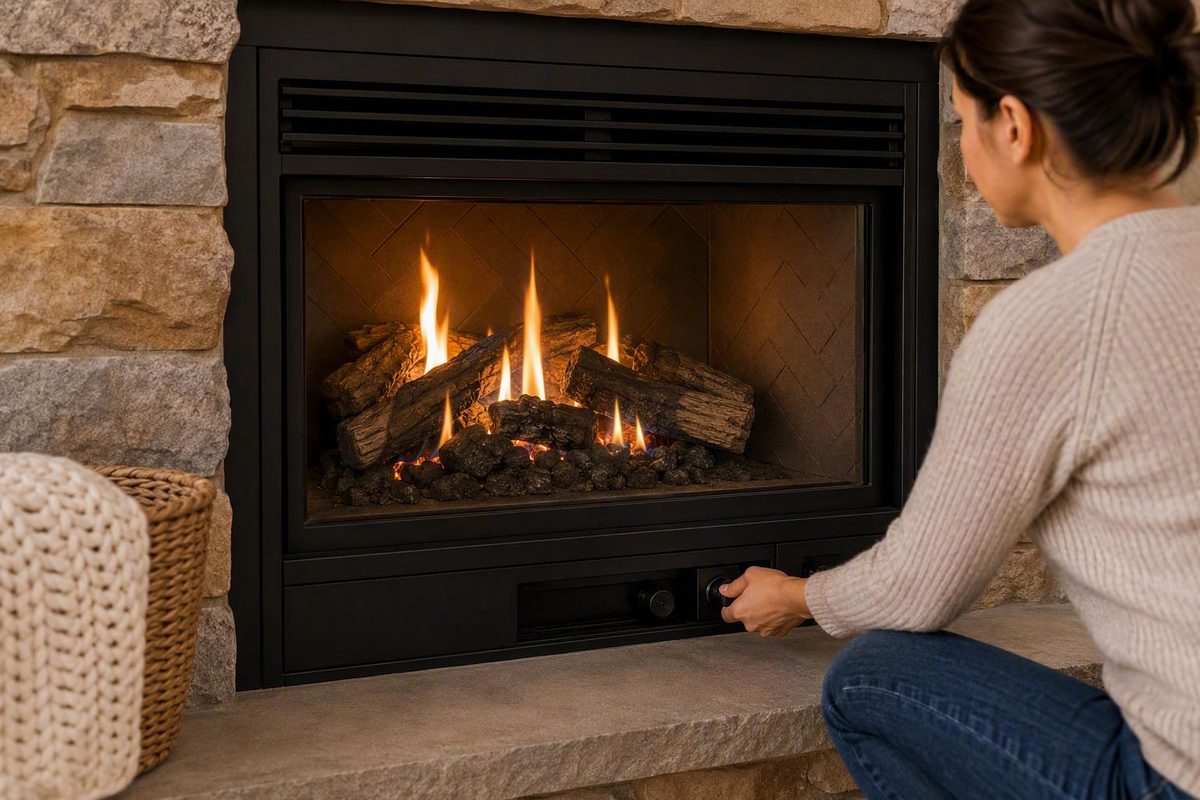
Identify your fireplace controls, then use the right startup sequence.
There is no single correct answer to “how to ignite a gas fireplace.” A sealed direct-vent fireplace with electronic ignition, an older millivolt fireplace with a standing pilot, and a match-lit gas-log set can have completely different controls and lighting sequences.
The safe approach is to stop if you smell gas, locate the appliance instructions, identify the ignition system, and follow the procedure for that exact model. Do not improvise with a match, force a control, or bypass a safety device.
This article provides general orientation, not a substitute for the appliance listing, attached lighting label, owner’s manual, applicable local requirements, inspection, or qualified gas-appliance service.
Before You Start: The Gas-Odor Stop Rule
Warning: If you smell gas before or during an ignition attempt, do not try to light the fireplace, press the igniter, or continue troubleshooting. Leave the area and follow your gas supplier’s or local emergency authority’s directions from a safe location.
Routine fireplace service is not an adequate first response to an active gas odor. Get everyone out, including children and pets, and make the appropriate call from a safe location. General gas-log safety guidance likewise says not to attempt ignition when gas is smelled and to leave rather than continue the procedure (Woodland Direct’s gas-log lighting guide).
If there is no gas odor, complete a visual check before touching the controls:
- Look for visible damage, displaced parts, debris, or an obvious obstruction.
- Keep paper, decorations, curtains, furniture, toys, and other combustible materials away from the fireplace.
-
Confirm that the protective barrier or screen is installed as intended.
-
Open only an access panel that the manual identifies for routine user operation.
- Do not dismantle the fireplace or access an internal valve, sensor, module, burner, or wiring compartment.
Do not apply a universal damper instruction. Follow the venting and damper instructions for the installed appliance rather than advice written for another fireplace type.
A working carbon-monoxide detector is a prudent safeguard around combustion equipment, but it does not replace correct installation, venting, inspection, or operation. Keep the fireplace’s safety barrier in place, maintain the manufacturer-specified clearance from combustible materials, and supervise children and pets whenever the unit is hot. Manufacturer safety guidance also cautions against leaving a gas fireplace operating overnight, while occupants are sleeping, or unattended for an extended period (Valor’s gas-fireplace safety guidance).
Find the Manual, Lighting Label, and Controls
The manufacturer’s owner’s manual and the lighting label attached to the fireplace govern the procedure. Access methods, knob positions, battery arrangements, pilot hold times, retry limits, and lockout resets vary by model.
Look near the bottom of the fireplace for a hinged grille, removable decorative panel, or another opening plainly intended for routine access. Lighting instructions may be attached behind or below that panel, and the control panel is often near the base of the unit. A home-inspection guide shows how manufacturer instructions may be mounted below a fireplace and emphasizes following those appliance-specific directions (Structure Tech’s guide to fireplace instructions).
Do not remove a glass front, burner assembly, fixed trim, or internal cover merely because the controls are not immediately visible. If the manual does not identify a part as user-accessible, leave it in place.
When the printed instructions are missing or unreadable, locate the appliance identification information and record:
- Manufacturer
- Complete model number
- Serial number, if needed to distinguish revisions
- Fuel type shown on the appliance
- Any named ignition or control system
Use the manufacturer and complete model number to obtain the correct manual from the manufacturer or an authorized dealer.
Next, identify only the routine controls you can positively recognize:
- Handheld remote
- Wall switch
- Receiver switch
- User-accessible battery compartment
- Control-panel ON, OFF, IGNITE, or START button
- Piezo igniter button
- Gas control marked OFF–PILOT–ON
- Manufacturer-identified fireplace key and key valve
Do not turn an unidentified valve to see what it does. Do not force a knob that will not rotate or depress normally. A stuck, damaged, or unfamiliar control is a reason to leave the fireplace off and obtain qualified service.
The pilot can be difficult to see on some designs. Use only the viewing location and pilot diagram identified in the manual. Do not dismantle the appliance or remove sealed glass merely to find the pilot.
Pre-start checklist
- [ ] Correct model-specific manual or attached lighting label is available
- [ ] No gas odor is present
- [ ] Fireplace appears intact, with no visible damage or obstruction
- [ ] Combustible items are clear of the appliance
- [ ] Barrier or screen is installed as intended
- [ ] Routine operating controls have been positively identified
- [ ] Ignition-system type has been confirmed
If you cannot check the last two boxes, stop. The next step is to identify the system, not experiment with the controls.
Identify the Ignition System Before Operating It
Use the visible controls as clues, then confirm the system in the manual.
| What you see | What it may indicate | Next safe action |
|---|---|---|
| Remote, wall switch, or control-panel button | Electronic ignition or a millivolt fireplace with an established standing pilot | Check the manual; the remote alone does not identify the system |
| OFF–PILOT–ON knob with a piezo button | Common standing-pilot or millivolt arrangement | Confirm the standing-pilot procedure on the attached label |
| Fireplace key and wall- or floor-mounted valve | Key-operated gas-log system | Use only the exact key-valve procedure in the appliance instructions |
| Instructions explicitly identifying “match-lit” operation | Purpose-built manual ignition system | Follow the specified flame and gas sequence exactly |
| Missing, unreadable, or conflicting labels and controls | Unknown system | Leave the fireplace off and retrieve the correct manual |
Remote or wall switch
A remote or wall switch does not prove that the fireplace has electronic ignition. Some standing-pilot millivolt fireplaces also use a remote or wall switch to activate the main burner after the pilot has been established.
If the manual identifies Intermittent Pilot Ignition, IPI, electronic ignition, direct spark, or another automatic system, the approved control normally initiates an automated sequence. In a common IPI arrangement, the system produces a spark, admits pilot gas, confirms the pilot flame through a sensor, and then opens the main-burner valve. Millivolt and IPI systems differ in both their ignition sequence and power requirements (US Fireplace Store’s millivolt and IPI overview).
OFF–PILOT–ON knob and piezo button
A gas control marked OFF, PILOT, and ON, paired with a push-button igniter, commonly indicates a standing-pilot or millivolt arrangement. The pilot may need to be manually relit before the wall switch or remote can activate the main burner.
Treat that layout as a clue, not confirmation. Read the attached lighting label before moving the knob.
Continuous Pilot Ignition versus Intermittent Pilot Ignition
These terms describe what the pilot does between calls for flame:
- Continuous Pilot Ignition (CPI): The pilot remains lit between normal uses, subject to the model’s settings and operating logic.
- Intermittent Pilot Ignition (IPI): The pilot starts on demand and does not remain lit after the fireplace is turned off.
Some electronic platforms provide more than one pilot mode. A traditional standing-pilot millivolt system may also keep a pilot burning continuously without being the same type of electronic CPI platform. Use the terminology in the appliance manual.
Key valve
A removable fireplace key and a wall- or floor-mounted valve may indicate a key-operated gas-log system. Do not apply a standing-pilot sequence simply because the installation has a key.
The key may control burner gas, flame height, or another model-specific function. Identify the exact appliance and approved sequence before turning it.
Match-lit controls
A genuine match-lit system is designed for an external flame to be presented at a specified burner location as gas is admitted. It does not use the same procedure as an electronic or standing-pilot fireplace.
Because an incorrect sequence could release gas without ignition, operate this category only when the installed burner’s instructions explicitly identify it as match-lit and explain the complete procedure.
Unknown system
If the controls do not fit one of these categories—or if labels, remotes, receivers, and knobs appear to conflict—stop and retrieve the correct manual. Trial and error is not a reasonable way to identify gas controls.
How to Start a Fireplace With Electronic Ignition
These steps apply only after the manual confirms that the fireplace uses electronic ignition.
-
Confirm that no gas odor is present. If you smell gas, do not press the remote, wall switch, or panel control. Leave and follow emergency directions from a safe location.
-
Check the fireplace visually. Confirm that its barrier, visible parts, logs or media, and controls appear intact and undisturbed.
-
Verify power through approved external checks. If the fireplace requires household electricity, check the known circuit, plug, or switch identified by the manual. Do not open electrical compartments. If the system uses batteries, check the remote and any user-accessible receiver or backup battery pack.
-
Check only a known, user-operable gas control. If the manual identifies a supply control and you already know its required position, confirm that it is set as directed. Do not search for or manipulate an unfamiliar valve.
-
Use the approved operating control. Select ON, IGNITE, or START on the remote, wall switch, or control panel as the manual directs. Some controls require a particular mode or button sequence, so do not assume that every remote works the same way.
-
Allow the startup sequence to finish. Clicking can be normal while an electronic igniter sparks. On many IPI systems, the pilot lights first, a sensor confirms the pilot flame, and the main burner follows after a short delay. Manufacturer guidance for electronic systems likewise describes the pilot igniting before the fireplace burner starts (Regency’s electronic-ignition startup guide).
-
Observe the result from outside the barrier. If the fireplace starts normally, use only its approved controls to adjust flame height, thermostat mode, heat, or fan settings.
If nothing happens, check simple external items first:
- Are the remote batteries installed correctly and charged?
- Does the receiver have a separate user-accessible battery pack?
- Is the receiver switch in the position specified by the manual?
- Is the fireplace receiving household power, if required?
- Is the remote in the correct operating mode?
- Does the manual identify a reset or lockout procedure?
Receiver-switch positions are not universal. Labels such as ON, REMOTE, and OFF can have model-specific functions, so follow the manual rather than cycling the switch at random.
If the fireplace clicks but produces no flame, do not keep sending start commands indefinitely. Stop and follow the model’s failed-ignition, lockout, reset, and retry instructions. Continued unsuccessful clicking can mean the system is attempting but failing to establish or verify a flame.
A missing remote does not automatically make manual flame ignition acceptable. Some electronic fireplaces have an approved panel button, receiver switch, or wall switch. Others require a compatible replacement control or service procedure.
Those are internal ignition and safety components.
How to Relight a Typical Standing Pilot
This is a typical standing-pilot sequence, not a universal procedure. The appliance’s attached lighting label and owner’s manual override every step below.
Proceed only after confirming that the fireplace uses an OFF–PILOT–ON control, a standing pilot, and a built-in igniter.
-
Check for gas odor. Do not proceed if you smell gas. Leave and follow your gas supplier’s or local emergency authority’s directions from a safe location.
-
Confirm that the approved gas supply is available. Do this only if you already know the manufacturer-identified supply control and its required position. Do not search for or turn an unidentified valve.
-
Set the fireplace gas control to OFF. Follow the label’s directions for moving the knob. Some controls must be depressed before turning. Never force the control.
-
Wait at least five minutes, or longer if the manual specifies. This waiting period allows unburned gas to clear. Generic standing-pilot instructions commonly specify an OFF position followed by a five-minute wait, but the appliance label remains controlling (Structure Tech’s typical standing-pilot sequence).
-
Check again for gas odor. Do not place your face inside an opening. If you smell gas, stop, leave the area, and make the appropriate call from a safe location.
-
Locate the pilot through the approved viewing area. Use the manual’s diagram if needed. Do not remove sealed glass or disturb the log arrangement to obtain a better view.
-
Turn the control to PILOT. Press and hold it exactly as the label directs. On a typical control of this kind, holding the knob in the lighting position permits pilot gas to flow while the flame-sensing component is still cold.
-
Operate the built-in piezo igniter. Press the igniter as directed while continuing to hold the pilot control. Watch through the approved viewing area for the pilot flame.
-
After the pilot lights, continue holding the control for the specified time. Hold times vary by appliance. One general guide describes approximately 15–30 seconds, but explicitly notes that the time differs by unit (The Home Depot’s gas-fireplace guide). Other generic instructions allow as long as one minute. The time printed on the fireplace label must govern.
-
Release the control and verify that the pilot remains lit. If the pilot goes out, use only the retry procedure authorized by the manual. Do not repeat attempts indefinitely.
-
Turn the gas control to ON. Once the pilot remains stable, the ON position typically enables the main-burner circuit.
-
Start the main burner. Use the wall switch, remote, thermostat, or burner control identified in the manual.
Holding the pilot control after ignition gives the flame time to warm the flame-sensing component that permits continued pilot-gas flow on a typical standing-pilot system. If the control is released before the manual-specified period has elapsed, the pilot may go out. That is one possible explanation, not proof that a component has failed.
Remember the usual functional distinction:
- PILOT is the lighting position.
- ON normally allows the wall switch, remote, or burner control to activate the main burner.
- OFF generally shuts off both the pilot and main burner on this type of control.
If the pilot repeatedly goes out when the control is released, stop rather than extending the hold time without limit.
Matches, Lighters, and Key Valves: Use Only an Approved Procedure
A long lighter, match, or fireplace key is not a substitute for the correct ignition method.
Manual flame ignition is appropriate only when the manufacturer’s instructions explicitly authorize it for the exact fireplace, burner, or gas-log set. A visible burner is not necessarily match-lit. Failure of a remote, piezo igniter, or electronic module does not convert an appliance into a manually lit system.
Some purpose-built key-valve or match-lit gas-log systems require the user to position a lit match or long lighter at a specified burner location before opening gas with the key. That order is specific to the systems for which it is approved and must not be copied to another appliance. General ignition-system overviews distinguish match-lit, standing-pilot, and electronic systems because their startup methods differ (Starfire Direct’s ignition-system overview).
Do not use a match or lighter when:
- The fireplace has sealed glass.
- The manual identifies electronic ignition.
- The burner or approved ignition point is inaccessible.
- The instructions do not expressly permit manual flame ignition.
- You cannot positively identify the ignition system.
- The piezo igniter has failed but no alternative method is listed.
- Gas has already been released without ignition.
- The appliance or controls appear damaged.
A standing pilot is not automatically approved for match lighting when its piezo igniter fails. Some manuals permit a specific alternative; others do not. Verify the procedure before introducing an external flame.
If the manual is unavailable, the label is unreadable, the glass is sealed, or the ignition point cannot be reached without dismantling the appliance, leave the fireplace off and arrange qualified service.
Troubleshoot by Symptom Without Bypassing Safety Controls
Troubleshooting should stop at external, manufacturer-approved checks. It should not become repair of the gas train, burner, pilot assembly, electronic module, wiring, or safety circuit.
| Symptom | Safe user checks | When professional service is required |
|---|---|---|
| Electronic system gives no response | Confirm known household power where required. Replace remote or receiver batteries if the compartments are user-accessible. Check the approved control mode and follow the manual’s reset instructions. | Arrange service if the controls remain unresponsive, components appear damaged, or approved checks do not restore operation. |
| Brief clicking before ignition | Allow the normal startup sequence to complete. A short delay can occur while the pilot lights and the system verifies flame. | Stop if clicking continues without ignition, the system repeatedly locks out, or gas or another unusual odor appears. |
| Repeated clicking with no flame | Confirm batteries, power, and known control settings. Follow only the model-specific retry or lockout procedure. | Arrange service when the authorized reset does not resolve the failure. Do not keep retrying or inspect internal ignition parts. |
| No spark from a standing-pilot piezo igniter | Confirm that the knob and igniter are being operated exactly as the label directs. Use an alternative lighting method only if the manual expressly authorizes it. | Seek service rather than opening, bending, cleaning, or repairing the igniter or electrode. |
| Pilot lights but goes out when the knob is released | Confirm that the control was held for the full manual-specified period. If permitted, perform only the authorized retry. | Repeated dropout can involve the pilot flame, thermocouple, control, or another fault. Stop after the permitted attempts. |
| Pilot stays lit but the main burner does not start | Confirm that the control is in ON, not PILOT. Check the remote or wall switch, batteries, receiver setting, thermostat mode, and any approved reset. | Request service if external checks fail. The symptom does not identify which component is faulty. |
| Pilot or burner flame appears unstable or abnormal | Turn the fireplace off with its approved control. Do not rearrange logs, adjust the pilot, or work on burner openings. | Leave the unit off and arrange qualified inspection. |
| Soot appears on the glass, logs, wall, or mantel | Stop operation rather than treating soot only as a cleaning issue. | Arrange qualified assessment before using the fireplace again. |
| Gas or another unusual odor appears | Stop. For gas odor, leave the area and follow gas-supplier or emergency-authority directions from a safe location. | Treat gas odor as an active safety issue rather than a routine service appointment. |
| Controls are loose, stuck, burned, cracked, or otherwise damaged | Do not force or operate them. | Leave the fireplace off until it has been inspected. |
A pilot that goes out when the knob is released may not have been given the specified warm-up time. It can also be associated with the pilot flame, thermocouple, control, or another fault. The symptom alone does not prove that the thermocouple has failed.
Likewise, a stable pilot with no main burner can have several causes. The standing-pilot control may still be in PILOT instead of ON; a remote or receiver may lack power; or the fault may involve the switch circuit, thermopile, burner, gas valve, wiring, or another component. These are diagnostic categories, not instructions to replace parts.
Millivolt and electronic systems rely on their sensors and controls to verify flame and regulate gas flow (HVACDirect’s standing-pilot and IPI explanation).
There is no universal retry interval. Some electronic systems enter a timed lockout, while others require a model-specific control sequence, power reset, or service action. Follow the manual rather than repeatedly cycling power or controls.
Stop operating the fireplace and arrange qualified service for repeated ignition failure, repeated lockout, pilot dropout, soot, abnormal flames, damaged controls, unusual odors, or suspected gas-flow trouble.
Turn Off the Burner, Pilot, or Entire Fireplace Correctly
“Turn off the fireplace” can mean stopping the main burner or shutting down the complete appliance. Decide which result you need, then use the model-specific control.
Burner-only shutdown ends the main flame while leaving the appliance ready for another normal start:
- On an electronic fireplace, selecting OFF with the approved remote, wall switch, or panel control normally ends the burner sequence.
- On a standing-pilot fireplace, switching the wall control or remote to OFF may extinguish the main burner while leaving the pilot lit.
Complete shutdown also extinguishes the standing pilot where one is present:
- On a typical OFF–PILOT–ON control, moving the gas control to OFF generally shuts off both the pilot and main burner.
- An electronic fireplace may have a different complete-shutdown or battery-isolation procedure.
- A key-valve or gas-log installation has its own approved shutdown sequence.
Do not manipulate a separate supply shutoff unless you can positively identify it and the manual provides the procedure. For seasonal shutdown, an extended vacancy, or preparation for service, use the manufacturer’s instructions or ask a qualified gas-appliance technician. There is no universal valve procedure suitable for every fireplace.
Keep the barrier installed, maintain clearance from combustible materials, and supervise children and pets. Do not leave the fireplace operating while occupants are sleeping or for a long unattended period.
Leave the fireplace off and arrange service when ignition repeatedly fails, the pilot will not remain lit, controls are damaged, soot appears, flames are abnormal, or gas or another unusual odor is present.
Frequently Asked Questions
How can I tell if my gas fireplace pilot is already lit?
Look through the viewing area identified in the manual for a small flame at the pilot assembly. A standing pilot normally remains visible when the main burner is off. In an intermittent-pilot system, no pilot flame is expected while the fireplace is off because the system creates one during startup.
Do not remove sealed glass or move logs to improve your view. If the pilot cannot be viewed through the approved area, use the manual’s pilot-location diagram or have the unit inspected.
A wall switch that does nothing may mean the standing pilot is out, but it could also indicate a battery, receiver, switch, power, or component problem. Do not infer pilot status from the wall switch alone.
Can I start an electronic gas fireplace without its remote?
Sometimes, but only through a manufacturer-approved alternative. The fireplace may have a control-panel button, receiver switch, wall switch, or compatible replacement remote. Manufacturer guidance notes that some electronic units can be operated from a fireplace control panel when a remote is unavailable, but the method is model-specific.
Do not manually light an electronic fireplace because its remote is missing. If the manual identifies no approved alternative, obtain the correct replacement control or qualified service.
How long should I hold the pilot knob after the pilot lights?
Use the time printed on the fireplace’s lighting label or stated in its owner’s manual. Generic instructions vary, with some describing approximately 15–30 seconds and others allowing as long as one minute. That variation is why no single hold time applies to every control.
Hold the knob only as directed. If the pilot repeatedly goes out after the proper hold time and authorized retries, stop and arrange service rather than holding it indefinitely.
Why does the pilot stay lit but the main burner not turn on?
First confirm that a standing-pilot gas control is in ON, not PILOT. Then check the ordinary external controls: wall switch, remote batteries, receiver batteries and setting, thermostat mode, and any reset authorized by the manual.
If those checks do not resolve the problem, possible fault categories include the switch circuit, thermopile, electronic control, burner, gas valve, or related wiring. The symptom does not identify a failed part by itself, and internal testing or repair belongs to a qualified technician.
Will a gas fireplace work during a power outage?
It depends on the ignition and control system.
A basic standing-pilot millivolt fireplace may operate without household electricity because the pilot heats components that generate the small electrical signal used by the gas valve. An electronic fireplace generally requires line power, functioning batteries, or a model-specific battery-backup system. Battery backup is available on some electronic models but is not universal, making outage operation model-dependent (Montigo’s guide to standing and intermittent pilot systems).
Check the manual before an outage. Do not improvise a power supply, install batteries in an unidentified compartment, or attempt to match-light an electronic unit.
The final rule has three parts: stop if gas is smelled, identify the ignition system before touching the controls, and let the appliance manual govern every model-specific step. Electronic units usually start through an approved switch, remote, or panel control. A typical standing pilot follows an OFF–wait–PILOT–ignite–hold–ON sequence. If the system remains unidentified, repeatedly fails, will not hold a pilot, produces soot or abnormal flames, has damaged controls, or gives off an unusual odor, leave it off and arrange qualified service.