
A Chimney Chase Cover Must Fit the Chase and the Vent System
Identify chase-cover damage and specify the metal, drainage, skirt and penetrations without violating the chimney system’s listing.
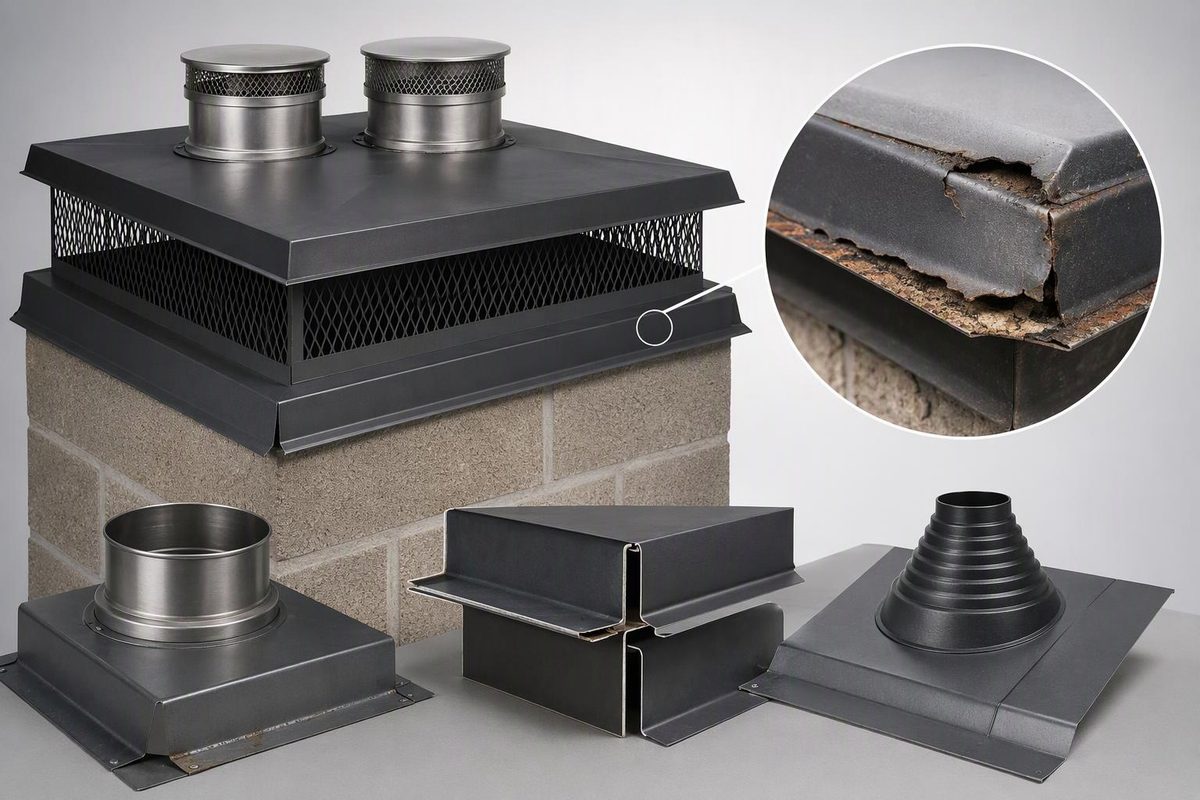
A chimney chase cover is the sheet-metal top over a framed chimney enclosure. It closes the chase against weather while allowing one or more metal chimneys or vents to pass through.
It is not the termination cap at the end of a flue, nor is it the concrete or mortar crown normally found on a masonry chimney. A factory-built system may have separate chase-top flashing, a storm collar around the chimney and a termination cap above it. DuraVent’s DuraChimney II documentation identifies those as separate components and requires a storm collar when flashing is used (DuraVent). See What Are the Parts of a Chimney? for the broader terminology.
That distinction matters when ordering a repair. Replacing the small rain cap will not correct a rusted or poorly draining chase cover below it.
Decide whether the cover is actually leaking
Inspect from the ground with binoculars or a zoomed photograph. Do not climb a wet, steep or deteriorated roof. Look for:
- rust streaks down the chase siding;
- holes, split seams or lifted edges;
- a sagging top that holds water;
- failed sealant at a penetration;
- a loose, missing or distorted storm collar;
- swollen trim, stained siding or decay near the chase top; and
- indoor leakage that follows wind-driven rain.
A localized sealant defect may be repairable if the metal remains sound and the vent-system instructions permit the repair. Widespread rust, perforation, failed seams or a cover that ponds water generally points toward replacement. A coating does not correct poor drainage, an undersized skirt or a badly placed penetration.
Water indoors does not prove that the chase cover is responsible. Roof-to-chase flashing, siding joints, the termination assembly and moisture inside the chase can create similar symptoms. The cover, chase walls and adjoining roof should be assessed as one drainage system.
Record more than length and width
A custom chase cover needs the following information:
- Actual chase dimensions. Measure both long sides and both short sides; do not assume the chase is square. Give the raw measurements to the fabricator and use that shop’s fitting allowance rather than adding a generic amount.
- Every penetration. Record each pipe’s outside diameter, shape and position from two adjacent edges. The appliance outlet diameter is not a substitute for the chimney’s outside diameter.
- The chimney or vent identity. Find the fireplace or appliance model and the exact vent series on labels and manuals. Where a listed system requires its own flashing, shield, collar or other component, a generic fabricated part is not an automatic substitute.
- Skirt and drip detail. The skirt needs to cover the exposed chase top and provide a suitable fastening location. A formed drip edge should direct runoff away from the siding rather than let water curl under the sheet.
- Drainage shape. The top should drain away from penetrations instead of acting as a broad, flat pan. Cross-breaks or a fabricated high point can add stiffness and promote runoff.
- Metal thickness and seams. A larger cover needs enough stiffness to limit deformation and ponding. Ask where seams will fall, how they will be joined and how the completed cover will drain.
One supplier’s order checklist includes overall size, hole size and location, collar height, skirt length, drip edge, diagonal creases and storm collar. It also instructs customers to measure all four sides (Rockford Chimney Supply). Those are useful categories, but the supplier’s dimensional allowances apply to its product—not to every fabricator or chimney system.
Choose the metal as a complete specification
Stainless steel is a common replacement choice where corrosion resistance is the priority. “Stainless” alone is incomplete: request the alloy, sheet thickness, seam construction and fastener material.
Copper has a distinctive appearance and good corrosion resistance, but it is usually more expensive. Its fasteners, adjoining metals and runoff path need compatible detailing.
Galvanized steel is commonly used and can cost less, but rust develops after its zinc coating is damaged or consumed. Coating performance depends on preparation as well as treatment of cuts, folds and seams.
Aluminum is light and does not develop red rust, but thickness, span and fastening still matter. Dissimilar-metal contact in wet conditions also has to be considered.
Compare quotes by alloy or coating, thickness, seam design, fasteners and drainage—not by metal name alone. Exposure conditions and nearby materials can change the suitable combination.
Do not close required ventilation or clearance
A chase cover is part of the weather shell, but it must also preserve the chimney system’s listing. Some systems require ventilation at the chase top. DuraVent describes its DuraChimney II chase-top flashing as enclosing the chase while providing a ventilation-air passage; the same literature calls for a roof radiation shield at the top of a chase enclosure (DuraVent).
Consequently, “seal every gap” is not safe general advice. Required clearance around a listed chimney is not a cavity for insulation, framing or blocking. DuraVent’s DuraPlus instructions, for example, require at least 2 inches between that chimney and its enclosure and tell installers to keep insulation away; they also distinguish ventilated from non-ventilated flashing for specific configurations (DuraVent). Another system may require different components or dimensions.
Use this sequence before fabrication:
- Identify the appliance and chimney or vent system.
- Obtain the applicable installation manuals.
- Confirm clearances, supports, shields, flashing and ventilation.
- Design the cover around those requirements.
- Confirm local permit and inspection requirements.
Installation is not just setting down sheet metal
Removing the old cover can expose wet sheathing, framing or siding. Damaged construction should be evaluated and repaired before the new metal conceals it. The replacement also needs secure attachment without compromising vent clearances or creating unnecessary leak paths.
At a round chimney penetration, the flashing collar and storm collar do different jobs. The storm collar sheds water over the joint where the chimney passes through the flashing. ICC’s EXCEL instructions, for example, direct the installer to apply sealant under the storm collar and at the collar-to-chimney joint (ICC). Follow the identified system’s directions for sealant, fasteners and placement rather than treating that example as universal.
A useful replacement quote should identify:
- cover material, alloy or coating, and thickness;
- seams and drainage shape;
- skirt and drip detail;
- all penetration and storm-collar components;
- compatible fasteners;
- repairs to damaged chase construction; and
- the chimney-system instructions being followed.
Roof access, sharp sheet metal and the risk of disturbing a combustion vent make this a poor first roofing project. If the chase contains an unidentified vent, has water-damaged framing or serves an operating solid-fuel appliance, stop at visual inspection. Identify the system and complete the repair before the next fire.