
Identify the Damper Before You Open, Close or Replace It
Learn how throat, top-sealing and stove dampers differ, when a damper must stay open, and what to check when it sticks, leaks or causes smoke.
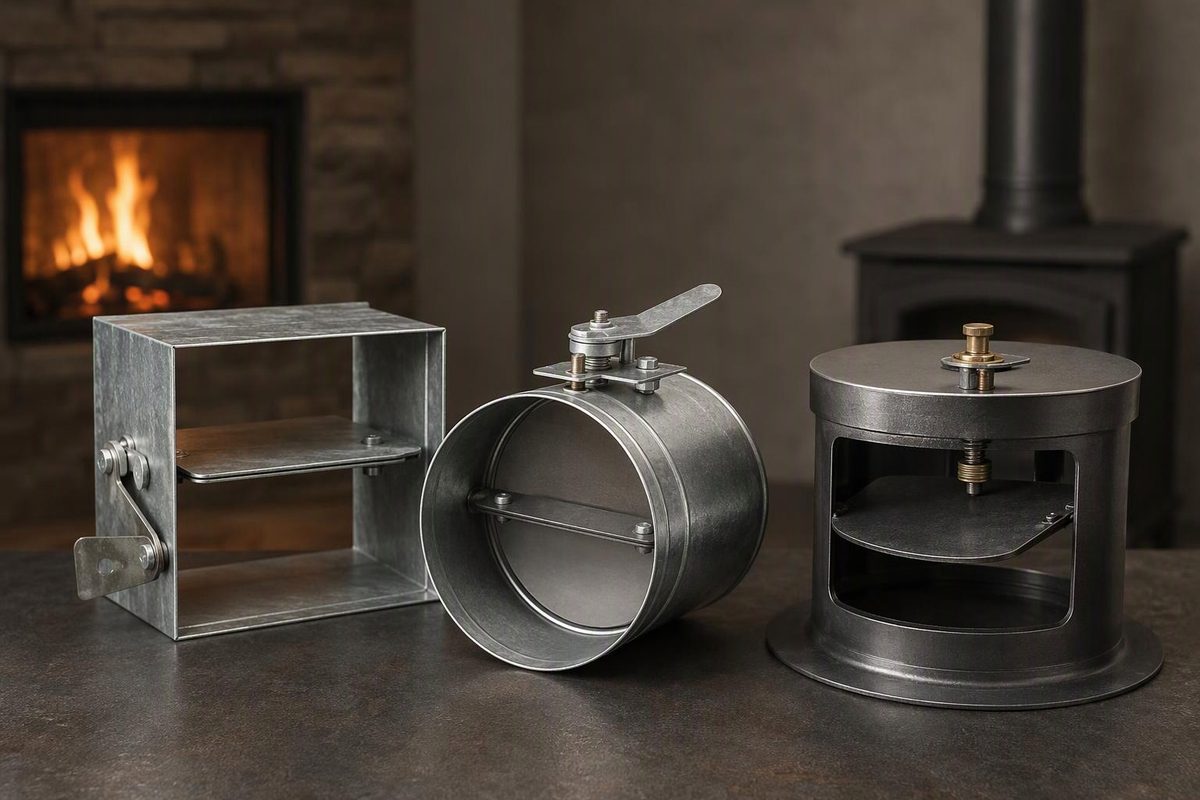
A chimney damper opens the exhaust path when a fireplace is operating and limits airflow through the chimney when it is cold and unused. That simple description hides an important distinction: a masonry-fireplace damper, a top-sealing damper and a wood-stove damper are not interchangeable controls.
For an open wood-burning fireplace, the basic rule is straightforward: open the damper fully before lighting the fire, and leave it open until the ashes are cool. The EPA warns never to close it or go to bed while ashes remain warm because an open damper may help prevent poisonous gases from building up indoors (EPA).
First identify which damper you have
| Damper type | Location | Typical control | What it does |
|---|---|---|---|
| Throat damper | Just above the firebox, below the smoke chamber | Lever, rotary control or poker-style handle | Opens or closes the passage from a masonry fireplace |
| Top-sealing damper | At the top of the chimney flue | Cable or chain running down to a firebox bracket | Opens the chimney at the top and seals over the flue when closed |
| Stovepipe damper | Inside the connector pipe above some wood or coal stoves | Small handle passing through the pipe | Adds resistance to the flue path where the appliance instructions permit it |
| Appliance bypass damper | Inside certain stoves or inserts | Lever built into the appliance | Routes exhaust around a catalyst or baffle during specified operating steps |
A stove’s combustion-air control is also sometimes called a damper, but it regulates incoming air rather than closing the chimney. Do not use open-fireplace instructions to operate a stove, insert or factory-built fireplace. Find the model label and follow that appliance’s manual.
How to check whether a fireplace damper is open
Perform these checks only with a cold, unused fireplace:
- Move the control through its normal range without forcing it. Handle direction is not standardized, so “left means open” or “up means open” is not a reliable rule.
- Look upward with a flashlight. With a throat damper open, the plate should move out of the exhaust passage rather than blocking it. Soot and darkness can make its position hard to judge, so do not reach into an area you cannot see safely.
- For a top-sealing unit, follow its operating instructions. Cable and bracket arrangements vary by product; the cable position alone may not prove that the lid opened.
- Do not use a test fire to find out. If the plate, lid or linkage cannot be positively identified as open, have it inspected before using the fireplace.
For the shutdown sequence, see How to Close a Chimney Flue Safely.
Do not close a damper over warm ashes
A wood fire can continue producing combustion gases after visible flames disappear. Leave the fireplace damper fully open through the coal and warm-ash stage. Close it only when the fire is completely out and the ashes are cool—not merely when the room is ready for bed.
If smoke enters the room after ignition, stop adding fuel. If it is safe to approach, verify that the damper is fully open. A closed damper is only one possible cause; a blocked flue, cold chimney or negative indoor pressure can also weaken or reverse draft. If a carbon-monoxide alarm sounds, leave the building and follow the alarm manufacturer’s emergency instructions rather than continuing to troubleshoot.
Gas logs may require a permanent damper opening
Do not assume a fireplace damper should close fully whenever there is no visible fire. A vented gas-log installation may require a damper stop or another permanent means of preventing full closure.
For example, the manual for the retired Heat-N-Glo FLS-30NG and FLS-30LP vented gas-log sets requires a permanent opening of at least 51 square inches, a stop clamp or equivalent means of maintaining that opening, and the damper’s fully open position whenever the burner operates (Heat-N-Glo installation manual). Those requirements apply to the named models, not every gas-log set.
Before changing, removing or sealing a damper in a fireplace containing gas equipment:
- identify whether the appliance is vented, direct vent or listed vent-free;
- find the exact appliance and fireplace manuals;
- check for a damper clamp or stop; and
- have the proposed change reviewed under the appliance listings and local requirements.
Do not add a top-sealing damper to a gas-equipped chimney unless the damper manufacturer, appliance instructions and local authority all permit that configuration.
What common symptoms mean
The damper will not move
Do not hammer the handle or pull hard enough to bend the linkage. With the system cold, look for an obvious obstruction, disconnected handle or cable, heavy deposits, rust or a displaced plate. A top-mounted lid may also be obstructed by snow or ice. Because repair can require reaching into the smoke chamber or working on the roof, inaccessible or uncertain faults belong with a qualified chimney professional.
The fireplace is drafty when closed
First verify that the damper reaches its closed stop and that debris is not sitting on its sealing edge. Traditional throat dampers commonly close metal against metal; a closed plate may therefore reduce airflow without creating an airtight seal.
A compatible top-sealing damper may provide a tighter closure, but it does not repair a cracked flue or make an active gas vent safe to seal. Confirm the fuel, appliance requirements, flue dimensions and damper instructions before treating replacement as an energy fix.
Smoke spills even though the damper is open
Confirm that it is fully open, not just that the handle moved. Then stop treating the damper as the only suspect. Deposits, an animal nest, damaged components, unsuitable flue sizing and negative indoor pressure require different remedies.
The 2021 International Residential Code specifies that the passage through the throat, damper and smoke chamber of a masonry fireplace cannot be smaller than the flue’s cross-sectional area, so a restriction or incorrectly fitted repair can affect the vent path (2021 IRC Chapter 10). The code edition and amendments adopted in the project’s jurisdiction control.
Repair or replace?
A loose handle or accessible linkage may be repairable without replacing the full assembly. A cracked, badly corroded or warped plate may justify replacement. Where removing an old throat damper would disturb substantial masonry, a compatible top-sealing model is another possible approach—but only after confirming the chimney’s condition, fuel, appliance listing, flue dimensions and local approval.
For masonry fireplaces, the 2021 IRC calls for a ferrous-metal damper that is operable from the room and located at least 8 inches above the fireplace opening (ICC). A factory-built fireplace instead depends on its listing and manufacturer-specified parts. Do not drill, cut or substitute a generic damper in a listed fireplace unless its instructions authorize the work.
Have the complete chimney inspected if the damper is missing, heat-damaged, heavily coated, difficult to operate or associated with recurring smoke. Fixing the control is not enough if the flue above it is obstructed or deteriorated.