
Will a Wind-Resistant Cap Actually Stop Your Chimney Downdraft?
Gust-specific smoke makes outlet turbulence plausible, not certain. Compare cap designs, then verify the appliance, flue and chimney-system listing.
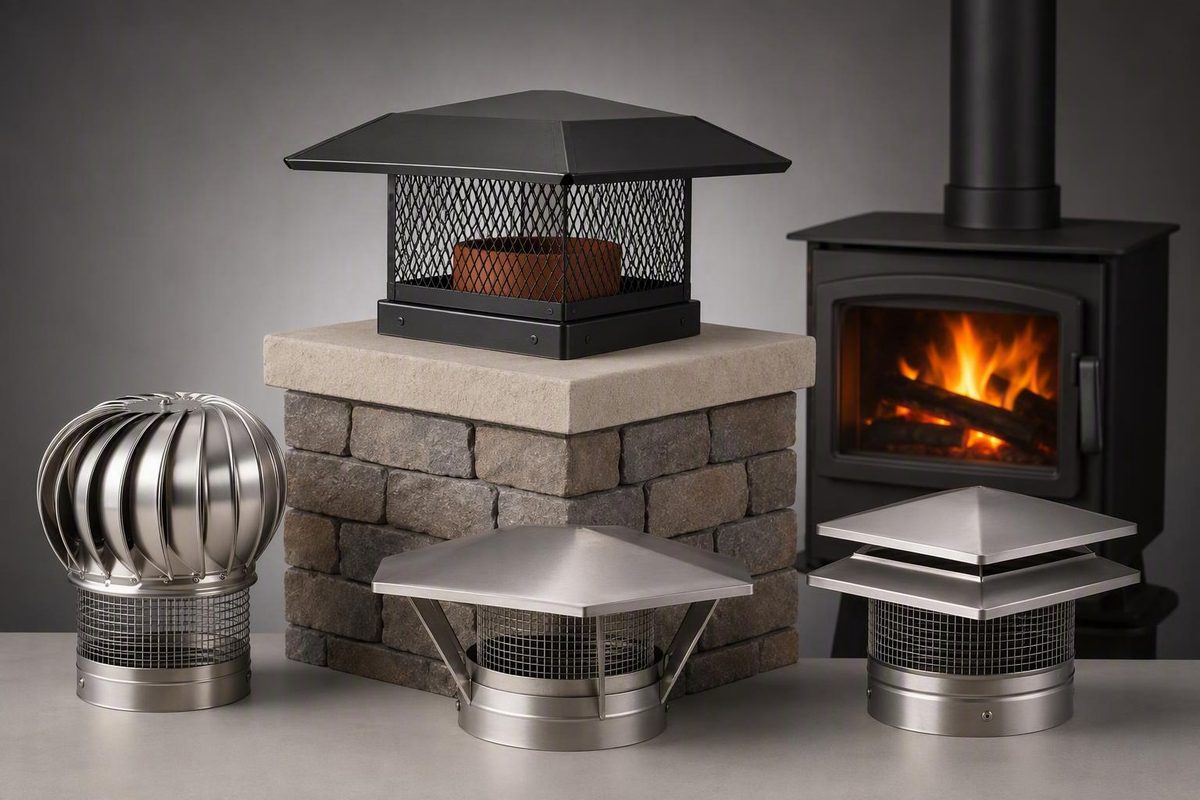
A high wind chimney cap may reduce downdraft when gusts are disrupting flow at the chimney outlet, but it is not a universal cure for a smoking fireplace or weak-drafting stove. Before buying one, confirm that the flue is clean, unobstructed, correctly sized, and sound.
The short answer: use a high-wind cap only after confirming the problem and compatibility
Smoke that appears mainly during strong gusts—particularly gusts from one direction—makes wind at the termination a plausible cause. It does not prove it.
That distinction matters because a specialty cap changes airflow only at the outlet. It cannot clean an obstructed flue, repair a damaged liner, resize an unsuitable chimney, or correct an installation that fails to meet the appliance’s draft requirements. The 2024 International Residential Code chimney and vent provisions require applicable venting systems to satisfy appliance draft requirements and carry combustion products outdoors. In the code’s stated context for connecting or disconnecting appliances from existing chimneys or vents, it also requires flue passageways to be free of obstructions and combustible deposits and the flue walls or liners to be free of damage that could release combustion products.
Do not treat these requirements as a simple ranking. The following must be reconciled for the particular installation:
- The appliance listing, label, and current installation instructions
- The chimney or vent-system listing and current manual
- Locally adopted codes and amendments
- Permit, inspection, and authority-having-jurisdiction requirements
A retailer’s “high-wind” label does not override any of them.
Safety note: If smoke or other combustion products enter the home, a carbon-monoxide alarm activates, or a blockage or damaged flue is suspected, do not keep operating the appliance to test different cap ideas. Have the appliance and venting path evaluated before reuse.
There is no defensible universal “best” cap. The available commercial pages describe products and operating concepts, but the cited listings do not publish independent head-to-head testing or usable wind-speed ratings that establish one design as the winner for every installation.
Diagnose before you buy: a symptom-to-action table
Start with the operating pattern, not a product catalog.
| Observed pattern | Possible issue | Next action |
|---|---|---|
| Smoke appears mainly during gusts from a particular direction | Wind pressure or turbulence at the termination is plausible | Record the wind direction, weather, appliance state, and timing. Arrange an inspection before blaming the cap alone. |
| Draft is poor in calm and windy weather | Deposits, obstruction, flue damage, sizing, appliance requirements, or vent configuration may be involved | Have the complete flue and vent path evaluated before considering a specialty cap. |
| Existing cap is bent, loose, corroded, clogged, or poorly fitted | The cap may be obstructing flow or may not remain securely attached | Have its condition, dimensions, attachment, and system compatibility assessed. |
| A CO alarm activates or combustion products spill indoors | The venting system is not keeping combustion products out of the occupied space | Stop using the appliance as a cap test and obtain qualified assistance before reuse. |
An inspection should address the whole passageway, not merely the visible termination. The 2021 International Mechanical Code venting provisions require applicable systems to develop adequate positive flow to carry combustion products outdoors. They also require applicable existing flues to be unobstructed, free of combustible deposits, and free of damage that could allow combustion products to escape.
Avoid treating one casual homeowner check as conclusive. Wind effects can overlap with cold-flue startup behavior, indoor pressure conditions, and installation defects. A gust-specific pattern is useful diagnostic information, but it is not a substitute for evaluating the appliance and its complete vent path.
Standard, rotating, and fixed wind caps: what changes at the outlet
“Chimney cap” describes products that can perform several different functions. A rain cap, animal guard, spark-arresting screen, and wind-control device may be combined in one product, but the functions are not interchangeable.
| Cap design | Primary role or mechanism | Potential fit | Limitations |
|---|---|---|---|
| Standard rain cap | Covers the outlet against precipitation and often includes screening against animals and debris | Routine weather and entry protection where approved for the system | Ordinary geometry may not address site-specific wind downdraft; screened openings can become restricted |
| Rotating directional cap | Turns a sheltered or closed side toward the wind while leaving an outlet on the leeward side | Gust-related outlet interference where the exact design is compatible | The rotating assembly adds a service item; marketing claims are not performance guarantees |
| Fixed anti-downdraft or wind-assisted cap | Uses fixed geometry marketed to redirect airflow around the outlet | Installations for which an approved fixed design is available | Products use different geometries; an unsuitable or restricted design may impair flow |
A standard cap primarily keeps precipitation, animals, leaves, and similar debris out. A spark arrestor uses mesh to limit escaping sparks or embers. A cap may incorporate both functions, but neither feature automatically makes it resistant to wind-induced downdraft.
For rotating designs, commercial explanations describe weather-vane-like movement. FAMCO says its directional cap rotates to align with the wind, while Swede Chimney Sweep describes the closed side facing the wind and smoke leaving on the sheltered side. These are descriptions of the mechanism and commercial performance claims, not comparative proof that a rotating cap will outperform a fixed design at a particular house.
Fixed anti-downdraft and wind-assisted caps are also marketed as ways to redirect airflow, but products grouped under those names do not necessarily share the same geometry. Ask for the exact model’s drawing, installation instructions, allowed applications, listing information, and any measured performance data.
Rotating designs also need whatever inspection and maintenance the manufacturer specifies. Claims such as “promotes updraft” or “prevents downdraft” should therefore be treated as product claims, not guarantees.
Compatibility comes before cap style
A cap that physically fits can still be wrong for the appliance or chimney. First determine whether the installation uses a masonry chimney or a listed factory-built chimney or vent.
Masonry chimneys
For a masonry chimney, document:
- Appliance type, fuel, manufacturer, and model
- Appliance flue-outlet requirements
- Flue shape and dimensions
- Liner material, condition, and sizing
- Single-flue or multi-flue configuration
- Existing cap and termination arrangement
- Proposed attachment point and method
- Applicable local rules and inspection requirements
Dimensional fit is only one part of the decision. Fuel, appliance instructions, liner condition, outlet area, cap clearance, and secure attachment also matter.
Factory-built chimneys, fireplaces, and vents
For a factory-built chimney, prefabricated fireplace, pellet vent, or Type L vent, locate the manufacturer and exact model before shopping. Do not assume that a matching diameter or third-party adapter makes a cap acceptable.
Product-specific manuals can be restrictive. The DuraPlus installation instructions identify an authorized system cap and prohibit mixing DuraPlus chimney parts with other products. The ICC EXCEL manual requires EXCEL components and states that using other components voids that product’s certification and warranty.
These examples do not prove that every factory-built system prohibits every aftermarket wind cap. They demonstrate why compatibility must come from the current listing and manual for the exact system rather than from diameter alone.
Gas appliances require a separate verification path. The cited IRC and IMC chapters direct gas-fired appliances to other fuel-gas provisions, so their requirements should not be transferred to a gas fireplace, furnace, or other gas appliance without checking the appliance instructions and applicable gas code.
Pre-purchase worksheet: collect these labels and measurements
Do not order from one rooftop measurement or a photograph alone. Build a complete identification sheet that a manufacturer, supplier, or qualified chimney professional can review.
Appliance and system identification
- [ ] Appliance fuel
- [ ] Appliance manufacturer and exact model
- [ ] Photograph of the appliance rating label
- [ ] Masonry or factory-built chimney or vent
- [ ] Chimney or vent manufacturer and model
- [ ] Photograph of the chimney-system or vent label
- [ ] Existing termination model or part number
- [ ] Current appliance and chimney-system manuals
- [ ] Local permit and inspection requirements
Flue and cap dimensions
- [ ] Flue shape
- [ ] For a round flue: inside and outside diameters, as requested by the supplier or manufacturer
- [ ] For one square or rectangular flue: outside length and width
- [ ] For multiple flues: the overall area the cap must cover
- [ ] Height of the tallest flue in a multi-flue group
- [ ] Existing cap dimensions and mounting arrangement
Commercial measuring guidance distinguishes between masonry and factory-built systems. For example, Full Service Chimney’s measuring guide requests inside and outside diameters for a round flue, outside length and width for a single square flue, and the required coverage plus tallest-flue height for multiple flues.
Roof and support information
- [ ] Chimney height above the roof penetration
- [ ] Distance and elevation relative to nearby roof surfaces
- [ ] Nearby walls, additions, ridges, trees, or other obstructions
- [ ] Exposed chimney height above the last support
- [ ] Existing locking bands, roof brackets, braces, guying, or other supports
- [ ] Photographs of the existing cap, full roofline, and nearby obstructions
These measurements document the installation; they do not provide enough information to engineer a support solution. The chimney manufacturer or a qualified professional should determine which approved components are required.
When contacting a seller, manufacturer, or installer, ask:
- Which fuels and appliance types are allowed?
- Which chimney or vent systems are approved?
- Is the cap listed as part of that system?
- Is a model-specific adapter required and approved?
- What attachment method is specified?
- What cleaning or moving-part maintenance is required?
- Is measured pressure or wind-performance data available for the exact model?
- Will the cap and adapter preserve the chimney listing and appliance approval?
“Suitable for high wind” is not a complete answer.
Cap, chimney height, and roof bracing solve different problems
A wind cap, termination height, and structural support can interact, but they are not interchangeable fixes.
| Question | What it addresses | What to verify |
|---|---|---|
| Outlet aerodynamics | How gusts pass around the flue outlet | Approved cap geometry, outlet area, maintenance requirements, and evidence of wind-related symptoms |
| Termination geometry | Position relative to the roof and nearby building surfaces | Exact appliance manual, chimney-system manual, and locally adopted code |
| Structural stability | Ability of exposed chimney sections and joints to withstand loading | Approved locking bands, brackets, braces, guying, supports, and system-specific thresholds |
Several factory-built chimney manuals use the familiar 3-2-10 geometry: termination at least 3 feet above the point where the chimney passes through the roof and at least 2 feet above building surfaces within 10 feet. The Selkirk SuperVent/SuperPro instructions, for example, specify that geometry for that system. It is not a universal rule for every appliance or vent, and meeting it does not prove that local wind conditions will permit adequate draft.
Type L vents must remain in their own category. Under the cited 2024 IRC provisions, a Type L vent terminates with a listed and labeled cap installed according to the vent manufacturer’s instructions. The model-code rule for that vent type is at least 2 feet above the roof penetration and 2 feet above any part of the building within 10 feet.
Structural requirements also vary by system:
- DuraPlus requires an Extended Roof Bracket when its chimney extends more than 4 feet above the roof, according to its installation manual.
- ICC EXCEL limits unsupported chimney above the roof to 5 feet, according to its system manual.
- Selkirk recommends locking bands at chimney joints for added stability when its SuperVent/SuperPro system is exposed to high winds.
Those are product-specific examples, not general thresholds. A brace or locking band stabilizes the chimney; it does not improve draft or replace an anti-downdraft cap. Use the current instructions for the exact system to identify approved support components and attachment points.
How to evaluate materials, mesh, prices, and performance claims
Once compatibility is established, compare construction and serviceability rather than choosing by appearance alone.
Common material categories include:
- Stainless steel
- Galvanized steel
- Copper
- Aluminum
No material is universally best. Also verify whether the material and exact cap are approved for the system, how the cap attaches, whether it can be cleaned, and whether replacement parts or the required adapter remain available.
Treat the cap and its mesh or bird guard as separate design elements. Mesh may exclude animals and debris and serve a spark-arresting function, but openings that are too restrictive, dirty, or iced can interfere with flow. There is no universal mesh size for every fuel, appliance, climate, and jurisdiction; follow the cap instructions and applicable local requirements.
Evaluate product claims in this order:
- System listing or written manufacturer approval: establishes compatibility for the stated application.
- Exact installation instructions: establish required dimensions, components, attachment, and maintenance.
- Measured data for the exact model: may help compare performance under the stated test conditions.
- Retailer category or “high-wind” label: explains how the product is marketed, not how it will perform on a particular chimney.
Vacu-Stack, WeatherShield, and FAMCO directional caps are market examples, not recommendations. Retail pages show that products may differ by material, diameter, adapter, and whether they are intended for solid-pack or air-cooled systems. Those categories—and any displayed prices or customer ratings—do not establish approval, quality, or wind performance.
The final purchase gate is straightforward: do not order until the exact cap and any adapter are confirmed for the appliance and chimney system, the flue has been evaluated, and the attachment and structural-support requirements are known.
Can a high wind chimney cap be used on a prefabricated fireplace?
Possibly, but an aftermarket cap cannot be assumed acceptable. Identify the fireplace and chimney manufacturer and exact model, then check the current listing and manuals for approved terminations. DuraPlus and ICC EXCEL are examples of systems whose manuals restrict component mixing; they do not establish a universal prohibition for every prefabricated fireplace.
Can a high-wind cap make chimney draft worse?
Full Service Chimney also reports from its commercial experience that some draft-control cap designs can worsen performance, but it does not provide comparative test data. Verify compatibility and maintenance requirements rather than treating a “draft-increasing” label as a guarantee.
Are high-wind chimney caps assigned tested wind-speed ratings?
The cited FAMCO product page does not publish a usable wind-speed rating or an independent comparative test, and retailer placement in a high-wind category is not a performance rating. That does not prove no product has relevant test data. Ask the manufacturer for documentation tied to the exact cap, diameter, adapter, mounting arrangement, and test conditions.