
Choosing an Electric Chimney Insert for an Existing Fireplace
Check fireplace dimensions, clearances, electrical supply and chimney condition before choosing an electric insert—and set realistic heat expectations.
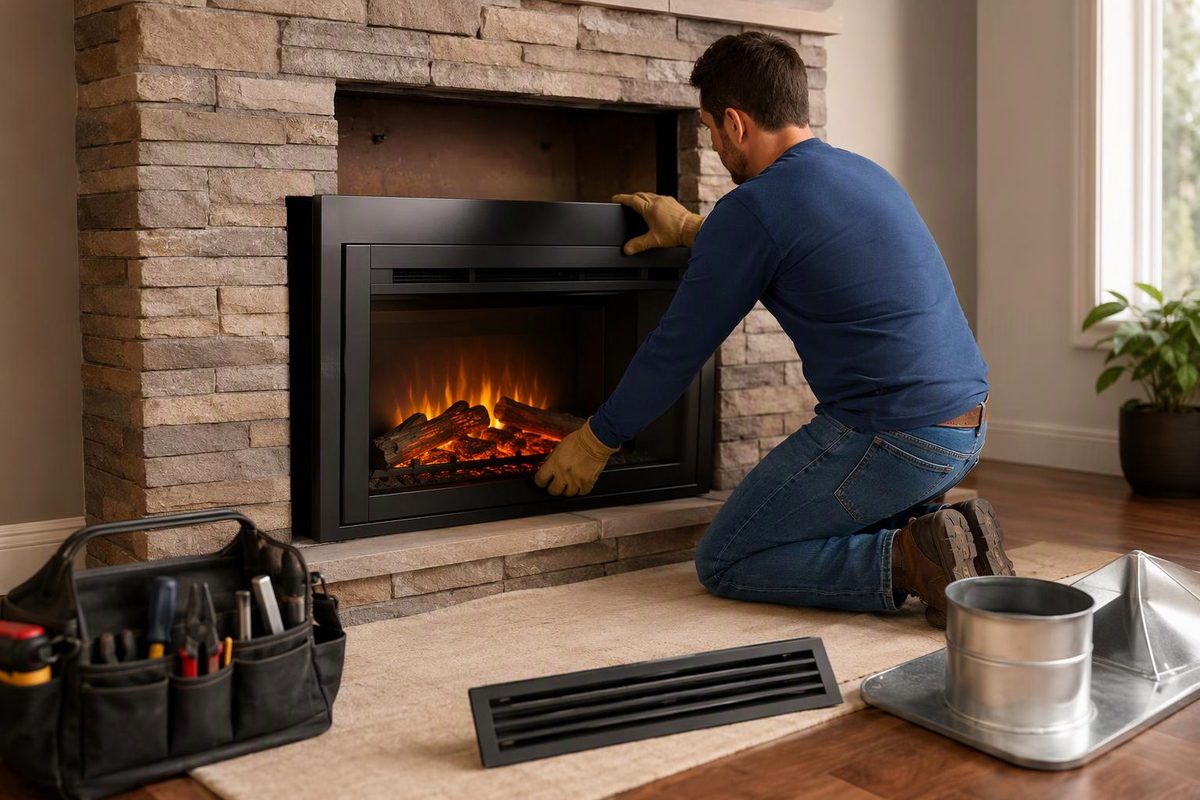
An electric chimney insert is usually an electric fireplace insert fitted into an existing fireplace opening—not an appliance installed up the chimney. It provides a simulated fire and, on heated models, electric room heat. It does not use the chimney to exhaust combustion gases; for example, Dimplex’s Revillusion built-in fireboxes require no special venting. They still need the specified electrical supply, clearances and unobstructed airflow. Dimplex installation guide
For an existing fireplace, settle three questions before buying: Is this installation permitted by the appliance manuals? Does the body fit behind the trim? Can power reach it safely?
1. Identify the fireplace before choosing the insert
Record whether the opening belongs to a masonry wood-burning fireplace, a factory-built metal fireplace or an existing gas appliance. Photograph any rating plate and find the original manual, especially for a factory-built unit.
Choose an electric model whose instructions explicitly cover your installation. The SimpliFire SF-INS25/30/35 manual, for example, permits installation in an existing wood-burning fireplace and discusses outlet placement in masonry or factory-built solid-fuel fireplaces. That is not blanket permission to modify every metal fireplace or place an insert inside a gas appliance. SimpliFire owner’s manual, sections 3–4
Stop if compatibility is unclear. Have the installer resolve both appliances’ requirements before cutting panels, drilling the firebox or removing components.
If replacing gas equipment, include professional gas-supply disconnection and safe termination under local requirements in the scope; turning off a valve is not a complete conversion plan. For example, the 2021 International Residential Code requires unused gas outlets to be capped gastight, with an exception for specified listed quick-disconnect devices and convenience outlets. 2021 IRC, G2415.15
For the broader compatibility checks, use the fireplace insert worksheet.
2. Measure the cavity, not just the visible opening
A fireplace can be wide at the front but narrow sharply toward the back. Record:
| Check | What to measure or observe |
|---|---|
| Front width | Clear width at the intended insert position |
| Rear width | Available width where the back of the insert will sit |
| Height | Clear height beneath the lowest obstruction |
| Depth | Usable distance from the finished front plane to the rear obstruction |
| Base | Whether the support surface is sound and can be leveled |
| Surround | Whether approved trim covers the opening without covering air openings or preventing removal |
Compare these measurements with the manual’s existing-fireplace minimum dimensions, not the advertised screen size or a new-construction framing diagram.
For example, the SimpliFire SF-INS30 requires an existing fireplace cavity at least 30 inches wide at the front, 23 inches at the rear, 20⅝ inches high and 11⅜ inches deep, according to its June 2024 Rev. H manual. Outlet placement may require more room. Those dimensions apply to that model, not all “30-inch” inserts. SimpliFire manual, Figure 4.9 and electrical outlet guidance
Do not assume “zero clearance” means the entire installation can be covered tightly. The same manual requires combustibles at least 3 feet from the front, prohibits blocking louvers with insulation, and requires the surround and appliance to remain removable for service. Dimplex also warns against recessing the front where it would restrict heater airflow. SimpliFire clearance requirements; Dimplex installation requirements
3. Plan the electrical connection before sliding it in
Check the exact model’s voltage, current, connection method and circuit requirements. A nearby outlet is useful only if its circuit and location suit the appliance.
The SimpliFire models above require a 15-amp, 120-volt, 60-Hz circuit with a properly grounded outlet, or the specified hardwired connection. Their cord may route through the bottom corner of the surround to a nearby outlet, provided it is protected from pinching, sharp edges and trip hazards. SimpliFire electrical guidance
Plan for direct connection rather than an extension cord or power strip. Dimplex expressly requires its cord to plug directly into an appropriate wall receptacle and recommends a dedicated circuit. New wiring or hardwiring should be handled by a qualified electrician under applicable local requirements. Repeated breaker trips mean stop and have the circuit checked—not keep resetting it. Dimplex electrical installation guidance
4. Protect the insert without neglecting the chimney
No exhaust connection does not mean no chimney work. Check for rain entry, loose debris and dampness before enclosing the opening. SimpliFire instructs installers to seal drafts, close or seal off the chimney flue and close the damper if applicable, and not install in a fireplace prone to moisture. These are conversion instructions, not damper-operating advice for a fireplace still burning fuel. SimpliFire existing-fireplace instructions
Before closing anything, verify that the fireplace is out of combustion service, which flue serves it, and whether the chimney contains other active flues. Never obstruct another appliance’s exhaust path.
The closure detail should protect the electric appliance while managing moisture in the remaining chimney. It is not a reason to seal every opening indiscriminately: National Park Service guidance for historic buildings recommends ventilated caps on unused chimneys that collect rainwater. For a retained masonry stack, have a chimney professional reconcile the insert instructions with the building’s condition. NPS moisture-control guidance
See options for an abandoned masonry chimney if permanent retirement is part of the project.
5. Buy for the heat rating, not the flame width
Treat supplemental heat and appearance as separate requirements. SimpliFire explicitly states that these inserts are not intended as primary heat sources. Dimplex’s Revillusion RBF30-FG, RBF36-FG, RBF36P-FG and RBF42-FG fireboxes and their weathered-concrete variants are rated at 1,300 watts on 120 volts, with higher ratings under specified 208- or 240-volt connections. Check the rating for the exact model and connection you plan to use. SimpliFire heating limitation; Dimplex electrical ratings
For a running-cost estimate, multiply rated kilowatts by operating hours and your electricity rate. At an assumed $0.20/kWh, continuous operation at 1.3 kW costs $0.26 per hour; thermostat cycling changes actual consumption.
Before ordering, put the model number, measured cavity dimensions, approved surround, electrical work and chimney repairs on one project sheet. That makes an insert-only price distinguishable from the cost of a complete, serviceable installation.