
Verify a Wood Stove Before You Buy or Install It
Learn to check a wood stove’s permanent label, exact EPA database record, matching manual, installation requirements, and current incentive status.
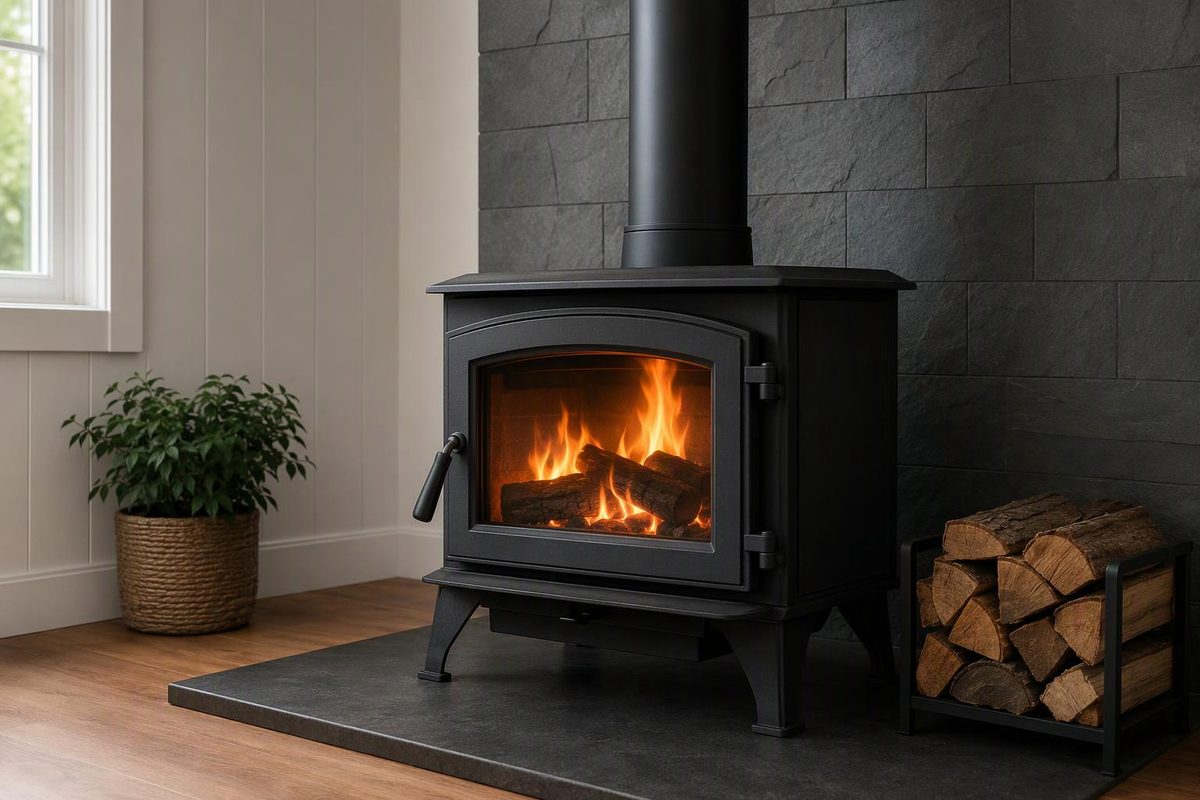
An EPA-certified wood stove belongs to a model line tested and certified for particulate emissions under federal residential wood-heater rules. For a new residential wood heater subject to those rules and sold in the United States, the 2020 limits are a weighted average of no more than 2.0 grams per hour under the main compliance path or 2.5 grams per hour under the cord-wood alternative (40 CFR 60.532). Certification does not establish that the stove is correctly sized, safely installed, compatible with a particular chimney or approved under local rules.
Mark what you can verify; the result will tell you whether to pause or proceed.
EPA Stove Verification Check
Installation and local checks
Source: 40 CFR 60.536 and the EPA Certified Wood Heater Database. This screen does not replace local approval or the model-specific manual.
What EPA Certification Means
The manufacturer has the model line tested through the federal certification program and obtains an EPA Certificate of Compliance. EPA has identified deficiencies in some certification test reports and has revoked a certificate covering several models, so the current EPA record is better evidence than an old brochure alone (EPA compliance monitoring program).
A permanent label may use one of these statements:
| Label Language | Meaning |
|---|---|
| 2020 particulate emission standards using crib wood | Certified under the 2.0 g/hr compliance path using a standardized test load |
| 2020 particulate emission standards using cord wood | Certified under the cord-wood alternative, with a 2.5 g/hr limit |
| 2015 particulate emission standards | Met the earlier 4.5 g/hr limit; the required label also says the heater was not approved for sale after May 15, 2020 |
Crib wood is dimensional lumber assembled into a standardized load. Cord wood is ordinary firewood. Because the results come from different test fuels and methods, do not treat 2.0 and 2.5 g/hr as directly comparable performance ratings. EPA describes the limits and fuels on its certified wood-stove page.
Verify the Stove in Three Places
1. Read the Permanent Emissions Label
Do not rely on a removable hangtag, online listing or the stove’s appearance. Find the permanent emissions label, often on the back or behind an accessible panel.
For affected heaters, federal rules require the label to show the individual unit’s month and year of manufacture, model name or number, serial number, certification-test emission value, test method and standard met. It must be durable and remain readily visible or accessible after installation (40 CFR 60.536).
Photograph the whole label and record the model exactly, including every suffix. Similar-looking models and different versions within one product family are not interchangeable.
A UL or other safety label is not an EPA emissions label, as the Oregon Department of Environmental Quality explains. The reverse is also true: an EPA emissions label does not establish the stove’s safety listing or installation requirements.
If a used stove is advertised as EPA-certified but has no readable emissions label, do not treat the claim as verified. Certification also cannot be added to an individual stove after manufacture; manufacturers certify model lines.
2. Match the Exact Model in EPA’s Database
Search the EPA Certified Wood Heater Database by manufacturer and complete model designation. EPA says the database can also be searched by heater type, efficiency, emissions rate, carbon-monoxide value, test fuel and whether a heater meets the 2020 limits.
Compare the record with the label and product documentation:
- Manufacturer and complete model designation
- Heater and fuel type
- Emissions standard and test fuel or method
- Particulate-emission rate
- Efficiency value, if it affects a rebate or purchasing comparison
Record the Certificate of Compliance number and status from the database if shown. Federal permanent-label requirements do not require that certificate number to appear on the stove.
EPA stopped maintaining the broader Burn Wise consumer program on October 30, 2025, leaving those pages as a historical record. Its compliance office still maintains the certification database, and the database landing page shows a September 4, 2026 revision date. Use the compliance database for the current check rather than assuming every older Burn Wise page remains current.
3. Obtain the Matching Manual and Safety Information
The owner’s manual should match the label’s exact model. Federal rules require it to include installation guidance covering stack height, location and draft, along with operating and maintenance information such as permitted fuels and replacement of emissions-critical parts (40 CFR 60.536).
The manual and the appliance’s safety listing provide the model-specific clearances, floor protection, connector arrangement and chimney requirements. Plan the complete system—not just the appliance—using the wood-stove installation safety sequence.
Pause the purchase if the seller cannot produce a matching manual or if the label, database and manual identify different versions.
Check the Installation Before Buying
Use EPA certification as the first filter, then check the building and vent path:
- Estimate the actual heating demand. Do not choose solely by the largest firebox or advertised maximum output.
- Choose the combustion system deliberately. Catalytic, noncatalytic and hybrid stoves can all be certified, but their controls, maintenance and replacement parts differ.
- Verify the chimney path. Flue size, height, insulation, routing and location affect draft. EPA calls the chimney the “engine” of the burning process and notes that installation errors may remain hidden until serious problems occur (installation and maintenance guidance).
- Take clearances and hearth protection from the exact manual. Do not copy dimensions from a showroom unit or similar model.
- Check permits and air-quality rules before purchase. Requirements vary by jurisdiction and may affect installation, resale, burn bans or stove changeouts. In Oregon, for example, an uncertified stove or insert generally must be removed, destroyed and reported when a home is sold (Oregon Heat Smart).
For a used stove represented as certified, check its condition as well as its paperwork. Have the firebox, baffle or catalyst, door and gaskets, controls, lining and proposed venting evaluated before use. Replacement firebrick should match the approved part and firebox position; use the label, manual and parts diagram to identify it.
Do Not Assume a 2026 Federal Tax Credit
Archived EPA consumer pages may still lead to older biomass-incentive material. The current IRS page says the Energy Efficient Home Improvement Credit covered qualifying property placed in service after January 1, 2023, and before December 31, 2025 (IRS guidance). As of September 2026, do not budget for that former federal credit. Check current federal law and any state, tribal, utility or local program before buying.
The practical buying test is a readable permanent label, exact EPA database match, matching manual, acceptable installation plan and local approval. If one is missing, pause before paying for or operating the stove.