
Choose a Wood Burning Cook Stove by the Installation First
Check a wood burning cook stove’s approval, clearances, hearth, chimney and oven controls before choosing a model for your kitchen or cabin.
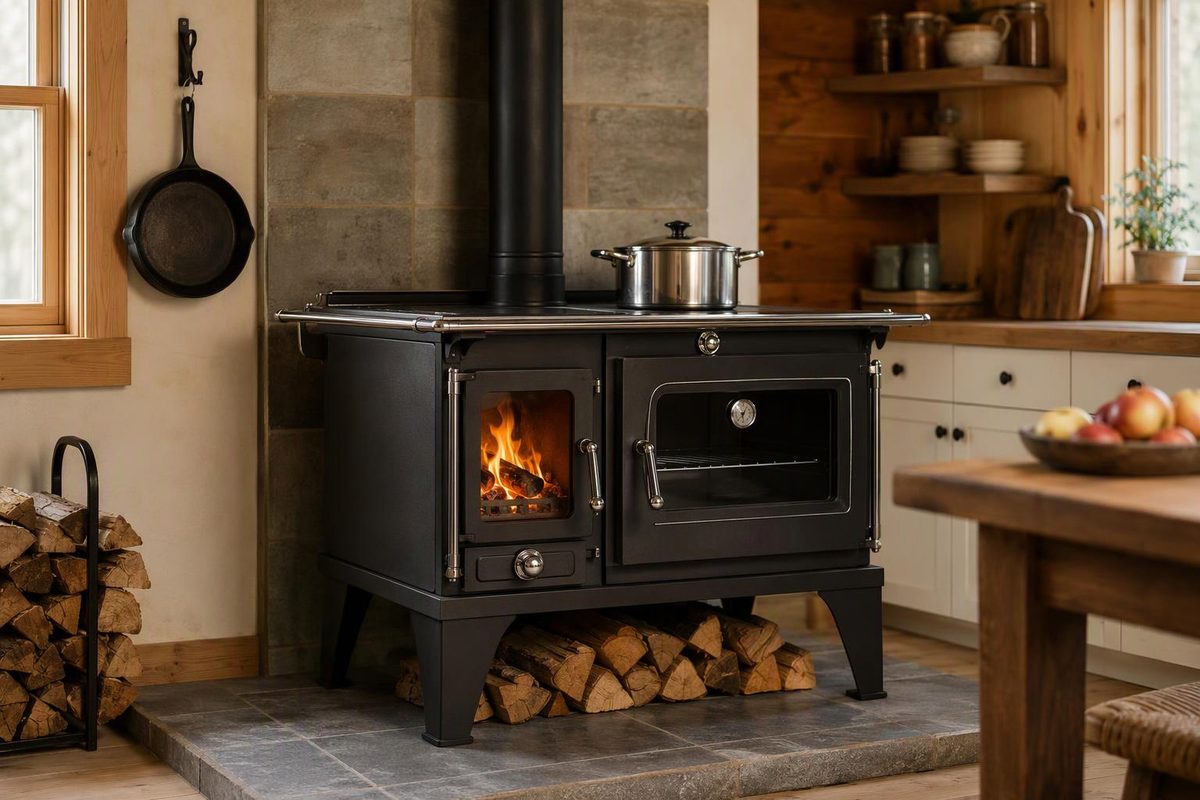
A wood burning cook stove uses a firebox to heat a cooking surface. On models such as those discussed below, hot combustion gases also circulate around a separate baking chamber. The stove releases heat into the room, too. That makes the first buying question practical: can the building accommodate the stove, its clearances and its chimney—not just its outside dimensions?
For a kitchen or cabin installation, settle approval and venting before comparing oven size, finish or price. A camping stove with a cooking plate is not automatically suitable for permanent indoor use.
1. Verify what the appliance is approved to do
Ask for the exact model number, permanent safety label and matching installation manual. Check the intended installation location and permitted fuel. Do not assume that a wood/coal version sold in another country has the same approval as the model offered locally.
Keep these two checks separate:
- Emissions status: whether the appliance is EPA-certified or qualifies for an exemption.
- Safety listing and installation requirements: how and where that exact appliance may be installed.
In the United States, qualifying cook stoves are exempt from the federal wood-heater emission limits and certification requirements specified in 40 CFR Part 60, Subpart AAA. But the definition is specific: the appliance must be designed, marketed and warranted primarily for cooking. Among other required features, it must have an oven of at least 1 cubic foot, an oven-temperature measuring device and a combustion-gas path around the oven. A flat stove top alone does not establish this exemption. “EPA-exempt” does not mean “EPA-certified.” Federal cook-stove definition and exemption.
Confirm local acceptance before purchase. Washington’s Department of Ecology, for example, distinguishes qualifying wood-fired cook stoves from heaters that also cook and directs installation questions to local building-permit departments. An emissions exemption is not blanket permission to install or burn. Washington wood-stove guidance.
Stop here if the seller cannot identify the appliance or supply its requirements. For an antique or unlisted stove, establish the local approval path before buying or lighting it.
2. Draw the installed footprint, including the hearth
Use the manual’s clearance drawing to mark the stove, connector pipe, walls, cabinets and overhead surfaces. Include room to open the firebox and oven doors, remove ashes and reach cleanouts. A cook stove should not be planned as a drop-in replacement for a conventional range.
Floor protection is model-specific, too:
| Model example | Floor-protection requirement |
|---|---|
| HearthStone Deva 100, model 8220 | Manufacturer specifies thermal protection with an R-value of at least 0.89 |
| Kitchen Queen Grand Comfort 550/750 | Manual specifies Type 1 ember protection, R-value 0 |
These are different protection requirements, not interchangeable hearth designs. Confirm both the required construction and its extensions beyond the stove in the matching manual. Tile or stone by itself does not prove that a proposed hearth meets a thermal-resistance requirement. Deva specifications; Deva manual, p. 8; Grand Comfort manual, p. 4.
Also check floor support and delivery access. HearthStone lists the Deva at 484 pounds before accounting for the hearth and other loads. Deva specifications.
3. Resolve the chimney and kitchen exhaust together
A cook stove needs the chimney system specified by its manual, not whatever pipe happens to fit the outlet.
For example, the Deva requires a 6-inch connector and a 6-inch inside-diameter flue for new installations. Its manual permits a suitable lined masonry chimney or an approved high-temperature factory-built chimney, prohibits sharing a flue with another appliance, and prohibits running ordinary connector pipe through floors, ceilings or concealed spaces. Those are Deva requirements—not universal dimensions for every cook stove. Deva venting instructions, pp. 11–12.
Have the installer assess existing chimney condition, flue sizing, route and draft. Include the kitchen exhaust arrangement in that review: the cited North American ESSE Ironheart manual explicitly prohibits an extractor fan in the same room. Do not assume that a conventional range hood can remain unchanged above or near a wood cook stove. Ironheart manual, p. 6.
For the broader planning sequence, see our woodburner installation guide.
4. Compare cooking controls—not just oven capacity
Look for usable rack space, accessible temperature readings, cooktop construction and an understandable oven-bypass control. Use the current manual matching your appliance; the examples here are not operating instructions for other models.
The bypass changes the route of combustion gases. On the Deva, opening it provides a direct outlet to help establish draft; closing it routes gases around the oven. Leaving it open prevents the oven from reaching maximum temperatures. The manual also requires opening it before opening the fuel-loading door. Deva operating instructions, pp. 16–18.
Hotplate temperatures need not be uniform. The Ironheart manual identifies its left side as hotter for boiling and its right side for simmering. Moving a pan between zones is part of heat control on that model. Ironheart cooking instructions, pp. 17–18.
Expect cooking to involve fuel additions, air adjustment and temperature monitoring rather than an electric oven’s set-and-forget routine. Consider whether the accompanying room heat is welcome during the seasons when you plan to cook.
5. Check maintenance access before committing
The gas passages around the oven add cleaning work beyond sweeping the chimney. Kitchen Queen’s manual calls for inspection of the entire gas path and describes removing deposits above, beside and below the oven. Its troubleshooting table links poor oven heating to bypass position, wet wood, deposits, draft problems and a faulty cleanout gasket. A cool oven is not automatically a reason to build a larger fire. Carry out cleaning only when the stove is cold. Grand Comfort maintenance and troubleshooting, pp. 10–13.
Use only the permitted fuel. For firewood, EPA’s archived Burn Wise guidance recommends moisture below 20%, checked with a moisture meter. It also recommends covered metal ash containers stored outdoors on a nonflammable surface. EPA wood-burning practices.
Arrange annual professional chimney and heating-equipment inspection and cleaning, with additional checks as the appliance manual requires. Install and maintain battery-operated CO alarms, or alarms with battery backup, on every level and outside sleeping areas. U.S. Fire Administration; CPSC CO guidance.
Before placing an order, obtain a written installation scope covering the exact stove, hearth, clearances, chimney, exhaust-fan compatibility, permits and inspection. Then compare cooking features among the models that actually fit.