
Choose an Electric Fireplace by Installation, Power and Heat
Compare electric fireplace types, check power and clearances, estimate running cost, and choose useful controls before committing to a model.
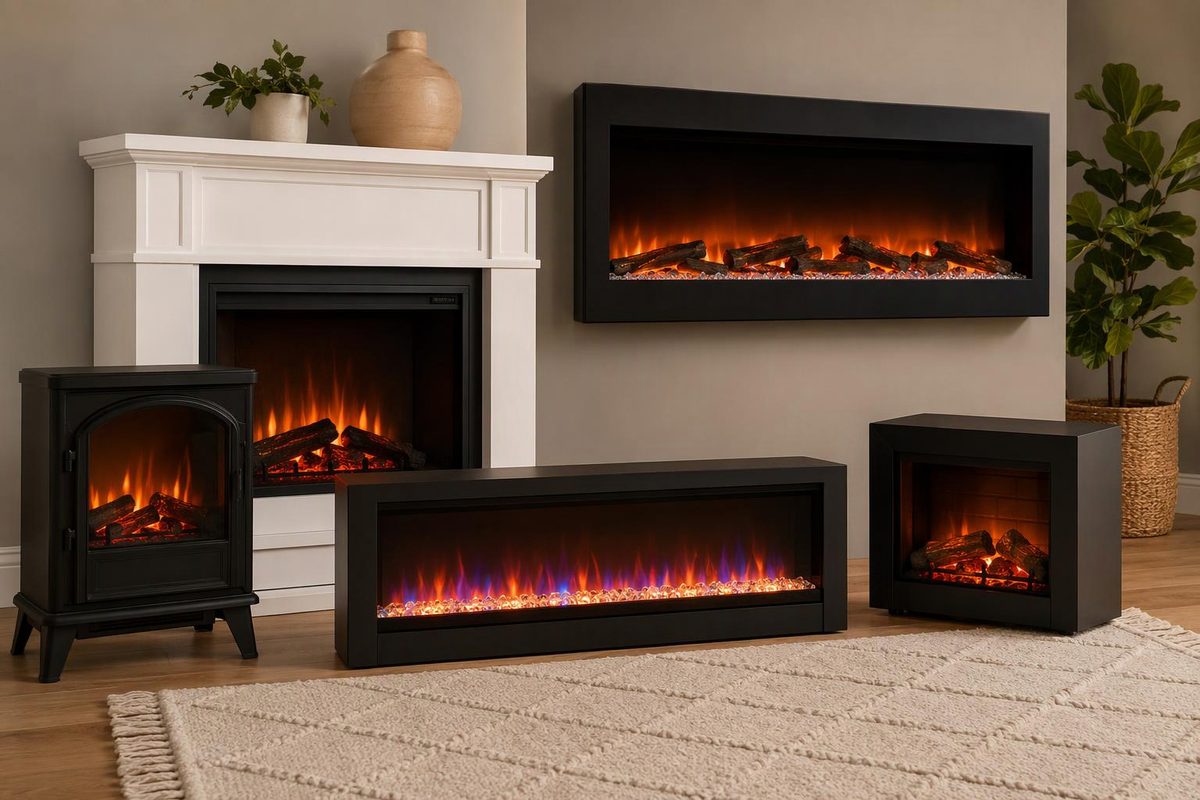
An electric fireplace creates a simulated fire without burning wood or gas. Many models also have an electric heater, and most allow the flame effect to run without heat. Because there is no combustion, the appliance needs no chimney or combustion vent. It still needs unobstructed heater airflow and a suitable electrical supply. Dimplex’s overview explains those basic differences.
Choose the installation type first, then check power and heating capacity. Flame appearance comes after those checks—not because it is unimportant, but because a convincing display cannot fix an unsuitable installation.
Choose the type that fits the project
“Electric fireplace” describes several different installation arrangements. A corner shape or long, linear display does not tell you whether the appliance can be recessed or how it connects to power.
| Type | When it makes sense | What to check first |
|---|---|---|
| Freestanding stove-style unit | You want a movable appliance without wall construction | Floor placement, stability, heater clearance and cord reach |
| Mantel or media-console fireplace | You want a furniture-style fireplace surround | Complete furniture dimensions, firebox compatibility and unobstructed airflow |
| Surface-mounted fireplace | You want a wall display without a recessed opening | Approved mounting hardware, wall support, projection into the room and outlet access |
| Recessed or built-in fireplace | You are planning a permanent feature wall | Framing depth, finishing instructions, electrical connection and service access |
| Insert or log set | You want to use an existing fireplace opening | Opening dimensions, permitted installation and fireplace condition |
Wall-mounted does not automatically mean recessible. Use only the installation methods in the exact model’s manual. For example, the Dimplex VCX1525 manual provides separate surface-mount and built-in instructions; the XHD manual describes installation in a mantel or suitable opening. Neither arrangement is permission to enclose another model.
If your project is already settled, use the more specific checks for a portable electric fireplace or an electric fireplace insert.
Check power and clearances before ordering
For a plug-in unit, locate the outlet and compare cord reach with the proposed position. Do not plan around an extension cord or power strip. The XHD manual requires a direct connection to a properly grounded wall outlet and prohibits routing its cord under carpeting or furniture. It specifies 120 volts, 12.5 amps and up to 1,500 watts, with a 15-amp circuit required. A dedicated circuit is preferred, and other appliances on the circuit can overload it. These are XHD specifications, not universal requirements for every fireplace.
For a built-in model, establish whether it is plug-in, hardwired or permits both. Have an electrician assess any new outlet, circuit or hardwired connection, and confirm local permit requirements before closing the wall. The VCX installation instructions specifically require a licensed electrician for new outlets or circuits.
Then check three different kinds of space:
- Enclosure clearances: the permitted framing, backing and finishing materials.
- Heater clearance: the required distance between the fireplace—especially its hot-air outlet—and furniture, curtains or other combustible items.
- Access: room to reach the plug, controls and components identified for maintenance.
Do not treat “no real flame” as “no hot surfaces.” The Dimplex XLF17-XD guide warns that heater-outlet trim becomes hot and requires combustible items to stay at least three feet from the front. Follow your model’s distances. For a TV or artwork above the fireplace, check both the fireplace instructions and the temperature-sensitive object’s manufacturer requirements.
Stop the purchase if safe placement depends on blocking a grille, stretching the cord or ignoring a clearance. Choose another position or include the necessary building and electrical work in the project.
Judge heat by watts, not display width
Treat an electric fireplace as supplemental room heat unless its output has been checked against the room’s heating requirement. A wider flame display does not necessarily provide more heat.
For perspective, a 1,500-watt resistance heater supplies approximately 5,100 Btu per hour. That conversion describes output, not a guaranteed room size. Windows, insulation, outdoor temperature, ceiling height and openings to adjoining rooms affect whether the heater can maintain the temperature you want.
Higher-output models exist, but their wiring matters. The XLF17-XD guide rates that series at 1,500 watts on 120 volts or 2,500 watts on 240 volts; its optional plug kit is only for 120-volt installations. Do not assume a larger unit delivers its higher rating from an ordinary outlet.
Estimate running cost with:
Input watts ÷ 1,000 × operating hours × electricity price per kWh
For example, a unit drawing 1,500 watts continuously for four hours at an assumed $0.20/kWh costs $1.20. Thermostat cycling or reduced-power operation can lower consumption compared with that full-power example. Flame-only operation needs its own consumption figure; do not use the full heating rating to estimate it.
Compare controls and upkeep last
Once installation and heat requirements are satisfied, compare:
- Independent flame-only operation.
- Thermostat settings and accessible manual controls.
- Flame appearance from your normal seating position, preferably in daylight as well as darkness.
- Fan noise with the heater operating—not just the display running.
- Cleaning access, warranty terms and replacement-parts availability.
The appliance avoids combustion-related chores, but it is not maintenance-free. Keep air intakes and outlets clear, and follow the manual’s cleaning procedure with power disconnected and the heater cool. Do not continue using a unit with a damaged cord or plug, or after a malfunction; the XHD safety instructions direct owners to stop operation and contact technical service.
Before paying, save the exact model’s manual and confirm its installation method, electrical rating, clearances and heater output. Those four items determine whether the fireplace belongs in your room.