
Fireplace Blower: Check Fit Before Buying or Replacing
Learn what a fireplace blower does, how to verify a compatible kit, and which checks to make before replacing a fan that will not run.
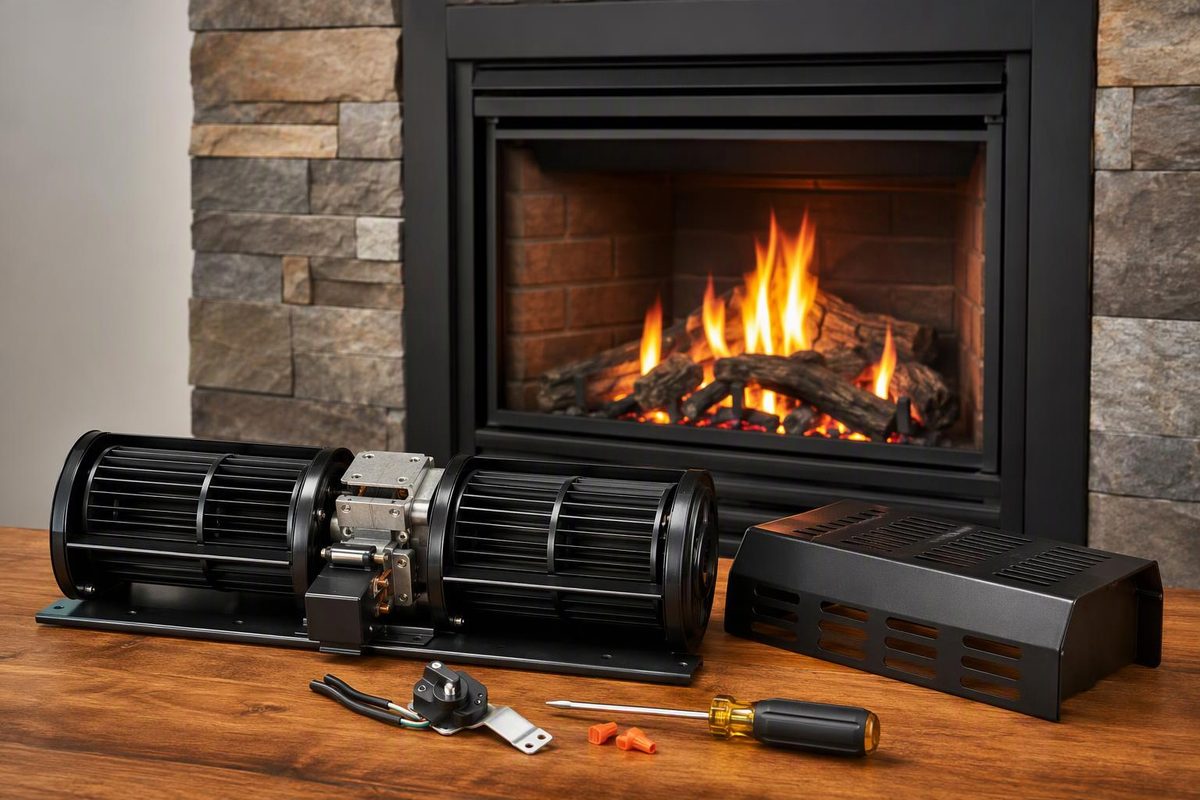
A fireplace circulation blower moves room air through the appliance’s designed heating passages and returns warmed air to the room. It can improve heat delivery, but it is not a remedy for a defective chimney, vent, or combustion system. Before buying one—or deciding an existing fan has failed—identify the fireplace and its approved blower arrangement. Hearth & Home Technologies describes this room-air circulation function in its GFK-160A kit instructions.
This guide concerns room-air circulation blowers, not exhaust or power-vent blowers. If the appliance reports a power-vent fault, arrange qualified service rather than applying these circulation-fan checks. Heat & Glo treats power-vent faults separately in its technician troubleshooting instructions.
Can you add a blower to your fireplace?
Start with the appliance’s model number, not the dimensions of an online fan listing. Locate the rating plate using the owner’s manual; record the full model designation and serial number. On Heat & Glo SL-5F-IFT and SL-7F-IFT fireplaces, for instance, the plate is usually in the control area, and the manual directs owners to the dealer for the correct optional fan kit. Heat & Glo owner’s manual
Check these items before ordering:
- Appliance type and fuel: Is this a gas fireplace, wood-burning insert, factory-built wood fireplace, or open masonry fireplace? Do not assume that visible grilles mean any blower will work.
- Approved kit or replacement part: Find the accessory number in the appliance manual or obtain confirmation from the manufacturer or authorized dealer. Physical fit alone does not establish approval.
- Controls: Determine whether the fan uses a separate speed knob and temperature switch or an integrated remote-control system.
- Electrical supply: Verify the specified voltage, receptacle or junction-box arrangement, and any wiring work needed.
- Access and mounting: Confirm that the kit can be installed and serviced through the access provided, without improvising changes to the firebox or enclosure.
These details differ even among similar-looking systems. The GFK-160A operates on 120 VAC, 60 Hz and uses the fireplace’s junction box; some remote systems do not use its separate speed control and temperature switch. Regency’s I2500 wood-insert manual identifies its own optional fan, part 142-917, rated at 115 volts, 60 Hz, 0.6 amps. Those are model-specific examples, not interchangeable specifications. The GFK-160A instructions require wiring by a qualified electrician in compliance with applicable electrical codes. GFK-160A instructions, Regency I2500 manual
If you cannot identify the fireplace or find an approved blower option, stop before purchasing a “universal” kit. If the real goal is upgrading an open fireplace for more useful heat, first review fireplace and insert compatibility.
What improvement should you expect?
The useful distinction is heat delivery versus heat production. A circulation blower moves heat from the appliance into the room; it does not increase the burner’s fuel-input rating. Its value is distributing warmed air through the appliance’s intended outlet rather than relying only on natural circulation and radiant heat.
Do not choose a blower on a promised percentage improvement or advertised airflow alone. Compatibility, the appliance’s air passages, usable speed settings, and acceptable operating noise matter more than an isolated fan specification. The GFK-160A instructions describe enhanced heat output through room-air circulation, but do not establish a universal efficiency gain for every fireplace. GFK-160A instructions
Blower not working: check in this order
Stop troubleshooting if you smell gas. Do not operate electrical switches, use a phone inside the building, or try to light the appliance. Leave the building and call the gas supplier from outside; follow their instructions. If you cannot reach them, call the fire department. Heat & Glo safety instructions
1. Confirm that a fan is installed and enabled
A fireplace may have an optional fan provision without the fan itself. Check the manual and installation records, then check the normal user-accessible fan control. A flame command and a fan-speed command are not necessarily the same thing. Heat & Glo operating instructions
2. Allow the specified warm-up period
A silent fan immediately after ignition may be normal:
- Temperature-switch control: When using its supplied temperature switch, the GFK-160A starts when the sensor closes at approximately 110°F. It can continue running after the fire is switched off until the sensor cools. GFK-160A instructions
- Timed electronic control: The Heat & Glo manual describes a three-minute fan-start delay with the optional IFT-RC400 control. Heat & Glo manual
- Wood-insert control: Regency’s I2500 instructions require at least 20 minutes of burning before fan use, with the unit hot enough, and a 20-minute fan-off period after each fuel loading. Regency I2500 manual
Use your model’s procedure—not a generic waiting time. A fan continuing after shutdown is not automatically defective.
3. Check household power separately from flame operation
A working gas flame does not prove that the blower has electrical power. Heat & Glo’s battery-backup instructions explicitly exclude the fan and other accessories requiring household AC power. Check whether household power is available; do not probe internal wiring. Heat & Glo power-outage instructions
4. Inspect only accessible, permitted cleaning areas
Turn the appliance off, let it cool fully, and disconnect electrical power before permitted blower maintenance. Keep air openings clear. Follow the appliance manual for removing dust and lint from accessible grilles or compartments, and reinstall any required guards or barriers before use. Some manuals reserve control-compartment cleaning for a technician. Do not reach into a running fan. GFK-160A maintenance instructions, Heat & Glo maintenance instructions
5. Hand off unresolved faults
Arrange service if the fan remains silent beyond the specified warm-up, hums without moving air, scrapes, repeatedly trips the circuit, or has damaged wiring. Leave a blower with electrical damage or repeated circuit trips off pending service.
Do not jumper wiring or defeat the temperature switch to force operation. A manufacturer-provided manual fan mode is different: use it only as your appliance manual permits. Regency’s I2500, for example, has an approved manual mode, but still specifies the warm-up and reloading restrictions above. Regency I2500 manual
Give the technician the model and serial number, blower part number if known, control type, and observations: whether the flame works, when the noise starts, whether airflow changes with speed, and whether the fault appeared after cleaning or a power interruption. Ask the quote to distinguish a complete kit from a motor-only replacement and to include any required controls, wiring, mounting parts, and installation labor.