
Choose a Heat Shield That Your Fireplace Actually Permits
Match a fireplace heat shield to your appliance, mantel depth and clearance rules. See when a hood, ventilated wall shield or heat-management kit fits.
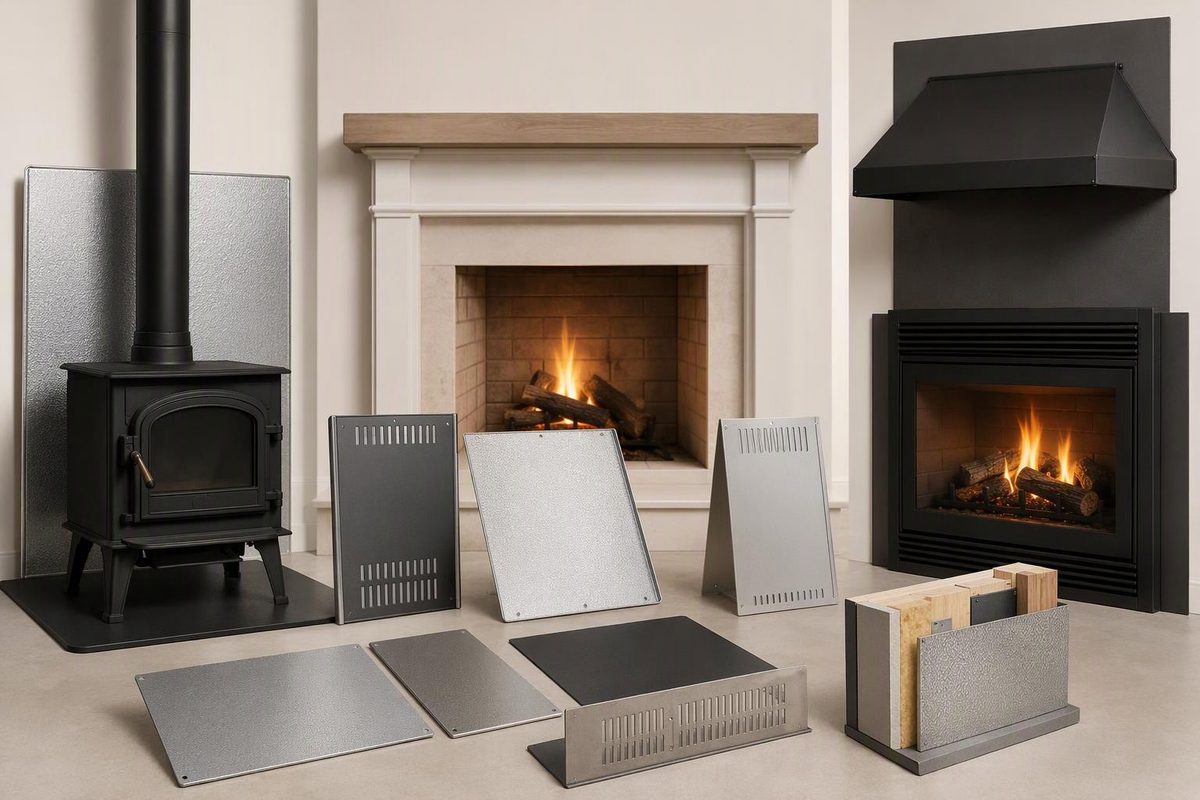
A fireplace heat shield can protect a mantel or redirect heat, but it does not automatically reduce required clearances. Use a shield to reduce clearance only when the applicable appliance instructions and local requirements permit that installation. Otherwise, retain the original clearance or change the mantel or appliance layout.
Select what needs protection and your appliance type; the tool identifies what must be verified before you buy.
Heat Shield Decision Check
Use the instructions for your exact model and production version, not a generic shield advertisement.
Keep the Original Clearance for Now
Find the matching appliance manual and check its mantel, trim and shield instructions. Metal alone does not establish a permitted reduction.
Before buying, verify the shield part number, mounting arrangement and clearance diagram against your measurements.
Source: appliance manuals and local-rule guidance cited below. This decision check does not calculate or authorize a clearance reduction.
Match the Shield to the Job
Products sold as “fireplace heat shields” do not all perform the same function.
| What Needs Protection | Product to Investigate | Required Check |
|---|---|---|
| Combustible mantel | Mantel shield or approved hood | Appliance permission and shielded-clearance chart |
| Wall behind a freestanding stove | Ventilated wall shield or model-specific system | Permitted clearance-reduction method |
| TV above a gas fireplace | Approved heat-management system; hood only if permitted | Fireplace rules and TV temperature limits |
| Missing internal appliance shield | Exact replacement part | Model, serial number and parts diagram |
A spark screen or gas-fireplace glass barrier is a different component. The Kingsman IDV34/IDV44 manual, for example, requires its glass barrier to reduce contact-burn risk and separately provides instructions for a mantel-clearance shield. One does not replace the other.
If nearby wood is scorched, finishes are blistering, or there is an unexplained burning smell, stop using the appliance and arrange an assessment by a qualified hearth professional. Do not install a shield and run another fire to see whether the damage continues. If you suspect an active fire, leave the building and call emergency services.
The Appliance Manual Determines Whether Clearances Can Change
For a factory-built fireplace, stove or insert, locate the rating plate and the installation manual matching that model and production version. Read the sections covering combustible mantels, trim, facing materials and accessories. A shield sold for another appliance does not establish a permitted installation for yours.
Manufacturers can give different answers even for products in the same general category. HearthStone publishes separate shielded and unshielded mantel clearances for its Clydesdale insert. By contrast, the July 2019 Vermont Castings Montpelier Medium Insert manual explicitly says its mantel, top-trim and side-trim clearances cannot be reduced by installing shields. That restriction applies to the appliance covered by that manual, not every fireplace insert. See the Montpelier manual, page 6.
Do not borrow a wall-shield reduction from a wood-stove guide and apply it to a gas fireplace or insert. Lorain, Ohio’s wood-stove guidance expressly tells owners of tested appliances to follow their specific installation instructions rather than the pamphlet’s general rules.
For an open, site-built masonry fireplace, have the locally adopted masonry-fireplace rules checked. As one U.S. model-code example, the 2021 IRC, R1001.11, addresses both the distance of combustible mantels from the opening and how far nearby material may project. That provision is not a universal insert-clearance chart or blanket permission to lower a mantel using a hood.
If an insert is involved, check the whole opening and hearth as well. Our fireplace compatibility guide helps organize those measurements.
Measure From the Manual’s Reference Point
With the appliance off and cool, record the mantel’s depth—how far it projects from the finished face—and its height to the lowest combustible portion. Record top-trim and side-trim dimensions, and whether the insert sits flush or projects onto the hearth. Match each measurement to the exact starting point in the manual’s clearance diagram.
Do not assume every vertical clearance starts at the fireplace opening. The HearthStone Clydesdale model 8492 specifications list these dimensions:
| Mantel Configuration | Mantel Depth | Height From Insert Bottom |
|---|---|---|
| Combustible, unshielded | 8 inches | 39½ inches |
| Shielded | 8 inches | 33⅜ inches |
Those are model-specific dimensions, not measurements for other inserts. They also use the bottom of the insert, not the top of the fireplace opening, as the reference point. Confirm the applicable manual and shield instructions before installation.
HearthStone describes its mantel shield as attaching below the combustible mantel with screws and ceramic spacers. The shield and its mounting arrangement belong together; the published shielded dimension is not permission to substitute any sheet of metal.
Buy the Specified Assembly, Not Just Metal
A shield’s attachment point, spacing and permitted appliance configuration matter. Kingsman’s I33CS shield attaches to the insert’s surround, and its clearance charts also depend on the selected front assembly. The Kingsman IDV34/IDV44 installation manual covers the separate glass barrier and mantel shield; see pages 15 and 27 for shield and clearance details.
Ventilated wall shields depend on an air gap and open airflow paths. Lorain’s general stove guidance describes a 1-inch gap on noncombustible spacers, with openings that allow air circulation. That is a wall-shield example, not a universal mantel-shield specification. Tile, stone or metal attached directly to a wall should not be assumed equivalent to that ventilated assembly.
Before buying, obtain the shield’s part number, permitted appliance and front combinations, mounting instructions and applicable clearance diagram. Compare those instructions with the measured installation. If the documents do not establish a permitted reduction, adding a shield does not justify reducing the original clearance.
A missing or damaged shield inside the appliance calls for a different purchase: the exact replacement identified by the appliance model, serial number and parts diagram. An external mantel hood is not a substitute for an internal component.
TV Protection Requires a Separate Temperature Check
Combustible clearances and electronics protection are separate requirements. Check both the fireplace installation manual and the TV’s operating-temperature and ventilation requirements. A compliant mantel arrangement alone does not establish that the TV location is suitable.
Some gas fireplaces offer purpose-designed heat-management systems. Heat & Glo’s heat-management overview describes passive heat outlets and model-specific systems that move heat elsewhere, with operating conditions such as continuous fan use for certain options. These are integrated installation choices, not interchangeable aftermarket shields.
There is no universal TV-safe temperature or mounting distance established by the sources here. If you cannot verify that the proposed location meets both the fireplace’s requirements and the TV’s requirements, move the TV rather than relying on a generic deflector.