
Direct Vent Propane Heater: Check Fuel, Wall Fit and Power
Choose a direct vent propane heater by fuel approval, wall thickness, vent clearances, heating capacity and outage operation—not BTU input alone.
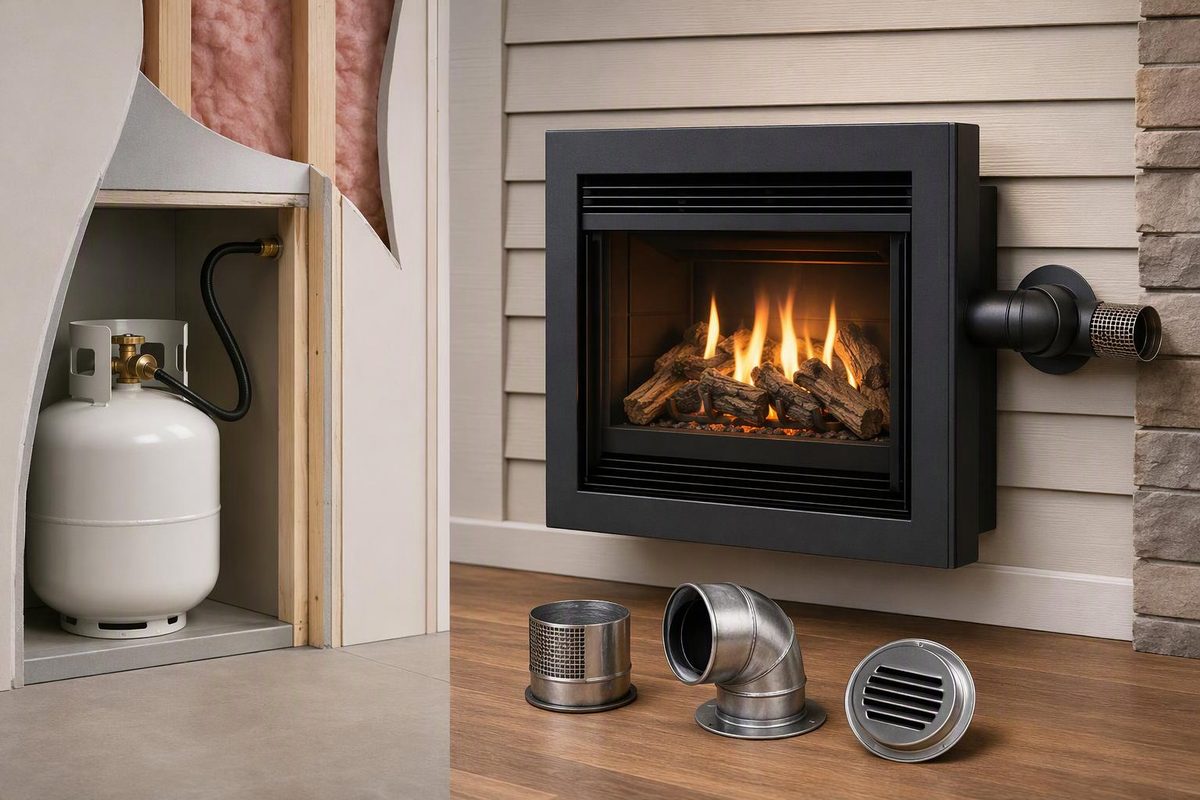
A direct vent propane heater draws combustion air from outdoors and sends exhaust outdoors, keeping the combustion circuit separate from the room air it heats. In a wall furnace, room air circulates around a sealed combustion chamber. It is not a ventless heater, and a through-wall installation can avoid the need for a conventional chimney. Empire explains this arrangement.
This guide focuses on through-wall room heaters and wall furnaces. Before choosing one, establish three things: the exact model is approved for propane, its vent fits the building, and its heat and electrical requirements suit the job. “Direct vent” alone does not settle any of those questions.
1. Confirm propane and installation approval
Find the complete model number and fuel designation on the rating plate—not just the name on the cabinet. Obtain the matching installation manual before buying, especially for a used heater.
A natural-gas version is not ready for propane simply because the cabinet looks identical. For example, Empire’s DV210SGXLP-2 and DV215SGXLP-2 manual permits only the gas shown on the rating plate unless a certified conversion kit is used. It also makes manufactured-home installation conditional on the stated approval and state or local restrictions. See the model-specific manual.
Have the installer verify:
- Fuel approval and any required conversion documentation.
- Approval for the intended building and room.
- Locally required permits and inspections.
- Gas piping, regulator suitability, supply pressure and leak testing.
Stop if the rating plate is missing, the fuel configuration is uncertain, or the matching manual cannot be identified. Do not treat conversion or pressure adjustment as a homeowner setup task.
2. Check the wall and outdoor termination before the cabinet
For a through-wall heater, inspect both sides of the proposed location. A clear indoor wall may put the outdoor cap beside an opening window, under a deck, near a regulator or in a snowdrift.
Record the finished wall thickness, including siding and any mounting spacer. Then compare it with the approved vent assembly. Also check wall framing, concealed utilities, cabinet clearances and service access before anyone cuts a hole.
A model-specific example
The Empire DV210SGX-2/DV215SGX-2 manual lists these selected requirements:
| Check | Requirement in this manual |
|---|---|
| Standard wall depth | 4½–13 inches |
| Extended wall depth | Up to 19 inches with the listed extension kit matched to the model and fuel |
| Clearance to combustible construction | 1 inch at the sides; 12 inches above |
| Vent cap to pressure regulator | At least 6 feet horizontally, measured from the nearest point of the cap |
These are examples for those models, not universal direct vent clearances or a complete installation checklist. The same manual explains that nearby projections can disturb airflow at the cap and cause pilot outages; siding accessories also add to the effective vent depth. Check its specifications, clearances and vent instructions.
Other heaters have different rules. Rinnai’s EX17CT/EX22CT manual, for instance, gives separate U.S. and Canadian termination clearances and applies its above-grade clearance to the anticipated snow line. It restricts the appliance to specified Rinnai flue kits. See its termination and flue-manifold requirements.
Do not substitute generic pipe or assume an existing wall hole and cap can be reused. For fireplace-style appliances, use the separate direct vent fireplace venting guide.
3. Size for the space, not the advertised coverage
Ask for a heating-load calculation for the room or zone the heater must serve. Treat an advertised square-foot coverage figure as a screening aid, not proof of adequate heating. PNNL’s Building America guidance identifies calculated heating and cooling requirements as the basis for accurate equipment sizing.
Keep BTU input separate from heat delivered to the room. Empire lists the DV210 and DV215 at 10,000 and 15,000 BTU/h input, respectively; those figures describe fuel energy entering the heater, not an equal amount of usable room heat. The specification table labels them explicitly.
For a modulating heater, ask about minimum as well as maximum output. For whole-home use, have the installer explain how heat will reach rooms beyond the heater’s location—not merely whether the total BTU rating looks sufficient.
4. Verify outage operation separately
Some direct vent propane heaters heat without household electricity; others require it.
Empire describes its DV210SGX/DV215SGX models as heating without electricity, with an optional automatic blower. By contrast, the fan-type DV20E-6/DV40E-6 manual requires a grounded 115-volt supply. Compare the gravity-heater description with the fan-type installation manual.
If backup heat is the goal, get confirmation for the exact burner, controls, thermostat and blower arrangement. Piezo ignition is not, by itself, proof of outage capability. See how heater design determines operation without electricity.
Before first use—and each heating season
Ask for an installed quote that identifies the heater, approved vent and siding accessories, gas work, electrical work, permits and commissioning. Retain the manual and have the installer demonstrate normal operation. Empire’s manual calls for inspection before use and at least annually by a qualified service person.
Direct vent does not remove the need for CO protection. CPSC recommends battery-operated or battery-backed CO alarms on each level and outside separate sleeping areas, monthly testing, and keeping snow clear of fuel-burning appliance vents. If a CO alarm sounds, get outside immediately and call 911. If you smell or hear leaking gas, leave without operating switches or electronics and call the gas supplier from outside. CPSC’s winter safety guidance.